


Clear, Unbiased Help With Prescription Drug Coverage
Prescription drug costs are one of the most stressful and confusing parts of Medicare — and in 2026, choosing the wrong Medicare Part D plan can lead to higher costs, frustration at the pharmacy, and a poor overall Medicare experience.
This page exists for one simple reason:
Medicare consumers often make poor choices when they’re forced to navigate Part D on their own — not because they’re careless, but because the system is complex and unforgiving.
Here, you’ll find clear explanations, up-to-date 2026 information, and help making sure your prescription coverage actually works when you need it.
What Is Medicare Part D?
Medicare Part D is the part of Medicare that helps cover prescription medications you pick up at the pharmacy.
Part D coverage is offered by private insurance companies approved by Medicare and works alongside:
- Original Medicare (Part A & Part B), or
- Medicare Advantage plans that include prescription drug coverage
If you take medications — now or in the future — having the right Part D coverage matters.
How You Can Get Medicare Part D Coverage
There are two main ways Medicare beneficiaries receive prescription drug coverage:
Stand-Alone Medicare Part D Plans (PDPs)
These plans pair with Original Medicare and are often the best option for people who want flexibility and nationwide access to doctors and hospitals.
Medicare Advantage Plans With Drug Coverage (MA-PD)
These plans combine medical and prescription coverage into one plan. They may include extra benefits, but often involve provider networks, formularies, and plan rules.
The right option depends on your medications, pharmacies, doctors, and budget — not just the monthly premium.
Medicare Part D in 2026 — What You Need to Know
You don’t need to understand every technical rule. You just need to know what affects your costs and coverage.
Annual Out-of-Pocket Cap
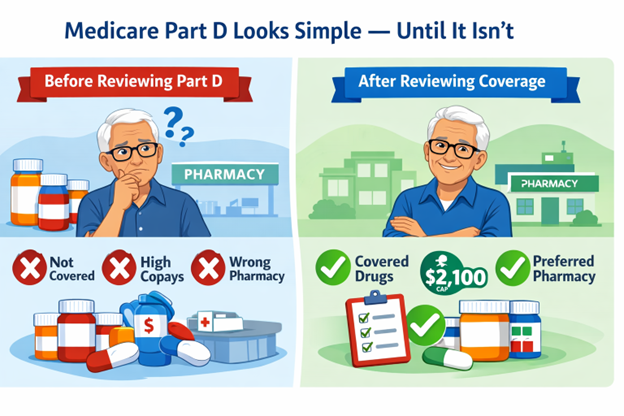
In 2026, Medicare Part D has a hard annual out-of-pocket limit of $2,100 for covered prescription drugs.
Once you reach this amount:
- Your Part D plan pays 100% of covered drug costs for the rest of the year.
This is one of the most important improvements Medicare has ever made to prescription drug coverage.
Deductibles
Some Part D plans include a deductible, while others do not.
- For 2026, the maximum deductible allowed is $615
- Many plans charge less than the maximum
- Some plans waive the deductible for certain medications
Monthly Premiums
Monthly Part D premiums vary by plan and location. But what matters most is total annual cost, including:
- drug tiers
- copays or coinsurance
- pharmacy networks
- restrictions like prior authorization
The cheapest premium plan is often not the least expensive plan over the year.
How Medicare Part D Works (Plain English)
Medicare Part D operates in stages, but the most important takeaway for consumers in 2026 is simple:
➡️ Your prescription drug costs now have a firm annual limit.
You pay your share through deductibles and copays until you reach the $2,100 cap. After that, your covered prescriptions cost $0 for the rest of the year.
This makes choosing the right plan — based on your actual medications — more important than ever.
Extra Help With Prescription Drug Costs
Many Medicare beneficiaries qualify for a federal program called Extra Help, but never realize it.
Extra Help can:
- lower or eliminate Part D premiums
- reduce or remove deductibles
- significantly lower prescription copays
Eligibility is based on income and resources, and it’s often more common than people think.
When You Can Enroll or Change a Part D Plan Most people can enroll in or change a Part D plan during:
- Annual Enrollment Period: October 15 – December 7
- Certain Special Enrollment Periods, such as:
- loss of other drug coverage
- plan termination
- qualifying for Extra Help
Why Getting Help With Medicare Part D Still Matters in 2026
Medicare Part D has become more complicated — not simpler — and many consumers are expected to figure it out on their own.
When people choose prescription coverage without guidance, the same problems happen repeatedly:
- medications aren’t covered as expected
- copays are much higher than anticipated
- pharmacies are out of network
- a plan looks inexpensive upfront but costs far more over the year
- deadlines are missed, leading to penalties or limited options
None of this is obvious when you’re staring at plan names, drug tiers, and premiums online.
Prescription drug coverage affects your health, finances, and peace of mind.
This page exists to help you avoid preventable mistakes — and make choices that actually work in real life.
What I Help You With (At No Cost)
✔ reviewing your current medications
✔ checking formularies and drug tiers
✔ comparing Part D plans side-by-side
✔ evaluating pharmacy networks
✔ identifying Extra Help eligibility
✔ explaining year-to-year changes
✔ helping you avoid late enrollment penalties
No pressure. No rushing. Just clear answers.
Medicare Part D Questions & Answers (2026)
Do I really need Medicare Part D if I don’t take prescriptions right now?
In most cases, yes. Enrolling can help you avoid late enrollment penalties and protect you if your prescription needs change unexpectedly.
What happens if I don’t enroll in Part D when I’m first eligible?
If you go without creditable prescription drug coverage and later enroll, you may face a late enrollment penalty that is added to your premium and can last as long as you have Part D.
How do I know if my prescriptions are covered by a Part D plan?
Each plan has a formulary (covered drug list). You also want to check:
- the drug’s tier
- any restrictions (prior authorization, step therapy, quantity limits)
- whether your pharmacy is preferred
- Why do drug costs look different from one plan to another?
Plans negotiate pricing differently and use different tiers, pharmacy networks, and deductibles. That’s why choosing based only on premium often leads to surprises.
What is the $2,100 out-of-pocket cap for Medicare Part D?
In 2026, once you spend $2,100 out of pocket on covered drugs, your plan pays 100% for covered medications for the rest of the year.
Do all Part D plans have a deductible?
No. Some have none, some apply it only to certain tiers, and some use the full deductible (up to $615 in 2026). Whether it matters depends on your medications.
Can I change my Medicare Part D plan every year?
Yes. Most people can change Part D plans during the Annual Enrollment Period (October 15 – December 7). Reviewing each year is smart because formularies and costs change. hat is Extra Help and how do I know if I qualify?
Extra Help is a federal program that can lower premiums, deductibles, and copays. Eligibility is based on income and resources — and many people qualify without realizing it.
Should I get my prescription drug coverage through Original Medicare or a Medicare Advantage plan?
This decision isn’t really about Part D — it’s about how you want your Medicare to work day to day.
If you prefer:
- the freedom to see any doctor nationwide who accepts Medicare
- fewer referrals and prior authorizations
- predictable access without provider networks
then Original Medicare paired with a stand-alone Part D plan is often the better fit.
If you’re comfortable with:
- using provider networks
- plan rules, approvals, and referrals
- trading flexibility for lower upfront costs and extra benefits
then a Medicare Advantage plan with built-in drug coverage may make sense.
Choosing the wrong structure — even with “good” drug coverage — is where many people run into problems.
Why do people get frustrated with Part D at the pharmacy?
Usually because a drug moved tiers, a pharmacy isn’t preferred, a deductible reset in January, or a restriction like prior authorization appears. These issues are common — but often avoidable with review.
What should I do next if I’m unsure about my Part D coverage?
Don’t guess — and don’t wait until you’re standing at the pharmacy. A quick review can prevent surprises and help you feel confident about your coverage.
Medicare Part D Glossary (Plain-English Explanations)
Medicare Part D
Prescription drug coverage through Medicare, offered by private plans approved by Medicare.
Stand-Alone Part D Plan (PDP)
Drug plan that works with Original Medicare.
Medicare Advantage with Drug Coverage (MA-PD)
A Medicare Advantage plan that includes prescription coverage, usually with networks and plan rules.
Formulary
The plan’s list of covered drugs.
Drug Tier
A pricing level that impacts what you pay. Lower tiers typically cost less.
Preferred Pharmacy
A pharmacy that offers lower costs under the plan.
Deductible
What you may pay before the plan starts sharing costs (up to $615 in 2026).
Copayment (Copay)
A fixed dollar amount you pay for a prescription.
Coinsurance
A percentage of the drug cost you pay (example: 25%).
Out-of-Pocket Maximum (Drug Cap)
In 2026, a $2,100 annual cap on out-of-pocket costs for covered drugs.
Extra Help (Low-Income Subsidy)
A program that can lower Part D premiums, deductibles, and copays for those who qualify.
Prior Authorization
Plan requires doctor approval before a drug is covered.
Step Therapy
Plan requires trying a lower-cost drug first.
Quantity Limits
Limits how much of a medication you can receive at once.
Late Enrollment Penalty
A penalty added to your Part D premium if you go without creditable drug coverage too long after you’re eligible.
Creditable Drug Coverage
Drug coverage that is considered as good as Part D (often employer/union coverage).
Annual Enrollment Period
October 15 – December 7, when most people can change Medicare and Part D plans.
Special Enrollment Period
A time outside normal enrollment when Medicare allows changes due to certain events.
Get Help With Medicare Part D (2026)
Prescription drug coverage shouldn’t feel overwhelming — and you shouldn’t have to guess.
If you want help reviewing your medications, confirming your coverage, or comparing options for 2026, I’m here to help.
📞 Request a Free Medicare Part D Review
📥 Get Your Prescription Coverage Checked
🔥 Recommended CTA Pairings (High Conversion)
Option 1 (Most Balanced)
Primary: Get Help With Prescription Coverage
Secondary: Request a Free Part D Review
Option 2 (Very Trust-Forward)
Primary: Get Clear Answers About Part D
Secondary: Review My Prescription Coverage
Option 3 (More Action, Still Safe)
Primary: Check My Prescription Coverage
Secondary: Avoid Costly Part D Mistakes