
Navigating the world of Medicare can feel like trying to solve a puzzle with missing pieces. With all the different “Parts,” plan letters, and endless mailers, it’s easy to feel overwhelmed and worried about making a costly mistake with your health coverage. You just want a straightforward answer to a simple question: what is the best medicare plan that covers everything? The fear of unexpected medical bills or discovering your doctor isn’t covered is a heavy weight to carry into retirement, but you don’t have to carry it alone.
While there isn’t one single “best” plan that fits everyone, the good news is that achieving comprehensive coverage is simpler than you think. This guide is here to provide the trusted, unbiased guidance you deserve. We will walk you through the two main paths you can take to get the most complete coverage possible, helping you protect both your health and your savings. By the end, you’ll understand the pros and cons of each option and feel confident choosing the right combination of plans for your unique needs and peace of mind.
Key Takeaways
- While no single plan covers everything, you can achieve comprehensive protection by understanding how different parts of Medicare work together.
- Discover the “maximum freedom” path, which combines three separate plans to create a powerful safety net for your healthcare needs.
- Explore the “all-in-one” convenience of Medicare Advantage plans, which bundle your hospital, medical, and often prescription drug benefits.
- The answer to “what is the best medicare plan that covers everything?” is different for everyone; learn how to assess your personal needs to find your perfect fit.
The Truth: No Single Medicare Plan ‘Covers Everything’
If you’re asking, “what is the best medicare plan that covers everything?” you are not alone. It’s the number one question we hear, and it comes from a desire for simplicity and complete peace of mind in retirement. You want to know you’re protected without having to worry about surprise bills or gaps in your healthcare.
The first and most important piece of guidance we can offer is this: there is no single government plan called “Medicare” that covers everything. Instead, the federal Medicare (United States) program is a system made up of different parts. Your real goal isn’t to find one magic plan, but to build the right combination of coverage that protects your health and your finances based on your specific needs.
What Does ‘Comprehensive Coverage’ Mean in Medicare?
When most people search for a plan that “covers everything,” they are looking for a setup that handles the major areas of healthcare. True comprehensive coverage means having a plan for each of these categories:
- Hospital Care (Part A): Covers inpatient hospital stays, care in a skilled nursing facility, hospice care, and some home health care.
- Medical Care (Part B): Covers doctor visits, outpatient services, medical supplies, and preventive care.
- Prescription Drugs (Part D): Covers the medications you pick up from the pharmacy.
- The Financial Gaps: Covers out-of-pocket costs like deductibles, coinsurance, and copayments that Original Medicare doesn’t pay.
The Two Main Paths to Maximum Coverage
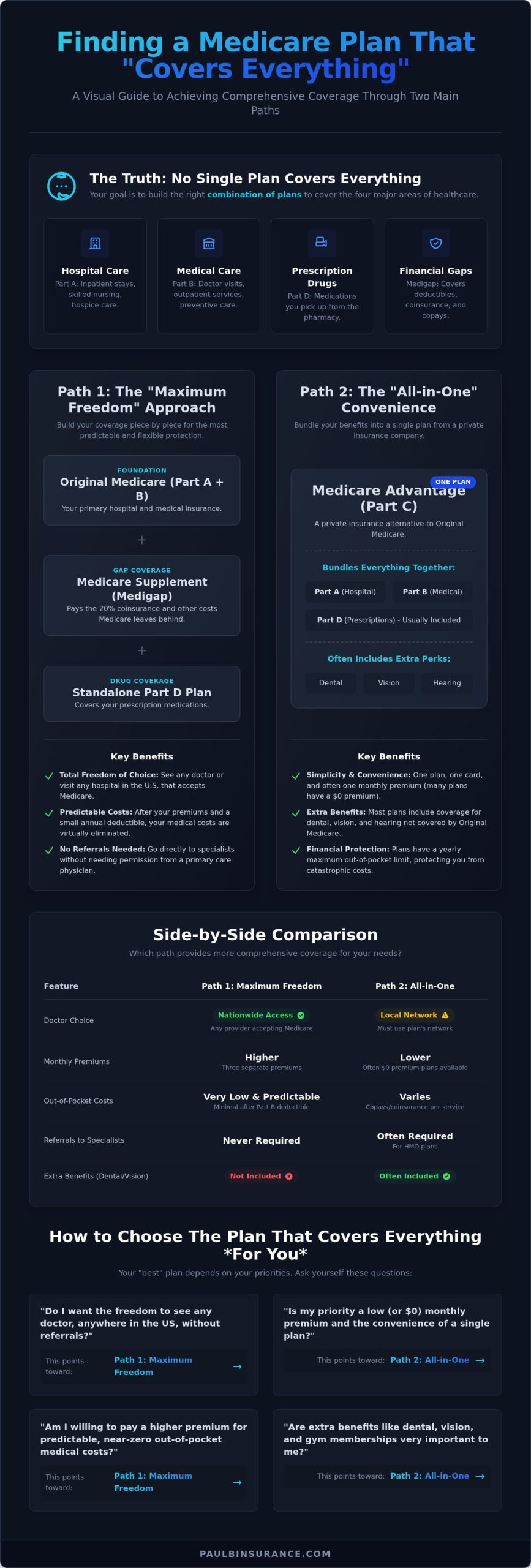
Once you understand the different pieces, building your coverage becomes much clearer. To solve the puzzle of what is the best medicare plan that covers everything for your situation, you will generally choose one of two foundational paths:
Path 1: Original Medicare with Supplemental Plans. This involves enrolling in Part A and Part B, then adding a separate Medicare Supplement (Medigap) policy to cover the gaps and a standalone Part D plan for prescriptions.
Path 2: A Medicare Advantage (Part C) Plan. This is an “all-in-one” alternative offered by private insurance companies. These plans bundle your Part A, Part B, and usually Part D benefits into a single plan, often with extra perks like dental or vision coverage.
Both strategies can provide you with fantastic, comprehensive protection. They just work in very different ways. In the next sections, we’ll provide trusted guidance to help you understand which path is the right fit for you.
Path 1: Original Medicare + Medigap + Part D Plan
For many people searching for what is the best medicare plan that covers everything, this three-part approach comes closest to that goal. Often called the ‘maximum freedom’ or ‘Cadillac’ option, this path combines three separate plans that work together to create a powerful and predictable healthcare safety net. Think of it as building your coverage piece by piece for the most comprehensive result.
Here’s how the pieces fit together to provide you with peace of mind:
- Original Medicare (Part A & Part B) acts as your primary insurance, covering your hospital and medical services.
- A Medicare Supplement (Medigap) plan pays for the costs that Original Medicare leaves behind.
- A standalone Prescription Drug Plan (Part D) covers your medications.
How Medigap Plans Cover ‘Everything Else’
After Original Medicare pays its share, you are typically left with deductibles, copayments, and 20% coinsurance for most medical services. This is where a Medigap plan steps in. These plans are designed specifically to fill those gaps. For example, a popular option like Medigap Plan G will cover your Part B coinsurance completely, leaving you with almost no out-of-pocket costs for doctor visits or outpatient care after you’ve met the annual Part B deductible. The most significant benefit is the freedom it provides; you can see any doctor or visit any hospital in the U.S. that accepts Medicare, no referrals needed. This flexibility is a key differentiator, and you can compare Medigap and Medicare Advantage plans with government resources to see just how different the network rules are.
Adding a Standalone Part D Drug Plan
It’s a common and costly mistake to assume Original Medicare covers prescriptions. Aside from drugs administered in a hospital setting, it does not. To get coverage for medications you pick up at the pharmacy, you must enroll in a separate Part D plan. Choosing not to enroll when you’re first eligible can lead to a permanent late enrollment penalty. Each Part D plan has its own list of covered drugs, called a formulary, so it’s vital to choose one that includes your specific medications.
Who is This Path Best For?
This comprehensive approach is often the ideal choice for individuals who:
- Want predictable monthly premiums and minimal, or even zero, out-of-pocket costs for medical care.
- Travel frequently within the U.S. and want the freedom to see providers anywhere without network restrictions.
- Value the ability to see specialists without needing a referral from a primary care physician.
- Are willing to pay a higher total monthly premium in exchange for maximum freedom and financial peace of mind.
Path 2: A Comprehensive Medicare Advantage (Part C) Plan
If the idea of managing multiple policies feels overwhelming, there is another popular path. Think of a Medicare Advantage plan, also known as Part C, as the “all-in-one” or “convenience” option. Instead of getting your benefits directly from the government, you choose a plan from a private insurance company approved by Medicare. These companies bundle your Part A (hospital), Part B (medical), and usually Part D (prescription drug) coverage into one single, easy-to-manage plan. Many even offer these plans with a $0 monthly premium, which can be very appealing.
How Medicare Advantage Plans Cover ‘Everything’
When people ask, “what is the best medicare plan that covers everything?” they are often drawn to the simplicity of Medicare Advantage. By law, these plans must provide, at a minimum, all the same coverage as Original Medicare. But they almost always go further. Most plans include prescription drug coverage built right in, and they often add extra benefits that Medicare doesn’t cover. These can include routine dental, vision, and hearing care. In fact, a recent KFF Medicare Advantage analysis shows just how common these valuable extra perks have become. Crucially, every Part C plan includes an annual out-of-pocket maximum, which puts a firm cap on your medical spending for the year—a vital financial protection that Original Medicare lacks on its own.
Understanding the Trade-Offs: Networks and Costs
The convenience of Medicare Advantage comes with a few trade-offs to understand. To keep costs low, these plans typically operate with a local network of doctors and hospitals, such as an HMO or PPO. This means you’ll need to use providers within that network to get the lowest costs. With some plans, like an HMO, you may need a referral from your primary care doctor to see a specialist. You’ll also pay for services as you use them in the form of copayments and coinsurance, up until you reach your annual maximum.
Who is This Path Best For?
A Medicare Advantage plan can be an excellent fit, but it’s not for everyone. This path often works best for:
- Individuals who are generally healthy and want to keep their monthly premiums as low as possible.
- People who don’t mind using a specific network of doctors and hospitals to receive care.
- Those who highly value the convenience of an all-in-one plan and want the extra dental, vision, and hearing benefits.
Feeling confused? It’s completely normal. The right path depends entirely on your unique health needs and budget. Let us help you compare plans in your area.
Side-by-Side Comparison: Which Path is More Comprehensive?
We’ve explored the two main avenues for Medicare coverage: Original Medicare with a Medigap plan and a separate Part D plan, or an all-in-one Medicare Advantage plan. Both paths offer robust protection, but they deliver that coverage in very different ways. The answer to “what is the best medicare plan that covers everything?” truly depends on what you value most: predictable costs, freedom of choice, or all-in-one simplicity.
To make it easier to see the differences, here is a simple breakdown of the key factors:
| Factor | Original Medicare + Medigap | Medicare Advantage (Part C) |
|---|---|---|
| Monthly Cost | Higher, predictable monthly premiums. | Low or $0 monthly premiums. |
| Out-of-Pocket Costs | Very low or no costs when you receive care. | Pay copays and coinsurance as you use services. |
| Doctor Choice | Freedom to see any doctor in the U.S. that accepts Medicare. | Must use doctors within the plan’s network for lowest costs. |
| Extra Benefits | Not included. Dental, vision, and hearing must be bought separately. | Often includes dental, vision, hearing, and gym memberships. |
| Simplicity | Manage 3 separate cards (Medicare, Medigap, Part D). | One plan, one card. |
Cost Breakdown: Premiums vs. Out-of-Pocket
With the Medigap path, you pay a higher monthly premium for your supplement plan, but in return, you face very few (if any) out-of-pocket costs when you visit a doctor or hospital. This creates predictable, budget-friendly healthcare spending. The Medicare Advantage path features low or even $0 monthly premiums, but you pay copays and coinsurance as you need care. This can be cost-effective in healthy years but may lead to higher, less predictable costs if you need frequent medical attention.
Doctor Choice and Flexibility
This is one of the most significant differences. A Medigap plan gives you the freedom to see any doctor, specialist, or hospital in the entire country that accepts Medicare—no referrals needed. This is ideal if you travel or want to ensure access to a specific provider. Medicare Advantage plans operate with local provider networks (like an HMO or PPO). You must use doctors in that network to keep your costs down, and you may need referrals to see specialists.
Included Benefits and Simplicity
If you value convenience, the Medicare Advantage path bundles your hospital, medical, and often prescription drug coverage into a single plan with one card. These plans frequently include extra perks like routine dental, vision, and hearing benefits at no additional cost. The Medigap path is more fragmented, requiring you to manage your Original Medicare card, your Medigap policy, and a separate Part D drug plan. Understanding these core trade-offs is the key to deciding what is the best medicare plan that covers everything for your unique life.
Feeling overwhelmed by the choice? That’s completely normal. Getting clear, unbiased guidance can help you move from confusion to confidence. Let’s find the right path for you, together.
How to Choose the Plan That Covers Everything For You
After exploring all the options, the final step is moving from the general to the personal. The search for what is the best medicare plan that covers everything isn’t about finding a single, universally perfect plan. It’s about finding the one that provides complete and total peace of mind for your unique situation. This simple, three-step process will help you move from confusion to confidence.
Step 1: Assess Your Health and Prescription Needs
Before you can find the right coverage, you need a clear picture of what you need covered. Taking just a few minutes to organize this information will make the entire process smoother. Start by making a simple list:
- Your Doctors: List every doctor, specialist, and hospital you want to keep.
- Your Prescriptions: Write down the names of all your medications and their dosages.
- Your Future Health: Consider any chronic conditions you manage or any surgeries you anticipate needing in the next year.
Step 2: Evaluate Your Budget and Risk Tolerance
Your financial comfort is just as important as your health coverage. Ask yourself: Would you prefer the predictability of a higher monthly premium with fewer surprise costs, or are you comfortable with a lower premium and paying more for services as you use them? Understanding your budget helps narrow down the choices between a Medigap plan’s stability and a Medicare Advantage plan’s lower upfront costs.
Step 3: Get Unbiased, Expert Help
Comparing dozens of plans from different insurance companies can feel like a full-time job. You don’t have to do it alone. An independent Medicare broker works for you, not for a specific insurance company. We provide trusted, unbiased guidance by comparing all your options to find the right fit for your health needs and budget. Our service is completely free, and it ensures you avoid common and costly enrollment mistakes. Ready to find your perfect plan without the stress?
Schedule your free, no-obligation consultation today.
From Confusion to Confidence: Finding Your Best Coverage
The journey to find your ideal Medicare coverage begins by understanding a key truth: there is no single, one-size-fits-all plan. The real answer to the question, what is the best medicare plan that covers everything, depends entirely on your unique health needs, budget, and lifestyle. As we’ve explored, this could mean building comprehensive protection with Original Medicare, a Medigap policy, and a Part D plan, or choosing a robust Medicare Advantage plan that fits your priorities. The most important step is choosing the path that gives you peace of mind.
Navigating these options alone can be daunting, but you don’t have to do it by yourself. As an independent agency that has served over 5,000 clients, we provide unbiased guidance on plans from more than 40 top carriers. Our simple 5-step process is designed to move you from confusion to confidence. Let’s find the right coverage for you. Talk to an expert for free.
The right plan is out there, and we’re here to help you find it with clarity and ease.
Frequently Asked Questions
Is Medicare Plan G the one that covers everything?
Medicare Plan G is the most comprehensive Medigap plan available to new enrollees. It covers nearly all your out-of-pocket costs after Original Medicare pays, except for the annual Part B deductible. This makes it an excellent choice for predictable budgeting and minimizing surprise bills. However, it’s crucial to remember that it only supplements Original Medicare and doesn’t cover things like prescription drugs, for which you’ll need a separate Part D plan.
Do any Medicare plans cover dental, vision, and hearing aids?
Original Medicare and Medigap plans typically do not cover routine dental, vision, or hearing services. For these benefits, you’ll want to look at Medicare Advantage (Part C) plans. Many of these all-in-one plans bundle these extra perks, such as coverage for exams, glasses, and hearing aids. The key is to weigh this convenience against the plan’s network restrictions and other rules to ensure it’s the right fit for your healthcare needs.
What happens if I choose the wrong Medicare plan?
Choosing a plan that isn’t a good fit can lead to higher-than-expected costs or network limitations. Fortunately, you aren’t stuck forever. You can typically make changes during the Annual Enrollment Period each fall. However, trying to switch to certain plans later, like Medigap, may require you to answer health questions. This is why getting personalized, unbiased guidance from the start is the best way to avoid stressful and costly enrollment mistakes.
Can I switch from a Medicare Advantage plan to a Medigap plan later?
Yes, you can switch, but it can be complicated. When you first enroll in Medicare, you have a one-time open enrollment period to get a Medigap plan without any health questions. If you try to switch from a Medicare Advantage plan to Medigap later, you will likely face medical underwriting. This means an insurance company can review your health history and may deny your application or charge you a higher premium based on pre-existing conditions.
Does ‘covering everything’ also include things like long-term care?
This is a critical distinction. When people ask what is the best medicare plan that covers everything, they often think of long-term care. However, no Medicare plan, including Medigap, covers long-term custodial care like help with daily activities in a nursing home. Medicare only covers short-term, medically necessary skilled nursing care after a qualifying hospital stay. For long-term care, separate insurance or other financial strategies are needed.
What is the out-of-pocket maximum for Medicare in 2026?
Original Medicare (Part A and Part B) has no annual out-of-pocket maximum, which can expose you to unlimited financial risk. This is why supplemental coverage is so important. Medicare Advantage plans are required by law to have a maximum out-of-pocket limit, which changes each year. For 2026, the specific figure has not yet been announced by CMS, but having this safety net is a key feature of all Advantage plans.

Article by
Paul Barrett
Paul Barrett, CMIP is the founder of The Modern Medicare Agency, an independent Medicare-only brokerage based in Melville, NY. With 18 years of Medicare-exclusive experience, a CMIP designation, and more than 5,000 clients served across 37 states, Paul is one of the most credentialed independent Medicare specialists on Long Island — and one of the most direct.
He represents 40+ carriers with no quotas and no allegiances, which means his recommendations are based entirely on what fits each client's specific situation. He is the author of Medicare Mastery Unlocked and host of the Wise Guys Retirement Talk podcast. His content is grounded in primary sources, real carrier intelligence, and 18 years of watching what happens when people get Medicare right — and when they don't.
📞 631-358-5793 | paulbinsurance.com