
Is your head spinning with all the different Medicare terms? Between Part A, B, C, and D, it’s easy to feel overwhelmed and confused. You know how important this decision is for your health and finances, and the fear of making a costly mistake is completely understandable. When you’re just looking for clear answers, the last thing you need is more jargon and confusing sales pitches. That’s why we’re here to help you understand one of the most popular options available: medicare advantage plans.
This simple guide is designed to give you straightforward, unbiased information for 2026. We promise to skip the confusing industry-speak and explain, in plain English, exactly what Medicare Advantage (also known as Part C) is and how it works. By the end of this article, you will have a clear picture of the real pros and cons, helping you feel confident and empowered to decide if an Advantage plan is the right choice for your specific healthcare needs and budget.
Key Takeaways
- Understand Medicare Advantage (Part C) as an all-in-one alternative that bundles your health and drug benefits into a single, managed plan.
- Learn the key differences between Original Medicare and medicare advantage plans, especially when it comes to doctor networks, costs, and extra benefits.
- Finally make sense of the different plan types (like HMOs and PPOs) to see which one best fits your personal healthcare needs and budget.
- Get a clear, unbiased look at both the benefits and potential drawbacks to confidently decide if a Part C plan is the right path for you.
What Exactly Is a Medicare Advantage Plan (Part C)?
Navigating the world of Medicare can feel overwhelming, but understanding your options is the first step toward confidence. Think of a Medicare Advantage Plan as a “combo meal” for your healthcare. Instead of getting your benefits separately from the government through Original Medicare, you can choose to receive them through a single, bundled plan.
These plans are offered by private insurance companies that are approved and regulated by Medicare. They provide an alternative way to get your healthcare coverage, but they must, by law, cover everything that Original Medicare (Part A and Part B) covers. This structure is designed to simplify your benefits into one easy-to-manage plan.
An All-in-One Alternative to Original Medicare
When you enroll in a Medicare Advantage plan, it’s crucial to understand that you are still in the Medicare program with all the same rights and protections. You are simply choosing to receive your benefits from a private company. This bundled approach, officially known as Medicare Advantage (Part C), is structured for convenience. You will use your plan’s insurance card for all your medical needs instead of your red, white, and blue Medicare card. Remember, you must continue to pay your monthly Medicare Part B premium to the government to keep your coverage active.
What’s Typically Included in a Part C Plan?
The main appeal for many people is the comprehensive nature of medicare advantage plans. They combine multiple types of coverage into one package, often for a low or even $0 monthly premium beyond your Part B cost. A typical plan includes:
- Part A (Hospital Insurance): Coverage for inpatient hospital stays, care in a skilled nursing facility, and hospice care.
- Part B (Medical Insurance): Coverage for doctor’s appointments, outpatient care, medical supplies, and preventive services.
- Part D (Prescription Drugs): Most Medicare Advantage plans (known as MA-PDs) include prescription drug coverage, so you don’t need a separate Part D plan.
- Extra Benefits: This is where plans truly differ. Many offer valuable extras not covered by Original Medicare, such as routine dental, vision, and hearing care, as well as fitness program memberships.
How Medicare Advantage Plans Work: Key Differences from Original Medicare
Once you’re enrolled in Medicare Parts A and B, you face a crucial decision: stay with Original Medicare or choose a Medicare Advantage plan? Understanding how these two paths differ in your day-to-day life is the key to making a confident choice. Think of it as choosing between a national, government-run program and a local, all-in-one plan offered by a private insurance company.
While both provide your core Medicare benefits, they operate very differently when it comes to the doctors you can see, the costs you’ll pay, and the extra perks you might receive. Let’s break down these practical differences to help you see which approach might be a better fit for your needs and budget.
Provider Networks: The Biggest Difference
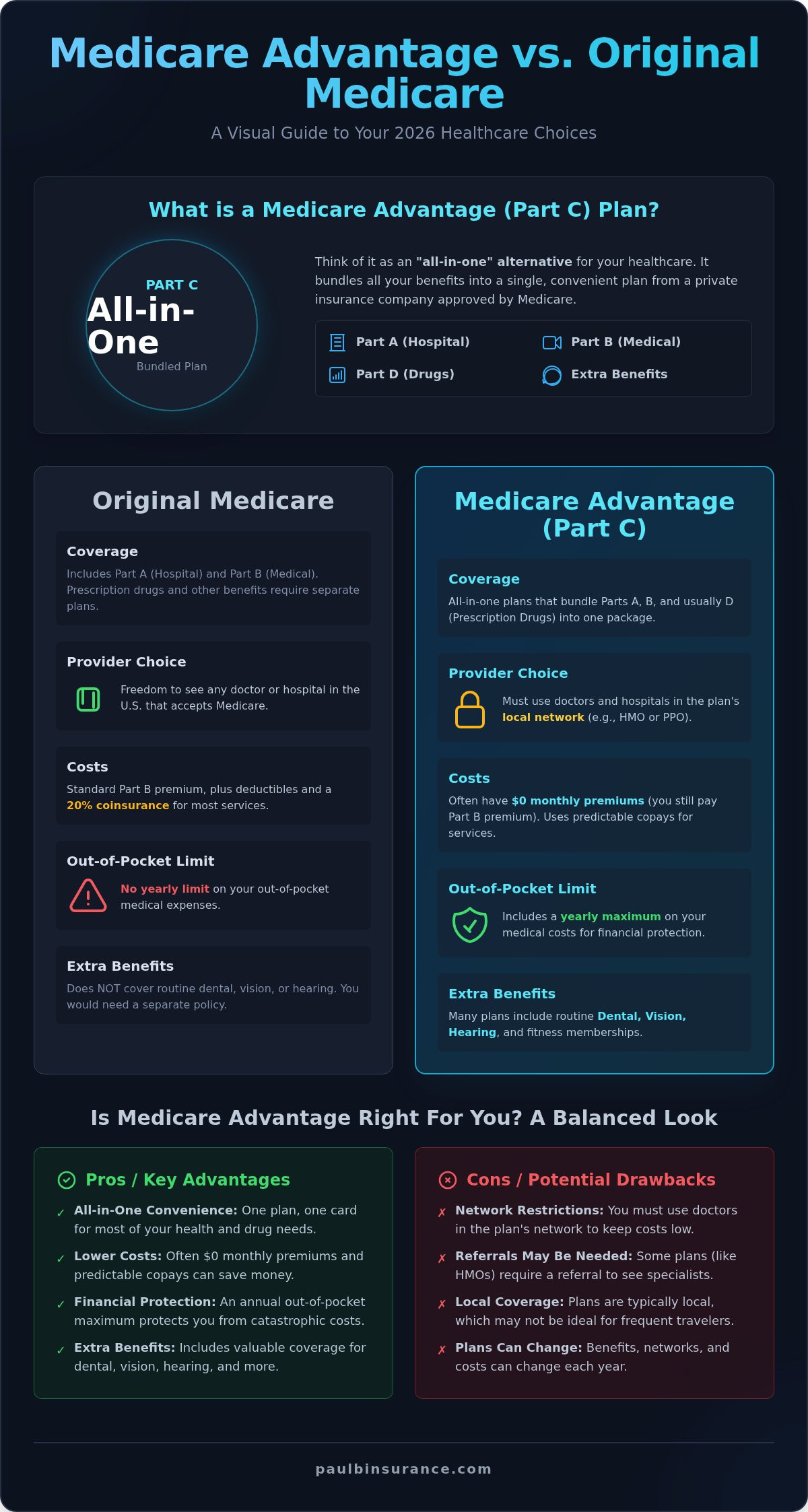
Perhaps the most significant difference you’ll experience is in provider choice. With Original Medicare, you have the freedom to see any doctor or visit any hospital in the U.S. that accepts Medicare. In contrast, most medicare advantage plans operate with a local provider network. You’ll need to use doctors, specialists, and hospitals within that network to receive the lowest costs. Going out-of-network can lead to much higher bills or no coverage at all, depending on your plan type (like an HMO or PPO).
Understanding Your Costs: Premiums, Deductibles, and Copays
Your healthcare costs are structured very differently in each path. Original Medicare has standardized costs set by the government, including deductibles for Part A and Part B, followed by a 20% coinsurance for most services with no annual limit on your spending. Medicare Advantage plans bundle your costs into a single plan with predictable copayments or coinsurance for services. Many plans offer an attractive $0 monthly premium (you still must pay your Part B premium). This cost structure is explored in detail in KFF’s analysis of 2025 Medicare Advantage Premiums and Benefits. Crucially, all Advantage plans include a yearly out-of-pocket maximum, which protects you from unlimited medical bills in a serious health year.
Extra Benefits Not Covered by Original Medicare
One of the main reasons people choose Medicare Advantage is for the valuable extra benefits that Original Medicare doesn’t cover. These all-in-one plans often include comprehensive coverage that goes beyond basic medical care. These built-in perks can save you significant money and support your overall wellness. Common extras include:
- Routine dental exams, cleanings, and X-rays
- Vision exams and allowances for eyeglasses or contacts
- Hearing exams and coverage for hearing aids
- Fitness program memberships like SilverSneakers
- Allowances for over-the-counter (OTC) health items
The Different Types of Medicare Advantage Plans Explained
When you start exploring your options, the “alphabet soup” of acronyms-HMO, PPO, SNP-can be one of the most confusing parts. But don’t worry. Understanding the different types of medicare advantage plans is simpler than it seems. It all comes down to a balance between your desire for choice and your budget. Let’s break down what each type means for you, your doctors, and your wallet, moving you from confusion to confidence.
HMO (Health Maintenance Organization) Plans
Think of an HMO plan as a coordinated team dedicated to your health. These plans are often the most affordable option because they work with a specific network of doctors, hospitals, and specialists. To keep costs low and care streamlined, they operate with a few key rules.
- Primary Care Physician (PCP): You’ll choose a main doctor to be your trusted guide. Your PCP manages your overall care.
- Referrals Required: If you need to see a specialist, like a cardiologist, you’ll almost always need a referral from your PCP first.
- In-Network Care: Except for emergencies, you must use doctors and facilities within the plan’s network for your care to be covered.
PPO (Preferred Provider Organization) Plans
If you value flexibility and a wider choice of doctors, a PPO plan might be the right fit. These plans give you the freedom to see providers both inside and outside the plan’s network, offering you more control over your healthcare decisions.
- More Doctor Choice: You can visit any doctor who accepts Medicare, but you’ll save money by staying with “preferred” in-network providers.
- No PCP or Referrals: You are not required to select a PCP, and you can see specialists directly without needing a referral.
- Cost Difference: This flexibility often comes with slightly higher monthly premiums and out-of-pocket costs, especially when you see out-of-network doctors.
Other Plan Types: PFFS and SNPs
While HMOs and PPOs are what most people choose, you might see two other types. PFFS (Private Fee-for-Service) plans let you see any Medicare-approved doctor, provided they agree to accept the plan’s payment terms for each visit. SNPs (Special Needs Plans) are tailored for specific groups, such as people who have both Medicare and Medicaid or have certain chronic conditions. As you prepare, you can always find detailed guidelines by reviewing the Official Medicare Enrollment Information from the U.S. government. For most individuals, however, the choice will come down to the structure of an HMO or the flexibility of a PPO.
Pros and Cons: Is a Medicare Advantage Plan Right for You?
Choosing your Medicare path is a deeply personal decision, and there is no single “best” answer for everyone. To move from confusion to confidence, it’s essential to look at the complete picture. Medicare Advantage (Part C) plans offer a compelling alternative to Original Medicare, but they come with a unique set of rules. Understanding both the benefits and the trade-offs is the first step in deciding if this path aligns with your health needs and lifestyle.
The Appeal of Advantage Plans (Pros)
For many people, the biggest draw of medicare advantage plans is their structure and affordability. They package your coverage into a single, streamlined plan.
- Lower Upfront Costs: Many plans feature $0 monthly premiums (you still pay your Part B premium) and predictable copayments for doctor visits and services, making budgeting easier.
- All-in-One Convenience: Your hospital (Part A), medical (Part B), and often prescription drug (Part D) coverage are bundled together. You use one card for nearly all of your healthcare needs.
- Valuable Extra Benefits: Most plans include routine dental, vision, and hearing coverage-benefits not offered by Original Medicare. Many also add perks like gym memberships and allowances for over-the-counter products.
- Financial Protection: Every plan has an annual maximum out-of-pocket limit. Once you reach this cap, the plan covers 100% of your approved medical costs for the rest of the year, providing a crucial financial safety net.
Potential Downsides to Consider (Cons)
The convenience of Advantage plans comes with certain limitations that are important to understand before enrolling.
- Network Restrictions: Most plans require you to use doctors, specialists, and hospitals within their network (like an HMO or PPO). Going out-of-network can be costly or may not be covered at all, meaning you might have to change providers.
- Referrals and Prior Authorizations: You may need a referral from your primary care physician to see a specialist. Plans also often require prior authorization for certain procedures or medications, which can sometimes cause delays in receiving care.
- Annual Changes: Plans can change their provider networks, copays, and drug formularies every year. It’s vital to review your plan’s “Annual Notice of Change” each fall.
- Travel Limitations: Because most plans operate with local provider networks, your coverage may be limited to emergencies when traveling outside your service area.
Who Benefits Most from Medicare Advantage?
An Advantage plan is often a great fit for individuals who are relatively healthy and appreciate low monthly premiums, are comfortable choosing doctors from a provider network, and value the simplicity of having their medical and drug benefits bundled with extra perks like dental and vision. It provides a structured, predictable way to manage healthcare costs.
However, every situation is unique. Confused? A free consultation can clarify your best path.
Eligibility and Enrollment: How and When to Sign Up
Understanding when you can enroll in a Medicare Advantage Plan is just as important as choosing the right one. These timelines are set by Medicare, and missing a deadline can lead to delays in coverage or even penalties. We’re here to simplify the rules and give you the confidence to move forward.
Who is Eligible for a Medicare Advantage Plan?
Before exploring your options, it’s essential to confirm you meet the basic requirements. Think of it as a simple, three-point checklist. To join one of the many available medicare advantage plans, you must:
- Be enrolled in Original Medicare (both Part A and Part B).
- Live in the specific service area of the plan you want to join.
- Not have End-Stage Renal Disease (ESRD) in most cases. However, recent rule changes have opened up eligibility for many individuals with this condition, so it’s always best to confirm.
Key Enrollment Periods to Know
Timing is everything with Medicare. Enrolling is not a year-round option for most people; instead, you must sign up during specific windows. Here are the most important ones to mark on your calendar:
- Initial Enrollment Period (IEP): This is your first chance to sign up. It’s a 7-month window around your 65th birthday-starting 3 months before your birthday month, including your birthday month, and ending 3 months after.
- Annual Enrollment Period (AEP): This is the key time for most beneficiaries. Every year from October 15 to December 7, you can join, switch, or drop a Medicare Advantage Plan for the upcoming year.
- Advantage Plan Open Enrollment Period: From January 1 to March 31, if you are already in an Advantage Plan, you have a one-time opportunity to switch to another one or return to Original Medicare.
- Special Enrollment Periods (SEPs): Certain life events, like moving, losing employer coverage, or qualifying for extra help, may grant you a special window to make changes to your coverage.
Navigating these dates and rules can feel like a puzzle. Making a mistake can be costly, but you don’t have to figure it out alone. For clear, personalized guidance that ensures you enroll correctly and on time, our team at Paul B Insurance is here to provide trusted support every step of the way.
Making Your Medicare Advantage Choice with Confidence
Choosing your healthcare coverage is one of the most important decisions you’ll make. As we’ve explored, Medicare Advantage (Part C) can bundle your benefits into a single, convenient plan, but its value truly depends on how well it fits your personal health needs, budget, and network of doctors. Understanding the key differences between the various medicare advantage plans is the first step, but you don’t have to take the next one alone.
Navigating these options can feel complex, but our goal is to bring you from confusion to clarity. Get free, unbiased help finding the right Medicare Advantage Plan for you. Trusted by over 5,000 clients nationwide, we provide personalized, unbiased advice on plans from over 40 top carriers. With our help, you gain a dedicated partner offering year-round support, all at no extra cost to you.
Making an informed choice is empowering. Let us help you find the plan that delivers the coverage and peace of mind you deserve for 2026 and beyond.
Frequently Asked Questions About Medicare Advantage
Do I still pay my Medicare Part B premium with a Medicare Advantage Plan?
Yes, this is a very common and important question. Even if you choose a Medicare Advantage plan with a $0 monthly premium, you must continue to pay your Medicare Part B premium to the government. Think of the Part B premium as what keeps you enrolled in the Medicare system. Your Advantage plan simply takes over the administration of your benefits from a private insurance company, but your enrollment in Original Medicare (Parts A and B) is still required.
Can I have a Medicare Advantage plan and a Medigap (Supplement) plan at the same time?
No, you cannot have both at once. In fact, it’s illegal for an insurance company to sell you a Medigap policy if they know you are enrolled in a Medicare Advantage plan. These two types of coverage serve different purposes. Medigap plans work with Original Medicare to cover its “gaps,” like deductibles and coinsurance. Medicare Advantage plans are a different way to receive your Medicare benefits, replacing Original Medicare’s role for your health coverage.
Are Medicare Advantage plans really ‘free’ if they have a $0 premium?
A $0 premium means you do not pay a monthly fee to the insurance company for that specific plan, which is a great benefit. However, it doesn’t mean your healthcare is entirely free. You are still responsible for your Part B premium. You will also have out-of-pocket costs like copayments, coinsurance, and deductibles when you visit a doctor or hospital. It’s crucial to review a plan’s total potential costs, not just the premium, before enrolling.
What happens if my favorite doctor or hospital leaves my plan’s network?
It can be unsettling when a trusted provider leaves your network. If this happens mid-year, you will likely have to pay much higher out-of-pocket costs to continue seeing them, or you may need to switch to a new, in-network provider. This is why it’s so important to review your plan’s network each year during the Annual Enrollment Period. This period gives you the chance to switch to a plan that better fits your needs and includes your preferred doctors.
Can I switch back to Original Medicare if I don’t like my Advantage plan?
Yes, you have dedicated times when you can make this change. The main opportunity is during the Annual Enrollment Period, which runs from October 15th to December 7th each year. You can also switch during the Medicare Advantage Open Enrollment Period from January 1st to March 31st. During these windows, you can disenroll from your Advantage Plan, return to Original Medicare, and sign up for a standalone Part D prescription drug plan if you need one.
How do I check if my prescription drugs are covered by a plan?
The best way to verify drug coverage is to check the plan’s formulary, which is its official list of covered medications. You can find this on the insurance carrier’s website. For personalized guidance, we recommend using the Plan Finder tool on Medicare.gov. There, you can enter your exact prescriptions and dosages to see how different medicare advantage plans cover them and compare your estimated annual costs, helping you make a confident and informed decision.

Article by
Paul Barrett
Paul Barrett, CMIP is the founder of The Modern Medicare Agency, an independent Medicare-only brokerage based in Melville, NY. With 18 years of Medicare-exclusive experience, a CMIP designation, and more than 5,000 clients served across 37 states, Paul is one of the most credentialed independent Medicare specialists on Long Island — and one of the most direct.
He represents 40+ carriers with no quotas and no allegiances, which means his recommendations are based entirely on what fits each client's specific situation. He is the author of Medicare Mastery Unlocked and host of the Wise Guys Retirement Talk podcast. His content is grounded in primary sources, real carrier intelligence, and 18 years of watching what happens when people get Medicare right — and when they don't.
📞 631-358-5793 | paulbinsurance.com