
Do your Medicare premiums, deductibles, and copayments feel like a heavy weight on your budget? It’s a common concern, and the stress of navigating healthcare costs can be overwhelming. When you’re also faced with a confusing array of government assistance programs, it’s easy to feel lost and unsure of where to turn for help. The fear of being billed for something you thought was covered is a real and constant worry for many.
But there is a clear path forward. This guide is here to provide the trusted, straightforward guidance you need. We’re going to simplify one of the most helpful programs available: the Qualified Medicare Beneficiary (QMB) program. We will explain exactly what it covers, help you understand if you qualify, and show you how it can significantly reduce-and in many cases, eliminate-your out-of-pocket Medicare costs. It’s time to move from confusion to confidence in your healthcare coverage.
Key Takeaways
- Discover how the QMB program can potentially eliminate your Medicare Part A and B out-of-pocket costs, including premiums, deductibles, and coinsurance.
- You might be eligible for significant savings based on your monthly income; find out if you meet the specific financial limits for this year.
- Applying for help is more straightforward than you might think-follow our simple, step-by-step guide to move from confusion to confidence.
- Understanding your status as a qualified medicare beneficiary is key to choosing the right Medicare plan and maximizing your savings every year.
What is the Qualified Medicare Beneficiary (QMB) Program?
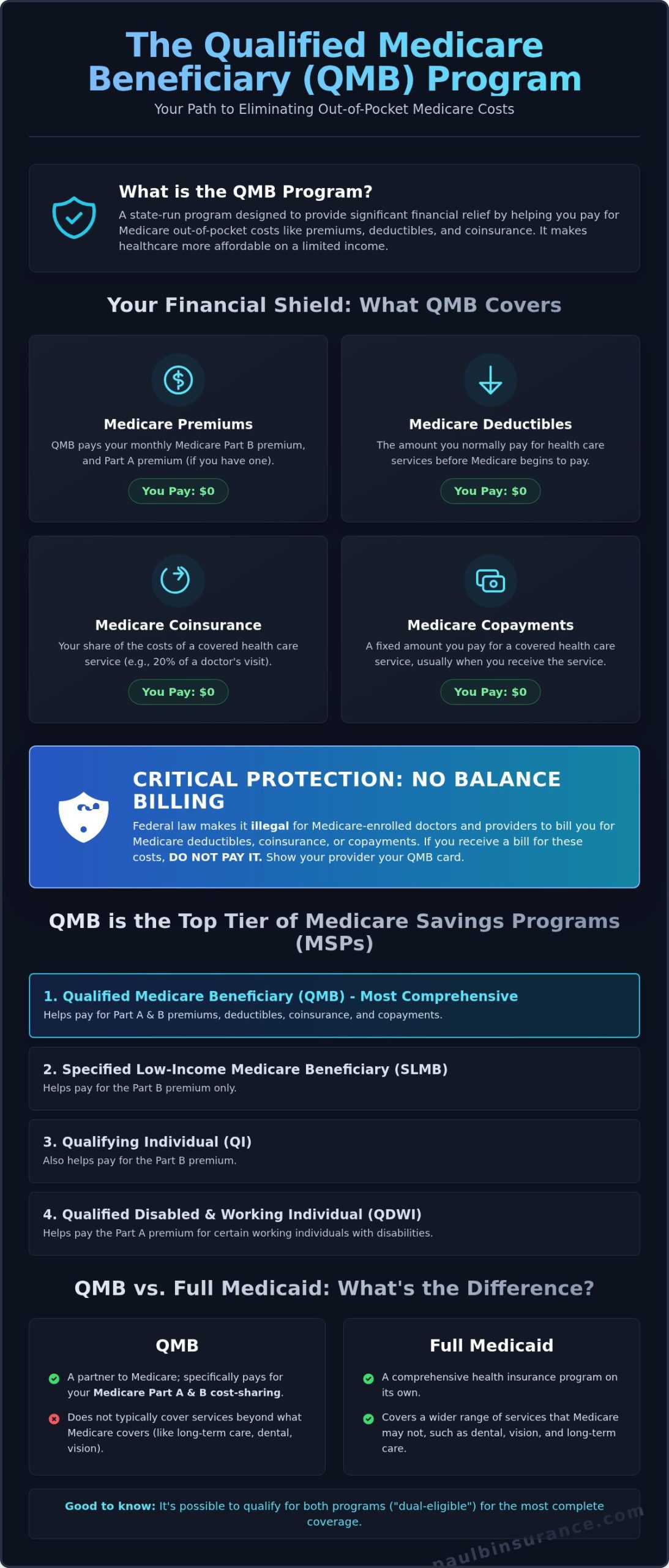
Navigating Medicare costs can feel overwhelming, but you don’t have to do it alone. If you’re on a limited income, there is help available. The Qualified Medicare Beneficiary (QMB) program is a state-run program designed to provide significant financial relief by helping you pay for out-of-pocket costs. Its primary goal is to make healthcare more affordable by covering expenses that the federal Medicare program would normally require you to pay.
It’s important to understand that while QMB is administered by your state’s Medicaid office, it isn’t the same as having full Medicaid coverage. Instead, its focus is very specific: it helps pay for your Medicare cost-sharing, such as premiums, deductibles, and coinsurance. This targeted support can make a tremendous difference in your monthly budget and ensure you get the care you need without the financial stress.
Understanding the ‘Medicare Savings Program’ Family
The QMB program is part of a larger family of programs called Medicare Savings Programs (MSPs). Each of these programs offers a different level of assistance based on your income and resources. The QMB program is the most comprehensive of the four.
- Qualified Medicare Beneficiary (QMB): Helps pay for Part A and B premiums, deductibles, coinsurance, and copayments.
- Specified Low-Income Medicare Beneficiary (SLMB): Helps pay for the Part B premium only.
- Qualifying Individual (QI): Also helps pay for the Part B premium.
- Qualified Disabled and Working Individual (QDWI): Helps pay the Part A premium for certain working individuals with disabilities.
Of these, becoming a qualified medicare beneficiary provides the highest level of assistance for your Medicare costs.
QMB vs. Full Medicaid: What’s the Difference?
A common point of confusion is how QMB differs from full Medicaid. Think of QMB as a dedicated partner to your Medicare plan. It specifically steps in to cover your Medicare Part A and Part B costs, effectively eliminating most of your out-of-pocket expenses for Medicare-covered services.
Full Medicaid, on the other hand, is a more comprehensive health insurance program. It covers a wider range of medical services that Medicare may not, such as certain dental, vision, or long-term care services. It is possible to qualify for both programs at the same time. This is often called “QMB Plus” or being “dual-eligible,” and it provides the most complete safety net for your healthcare needs.
Your QMB Benefits: What Costs Does the Program Actually Cover?
Understanding what a Qualified Medicare Beneficiary (QMB) is is the first step. The next, and most important, is seeing how this program provides powerful, tangible financial relief. Think of QMB as a shield that protects you from the most common out-of-pocket costs associated with Medicare. It’s designed to ensure you can get the care you need without the constant worry of medical bills.
Coverage for Medicare Part A & B Premiums
For most people, the most immediate and noticeable saving is on the Medicare Part B premium. QMB pays this monthly premium for you, which means hundreds of dollars stay in your pocket each year. If you are one of the few who must pay a premium for Medicare Part A (hospital insurance), the QMB program covers that cost as well. This significant monthly saving is precisely why understanding and meeting your state’s QMB eligibility limits can have such a positive impact on your budget. For personalized guidance on eligibility in New York, California, or Florida, contact Paul B Insurance.
Coverage for Deductibles, Coinsurance, and Copayments
Beyond premiums, Medicare has other costs that can quickly add up. These are your deductibles (what you pay before Medicare starts paying), coinsurance (your percentage of the cost), and copayments (a fixed amount for a service). With QMB, you get trusted guidance and real savings because the program pays for all of these costs for services covered by Medicare Part A and B.
- Part A & B Deductibles: Covered.
- Part A & B Coinsurance: Covered.
- Part A & B Copayments: Covered.
Here’s a simple, real-world example: Imagine you visit a specialist for a Medicare-approved service that costs $200. Without QMB, after meeting your deductible, you would likely owe 20% coinsurance, which is $40. With QMB, you pay $0 for that same visit.
The Most Important Protection: You Can’t Be Billed
This is where the peace of mind truly comes in. Federal law provides a crucial protection for anyone enrolled in the QMB program: it is illegal for Medicare-enrolled doctors, suppliers, and other providers to bill you for your Medicare deductibles, coinsurance, or copayments. This is often called “balance billing,” and you are completely protected from it.
If you ever mistakenly receive a bill for these charges, do not pay it. You should show your provider your Medicare and QMB cards and remind them of your status as a qualified medicare beneficiary. This powerful protection applies even if you see a doctor who doesn’t accept Medicaid, as long as they accept Medicare.
Do You Qualify for QMB? 2025 Income and Resource Limits
Navigating the financial requirements for Medicare Savings Programs can feel overwhelming, but we’re here to simplify the process. To become a qualified medicare beneficiary, your monthly income and total resources must fall below certain limits. These thresholds are updated annually and are the key to unlocking significant savings on your healthcare costs.
Below are the federal limits for 2025. Remember, these figures can help you see if you’re in the right ballpark for eligibility.
| Category | Individual Limit | Married Couple Limit |
|---|---|---|
| Monthly Income Limit | $1,315 | $1,780 |
| Resource Limit | $9,700 | $14,500 |
Please note: These limits are for the 48 contiguous states and D.C. The income and resource limits are higher for residents of Alaska and Hawaii.
What Counts as Income?
When your state reviews your application, they look at your gross monthly income-the amount you receive before any deductions like taxes. However, they automatically disregard the first $20 of most income, which helps more people qualify. Common sources of income include:
- Social Security benefits
- Wages from employment
- Pension payments
- Withdrawals from an IRA or 401(k)
What Counts as Resources (Assets)?
Many people worry that owning a home or a car will disqualify them, but that is not the case. The state only looks at “countable” resources, which are assets that can be easily converted to cash. Understanding what is and isn’t counted can provide tremendous peace of mind.
Countable resources typically include:
- Money in checking and savings accounts
- Stocks, bonds, and mutual funds
Crucially, these major assets do NOT count toward your resource limit:
- The home you live in
- One vehicle
- Your furniture and personal belongings
- A burial plot
How to Apply for the QMB Program: A Step-by-Step Guide
Navigating government programs can feel like a maze, but applying to become a qualified medicare beneficiary is more straightforward than you might think. We’ve broken the process down into three simple steps to help you move from confusion to confidence. Remember, you don’t have to do this alone-help is always available.
Step 1: Contact Your State Medicaid Agency
A common point of confusion is who handles the application. While QMB is a federal program that helps with Medicare costs, it is run by your state’s Medicaid agency. Your first step is to contact them directly and ask for an application for Medicare Savings Programs. They can confirm your state’s specific income and resource limits and guide you to the right forms.
You can find your state agency’s contact information through the official directory on Medicaid.gov.
Step 2: Gather Your Documents
Being prepared makes any application process smoother. While each state may have slightly different requirements, you will likely need to provide copies of documents that verify your identity, income, and resources. Having these ready will save you time and stress.
Here is a simple checklist of common documents to gather:
- Proof of identity and age (Driver’s license, birth certificate)
- Proof of U.S. citizenship or legal residency
- Your Social Security card and Medicare card
- Proof of income (Social Security benefit letter, pension statements, pay stubs)
- Recent bank statements for all checking and savings accounts
- Information on other assets like stocks or bonds
Step 3: Complete and Submit Your Application
Most states offer several ways to apply: online, by mail, or in-person. Choose the method you are most comfortable with. Fill out the application completely and honestly. If you get stuck on a question, don’t guess. Instead, call the Medicaid agency for clarification. For free, unbiased, one-on-one assistance, you can also contact your local State Health Insurance Assistance Program (SHIP). SHIP counselors are trained experts who can walk you through the entire application at no cost to you.
If you have questions about how the QMB program fits into your broader Medicare coverage, our team is here to provide the trusted, personalized guidance you deserve. Contact us at paulbinsurance.com for straightforward support.
How QMB Works With Your Medicare Plan Choices
Understanding that you are a qualified medicare beneficiary is the first step. The next is knowing how this status empowers you to make the best Medicare plan choices for your health and budget. Your QMB benefits work differently depending on the type of Medicare coverage you select, and making the right decision can lead to comprehensive care with minimal or even zero out-of-pocket costs.
Navigating these options can feel like a puzzle, but the pieces fit together perfectly once you see the big picture. Let’s look at how your QMB status pairs with your main Medicare coverage paths.
QMB with Original Medicare
When you have Original Medicare (Part A and Part B), your QMB benefits act like a powerful supplement. QMB pays for your Medicare Part A and Part B deductibles, coinsurance, and copayments. This means that for Medicare-covered services, you should have no out-of-pocket costs. This combination provides robust, nationwide coverage. As an added benefit, QMB status automatically qualifies you for the Extra Help program, which significantly lowers your prescription drug (Part D) costs.
QMB with a Medicare Advantage (Part C) Plan
Many individuals with QMB choose to enroll in a Medicare Advantage plan. You can often find plans with a $0 monthly premium. By law, if you are in the QMB program, your Medicare Advantage plan cannot charge you for deductibles, copayments, or coinsurance on Medicare-covered services. Many beneficiaries enroll in a specific type of plan called a Dual Eligible Special Needs Plan (D-SNP), which is designed to coordinate benefits for people who have both Medicare and Medicaid.
Do You Need Medigap if You Have QMB?
This is a common point of confusion, but the answer is clear: No, you do not need a Medigap (Medicare Supplement) plan if you have QMB. Medigap policies are designed to cover the very same costs that your QMB program already pays for, such as the 20% Part B coinsurance. Paying for a Medigap plan would mean you are paying for duplicate coverage you don’t need, costing you money unnecessarily.
Making the best choice depends on your specific needs, the doctors you visit, and the plans available in your area. Gaining unbiased, expert guidance can ensure you maximize your benefits without the stress. Let us help you find a plan that works with your QMB benefits.
Take the Next Step: Making QMB Work for You
The Qualified Medicare Beneficiary program is a powerful tool for reducing your healthcare expenses. As we’ve covered, it can eliminate your Medicare Part A and Part B premiums, deductibles, and coinsurance, offering significant financial relief. Understanding the eligibility rules and application process is the first crucial step toward unlocking these savings and gaining peace of mind.
But we know that figuring out how these benefits fit with your specific plan can still feel like a puzzle. If you are a qualified medicare beneficiary or think you might be, you don’t have to navigate the next steps alone. Paul has already helped over 5,000 seniors move from confusion to confidence, providing no-cost, personalized support and unbiased advice from more than 40 insurance carriers.
Navigating your Medicare options with QMB can be tricky. Book a free, no-obligation call with Paul to get clear, unbiased guidance. You deserve to feel secure in your healthcare coverage.
Frequently Asked Questions
What is the difference between QMB and full Medicaid?
This is a common point of confusion, but we can simplify it. The QMB program is a Medicare Savings Program that specifically helps pay for your Medicare costs, like premiums and copayments. Full Medicaid is comprehensive health insurance that covers a wider range of services that Medicare might not, such as dental or long-term care. While some people may qualify for both, QMB’s primary job is to help with your Medicare out-of-pocket expenses.
What happens if a doctor’s office tries to bill me for a copayment?
It’s important to know your rights. If you are in the QMB program, federal law prohibits providers from billing you for Medicare deductibles, coinsurance, or copayments. When you visit your doctor, always show both your Medicare card and your QMB or Medicaid card. If you receive a bill by mistake, you should not pay it. You can contact your provider to remind them of your QMB status or reach out to your state’s Medicaid agency for further guidance.
Does the QMB program help with my prescription drug costs?
While the QMB program itself focuses on your medical costs (Parts A and B), qualifying for it provides a powerful, automatic benefit for your medications. If you are a qualified medicare beneficiary, you automatically qualify for the Extra Help program, also known as Low-Income Subsidy (LIS). This program provides significant assistance with your Medicare Part D prescription drug plan premiums, deductibles, and copayments, making your medications much more affordable.
Can I have a Medicare Advantage plan if I am in the QMB program?
Yes, you absolutely can. Being in the QMB program does not prevent you from enrolling in a Medicare Advantage (Part C) plan. In fact, the programs work together to provide you with robust coverage. The QMB program will help pay for the cost-sharing associated with your Medicare Advantage plan, such as copayments, coinsurance, and deductibles, up to the state’s payment limit. This can make a great plan even more affordable.
How often do I have to renew my QMB eligibility?
Your eligibility for the QMB program is not permanent and typically needs to be renewed each year. Your state’s Medicaid agency will send you a renewal form or notice in the mail. It is crucial to complete and return this paperwork by the deadline to ensure your benefits continue without interruption. Responding promptly to any communication from your state agency is the best way to maintain your valuable QMB coverage and peace of mind.
If I qualify for QMB, do I still need to pay my IRMAA surcharge?
The good news is that this is not something you will have to worry about. The Income-Related Monthly Adjustment Amount (IRMAA) is an extra charge for high-income beneficiaries. Since the QMB program is designed for individuals with limited income and resources, your income would be well below the threshold that triggers an IRMAA surcharge. If you qualify for QMB, you will not be subject to IRMAA payments for Part B or Part D.

Article by
Paul Barrett
Paul Barrett, CMIP is the founder of The Modern Medicare Agency, an independent Medicare-only brokerage based in Melville, NY. With 18 years of Medicare-exclusive experience, a CMIP designation, and more than 5,000 clients served across 37 states, Paul is one of the most credentialed independent Medicare specialists on Long Island — and one of the most direct.
He represents 40+ carriers with no quotas and no allegiances, which means his recommendations are based entirely on what fits each client's specific situation. He is the author of Medicare Mastery Unlocked and host of the Wise Guys Retirement Talk podcast. His content is grounded in primary sources, real carrier intelligence, and 18 years of watching what happens when people get Medicare right — and when they don't.
📞 631-358-5793 | paulbinsurance.com