
Does the thought of an unexpected medical bill create a knot of worry, even though you have Medicare? Are you trying to make sense of an alphabet soup of plans-F, G, N-and feeling more confused than confident? You are not alone. The truth is, Original Medicare was never designed to cover 100% of your costs, leaving gaps that can be financially devastating. This is where medicare supplement insurance, also known as Medigap, steps in to provide the security and peace of mind you deserve.
This simple guide is designed to remove that confusion. We will walk you through exactly how these plans work to cover your out-of-pocket costs, what those different plan letters actually mean in plain English, and how you can choose the right one for your specific needs. By the time you’re done reading, you’ll have the clarity to protect your savings, maintain the freedom to see any doctor that accepts Medicare, and finally feel confident in your healthcare coverage.
Key Takeaways
- Learn how a Medigap plan can act as a financial safety net, covering the healthcare costs that Original Medicare doesn’t.
- Discover the simple key to understanding the ‘alphabet soup’ of Medigap plans and what "standardized" really means for your protection.
- Avoid costly mistakes by learning the single best time to enroll in a medicare supplement insurance plan, guaranteeing your acceptance.
- Decide with confidence whether Medigap or Medicare Advantage is the right path for your specific healthcare needs and budget.
Table of Contents
- What Is Medigap, and Who Really Needs It?
- How Medigap Plans Work in the Real World
- The ‘Alphabet Soup’ of Medigap Plans: A Clear Breakdown
- Medigap vs. Medicare Advantage: Making the Right Choice for You
- How to Enroll in a Medigap Plan (Without the Stress)
What Is Medigap, and Who Really Needs It?
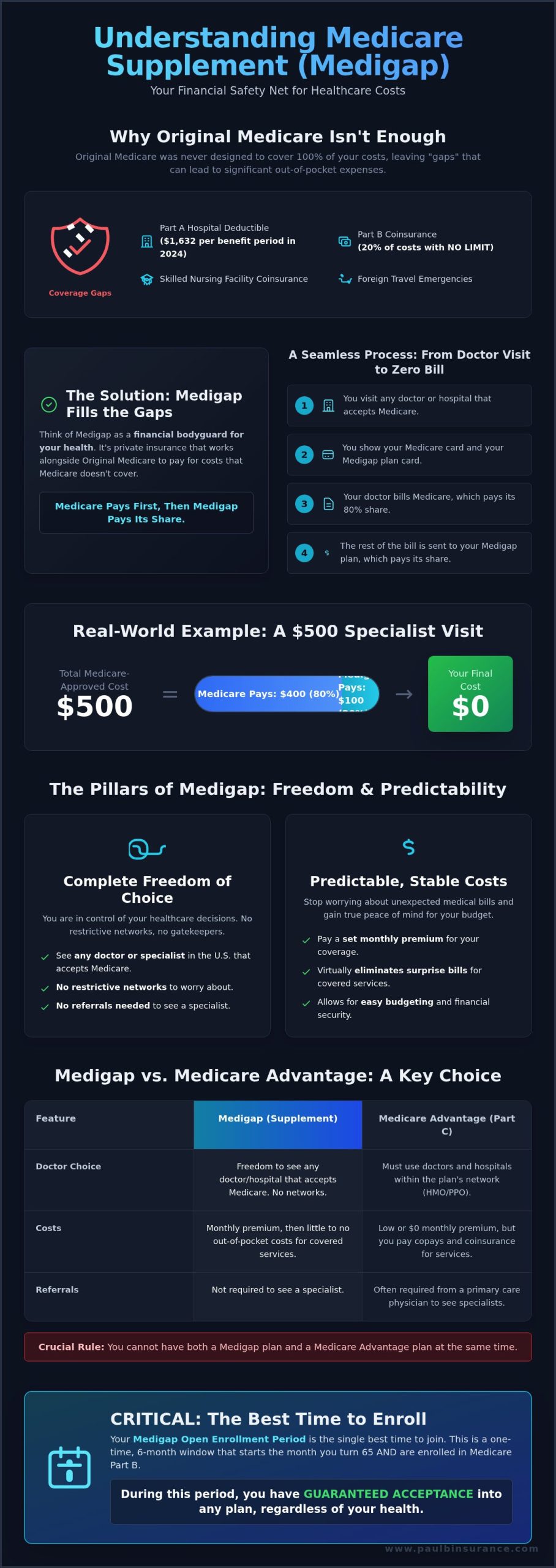
Navigating your healthcare options can feel overwhelming, but understanding Medigap doesn’t have to be. Think of a Medigap plan as a financial bodyguard for your health. In simple terms, it’s private insurance designed to work alongside your Original Medicare (Part A and Part B) to help pay for the costs that Medicare doesn’t cover.
These out-of-pocket expenses are often called "gaps," which is where the name Medigap comes from. These gaps include costs like deductibles, copayments, and coinsurance that can quickly add up. For a comprehensive Medigap overview, you can explore how these plans were structured to standardize coverage and protect beneficiaries. It’s a straightforward partnership: Medicare pays its share first, and then your Medigap plan steps in to help with the rest. It is crucial to remember you cannot have both a Medigap plan and a Medicare Advantage (Part C) plan at the same time.
Filling the ‘Gaps’ in Original Medicare
While Original Medicare provides foundational coverage, it was never designed to pay for everything. Without a safety net, you could face unpredictable and substantial medical bills. This is where medicare supplement insurance provides true peace of mind by covering many of these costs. Common expenses that Medigap plans can help pay for include:
- Part A Hospital Deductible: This is the amount you must pay for a hospital stay before Medicare begins to pay. In 2026, this deductible is $1,736 per benefit period.
- Part B Coinsurance: After you meet your annual Part B deductible, you are typically responsible for 20% of the cost for most doctor services and outpatient care. This 20% has no annual limit.
- Skilled Nursing Facility Care: Medigap can help cover the daily coinsurance costs for care you receive in a skilled nursing facility.
- Foreign Travel Emergencies: Original Medicare offers very limited coverage outside the U.S. Many Medigap plans help cover emergency care when you are traveling abroad.
Who Is Eligible for a Medigap Plan?
The path to securing a Medigap plan is clear, but you must meet a few key requirements. First and foremost, you must be enrolled in both Medicare Part A and Medicare Part B. These plans are generally available to individuals who are 65 or older. However, some states require that medicare supplement insurance also be offered to beneficiaries under 65 with certain disabilities.
A common point of confusion is who sells these plans. Medigap policies are not sold by the government; they are offered by private insurance companies that are approved by Medicare. This gives you choices, but it also makes trusted, unbiased guidance essential to finding the right fit for your needs and budget.
How Medigap Plans Work in the Real World
One of the biggest sources of confusion around Medicare is how the bills actually get paid. With a Medigap plan, the process is designed to be seamless and stress-free, working quietly in the background so you can focus on your health. When you visit a doctor, you simply show your Original Medicare card and your Medigap plan card. From there, the system takes over. Your doctor bills Medicare first, and Medicare pays its approved share, which is typically 80% of the cost. The official government site explains in detail how Medigap plans work, but the simple version is that Medicare automatically forwards the remaining bill to your Medigap company. Your Medigap plan then pays its portion directly to the doctor, leaving you with little or, in many cases, nothing to pay out-of-pocket for covered services.
This straightforward process delivers two of the most powerful benefits you can have in retirement: complete freedom of choice and predictable, stable healthcare costs.
The Core Benefit: Freedom to Choose Your Doctors
With a Medigap plan, you are in control. You can see any doctor, visit any hospital, or consult with any specialist in the entire United States, as long as they accept Medicare. There are no restrictive networks to worry about, and you never need a referral from a primary care physician to see a specialist. This stands in sharp contrast to many other types of plans that limit your choices to a specific list of providers, giving you true freedom over your healthcare decisions.
A Simple Example: A Visit to a Specialist
Let’s see how this works with a real-world number. Imagine you visit a cardiologist for a consultation, and the Medicare-approved amount for the visit is $500. Assuming you’ve already met your annual Part B deductible:
- Medicare Part B pays its 80% share: $400.
- The remaining 20% bill of $100 is sent to your Medigap company.
- Your Medigap Plan G pays that remaining 20%: $100.
- Your final out-of-pocket cost for the visit: $0.
Predictable Costs for Peace of Mind
By paying a set monthly premium for your medicare supplement insurance, you effectively eliminate the risk of large, unexpected medical bills that can derail a retirement budget. This transforms your healthcare expenses from a source of anxiety into a predictable, manageable line item. Knowing what you’ll spend each month provides incredible peace of mind. For those who want to keep monthly premiums lower, some plans even offer a high-deductible option, giving you another way to control costs with confidence.
The ‘Alphabet Soup’ of Medigap Plans: A Clear Breakdown
When you first look at your options for medicare supplement insurance, you’ll see a list of plans labeled with letters: A, B, C, D, F, G, K, L, M, and N. It can feel like you’re staring into a bowl of alphabet soup. But here is the simple, reassuring truth: this system was designed to protect you and make your decision easier.
Each letter represents a standardized plan. This means that a Plan G from one company has the exact same core benefits as a Plan G from any other company. The only differences are the monthly premium and the company’s reputation for service. This standardization is your greatest advantage, as it makes Comparing Medigap plans a straightforward process based on cost and quality, not confusing benefit variations. It’s important to note, however, that some states, like Massachusetts, Minnesota, and Wisconsin, standardize their plans differently.
Why Plan Letters Matter (And Why You Can Ignore Most of Them)
While there are 10 plan types, you don’t need to worry about memorizing them all. The reality is that most people find their perfect fit by choosing between just two or three of the most popular options. This simplifies the decision-making process immensely, moving you from confusion to confidence. Also, keep in mind that two plans, Plan C and Plan F, are only available to those who were eligible for Medicare before January 1, 2020.
Meet the Most Popular Plans: G and N
For anyone new to Medicare, the choice often comes down to two excellent plans that offer fantastic coverage and peace of mind.
- Plan G: The Comprehensive Choice. This is the most popular plan for new enrollees for a reason. It covers nearly all of the gaps in Original Medicare, leaving you with very predictable healthcare costs. Once you pay your annual Medicare Part B deductible, Plan G covers 100% of your remaining Medicare-approved costs for the year.
- Plan N: The Great Value Option. If you’re comfortable with a little more cost-sharing in exchange for a lower monthly premium, Plan N is an outstanding choice. It offers the same robust coverage as Plan G but requires small, predictable copays for some doctor visits (up to $20) and emergency room visits (up to $50).
Medigap vs. Medicare Advantage: Making the Right Choice for You
Once you’re enrolled in Original Medicare (Part A and Part B), you’ll face one of the most common and important decisions in your healthcare journey: how to supplement your coverage. The choice typically comes down to two main paths: adding a Medigap plan or choosing a Medicare Advantage plan. It’s important to understand that one isn’t inherently "better" than the other. They are simply different ways to receive your Medicare benefits, each with its own structure and advantages.
Thinking through this choice can feel overwhelming, but breaking it down makes it much clearer. The right path for you depends entirely on your personal health needs, budget, and lifestyle preferences.
Key Differences at a Glance: A Comparison Table
This simple table highlights the fundamental differences between these two options, helping you see how they stack up side-by-side.
| Feature | Medigap (Medicare Supplement Insurance) | Medicare Advantage (Part C) |
|---|---|---|
| Monthly Costs | You pay a separate monthly premium in addition to your Part B premium. | Many plans have a $0 monthly premium (you still pay your Part B premium). |
| Doctor Choice | Freedom to see any doctor or visit any hospital in the U.S. that accepts Medicare. No referrals needed. | You must use doctors and hospitals within the plan’s network (HMO or PPO). Referrals may be required. |
| Out-of-Pocket Costs | Highly predictable. Your plan covers most or all of your deductibles and coinsurance. | Variable. You pay copayments and coinsurance for services. Costs can add up to an annual maximum. |
| Extra Benefits | No built-in benefits. You must buy separate plans for prescription drugs (Part D), dental, or vision. | Often includes prescription drug coverage, plus routine dental, vision, and hearing benefits in one plan. |
Which Path Fits Your Lifestyle and Health Needs?
Understanding the facts is one thing; applying them to your life is another. Here’s a simple way to think about which option might align better with your priorities.
A Medicare Supplement Insurance plan may be the right fit if:
- You value the freedom to choose any doctor or specialist who accepts Medicare, without network restrictions.
- You travel frequently within the U.S. and want to ensure your coverage follows you everywhere.
- You prefer predictable, stable healthcare costs and want to minimize surprise medical bills.
A Medicare Advantage plan might be a better choice if:
- You are comfortable with a lower monthly premium and don’t mind using a local network of providers.
- You prefer the convenience of an all-in-one plan that includes prescription drug, dental, and vision coverage.
- You are generally healthy and anticipate needing routine care more than specialized services.
This decision is a significant one that impacts your healthcare and your budget for years to come. Feeling stuck? Get unbiased help comparing your options. We’re here to provide the clarity you need to move forward with confidence.
How to Enroll in a Medigap Plan (Without the Stress)
Navigating the enrollment rules for medicare supplement insurance can feel like walking through a maze. But here’s the simple truth: timing is everything. Enrolling at the right moment is the single most important step you can take to secure the coverage you want at the best possible price, for life. Getting this wrong can lead to higher costs or even being denied coverage altogether. We’re here to make sure that doesn’t happen.
Your Golden Window: The Medigap Open Enrollment Period
Think of this as your one-time, guaranteed pass. Your Medigap Open Enrollment Period is a six-month window that starts on the first day of the month you are both 65 or older and enrolled in Medicare Part B. During this protected period, you have "guaranteed issue rights." This means an insurance company cannot use your health history to deny you a policy or charge you a higher premium. It is truly the golden opportunity to get any Medigap plan you want.
What Happens if You Miss Your Open Enrollment?
If you apply outside of your open enrollment window, insurance companies can require medical underwriting. In simple terms, they can ask you a long list of health questions and review your medical records. Based on your health history, they have the right to charge you more, offer you a less comprehensive plan, or deny your application completely. While some special situations can grant you these rights again, you should never count on them.
Why an Independent Broker Simplifies Everything
You don’t have to figure this out alone. Working with a trusted, independent broker removes the stress and guesswork from the entire process. Unlike a captive agent who only works for one company, an independent broker works for you. Our goal is to find you the best coverage for your needs, not to push a specific product.
Here’s how we provide peace of mind:
- Unbiased Comparisons: We shop plans from dozens of top-rated insurance companies to find the best rate for your chosen letter plan.
- Expert Guidance: We help you understand your options and steer you clear of costly enrollment mistakes. Our guidance is always at no extra cost to you.
- A Stress-Free Process: We handle the paperwork and make the application process simple and clear.
Let us help you move from confusion to confidence. You can get started by exploring your options with trusted, patient guidance at wwwpaulbinsurance.com.
Your Path to Medicare Peace of Mind
Navigating your Medicare options can feel overwhelming, but now you have a clear map. You’ve learned how Medigap plans work to cover the out-of-pocket costs that Original Medicare doesn’t, giving you financial predictability and security. You also know that choosing the right medicare supplement insurance isn’t about finding a secret plan, but about matching a standardized plan to your specific health and budget needs.
You don’t have to make this important decision alone. With personalized, unbiased guidance, we help you compare plans from over 40 trusted carriers to find the perfect fit-without any sales pressure. Ready to trade confusion for confidence? Schedule a free, no-pressure call to find your best Medigap plan. Our dedicated experts provide year-round support for all your questions, giving you the lasting peace of mind you deserve.
Frequently Asked Questions About Medicare Supplement Insurance
Can an insurance company ever cancel my Medigap policy?
This is a common worry, but you can have peace of mind. Medigap policies are "guaranteed renewable." This means the insurance company cannot cancel your policy as long as you pay your premiums on time. The only other exceptions are if you made false statements on your application or if the insurance company goes out of business. Your coverage is designed to be a stable, reliable source of protection you can count on for the long term.
Do Medigap premiums increase as I get older?
Yes, it’s very likely your premiums will increase over time. Most plans are priced using an "attained-age" rating, meaning the premium is based on your current age and goes up as you get older. Some other plans are "issue-age" rated (based on your age when you bought it) or "community-rated" (everyone pays the same). Understanding how a company prices its plans and its history of rate increases is a key part of making a confident choice.
Can I switch from a Medicare Advantage plan to a Medigap plan?
Yes, you can switch, but the timing is critical to avoid complications. You can switch back to Original Medicare and apply for a Medigap plan during the Annual Election Period (October 15 – December 7). However, unless you qualify for a "guaranteed issue right," you will likely have to answer health questions. This means an insurance company could charge you more or deny your application based on your health. Navigating this switch requires careful guidance.
Does Medigap cover prescription drugs?
No, Medigap plans sold today do not include prescription drug coverage. Since 2006, federal law has prohibited new Medigap plans from offering this benefit. For help with the costs of your medications, you will need to enroll in a separate, standalone Medicare Part D Prescription Drug Plan. We can help you find a Part D plan that fits your specific medication needs, ensuring you have comprehensive and affordable coverage for your health.
If benefits are standardized, does it matter which company I choose?
Absolutely. While the government standardizes the benefits for each plan letter (for example, every Plan G offers the same medical coverage), the companies offering them are very different. Premiums for the exact same plan can vary by hundreds of dollars per year. Companies also differ in their financial stability, history of rate increases, and customer service quality. Choosing the right company for your medicare supplement insurance is just as important as choosing the right plan.
What if I move to another state with my Medigap plan?
One of the greatest benefits of a Medigap plan is its portability. Your policy goes with you anywhere in the United States. Since Medigap works with any doctor or hospital that accepts Original Medicare, you have the freedom to see any provider you choose, regardless of your state. You simply need to notify your insurance company of your new address. Your premium may be adjusted up or down based on the rates in your new location.

Article by
Paul Barrett
Paul Barrett, CMIP is the founder of The Modern Medicare Agency, an independent Medicare-only brokerage based in Melville, NY. With 18 years of Medicare-exclusive experience, a CMIP designation, and more than 5,000 clients served across 37 states, Paul is one of the most credentialed independent Medicare specialists on Long Island — and one of the most direct.
He represents 40+ carriers with no quotas and no allegiances, which means his recommendations are based entirely on what fits each client's specific situation. He is the author of Medicare Mastery Unlocked and host of the Wise Guys Retirement Talk podcast. His content is grounded in primary sources, real carrier intelligence, and 18 years of watching what happens when people get Medicare right — and when they don't.
📞 631-358-5793 | paulbinsurance.com