




Does the thought of choosing a prescription drug plan leave you feeling overwhelmed? Staring at dozens of options while trying to decipher terms like ‘formulary’ and the ‘donut hole,’ it’s easy to feel lost. The fear of picking the wrong plan and facing unexpectedly high costs at the pharmacy is real, but it doesn’t have to be your reality. We believe that learning how to choose a Medicare Part D plan should bring you peace of mind, not more stress.
This simple 5-step guide is your clear path from confusion to confidence. We will walk you through a trusted, stress-free process to accurately compare your options based on the medications you actually take. You’ll learn how to ensure your pharmacy is in-network, avoid costly late enrollment penalties, and select the most cost-effective plan for your unique needs. Get ready to feel empowered and secure in your decision, knowing you have the right coverage without overpaying.
Key Takeaways
- The monthly premium is only a small part of the story; learn how to calculate the true annual cost of a plan to avoid surprise expenses.
- A plan is only as good as its drug list. We’ll show you the simple way to confirm your essential medications are covered before you enroll.
- Our 5-step process demystifies how to choose a Medicare Part D plan, guiding you from confusion to a confident, cost-effective decision.
- Make your final choice with peace of mind by learning how to sidestep the common and costly mistakes many people make every year.
Table of Contents
- Step 1: Before You Compare, Gather Your Essential Information
- Step 2: Understand the 4 Key Costs of a Part D Plan
- Step 3: Check if Your Drugs Are Covered (The Formulary)
- Step 4: How to Compare Plans Side-by-Side
- Step 5: Making Your Final Choice and Avoiding Common Pitfalls
Step 1: Before You Compare, Gather Your Essential Information
Navigating the world of prescription drug plans can feel overwhelming, but the path to confidence starts with one simple, powerful step: preparation. Before you even look at a single plan, taking a few minutes to gather key details will save you hours of frustration and help prevent costly mistakes. Think of this as creating your personal ‘Part D profile.’
This profile is the foundation for learning how to choose a Medicare Part D plan that truly works for you. With this information in hand, online comparison tools become easy to use, and conversations with advisors become clear and productive. Let’s build your profile together.
Make a Complete List of Your Prescription Drugs
This is the single most important factor in your decision. A plan that looks great on paper might be a financial burden if it doesn’t cover your specific medications. To get an accurate picture of your potential costs, you need a detailed list. Be sure to include:
- The exact name of every medication, both brand-name and generic (e.g., Lipitor and its generic, Atorvastatin).
- The specific dosage (e.g., 20mg, 40mg).
- How often you take it (e.g., once daily, twice daily, or as needed).
Remember to include prescriptions you only use occasionally, like an emergency inhaler or a seasonal allergy medication. Every drug counts.
List Your Preferred Pharmacies
Where you fill your prescriptions matters. Most drug plans have a network of pharmacies, and you will save money by using their "preferred" locations. Jot down the names and addresses of the pharmacies you like to use, including your local independent pharmacy, a large chain like Walgreens or CVS, and any mail-order service you prefer. This ensures the plan you choose offers both savings and convenience.
Have Your Medicare Information Handy
Finally, find your red, white, and blue Medicare card. To properly compare and enroll in any Medicare Part D plan, you will need the information on this card. Specifically, have your Medicare Number (which is no longer your Social Security Number) and your Part A and/or Part B effective dates ready. Having this nearby makes the official enrollment process smooth and simple, whether you do it online or with trusted guidance.
Step 2: Understand the 4 Key Costs of a Part D Plan
When you start looking at prescription drug plans, it’s easy to focus only on the monthly premium. But that’s just one piece of the puzzle. A plan with a $15 monthly premium might end up costing you hundreds more over the year than a plan with a $40 premium, depending on the medications you take. The secret to how to choose a Medicare Part D plan that truly fits your budget is to look at your total out-of-pocket costs for the entire year.
Think of the total cost like a pie made of four slices. Each slice represents a different way you pay for your coverage and prescriptions. Let’s break them down in simple terms so you can approach your decision with confidence.
The Monthly Premium
This is the fixed amount you pay to the insurance company each month, just like a subscription fee. It keeps your plan active, but it does not include the cost of your actual medications. It’s tempting to pick the plan with the lowest premium, but this can be a costly mistake if the plan’s other costs are high for the specific drugs you need.
The Annual Deductible
The deductible is the amount you must pay out-of-pocket for your prescriptions before your plan starts to pay its share. For 2026, Medicare has set the maximum deductible for Part D plans at $615. Some plans offer a $0 deductible, which sounds great, but they often come with higher monthly premiums or copayments.
Copayments and Coinsurance
Once you’ve met your deductible, you will share the cost of your prescriptions with your plan. This is your copayment or coinsurance. These costs vary depending on the drug’s "tier."
- Copayment: A fixed dollar amount you pay for a prescription (e.g., $10 for a generic drug).
- Coinsurance: A percentage of the drug’s total cost you pay (e.g., 25% for a brand-name drug).
Understanding these costs is a critical step in learning how to choose a Medicare Part D plan, as high coinsurance on an expensive drug can quickly add up. Calculating these different costs for each plan can feel overwhelming, which is why tools like the official Medicare Plan Finder tool are so valuable for estimating your yearly expenses.
The Coverage Gap (or ‘Donut Hole’)
Is now closed thanks to the inflation reduction act. Consumers now have a much simpler cost schedule, deductible phase for drugs typically tier 3 or above. Then the copay/ co insurance phase last until you reach 2,100 in 2026. After 2,100 drugs will be covered 100% until the years end.
Step 3: Check if Your Drugs Are Covered (The Formulary)
Once you have a list of plans available in your area, this next step is the most important one. It’s where you move from general options to the specific plan that truly works for you. We’re going to look at the plan’s formulary, which is simply the official list of prescription drugs it covers.
Every single Part D plan has its own unique formulary. This is why you can’t just pick the plan your neighbor or friend recommends. Their medications are different from yours, and a plan that’s perfect for them could leave you with huge, unexpected bills at the pharmacy. Checking the formulary is a non-negotiable step in learning how to choose a medicare part d plan that protects your health and your budget.
Finding and Searching the Formulary
You can typically find a plan’s formulary on its website, often in a section labeled "Pharmacy" or "Prescription Drug Coverage." Most plans offer a simple search tool where you can type in the names of your medications. Be sure to check for the exact name and dosage you take. If one of your essential drugs is not listed, that plan is probably not the right choice for you.
Understanding Drug Tiers
As you check your medications, you’ll see them assigned to a "tier." Think of tiers as pricing levels. The lower the tier, the lower your copay will be.
- Tier 1: Preferred Generics. These are the most common, lowest-cost generic drugs.
- Higher Tiers (2-5): These include non-preferred generics, brand-name drugs, and specialty drugs, each with a progressively higher cost.
The same drug can be on a different tier in different plans. For example, your medication might be a low-cost Tier 2 drug in Plan A but a more expensive Tier 4 drug in Plan B. This is why your out-of-pocket costs can vary so dramatically, a fact confirmed by KFF’s analysis of Part D plans, which shows a wide range in cost-sharing structures.
Look for Coverage Restrictions
Finally, look for any rules or restrictions tied to your medications. Knowing these upfront prevents frustrating surprises. Common restrictions include:
- Prior Authorization: The plan must approve the medication before your doctor can prescribe it.
- Step Therapy: You are required to try a similar, less expensive drug first.
- Quantity Limits: The plan limits the amount of the drug you can get at one time (e.g., a 30-day supply).
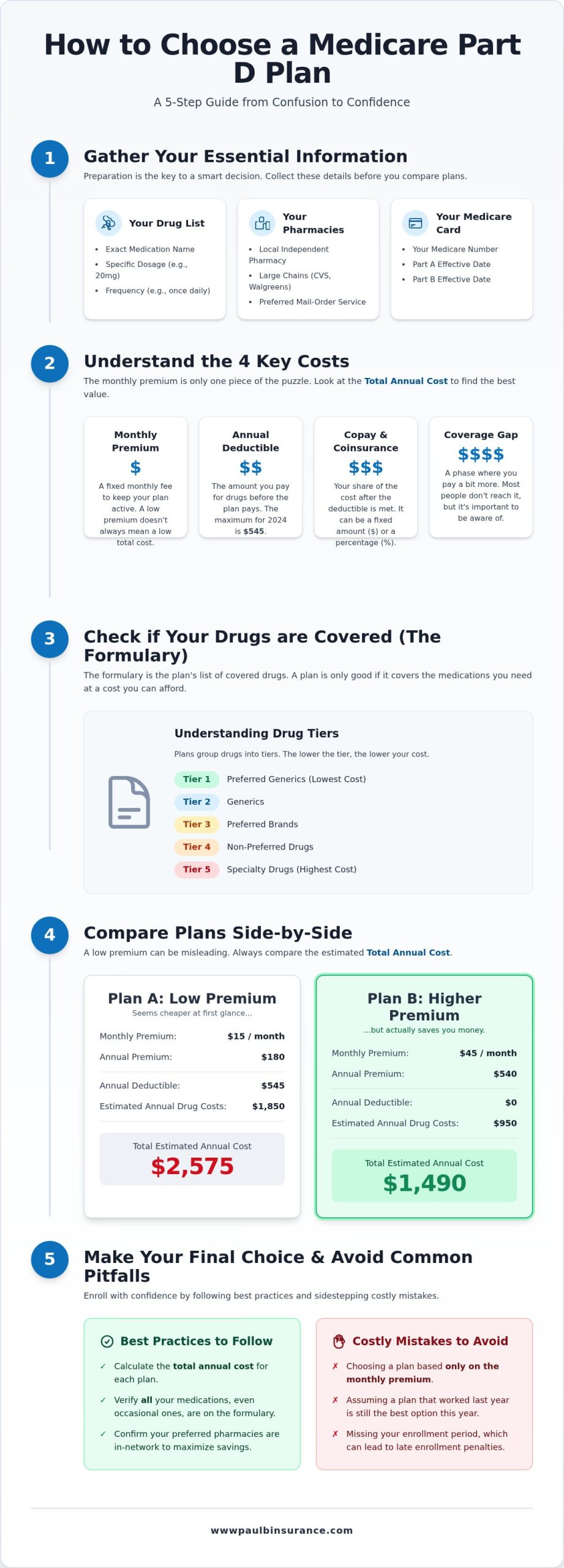
Step 4: How to Compare Plans Side-by-Side
You’ve done the hard work of gathering your prescription list and pharmacy information. Now, it’s time to put that information to use and find the plan that offers you the most value. The goal here is simple: find the plan with the lowest total annual cost for the specific medications you take.
This is the most important part of learning how to choose a Medicare Part D plan. It can feel a little overwhelming when you see all the options, but by taking it one step at a time, you can move from confusion to confidence. We will compare plans apples-to-apples to find your best fit.
Using the Official Medicare Plan Finder Tool
The single best resource for this step is the official Medicare Plan Finder tool on Medicare.gov. It provides personalized, unbiased results based on your unique needs. You simply enter your list of drugs, their dosages, and your preferred pharmacies. The tool then calculates your estimated yearly costs for every plan available in your area, ranking them from lowest to highest total cost.
This tool is powerful, but we know it can still be confusing to navigate on your own. Feeling stuck? The Modern Medicare Agency can walk you through it for free.
Look Beyond the Premium: Evaluate Total Costs
It’s easy to get drawn to a plan with a low monthly premium, but this is one of the most common and costly mistakes people make. A low premium often hides high deductibles or expensive copays for your specific drugs. The Plan Finder tool helps you avoid this trap by showing your estimated total annual cost, which includes:
- Your monthly premiums for the year
- Your annual deductible
- Your estimated copays and coinsurance for your prescriptions
Seeing this complete picture is crucial for understanding how to choose a Medicare Part D plan that truly saves you money over the entire year.
Check Pharmacy Networks and Star Ratings
Finally, before making a decision, check two more details. First, confirm that your favorite pharmacy is in the plan’s network, and ideally, that it’s a “preferred” pharmacy for the lowest possible copays. Second, look at the plan’s Star Rating. Medicare rates plans on a 1-to-5-star scale for quality and customer service. The Modern Medicare Agency always guides its clients to aim for plans with 4 stars or higher to ensure a better experience and fewer headaches.
Step 5: Making Your Final Choice and Avoiding Common Pitfalls
You’ve done the hard work of gathering your prescription list, understanding the costs, and comparing your options. Now, you can move forward with confidence. The final step in learning how to choose a medicare part d plan is to review your top choice and enroll, while steering clear of a few common mistakes that can cost you time and money.
Before you enroll, do one last check. Does the plan you’ve selected offer the best balance of these key factors for your specific needs?
- Total Cost: The monthly premium plus your estimated out-of-pocket costs for prescriptions.
- Drug Formulary: Confirmation that all your essential medications are covered.
- Pharmacy Network: Assurance that your preferred pharmacy is in-network.
If the answer is yes, you are ready. However, be aware of these frequent missteps to ensure your peace of mind for the long term.
The #1 Mistake: Not Reviewing Your Plan Annually
Medicare Part D plans change every single year. A plan’s formulary, premium, deductible, and copays can be completely different next year. The best plan for you today might be a poor choice tomorrow. That’s why the Annual Enrollment Period (October 15th to December 7th) is so critical. Use this time each year to re-evaluate your coverage and ensure it still meets your needs.
The #2 Mistake: Forgetting About the Late Enrollment Penalty
If you don’t sign up for a Part D plan when you are first eligible and don’t have other creditable drug coverage, you could face a lifelong penalty. This isn’t a one-time fee; it’s a permanent amount added to your monthly premium for as long as you have coverage. To avoid this costly mistake, be sure to enroll in a Part D plan during your Initial Enrollment Period.
Why Working With an Independent Broker Simplifies Everything
Feeling overwhelmed by the details? You don’t have to do this alone. An independent Medicare broker works for you, not a single insurance company. We can run a comprehensive comparison of all the plans in your area, helping you avoid these pitfalls and find the right fit. Our trusted, unbiased guidance comes at no cost to you, providing the clarity you need to move from confusion to confidence.
Move From Confusion to Confidence with Your Part D Plan
Choosing the right prescription drug coverage doesn’t have to be overwhelming. By gathering your medication list, understanding all four key costs, and carefully checking each plan’s formulary, you have built a strong foundation. This methodical approach is the key to how to choose a medicare part d plan that protects both your health and your budget year after year.
But you don’t have to make this important decision alone. As an independent broker, we provide truly unbiased guidance, comparing plans from over 40 carriers to find the perfect fit for your specific needs. Our mission is to provide personalized, year-round support at no extra cost to you. We are here to help you move from confusion to complete confidence in your choice.
Take the next simple step toward peace of mind. Schedule Your Free, Unbiased Medicare Plan Review Today and feel certain about your coverage. The right plan is waiting for you.
Frequently Asked Questions About Medicare Part D
Do I need a Medicare Part D plan if I don’t take any prescriptions right now?
This is a wise question. While you may not need prescriptions today, enrolling in a Part D plan when you first become eligible is the best way to avoid a lifelong late enrollment penalty. Think of a low-premium plan as affordable insurance for the future. It provides peace of mind and protects you from unexpected costs down the road, ensuring you’re covered the moment you need it without paying more than you have to.
Can I change my Medicare Part D plan if I’m unhappy with it?
Yes, you are never locked into a plan that no longer serves your needs. Every year during the Annual Enrollment Period (October 15 – December 7), you have the opportunity to switch your Part D plan. This is a critical time to review your coverage, as plan formularies and costs can change. We can provide trusted, unbiased guidance to help you compare your options and make a switch with confidence if a better plan is available.
What happens if my doctor prescribes a new drug that isn’t on my plan’s formulary?
This can feel overwhelming, but you have a clear path forward. First, ask your doctor if an alternative drug on your plan’s approved list (its formulary) would work. If not, you or your doctor can request a "formulary exception" from your plan, explaining why the prescribed drug is medically necessary. Navigating this process can be tricky, but we are here to help guide you through the steps to get the medication you need.
How does Medicare Part D work if I have a Medicare Advantage plan?
This is a key detail in learning how to choose a Medicare Part D plan. Most Medicare Advantage (MA) plans already include prescription drug coverage and are known as MAPD plans. If you enroll in an MA plan that includes drug coverage, you cannot also have a separate, standalone Part D plan. It’s essential to review the drug benefits within an MA plan just as carefully as you would any other to ensure it fits your needs.
What is the difference between a standalone Part D plan and a Medicare Advantage Prescription Drug (MAPD) plan?
We simplify the jargon so you know exactly how it works. A standalone Part D plan is a separate policy that only covers prescriptions and works alongside Original Medicare (Part A and Part B). In contrast, a Medicare Advantage Prescription Drug (MAPD) plan is an all-in-one alternative that bundles your hospital, medical, and prescription drug benefits into a single, convenient plan, often with extra perks like dental or vision coverage.
How can I get help paying for my Part D costs?
You don’t have to carry the burden of high drug costs alone. The federal "Extra Help" program, also called the Low-Income Subsidy (LIS), is designed to help pay for Part D premiums, deductibles, and copayments for those who qualify. Many states also offer State Pharmaceutical Assistance Programs (SPAPs). We can help you navigate these resources to see if you are eligible for assistance, providing clarity and potential financial relief.

Article by
Paul Barrett
Paul Barrett, CMIP is the founder of The Modern Medicare Agency, an independent Medicare-only brokerage based in Melville, NY. With 18 years of Medicare-exclusive experience, a CMIP designation, and more than 5,000 clients served across 37 states, Paul is one of the most credentialed independent Medicare specialists on Long Island — and one of the most direct.
He represents 40+ carriers with no quotas and no allegiances, which means his recommendations are based entirely on what fits each client's specific situation. He is the author of Medicare Mastery Unlocked and host of the Wise Guys Retirement Talk podcast. His content is grounded in primary sources, real carrier intelligence, and 18 years of watching what happens when people get Medicare right — and when they don't.
📞 631-358-5793 | paulbinsurance.com