
Does the thought of figuring out Medicare feel like trying to solve a puzzle with half the pieces missing? You are not alone. For so many people turning 65, the maze of new terms, rules, and deadlines is incredibly stressful, leaving them worried about making a costly mistake with their healthcare coverage. The good news is, it doesn’t have to be this complicated. Our goal is to make understanding Medicare Part A and B a simple, clear, and reassuring process for you.
In this straightforward guide for 2025, we will walk you through the absolute foundation of your coverage. We’ll break down exactly what your hospital insurance (Part A) and medical insurance (Part B) cover, what they cost, and just as importantly, what they don’t-all in plain English. By the time you’re done reading, you will have the clarity and confidence to take the next step, armed with the peace of mind that comes from truly knowing your options.
Key Takeaways
- This guide makes understanding Medicare Part A and B simple by clearly defining what each part covers and how they work together for you.
- Discover the common-and often surprising-costs that Original Medicare doesn’t cover, so you can avoid unexpected medical bills.
- Gain the confidence to navigate your healthcare choices by seeing a clear, jargon-free comparison of your hospital versus medical benefits.
- Learn the two straightforward paths you can take to fill the gaps in your coverage and secure complete peace of mind.
What is Original Medicare? Your Foundation for Health Coverage
Stepping into the world of Medicare can feel overwhelming, but we’re here to make it simple. Let’s start with the basics. When you hear the term “Original Medicare,” it simply refers to the two foundational parts of the federal health insurance program: Part A and Part B. Think of it as the sturdy foundation of your healthcare house. It’s essential and provides significant coverage, but it isn’t the entire home.
For most Americans turning 65, this is the starting point. A core piece of understanding medicare part a and b is recognizing it as the government-provided base upon which you can build a more complete coverage plan later on. This federal system has a long history, and you can explore a detailed Medicare program overview to see how it was established to serve seniors and those with certain disabilities.
The Two Core Parts: Hospital and Medical
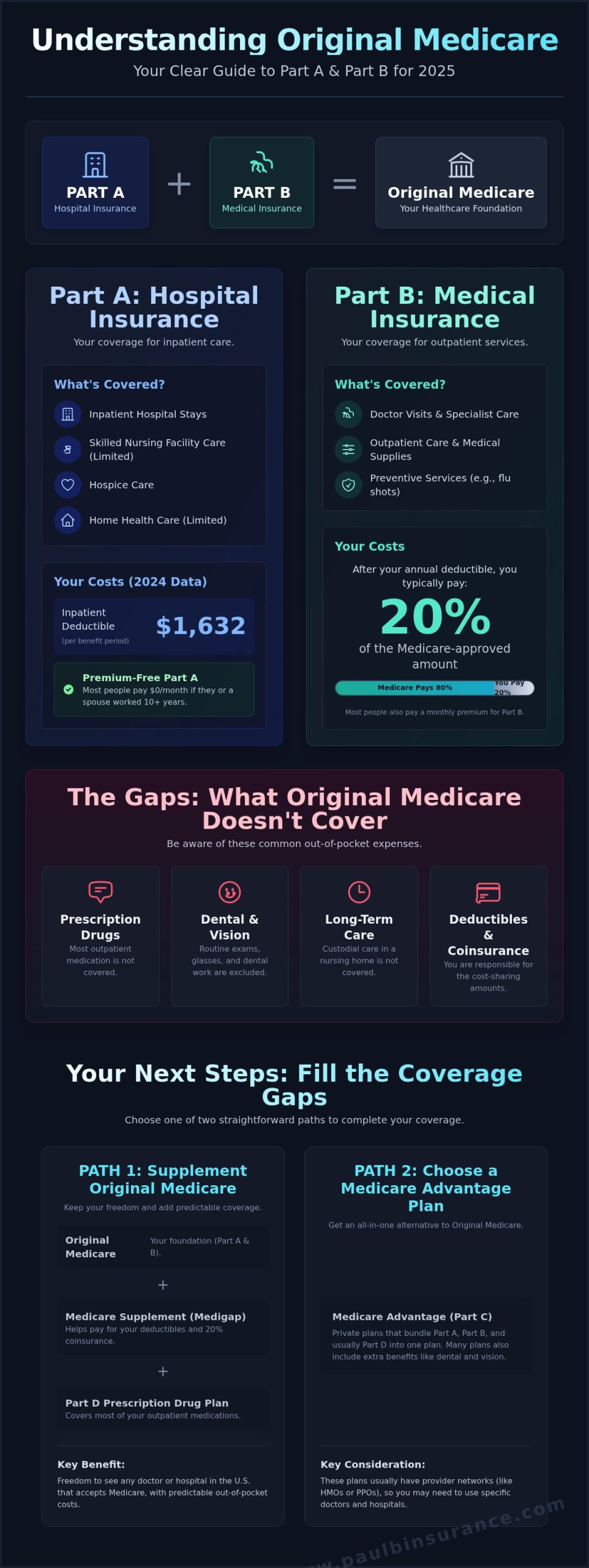
To put it simply, Original Medicare is made of two distinct but complementary pieces. Part A is your hospital insurance, covering things like inpatient hospital stays and skilled nursing facility care. Part B is your medical insurance, which covers doctor visits, outpatient care, and preventive services. Together, they form a powerful team designed to handle most of your essential healthcare needs. We will walk through each part with clarity so you can move forward with confidence.
How Original Medicare Works
One of the greatest strengths of Original Medicare is its freedom. You can visit any doctor, specialist, or hospital in the entire country, as long as they accept Medicare. There are no restrictive networks to worry about, unlike many private insurance plans. However, it operates on a fee-for-service basis, which means you share in the costs. You’ll typically be responsible for paying annual deductibles and a 20% coinsurance for most services covered by Part B. Knowing about this cost-sharing is a critical part of planning for your future healthcare expenses.
A Deep Dive into Medicare Part A (Hospital Insurance)
Navigating the world of health insurance can feel overwhelming, but we’re here to bring clarity and confidence to the process. A critical piece of understanding Medicare Part A and B is knowing what each part does for you. Think of Medicare Part A as your hospital insurance. It’s designed to be your safety net, protecting you from the high costs of a major inpatient medical event. When you are formally admitted to a hospital or skilled nursing facility, Part A steps in to help cover the bills, giving you peace of mind when you need it most.
What Exactly Does Part A Cover?
Part A provides coverage for specific types of inpatient care. It’s not for doctor’s visits (that’s Part B), but for more intensive medical situations. While the government provides an official explanation of Medicare parts, we’ve simplified the key benefits for you here. Coverage typically includes:
- Inpatient Hospital Stays: This covers semi-private rooms, meals, general nursing care, and drugs administered as part of your inpatient treatment.
- Skilled Nursing Facility (SNF) Care: If you have a qualifying hospital stay, Part A helps pay for a limited time in a SNF for recovery. It’s crucial to know this is for skilled care, not long-term custodial care.
- Hospice Care: For those with a terminal illness, Part A covers care focused on comfort and quality of life.
- Home Health Care: In certain limited circumstances, Part A covers part-time skilled care in your home.
Understanding the Costs of Part A
While Part A covers a great deal, it isn’t completely free. Your costs are structured around a “benefit period.” A benefit period begins the day you’re admitted as an inpatient and ends when you haven’t received any inpatient care for 60 consecutive days. For 2024, you are responsible for a $1,632 deductible for each new benefit period. If your stay extends beyond 60 days, you will also pay a daily coinsurance, which increases for very long stays. This structure is key to understanding Medicare Part A and B and how your costs are calculated.
Who Gets Part A for Free? (Premium-Free Part A)
Here’s the great news: most people do not pay a monthly premium for Medicare Part A. You are generally eligible for premium-free Part A if you or your spouse worked and paid Medicare taxes for at least 10 years (which equals 40 quarters). If you don’t meet this requirement, don’t worry-you may still be able to buy into Part A, and we can help you explore those options with confidence.
Unpacking Medicare Part B (Medical Insurance)
If you think of Part A as your hospital insurance, then Part B is your day-to-day medical insurance. This is the part of Medicare that covers the services you need to stay healthy and treat illnesses when you’re not admitted to a hospital. Think of it as your coverage for doctor visits, preventive care, and other essential outpatient services. Gaining clarity on this is a crucial step in understanding Medicare Part A and B and how they work together to protect your health. While the official What is Medicare? guide provides the foundation, let’s break down what Part B means for you in simple, practical terms.
What Services Are Covered by Part B?
Part B is designed to cover a wide range of medically necessary services and preventive care. It helps you manage your health proactively and get the treatment you need, when you need it. Key services include:
- Doctor’s Visits: This includes appointments with your primary care physician and specialists like cardiologists or dermatologists.
- Outpatient Care: Covers services you receive in a hospital outpatient setting or clinic, such as minor surgeries, emergency room services, and lab tests.
- Preventive Services: To help you stay healthy, Part B covers flu shots, wellness visits, and various cancer screenings.
- Medical Supplies & Equipment: This includes ambulance services and durable medical equipment (DME) like walkers, wheelchairs, and oxygen.
The Costs of Part B: Premiums and Deductibles
Unlike Part A, which is premium-free for most people, Part B requires a monthly premium. For 2024, the standard premium is $174.70, though higher earners may pay more (this is known as IRMAA). Before Medicare starts paying its share, you must first meet your annual deductible, which is $240 in 2024. After your deductible is met, you typically pay 20% of the Medicare-approved amount for most services. This 80/20 split is why many people choose to get a Medicare Supplement plan.
The Part B Late Enrollment Penalty: A Costly Mistake to Avoid
Are you approaching 65? It is absolutely critical to enroll in Part B on time. If you delay enrollment and don’t have other qualifying health coverage (like from an employer), you could face a lifelong late enrollment penalty. This isn’t a one-time fee; it’s a permanent increase added to your monthly Part B premium for as long as you have the coverage. To avoid this, you must sign up during your Initial Enrollment Period-the 7-month window around your 65th birthday. Proper guidance here is essential for understanding Medicare Part A and B enrollment rules and protecting your finances.
The Gaps: What Original Medicare (Part A & B) Doesn’t Cover
Original Medicare provides a strong foundation for your healthcare coverage. However, it was never designed to cover 100% of your medical costs, and this is where many people face unexpected and stressful financial burdens. A critical part of understanding Medicare Part A and B is knowing exactly what isn’t covered.
Seeing these gaps isn’t a reason to worry-it’s a reason to be prepared. By knowing where the holes are, you can make an informed plan to protect your health and your savings with confidence.
The Biggest Gap: Prescription Drugs
This is the most common and costly surprise for new Medicare beneficiaries. Original Medicare (Part A and B) does not cover most prescription drugs you pick up from a retail pharmacy. This is precisely why Medicare Part D was created. Without a separate prescription drug plan, you would be forced to pay the full price for your medications out-of-pocket, which can easily amount to hundreds or even thousands of dollars each month.
Routine Care: Dental, Vision, and Hearing
While Medicare covers medically necessary procedures, it generally does not pay for routine care that helps you see, hear, and maintain your oral health. This means you are typically responsible for the full cost of:
- Routine dental exams, cleanings, fillings, and dentures.
- Eye exams for glasses, as well as the cost of eyeglasses and contact lenses.
- Hearing exams and the high cost of hearing aids.
Your Financial Exposure: The 20% Coinsurance
After you meet your annual Part B deductible, Medicare pays 80% of most approved medical services. You are responsible for the remaining 20%. Here is the crucial detail that creates significant financial risk: There is no annual cap on your 20% share.
For example, if you needed a major surgery that cost $100,000, your 20% responsibility would be $20,000. If you faced a serious illness with bills totaling $250,000, you could owe $50,000. This unlimited potential exposure is the single largest financial risk under Original Medicare. Recognizing these gaps is the first step toward building a secure healthcare plan. The next step is learning how to fill them.
Your Next Steps: How to Complete Your Medicare Coverage
Now that you have a solid grasp of Original Medicare, you might be asking, “What about the 20% that isn’t covered?” That is the perfect question to ask. Truly understanding Medicare Part A and B means recognizing the gaps they leave behind. The good news is that you don’t have to face those potential costs alone. Your next step is to choose how you want to complete your coverage, and there are two clear, trusted paths to do just that. This is the most important decision you’ll make after enrolling, and we are here to make it simple.
Path 1: Add a Medicare Supplement (Medigap) and Part D Plan
This approach keeps you in Original Medicare but adds two private plans to fill the gaps. A Medicare Supplement (or Medigap) plan helps pay for your deductibles and the 20% coinsurance. To cover prescriptions, you enroll in a separate Part D drug plan. The biggest advantage here is freedom-you can see any doctor or visit any hospital in the U.S. that accepts Medicare, with no network restrictions or referrals needed.
Path 2: Choose a Medicare Advantage Plan (Part C)
Think of this as an “all-in-one” alternative. You get your Part A and Part B benefits bundled into one simple plan from a private insurance company. Most of these plans also include prescription drug coverage (Part D) and may offer extra benefits not covered by Original Medicare, like dental, vision, and hearing aids. The trade-off is that you typically must use doctors and hospitals within the plan’s provider network.
From Confusion to Confidence: How We Can Help
Choosing between these two paths can feel overwhelming. Which one is right for your health needs and your budget? This is where our guidance makes all the difference. As independent brokers, we don’t work for an insurance company-we work for you. We provide simple, unbiased advice on all your options so you can make a decision with total confidence.
Our expert guidance is always provided at no cost to you. Let us help you find the perfect fit. Schedule a free, no-pressure call with The Modern Medicare Agency to find your perfect plan.
Your Path to Medicare Clarity and Confidence
Navigating your healthcare options can feel overwhelming, but you’ve taken a powerful first step. Remember, Original Medicare is your foundation: Part A covers your hospital stays, while Part B handles your medical services. Recognizing that this foundation has gaps is crucial. Truly understanding medicare part a and b is the key to building a secure and complete healthcare plan for your future.
You don’t have to figure out the rest alone. Join thousands of clients who have moved from confusion to confidence with our trusted guidance. As an unbiased, independent broker representing over 40 carriers, we provide personalized advice to help you avoid costly enrollment mistakes. We take the stress out of the process so you can make the best choice with absolute certainty.
Ready to feel secure in your coverage? Let’s find the right path for you. Schedule your free Medicare review today. Your peace of mind is our priority, and we’re here to help you step into this next chapter feeling protected and prepared.
Frequently Asked Questions About Medicare Part A & B
Do I have to enroll in Medicare Part B if I’m still working?
This is a common source of confusion, but the answer is often no. If you have group health coverage from an employer with 20 or more employees, you can typically delay Part B enrollment without facing a penalty. When you eventually stop working or lose that coverage, you will be granted a Special Enrollment Period to sign up for Part B. Getting this timing right is crucial to avoid lifetime penalties, and we can help you navigate that decision with confidence.
Can I have only Medicare Part A and not Part B?
Yes, you can enroll in Part A without enrolling in Part B. This is a common choice for those who qualify for premium-free Part A but are still working and covered by an employer’s health plan. However, it’s critical to know that Part A only covers inpatient hospital care. Without Part B, you have no coverage for doctor visits, outpatient medical services, or durable medical equipment. This leaves a significant and risky gap in your healthcare coverage.
What is the difference between the Part A deductible and the Part B deductible?
The main difference is how often you pay them. The Part B deductible is an annual amount you pay once per calendar year for doctor visits and outpatient care. After it’s met, Medicare pays its share. The Part A deductible is for hospital stays and is charged per “benefit period,” not per year. A new benefit period can start just 60 days after your last hospital discharge, meaning you could unfortunately end up paying the Part A deductible multiple times in one year.
How do I know if I qualify for premium-free Part A?
Most people qualify for premium-free Part A by working and paying Medicare taxes for at least 10 years (or 40 quarters). This work history can be your own or your spouse’s. If you don’t meet this requirement, you may still be able to get Part A, but you will have to pay a monthly premium for it. The Social Security Administration is the best source to verify your specific work history and confirm your eligibility for premium-free coverage.
What happens if I miss my Initial Enrollment Period for Part A and B?
Missing your seven-month Initial Enrollment Period can lead to serious consequences. You will likely face a gap in your health coverage and may be charged a lifetime late enrollment penalty for Part B, which increases your premium for as long as you have the coverage. Properly understanding Medicare Part A and B enrollment deadlines is one of the most important steps to avoid these stressful and costly mistakes. We are here to provide trusted guidance to ensure you enroll on time.
Are Original Medicare costs the same in every state?
Yes, the foundational costs for Original Medicare are standardized nationwide by the federal government. This means the Part A and Part B monthly premiums, deductibles, and coinsurance amounts are the same whether you live in California or Florida. However, the costs for private insurance plans that work with Medicare, such as Medicare Supplement (Medigap) or Medicare Advantage plans, can and do vary significantly based on your state, county, and the specific insurance carrier you choose.

Article by
Paul Barrett
Paul Barrett, CMIP is the founder of The Modern Medicare Agency, an independent Medicare-only brokerage based in Melville, NY. With 18 years of Medicare-exclusive experience, a CMIP designation, and more than 5,000 clients served across 37 states, Paul is one of the most credentialed independent Medicare specialists on Long Island — and one of the most direct.
He represents 40+ carriers with no quotas and no allegiances, which means his recommendations are based entirely on what fits each client's specific situation. He is the author of Medicare Mastery Unlocked and host of the Wise Guys Retirement Talk podcast. His content is grounded in primary sources, real carrier intelligence, and 18 years of watching what happens when people get Medicare right — and when they don't.
📞 631-358-5793 | paulbinsurance.com