




Entering the world of Medicare can feel like navigating a maze blindfolded, especially when facing the core decision of Medicare Advantage vs. Medicare Supplement. You’re bombarded with jargon, conflicting advice, and the nagging fear of making a costly mistake with your healthcare. Will you be able to keep your trusted doctor? Are you choosing the best financial protection for your future? These questions can be stressful, leaving you feeling more confused than confident.
This guide is here to replace that stress with peace of mind. We promise to provide simple, unbiased guidance. We will break down the complex rules and provide a straightforward, side-by-side comparison to help you understand exactly how each plan works, what it costs, and how it protects you. Our goal is to give you the clarity you need to confidently choose the right coverage for your health and budget in 2026, ensuring your medical costs are predictable and your choices are clear.
Key Takeaways
- Understand the fundamental choice you must make: either enhance your Original Medicare coverage or choose an all-in-one replacement plan.
- The medicare advantage vs medicare supplement choice boils down to a key trade-off: lower monthly premiums with a network vs. higher premiums for the freedom to see any doctor.
- Discover if an all-in-one Advantage plan is the right fit for your budget, especially if you value the convenience of having benefits bundled together.
- Learn why a Medicare Supplement plan offers peace of mind for those who prioritize predictable costs and unrestricted access to doctors nationwide.
The Two Paths of Medicare: A Simple Starting Point
Once you enroll in Original Medicare (Part A for hospital stays and Part B for doctor visits), you arrive at a critical fork in the road. This is where the confusion often begins, but we’re here to make it simple. You face one fundamental choice: do you want to keep Original Medicare and add to it, or do you want to replace it with an all-in-one private plan? Understanding this choice is the key to navigating the medicare advantage vs medicare supplement decision with confidence.
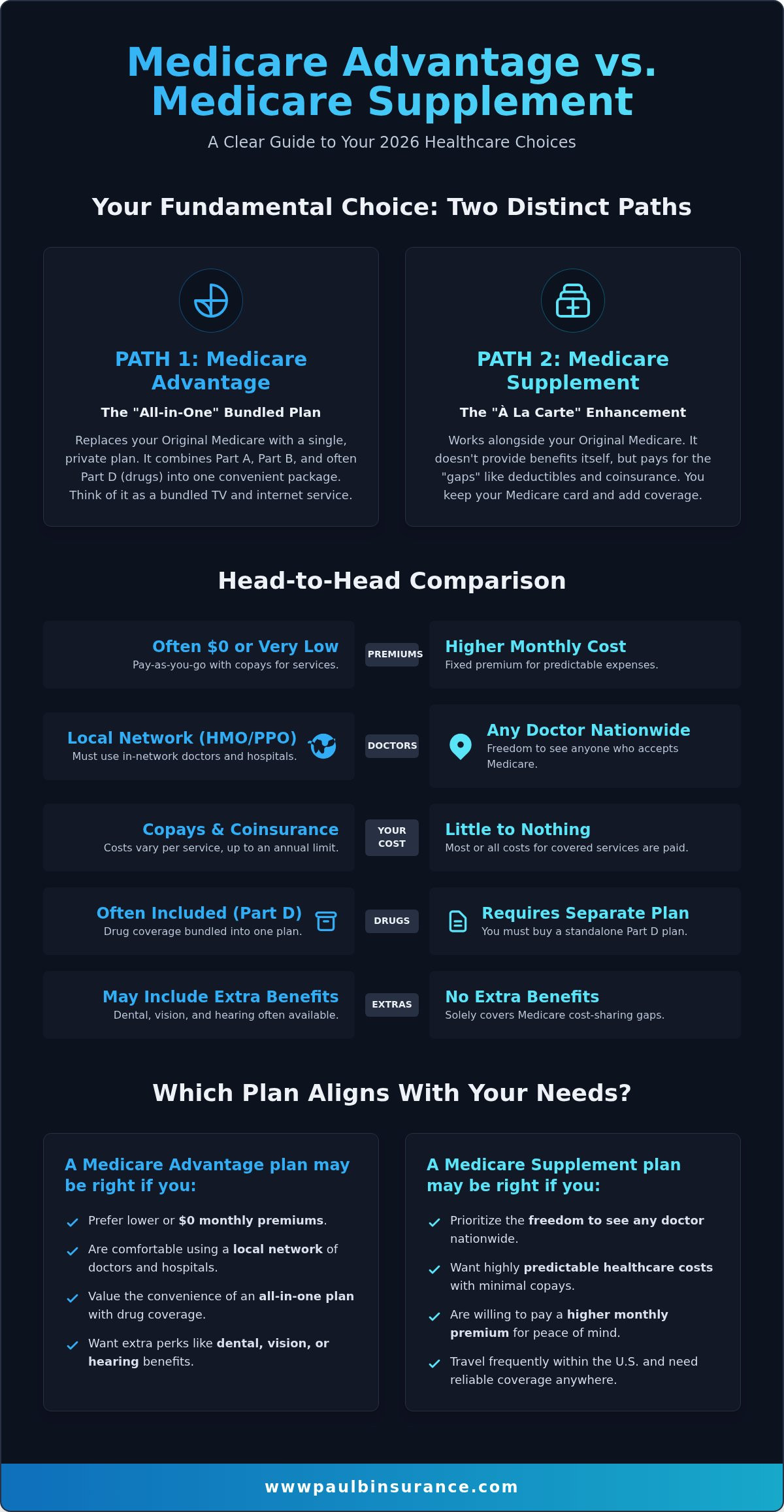
Think of it like choosing a TV and internet service. You can either pick and choose your services from different providers (à la carte) or you can opt for a single, bundled package from one company. One path offers flexibility, while the other offers convenience. Neither is right for everyone, but one will be right for you.
How Medicare Advantage Plans Work
This is your ‘bundled package’ option. Medicare Advantage (Part C) plans are offered by private insurance companies that are approved by Medicare. They roll your Part A, Part B, and usually your Part D prescription drug coverage into one single plan. While you get your benefits from a private company, you are still in the Medicare program. It’s important to know that you must continue paying your monthly Part B premium to the government, in addition to any premium your Advantage plan may have.
How Medicare Supplement (Medigap) Plans Work
This is your ‘à la carte’ option. A Medicare Supplement plan, also known as Medigap, doesn’t replace your Original Medicare—it works alongside it. Its only job is to help pay for the out-of-pocket costs, or “gaps,” that Original Medicare leaves behind. These gaps include:
- Deductibles
- Coinsurance
- Copayments
With this path, you keep your red, white, and blue Medicare card, and you’ll need to purchase a separate Part D plan for your prescription drug coverage. This approach offers predictable costs and broad network freedom, making it a cornerstone in the medicare advantage vs medicare supplement comparison.
Head-to-Head Comparison: Costs, Coverage, and Choice
Navigating the medicare advantage vs medicare supplement landscape can feel overwhelming. To bring clarity and confidence to your decision, we’ve broken down the key differences side-by-side. There is no single “best” plan—only the one that is right for your personal health needs, budget, and lifestyle.
This simple table gives you a quick snapshot of how these two paths compare.
| Feature | Medicare Advantage (Part C) | Medicare Supplement (Medigap) |
|---|---|---|
| Monthly Premium | Often $0 or very low | Varies by plan, state, and age |
| Doctor Choice | Must use the plan’s local network (HMO/PPO) | Any doctor/hospital nationwide that accepts Medicare |
| Out-of-Pocket Costs | Copays & coinsurance for services | Little to nothing for covered services |
| Prescription Drugs (Part D) | Often included in the plan | Requires a separate, standalone Part D plan |
| Extra Benefits | May include dental, vision, & hearing | Does not include extra benefits |
Monthly Premiums and Out-of-Pocket Costs
The financial trade-off is one of the biggest factors in the medicare advantage vs medicare supplement decision. Advantage plans attract many people with their low or even $0 monthly premiums. However, you pay for services as you use them through copays and coinsurance until you reach an annual maximum out-of-pocket limit. In contrast, Supplement plans have a higher, fixed monthly premium but provide incredible peace of mind by covering most or all of your remaining costs, leading to very predictable healthcare expenses.
Doctor and Hospital Choice (Networks)
Your freedom to choose your providers is a fundamental difference. Medicare Advantage plans typically operate with local networks, like an HMO or PPO. This means you must see doctors and use hospitals within that network to receive coverage, and you may need a referral from your primary doctor to see a specialist. Medicare Supplement plans work alongside Original Medicare, giving you the freedom to see any doctor or specialist in the entire country who accepts Medicare—no networks and no referrals required.
Included Coverage and Extra Benefits
Advantage plans are often marketed as an “all-in-one” solution. Most bundle your hospital (Part A), medical (Part B), and prescription drug (Part D) coverage into a single plan. Many also include extra benefits that Original Medicare doesn’t cover, such as routine dental, vision, and hearing services. Supplement plans are designed for one specific purpose: to fill the “gaps” in Original Medicare, like deductibles and coinsurance. As the official Medicare website explains, these policies are standardized and do not include prescription drugs, dental, or vision coverage, which must be purchased separately.
Who Should Consider a Medicare Advantage Plan?
Navigating the choice between medicare advantage vs medicare supplement can feel overwhelming, but it becomes much simpler when you match the plan to your life. A Medicare Advantage (Part C) plan is often a fantastic choice for those who value convenience, predictable costs, and bundled benefits. Think of it as an all-in-one package designed for simplicity and, often, lower monthly premiums.
This path isn’t for everyone, and that’s okay. The key is understanding the trade-offs. For many, the benefits of an Advantage plan align perfectly with their financial goals and healthcare needs, offering comprehensive coverage and peace of mind without a high monthly price tag. Let’s explore who this type of plan serves best.
The Pros: Why People Choose Advantage Plans
You might find a Medicare Advantage plan is the right fit if you:
- Prefer lower, predictable monthly premiums. Many Advantage plans have a $0 monthly premium (you still pay your Part B premium). This can free up room in your monthly budget for other expenses.
- Like having all your benefits in one plan. These plans bundle your hospital (Part A), medical (Part B), and usually prescription drug (Part D) coverage together. Many also include extra benefits like dental, vision, and hearing aids.
- Don’t mind using a network of doctors. To keep costs down, Advantage plans use a local network of doctors and hospitals. If you’re comfortable using providers within that network, you can save a significant amount of money.
- Want a safety net for your spending. Every Advantage plan has an annual out-of-pocket maximum. This is a crucial financial protection that caps what you’ll spend on medical care in a year, preventing catastrophic costs.
The Cons: Potential Downsides to Consider
While Advantage plans offer great value, it’s important to be aware of the potential trade-offs. This choice may be less suitable if you:
- Want to avoid referrals to see specialists. Many HMO-style Advantage plans require you to get a referral from your primary care doctor before seeing a specialist, which can be an extra step.
- Have specific doctors you must see. If your trusted doctor or preferred hospital isn’t in the plan’s network, your care may not be covered, or you could face much higher costs.
- Travel frequently within the U.S. Coverage outside of your plan’s service area is typically limited to emergencies and urgent care, which isn’t ideal for snowbirds or frequent travelers.
- Dislike yearly changes. Plan benefits, provider networks, and drug formularies can change each year, requiring you to review your coverage annually to ensure it still meets your needs.
Who Should Consider a Medicare Supplement (Medigap) Plan?
Navigating the medicare advantage vs medicare supplement decision often comes down to a simple question: What do you value most? If your answer is predictability and total freedom in your healthcare choices, then a Medicare Supplement (Medigap) plan deserves your full attention. This path is for those who prefer to pay a higher, predictable premium each month in exchange for minimal—or even zero—out-of-pocket costs when they receive care. It’s the “peace of mind” option.
With Medigap, you are building your coverage by adding to Original Medicare, not replacing it. This means you’ll manage a few separate policies: your Medigap plan to cover cost-sharing and a standalone Medicare Part D plan for your prescriptions. While it requires a bit more management, it offers a level of control and flexibility that many people find invaluable.
The Pros: Why People Choose Medigap Plans
A Medigap plan might be the right fit if you want to feel secure and in control of your healthcare journey. People who choose this path often do so because:
- You want absolute freedom of choice. You can see any doctor, specialist, or hospital in the entire country, as long as they accept Medicare. No networks, no restrictions.
- You travel frequently. Whether you’re a “snowbird” or an avid RVer, your coverage travels with you seamlessly across all 50 states.
- You need predictable costs. After your monthly premium, your medical bills are largely covered. This makes budgeting for healthcare simple and protects you from surprise costs.
- You don’t want to deal with referrals. If you need to see a specialist, you simply make an appointment. There are no “gatekeepers” to go through first.
The Cons: Potential Downsides to Consider
While Medigap offers incredible freedom, it’s important to understand the trade-offs. The primary considerations are:
- Higher monthly premiums. You pay more upfront each month for this comprehensive coverage compared to the low or $0 premiums of many Advantage plans.
- You must buy separate drug coverage. Medigap plans sold today do not include prescription drug benefits, so you will need to enroll in a separate Medicare Part D plan.
- No “extra” benefits. These plans do not cover routine dental, vision, or hearing services. You would need to purchase separate policies for those.
- Switching can be difficult. After your initial enrollment period, insurance companies can use medical underwriting to deny your application or charge you more if you want to switch plans.
Choosing the right plan is a significant decision. If the stability and freedom of a Medigap plan align with your needs, the next step is finding the right one. We provide trusted, unbiased guidance to help you compare your options with clarity and confidence.
From Confusion to Confidence: How to Make Your Decision
You’ve learned the facts and figures. Now, it’s time to translate that knowledge into a decision that brings you peace of mind. The debate of medicare advantage vs medicare supplement isn’t about finding the single “best” plan—it’s about discovering the best plan for you. Your health, budget, and lifestyle are unique, and your Medicare coverage should be, too.
This final step is about moving from information to a confident choice. To find clarity, start by reflecting on your personal needs.
Key Questions to Ask Yourself
Your answers to these questions will point you toward the right type of coverage for your specific situation:
- Your Health: Do you live with chronic conditions or see multiple specialists? Is having predictable access to care without referrals a priority?
- Your Budget: Are you more comfortable with a very low (or $0) monthly premium, even if it means unpredictable out-of-pocket costs? Or do you prefer a higher monthly premium for the security of knowing your major medical expenses are almost entirely covered?
- Your Doctors: Is it critical that you keep your current doctors and hospitals? Have you confirmed which plans they accept, or do you need the freedom to see any provider who accepts Medicare?
- Your Lifestyle: Do you travel frequently within the U.S.? Would you prefer an all-in-one plan that includes benefits like dental, vision, and hearing, or do you handle those separately?
Why You Shouldn’t Have to Decide Alone
Answering these questions is a powerful start, but you don’t have to connect the dots by yourself. It’s easy to get advice from a captive agent who only works for one insurance company and can only show you their limited products. That isn’t a choice; it’s a sales pitch.
An independent broker, on the other hand, works for you. Our loyalty is to you, not an insurance carrier. We listen to your needs and then compare dozens of plans from various trusted companies to find the perfect fit. We simplify the jargon and ensure you understand exactly how your choice in the medicare advantage vs medicare supplement discussion will impact your care and costs in 2026 and beyond.
You deserve to feel secure and confident in your healthcare. Let us provide the unbiased guidance you need. Schedule a free, unbiased Medicare review today.
From Confusion to Confidence: Choosing Your Medicare Path
Choosing your Medicare coverage is a deeply personal decision. As we’ve explored, Medicare Advantage plans offer an all-in-one, managed-care approach, while Medicare Supplement plans provide predictable costs and the freedom to see any doctor who accepts Medicare. The decision of medicare advantage vs medicare supplement isn’t about which one is universally better, but which one is truly better for you—your health needs, your budget, and your peace of mind.
You don’t have to navigate this complex choice alone. As your dedicated, independent Medicare expert, I provide trusted, unbiased advice on plans from over 40 carriers, ensuring you find the right fit without the pressure. My goal is to give you clarity and my support continues year-round to make sure your plan always serves your needs.
Feeling overwhelmed? Schedule a free, no-pressure call with Paul to find the right path for you. Let’s work together to secure the coverage and confidence you deserve for the years ahead.
Frequently Asked Questions About Medicare Advantage vs. Medicare Supplement
Can I have both a Medicare Advantage Plan and a Medicare Supplement Plan?
This is a common source of confusion, but the answer is a clear no. It is illegal for an insurance company to sell you a Medigap plan if you have Medicare Advantage. These two plan types work in fundamentally different ways. Medigap works with Original Medicare, while Medicare Advantage is an alternative way to receive your benefits. Your choice in the medicare advantage vs medicare supplement decision is about which path you want to take.
Do Medicare Advantage and Medigap plans cover prescription drugs?
Most Medicare Advantage plans conveniently include prescription drug coverage (Part D). In contrast, Medicare Supplement (Medigap) plans do not offer any prescription benefits. If you choose a Medigap policy to pair with your Original Medicare, you must enroll in a separate, standalone Part D prescription drug plan. This is a critical step to ensure your medications are covered and you avoid any late enrollment penalties from Medicare.
If I choose one type of plan, can I switch to the other later on?
Yes, you can switch between plans, but it’s not always easy. You can typically move from a Medicare Advantage plan back to Original Medicare with a Medigap plan during specific enrollment periods. However, you may have to answer health questions and could be denied Medigap coverage. Switching from Medigap to Medicare Advantage is much simpler. We can help you understand these rules so you can make a confident choice for the long term.
What is the best time to enroll in a Medicare Supplement (Medigap) plan?
The absolute best time is during your one-time, six-month Medigap Open Enrollment Period. This window starts the first month you are 65 or older and enrolled in Medicare Part B. During this protected time, insurance companies cannot use medical underwriting to deny you a policy or charge you higher premiums due to your health. Missing this critical window can make it much harder and more expensive to get a plan later on.
Are all Medigap Plan G policies the same, regardless of the company?
Yes, the core benefits of any Medigap plan are standardized by the government. This gives you wonderful peace of mind. A Plan G from one insurance company must offer the exact same medical coverage as a Plan G from any other company. The only differences you will find are the monthly premium you pay, the company’s customer service reputation, and its history of rate increases. This allows you to shop for the best price with confidence.
How do I know if my doctor is in a Medicare Advantage plan’s network?
This is a crucial step that you must take before enrolling. The most reliable method is to check the insurance plan’s provider directory, which is usually on its website. You can also call the insurance company directly to confirm your specific doctors, specialists, and hospitals are in-network. Never assume your providers are included. Verifying your network is a simple step that protects you from surprise bills and ensures you get the care you need.

Article by
Paul Barrett
Paul Barrett, CMIP is the founder of The Modern Medicare Agency, an independent Medicare-only brokerage based in Melville, NY. With 18 years of Medicare-exclusive experience, a CMIP designation, and more than 5,000 clients served across 37 states, Paul is one of the most credentialed independent Medicare specialists on Long Island — and one of the most direct.
He represents 40+ carriers with no quotas and no allegiances, which means his recommendations are based entirely on what fits each client's specific situation. He is the author of Medicare Mastery Unlocked and host of the Wise Guys Retirement Talk podcast. His content is grounded in primary sources, real carrier intelligence, and 18 years of watching what happens when people get Medicare right — and when they don't.
📞 631-358-5793 | paulbinsurance.com