
Has your doctor ever told you that a procedure or prescription needs “prior authorization”? Hearing those words can be unsettling, leaving you with a knot of worry and a list of questions. What is it? Will my care be denied? For many Medicare beneficiaries, understanding the true prior authorization meaning is the first hurdle in an already confusing process. You’re not alone in feeling overwhelmed by insurance jargon, and you shouldn’t have to navigate it by yourself.
We’re here to turn that confusion into confidence. This simple guide is designed to give you clear answers and peace of mind. We’ll break down what prior authorization is in plain English, explain why your Medicare plan uses it, and provide the trusted guidance you need to manage the process without stress. Our goal is to empower you with knowledge so you can avoid surprises and feel secure in your healthcare decisions.
Key Takeaways
- Understand prior authorization as a simple “permission slip” your Medicare plan requires for certain services, ensuring you know what’s covered beforehand.
- While it can feel like a hurdle, grasping the prior authorization meaning helps you see why your plan uses it to manage care and costs.
- Discover the straightforward, step-by-step process for getting pre-approval, which is typically managed by your doctor’s office with little stress for you.
- A denial is not the final word-learn the clear steps you can take to appeal the decision with confidence.
What is Prior Authorization in Simple, Everyday Terms?
Have you ever been told you need a ‘prior authorization’ and felt a wave of confusion? You’re not alone. We believe in turning confusion into confidence, so let’s simplify the prior authorization meaning together. Think of it as a permission slip from your insurance company. Before you can receive certain medical services or prescriptions, your insurer needs to review the request and give a green light, confirming that the care is medically necessary and covered under your plan.
It’s important to understand that this process is for planned, non-emergency situations. This could include a scheduled MRI, a specific type of physical therapy, a planned surgery, or a high-cost prescription drug. In a true medical emergency, your health and safety always come first-you should seek care immediately. Seeing a prior authorization request is a standard checkpoint in modern healthcare; it is not necessarily a sign that something is wrong with your recommended treatment.
The Key Players: Who’s Involved in the Process?
Navigating this process is much easier when you know who does what. It’s a team effort, and each player has a clear and simple role:
- You, the Patient: You are the reason for the care. While your direct involvement is often minimal, staying informed is your most important role.
- Your Doctor or Provider: Your trusted medical expert recommends the treatment. Their office is responsible for submitting the paperwork and clinical details to your insurer to justify the request.
- Your Insurance Plan: The insurer is the reviewer. They use the information from your doctor to determine if the service meets their guidelines for coverage and medical necessity.
Why is it Called ‘Prior’ Authorization?
The name says it all: the approval must happen prior to-or before-you receive the service. This is different from other reviews that can happen after you’ve already had a procedure, which can sometimes lead to unexpected bills. The goal of the prior authorization process is to provide clarity and financial security upfront, ensuring everyone agrees on the path forward before it begins. It’s a step designed to give you peace of mind by confirming coverage ahead of time.
Why Do Insurance Plans Use Prior Authorization?
When your doctor recommends a treatment, test, or medication, hearing the words “prior authorization” can feel like an unnecessary and frustrating roadblock. We understand completely. It often seems like just another piece of paperwork standing between you and the care you need. From the insurance company’s perspective, however, this process is a checkpoint designed to balance two critical goals: ensuring you receive appropriate care and managing overall healthcare costs.
While it can cause delays, understanding the prior authorization meaning and its purpose can help you navigate the system with more confidence. Let’s break down the reasons why this step exists.
To Ensure Medical Necessity and Safety
At its core, prior authorization is a review process. Your insurance plan wants to confirm that the service your doctor has ordered is the right and necessary step for your specific health situation. Before approving a request, the plan’s medical team typically asks:
- Is this treatment, scan, or surgery medically necessary for your diagnosis?
- Is there a more conservative or less expensive option that would be just as effective? For example, trying a generic drug before a brand-name one.
- Will this process prevent a duplicate test or a potentially harmful drug interaction with other medications you are taking?
This review acts as a clinical safeguard, aiming to protect your health and ensure you receive evidence-based care.
To Manage Healthcare Costs
Healthcare is expensive, and prior authorization is a primary tool insurance companies use to control unnecessary spending. This isn’t just about the company’s bottom line; it’s also about keeping the plan affordable for all its members. By reviewing high-cost services-like non-emergency surgeries, advanced imaging (MRIs and CT scans), and expensive specialty drugs-plans can prevent waste. This cost management helps keep your monthly premiums more stable and predictable over time.
How It Relates to Your Medicare Plan
Where you encounter prior authorization depends heavily on your type of Medicare coverage. If you are enrolled in a Medicare Advantage plan (Part C), you will almost certainly run into these requirements. As the Center for Medicare Advocacy explains in its guide on What is Prior Authorization in Simple Terms, it is a standard feature that private insurance companies use to manage care and costs within their networks.
In contrast, Original Medicare rarely requires pre-approval for most services covered under Part A and Part B. You will also frequently see prior authorization requirements for prescription drug coverage within standalone Medicare Part D plans, particularly for higher-tier or non-preferred medications.
What Services and Prescriptions Typically Require Pre-Approval?
Navigating the world of healthcare can feel like learning a new language. While every insurance plan has its own specific list of rules, most follow a similar logic when it comes to requiring prior authorization. They tend to focus on services and medications that are expensive, potentially risky, or could be replaced by a more cost-effective alternative.
Understanding the practical prior authorization meaning becomes much clearer when you see the types of care that commonly need this extra step. The good news is, you don’t have to memorize this list. Your doctor’s office handles these requests every day and is your best ally in the process.
Here are the most common categories broken down into simple terms:
Common Medical Procedures and Tests
Insurers want to ensure that significant medical procedures are truly necessary before they agree to cover the cost. This often includes:
- Advanced Imaging: High-tech scans like MRIs, CT scans, and PET scans that provide detailed pictures of the inside of your body.
- Planned Surgeries: Any non-emergency or elective surgery, such as a knee replacement or cataract removal, that is scheduled in advance.
- Durable Medical Equipment (DME): Medical equipment for home use, such as an oxygen tank, a hospital bed, a power wheelchair, or a CPAP machine.
Specialist Visits and Therapies
Sometimes, getting specialized care requires a check-in with your plan first. This is especially true for ongoing treatments to ensure they remain medically necessary.
- Certain Specialist Visits: Your plan might require a referral or pre-approval before you see a specialist like a cardiologist, rheumatologist, or endocrinologist.
- Ongoing Therapy: Services like physical therapy, occupational therapy, or speech therapy may be approved for an initial set of visits, but require a new authorization to continue.
- Mental Health Services: Certain types of therapy, intensive outpatient programs, or inpatient stays for mental health or substance abuse treatment often need pre-approval.
High-Cost and Specialty Prescription Drugs
Prescription drugs are a major area for prior authorizations, particularly for new, expensive, or powerful medications. This is a core part of the prior authorization meaning for pharmacy benefits.
- Brand-Name Drugs: If a less expensive, generic version of a medication is available, your plan will likely require a prior authorization to cover the brand-name drug.
- Specialty Medications: These are high-cost drugs used to treat complex conditions like cancer, rheumatoid arthritis, or multiple sclerosis.
- Drugs with Potential for Misuse: Medications like certain strong painkillers or stimulants often require pre-approval to ensure they are being prescribed and used safely.
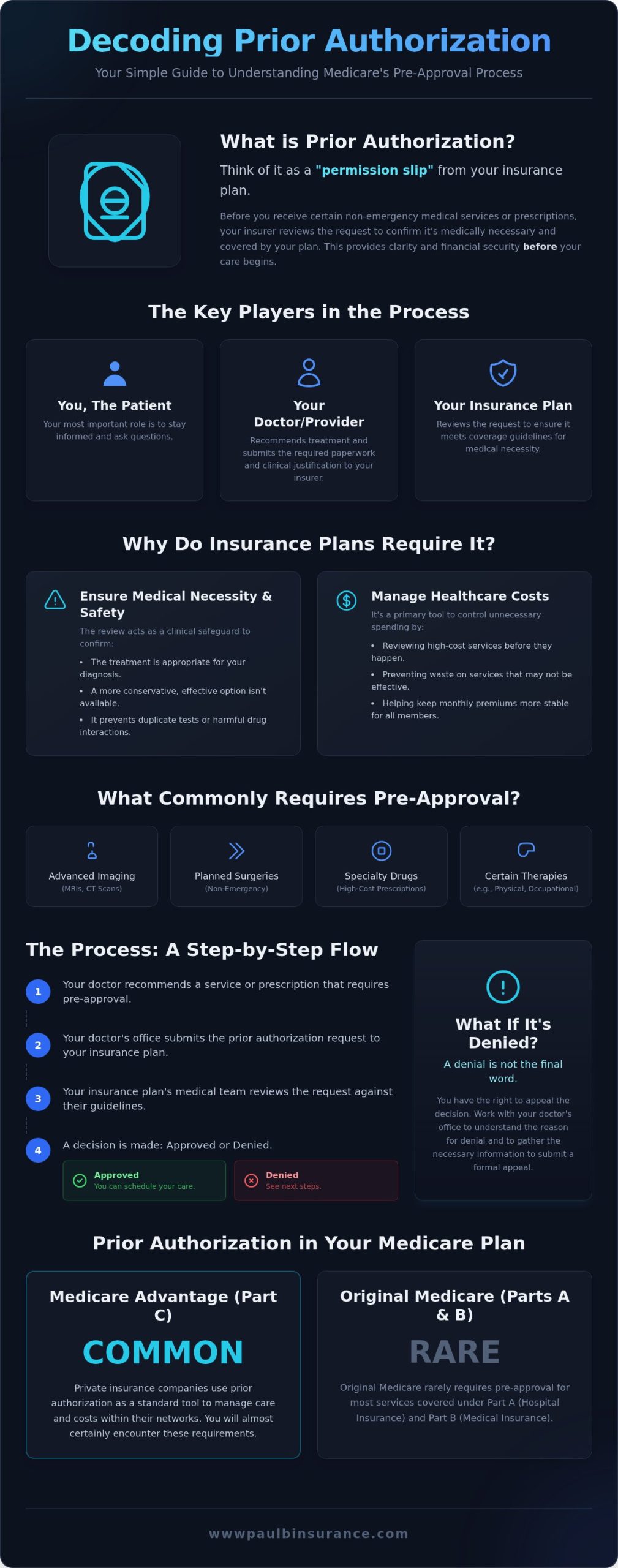
The Prior Authorization Process: A Step-by-Step Walkthrough
Hearing that you need a “prior authorization” can feel stressful and confusing. It sounds like another complicated hurdle in your healthcare journey. However, we’re here to bring you from confusion to confidence by breaking the process down into simple, manageable steps. The best part? Your doctor’s office does most of the heavy lifting.
Here is what you can typically expect:
Step 1: Your Doctor Makes a Recommendation
The process begins the moment your doctor decides you need a specific medication, medical device, or procedure. Their office staff will then check if your insurance plan requires pre-approval for that service. At this stage, you don’t need to do anything at all. Your healthcare team takes the lead.
Step 2: The Doctor’s Office Submits the Request
Your doctor’s office will compile all the necessary paperwork to send to your insurance company. This packet includes clinical notes, test results, and a detailed justification explaining why the recommended care is medically necessary for you. This is their way of making a strong case on your behalf.
Step 3: The Insurance Plan’s Review
Once submitted, a clinical team at your insurance company carefully reviews the request. They compare your doctor’s notes against your plan’s coverage guidelines to ensure the service is appropriate and covered. This review process typically takes anywhere from a few days to two weeks. A core part of the prior authorization meaning is this verification step, designed to ensure care is both necessary and effective.
Step 4: You and Your Doctor Receive a Decision
Finally, the insurance company will notify both you and your doctor of their decision. There are three common outcomes:
- Approved: This is the green light. You can proceed with scheduling your procedure or picking up your prescription.
- Denied: If the request is denied, the insurer must explain why. This is not the final word; you have the right to appeal the decision, and your doctor can help.
- Request for More Information: Sometimes, the plan simply needs more clinical details to make a final choice. Your doctor’s office will provide the additional information required.
While your medical team handles the paperwork, understanding this process helps you know what’s happening behind the scenes. If you ever feel overwhelmed by insurance rules, remember that trusted, unbiased guidance can make all the difference. Visit www.paulbinsurance.com to see how we help clients navigate their healthcare with confidence.
What to Do If Your Prior Authorization is Denied
Receiving a denial letter for a needed medical service can feel stressful and defeating. But it’s important to remember this: a denial is not the final answer. Often, it’s just the first step in a process you can navigate with confidence. The key is to understand why your request was denied and to know what your rights are moving forward.
Understand the Reason for the Denial
Your insurance company is required to explain why it denied your request. Before you worry, work with your doctor’s office to review the reason. Many denials happen for simple, fixable administrative issues, not because you don’t need the care. Common causes include:
- A simple clerical error, like a typo or an incorrect billing code.
- Missing medical records or documentation needed to justify the service.
- The plan’s reviewers determined it wasn’t “medically necessary” based on their specific guidelines.
- The plan requires you to try a less expensive treatment first (a process called “step therapy”).
Understanding the specific prior authorization meaning in the context of your denial is the first step toward a successful appeal.
Your Right to Appeal the Decision
You have the right to appeal the insurance company’s decision. The first step is typically an “internal appeal,” which simply means you are asking the insurer to take a second look at your case. Your doctor is your most important partner here. They can submit a letter of medical necessity, along with additional patient records and clinical notes, to build a stronger case. It’s reassuring to know that many initial denials are overturned once more information is provided.
How an Expert Can Help You Plan Ahead
While you can fight a denial after it happens, the best strategy is to choose a health plan that minimizes these roadblocks from the start. This is where the guidance of a trusted, independent broker is invaluable. An expert can help you compare different plans and their rules on authorizations before you enroll, helping you find coverage with fewer restrictions for the care you need. For example, Medigap plans work with Original Medicare and don’t use prior authorizations for Medicare-covered services. Planning ahead with an expert guide is the best way to ensure your healthcare journey is a smooth one.
From Confusion to Confidence: Mastering Prior Authorization
Understanding the prior authorization meaning is the first step toward taking control of your healthcare journey. Remember, it’s simply a review process your plan uses to approve certain treatments and prescriptions before you get them. Knowing how to navigate this process, and what your options are if you face a denial, empowers you to advocate for the care you need and deserve.
But even with a guide, these rules can feel stressful and confusing. If you’re tired of trying to decipher Medicare jargon on your own, you don’t have to. Getting trusted, unbiased guidance from an independent broker makes all the difference. The Modern Medicare Agency provides personalized advice tailored to your unique needs, with support available across 34+ states.
Feeling overwhelmed by Medicare rules? You don’t have to figure it out alone. Schedule a free, no-pressure call with Paul today. Let’s replace the guesswork with a clear, confident plan for your healthcare.
Frequently Asked Questions About Prior Authorization
How long does a prior authorization usually take?
The waiting period for a prior authorization can be a source of stress, and it truly varies. For urgent medical needs, a decision is often made within 72 hours. However, for standard, non-urgent requests, the process can take anywhere from 5 to 14 business days. This is why it’s so important to begin the process as soon as your doctor recommends a service or prescription that requires approval from your insurance plan.
Do I need to get prior authorization in a medical emergency?
No, you do not. In a true medical emergency, your immediate health and safety are the only priority. Insurance companies cannot require you to get approval before receiving emergency care. You should always seek the help you need without delay. The focus is on getting you stable and well; any necessary insurance paperwork and approvals can be handled after the emergency has been managed. Your well-being always comes first.
What can I do to help speed up the prior authorization process?
You can be your own best advocate to help move things along. The key is proactive communication. We recommend speaking with your doctor’s office to confirm they have sent all the necessary medical records to the insurer. You can also call your insurance company directly to check the status of your request. Having the reference number for your case will make this process much simpler and give you peace of mind.
Does Original Medicare (Part A and Part B) require prior authorization?
This is a common point of confusion we help people navigate. For the most part, Original Medicare does not require prior authorization for most services. However, there are some important exceptions for specific items like certain durable medical equipment (e.g., power wheelchairs) and some outpatient procedures. It’s always wise to confirm with your provider beforehand to steer clear of any surprise denials or bills.
Can I be charged for a service if the prior authorization was denied?
Yes, and this is a costly mistake you want to avoid. If your request is denied and you still receive the service or fill the prescription, you will likely be responsible for the full cost. Understanding the prior authorization meaning is crucial-it’s your insurer’s approval to pay. If you receive a denial, your first step should always be to work with your doctor to file an appeal and fight for the coverage you need.
How often do prior authorizations need to be renewed?
The need for renewal depends on the specific treatment or medication. Some approvals are for a one-time procedure, like a surgery. Others, typically for managing chronic conditions or for ongoing prescriptions, are valid for a set period, such as six or twelve months. Your approval letter from the insurance company will clearly state the expiration date, so you and your doctor will know exactly when to reapply for continued coverage.

Article by
Paul Barrett
Paul Barrett, CMIP is the founder of The Modern Medicare Agency, an independent Medicare-only brokerage based in Melville, NY. With 18 years of Medicare-exclusive experience, a CMIP designation, and more than 5,000 clients served across 37 states, Paul is one of the most credentialed independent Medicare specialists on Long Island — and one of the most direct.
He represents 40+ carriers with no quotas and no allegiances, which means his recommendations are based entirely on what fits each client's specific situation. He is the author of Medicare Mastery Unlocked and host of the Wise Guys Retirement Talk podcast. His content is grounded in primary sources, real carrier intelligence, and 18 years of watching what happens when people get Medicare right — and when they don't.
📞 631-358-5793 | paulbinsurance.com