




Did you know that by the end of 2025, more than 760,000 Americans were paying permanent monthly surcharges simply because they missed a single filing date? As we move through 2026, identifying the common medicare enrollment mistakes to avoid is the only way to protect yourself from these lifelong financial traps. We understand that your mailbox is likely buried under a mountain of confusing junk mail right now. It’s completely normal to feel anxious about losing access to your trusted doctor or accidentally triggering a hidden fee that lasts forever.
That’s why The Modern Medicare Agency is here to simplify this “crazy maze” and replace that anxiety with genuine peace of mind. Our goal is to move you from a state of total confusion to complete confidence in your healthcare choices. We’ll walk you through a clear timeline for your 2026 enrollment and explain the vital differences between Original Medicare and Advantage plans. By the time you finish reading, you’ll have a simple, step-by-step plan to secure your coverage without the typical stress or pressure.
Key Takeaways
- We’ll guide you through the critical seven-month window for your Initial Enrollment Period to ensure you don’t miss out as healthcare costs shift in 2026.
- Learn how to protect your retirement savings from the permanent Part B and Part D late enrollment penalties that can last a lifetime.
- We simplify the common medicare enrollment mistakes to avoid if you are still working, specifically how your company’s size dictates your coverage options.
- Discover why checking your specific 2026 drug list and doctor network is the only way to ensure your favorite specialist stays by your side.
- Follow our straightforward five-step checklist to replace the stress of the “Medicare maze” with the clarity and confidence you need to move forward.
The High Cost of Waiting: Why Medicare Timing is Everything
The transition to Medicare often feels like walking into a maze without a map. We see the stress and confusion on the faces of seniors every day as they try to decode federal timelines and complex rules. In 2026, the stakes for getting your timing right are higher than ever before. This year marks a significant shift in healthcare costs, specifically with the full implementation of the $2,000 out of pocket cap for prescription drugs. If you miss your window, you don’t just face a delay in care; you risk permanent financial penalties that follow you for the rest of your life. We are here to help you move from confusion to confidence by simplifying these rules into a clear, manageable plan.
Many people fall into the psychological trap of thinking they can deal with insurance later. They assume the system is flexible, but Medicare is built on rigid dates. Waiting even a few weeks past your deadline can create a coverage gap that leaves you vulnerable to 100 percent of your medical costs. Since its inception, Medicare (United States) has functioned as a structured safety net, but it requires you to step onto that net at exactly the right moment. One of the most common medicare enrollment mistakes to avoid is assuming your current coverage will automatically bridge the gap until you feel ready to sign up.
We help you avoid these pitfalls by mapping out a personal Medicare calendar tailored to your 65th birthday. Our goal is to ensure you never miss a date or pay a late fee. We take the pressure off your shoulders by tracking the milestones for you, so you can focus on enjoying your retirement instead of worrying about paperwork. Let’s look at the specific windows you need to know to stay protected.
The 7-Month Rule: Your First Enrollment Window
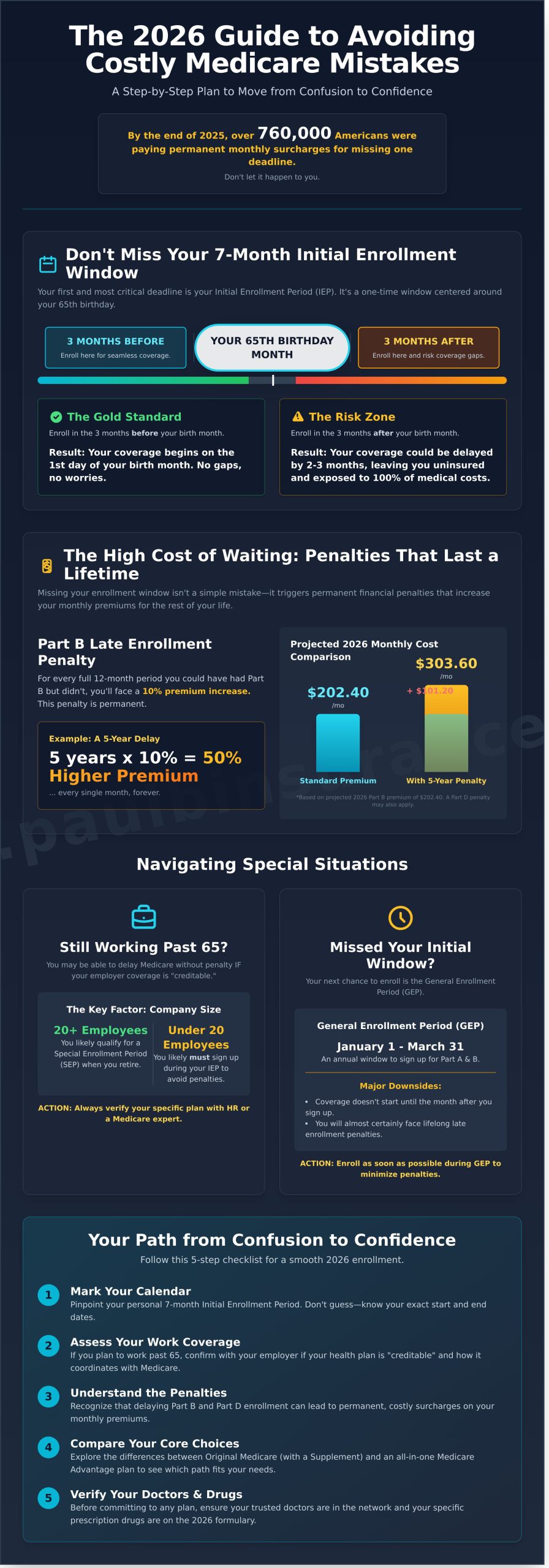
Your Initial Enrollment Period (IEP) is a 7-month window that centers around your 65th birthday. It includes the 3 months before you turn 65, the month of your birthday, and the 3 months immediately following. If your birthday is in July, your window opens on April 1 and closes on October 31. We consider enrolling during the first 3 months to be the gold standard for seamless coverage. This ensures your benefits begin on the first day of your birth month, preventing any days without insurance.
If you wait until the last 3 months of your IEP, you will likely face a delayed start date. In 2026, a delay of even 60 days can be costly, especially with the projected Part B premium of $190.40 and the risk of unexpected health events. Enrolling late in your window means your coverage might not start for two or three months after you apply. This gap is where most financial disasters happen, but we can help you lock in your start date early to keep your peace of mind intact.
General vs. Special Enrollment: Knowing the Difference
If you miss your IEP, you are often forced into the General Enrollment Period, which runs from January 1 to March 31 each year. This is a dangerous path because your coverage won’t start until the following month, and you will likely face a lifetime late enrollment penalty. These penalties add 10 percent to your Part B premium for every 12-month period you were eligible but didn’t enroll. This is one of the common medicare enrollment mistakes to avoid if you want to keep your monthly costs low and predictable.
The Special Enrollment Period (SEP) is the exception to these strict rules. A Special Enrollment Period serves as a critical safety valve for people who lose their employer health coverage or move out of their plan’s service area. If you are still working and have “creditable” coverage from an employer with 20 or more employees, you may not need to sign up at 65. We provide unbiased guidance to help you determine if your current work plan qualifies, ensuring you don’t trigger a penalty when you finally decide to retire.
Late Enrollment Penalties: The Mistakes That Last a Lifetime
Missing your initial enrollment window might feel like a minor clerical error, but the federal government views it differently. These lapses trigger permanent financial consequences that stay with you as long as you have Medicare. The Modern Medicare Agency often meets individuals who are shocked to find their monthly costs are much higher than their neighbors simply because they signed up a few months late. Understanding these common Medicare enrollment mistakes is the first step toward protecting your retirement budget in 2026.
The math behind these penalties is cumulative. For Part B, you face a 10% increase for every full 12-month period you were eligible but didn’t enroll. If you wait five years to sign up, you’ll pay 50% more than the standard premium every single month for the rest of your life. Based on the projected 2026 Part B premium of $202.40, a five-year delay would add an extra $101.20 to your bill. That means you’d pay $303.60 monthly while others pay the base rate. The Modern Medicare Agency wants to help you avoid this unnecessary drain on your savings.
The Lifetime Sting of the Part B Penalty
The Modern Medicare Agency has heard many people say they skipped Part B because they felt healthy and didn’t want the extra expense. This is a risky gamble. Medicare calculates the penalty based on the current year’s premium, not the rate from when you first turned 65. As the base premium rises each year, your penalty amount grows along with it. It’s a sliding scale that never stops moving upward.
If you believe you’ve been unfairly assessed a penalty, The Modern Medicare Agency can help. The Modern Medicare Agency assists its clients in gathering documentation of past employer coverage to challenge these charges. Having a trusted advisor in your corner ensures that your history is presented accurately to Social Security, potentially saving you thousands over the coming decade.
Part D Penalties and the Creditable Coverage Trap
Part D drug coverage has its own set of rules that often catch people off guard. Even if you don’t take any prescription medications today, Medicare requires you to have “creditable coverage.” This means your insurance must be at least as good as a standard Medicare drug plan. If you go 63 days or more without this specific type of coverage, a 1% monthly penalty starts ticking.
The penalty is calculated by multiplying 1% of the “national base beneficiary premium,” which is projected to be around $39.20 in 2026, by the number of full months you went without coverage. A five-year gap results in a 60% penalty. This extra $23.52 is added to whatever drug plan premium you eventually choose. You can explore your options and see how different plans handle these requirements in The Modern Medicare Agency’s Medicare Part D guide.
Don’t let a simple timing error derail your financial peace of mind. The Modern Medicare Agency specializes in identifying these common medicare enrollment mistakes to avoid before they become permanent fixtures on your monthly statement. The Modern Medicare Agency’s goal is to move you from a state of confusion to total confidence by handling the heavy lifting for you. The Modern Medicare Agency provides the clarity you need to make the right choice the first time, ensuring you never pay a penny more than necessary for your healthcare.
Mistakes for the ‘Working Retired’: Coordinating with Employer Plans
We speak with neighbors every day who believe that staying employed past age 65 means they can simply ignore Medicare. It’s a logical thought, but it’s often the first step toward a very expensive surprise. As we move through 2026, roughly 25% of seniors remain in the workforce. Many of them operate under the #1 misconception in the industry: “I have work insurance, so I’m totally fine.” This single belief leads to some of the most common Medicare enrollment mistakes we encounter.
The truth is that your employer coverage doesn’t always take the lead. The “20 Employee Rule” is the benchmark you must know. If your company has 20 or more employees, your group plan is generally the primary payer. In this case, you can often delay Medicare Part B without penalties. However, if your company has 19 or fewer employees, Medicare becomes “primary” the moment you turn 65. This means Medicare is expected to pay first. If you don’t enroll, your small business plan might refuse to pay the 80% of costs that Medicare would have covered, leaving you responsible for thousands of dollars in medical debt.
Another dangerous trap involves COBRA. We’ve seen retirees choose COBRA because they like their current doctor, assuming it counts as “active” coverage. It doesn’t. Medicare does not recognize COBRA as creditable coverage for Part B. If you rely on COBRA and miss your enrollment window, you will face a lifetime late enrollment penalty of 10% for every 12-month period you waited. Even more frightening, you could find yourself with $0 in actual coverage if the COBRA provider discovers you were eligible for Medicare and didn’t sign up. They can retroactively deny claims, leaving you completely exposed.
The Small Business Trap (Under 20 Employees)
If you work for a small firm, you must act before your 65th birthday. We recommend sitting down with your HR department at least 4 months early. Ask them specifically if the plan is primary or secondary to Medicare. Do not take a casual “you’re fine” for an answer. In 2026, insurance coordination of benefits is stricter than ever. If Medicare is primary, you must enroll in Part A and Part B to avoid massive out-of-pocket gaps. We simplify this jargon so you know exactly how the transition works for your specific office size.
HSA Contributions and Medicare: A Tax Headache
Health Savings Accounts are wonderful tools, but they don’t play well with Medicare. You must stop all contributions to your HSA at least 6 months before you apply for Medicare. This is because Medicare Part A coverage is often backdated up to 6 months. If you continue contributing during that window, the IRS will hit you with tax penalties and excise fees, which currently sit at 6% per year on the excess amount. You can see how some modern options handle these transitions in our Medicare Advantage Guide. We help you time your exit from an HSA perfectly so you avoid “double-dipping” penalties while maximizing your final tax-free contributions. To transition safely, we suggest starting your Medicare application 90 days before your retirement date. This ensures your new coverage starts the very first day your corporate plan ends, giving you total peace of mind.
Choosing the Wrong Path: Advantage vs. Supplement vs. DIY
Deciding between Medicare Advantage and a Medigap plan is the most significant fork in the road you’ll face. It’s also where we see the most common medicare enrollment mistakes to avoid. Many people choose a plan based solely on a low monthly premium without looking at the long term consequences of that choice. We want to make sure you understand the permanent nature of some of these decisions before you sign on the dotted line.
We’ve met many folks who assumed their specialist would accept any Medicare plan because they’ve been going there for years. This is the ‘Network Mistake.’ While 98% of physicians across the country participate in Original Medicare, Advantage plans use restricted private networks. If your oncologist or cardiologist isn’t in that specific HMO or PPO network for 2026, you’ll be forced to pay the full cost out of pocket or find a new doctor. We’ve seen networks change mid year, leaving patients in a difficult spot during active treatments.
The ‘Supplement Lockdown’ is another trap that catches many off guard. During your initial six month Medigap Open Enrollment Period, you have a guaranteed right to buy any policy regardless of your health. Once that window closes, in most states, insurance companies can use medical underwriting to deny you coverage or charge you much higher rates. Your first choice of a Medigap plan often becomes your permanent one; switching from an Advantage plan back to a Supplement later might be impossible if you’ve developed a chronic condition.
Medigap vs. Medicare Advantage: The Flexibility Gap
Original Medicare paired with a Medigap plan offers total freedom. You can visit any doctor in the United States who accepts Medicare patients without needing a referral. Advantage plans often have $0 premiums but restrict you to specific provider groups and require prior authorizations for many procedures. You can visit our Medigap page to see why many of our clients prefer the stability and predictability of a supplement plan.
The 2026 Prescription Drug Revolution
This year marks the most significant shift in drug coverage since the program began. Thanks to the Inflation Reduction Act, there’s a new $2,000 out of pocket cap on Part D drugs for 2026. While this protects your wallet, it has caused insurance companies to completely overhaul their formularies to manage their own costs. The best plan last year is rarely the best plan this year. We’ve seen plans drop common medications or move them to higher cost tiers with no warning.
Checking your specific 2026 prescriptions against the updated formulary is no longer optional. If you rely on an old ‘reliable’ plan without verifying the new drug lists, you could find your monthly costs tripling despite the new federal cap. Understanding these common medicare enrollment mistakes to avoid helps you move from confusion to confidence. We simplify the jargon and look at the actual math for your specific medications so you know exactly what to expect at the pharmacy counter.
Don’t let a simple oversight lock you into the wrong plan for the next twelve months. Schedule a Call With Paul to review your 2026 options and ensure your doctors and drugs are fully covered.
From Confusion to Confidence: Your 2026 Enrollment Checklist
We know the Medicare maze feels like a puzzle with missing pieces. By following this 2026 checklist, you can move from confusion to complete confidence. One of the most common medicare enrollment mistakes to avoid is waiting until the last minute to understand your specific deadlines. We are here to make sure that doesn’t happen to you.
- Step 1: Confirm your Initial Enrollment Period. Your window is a 7-month period that begins 3 months before you turn 65 and ends 3 months after. If your birthday is July 15, your window opens April 1 and closes October 31.
- Step 2: Audit your prescriptions and doctors. For 2026, the Inflation Reduction Act has capped out-of-pocket prescription costs at $2,000. We need to verify your specific medications are on the plan’s formulary and your preferred specialists are in-network.
- Step 3: Choose your path. Decide between the predictability of Medigap, which has higher premiums but almost no out-of-pocket costs, or the bundling of a Medicare Advantage plan. Advantage plans often have $0 premiums but require you to use a specific network of providers.
- Step 4: Address the gaps. Original Medicare does not cover most dental, vision, or hearing care. We help you find solutions so a simple cavity doesn’t turn into a $1,500 financial burden.
- Step 5: Partner with an independent broker. We compare over 40 different carriers to find the one that fits your life. This service costs you nothing, but it saves you from the stress of doing it alone.
Building Your Personal Medicare Portfolio
We look at your total cost of care, not just the monthly premium. A plan with a $0 premium might actually cost you more if the co-pays for your specific heart medication are high. We also strongly recommend adding a dental insurance plan to cover what Medicare won’t. In 2026, basic dental cleanings and X-rays can cost upwards of $350 out of pocket without coverage. We simplify the jargon so you know exactly how your plan works. You won’t find any “insurance-speak” here; just clear answers that help you feel secure.
The Power of Unbiased Guidance
There’s a big difference between an independent broker and a captive agent. A captive agent works for one insurance company and can only sell you their products. We think you deserve better. We represent 40+ carriers, which means we work for you, not the insurance companies. This is how we ensure you’re not falling into common medicare enrollment mistakes to avoid, like picking a plan based on a TV commercial rather than your actual medical needs. We provide year-round support, so if your doctor leaves a network in November, we are here to help you find a new path. We are never rushed and never pressured. Ready to get started? Schedule a Call with Paul to mistake-proof your Medicare journey and find the peace of mind you deserve.
Secure Your Future with a Clear Medicare Plan
Navigating the 2026 Medicare landscape doesn’t have to feel like a walk through a maze. We’ve seen how missing a single deadline can lead to a 10 percent Part B penalty that stays with you for the rest of your life. It’s also vital to understand how your employer coverage interacts with federal benefits so you don’t end up paying for insurance you can’t use. By taking these steps now, you can steer clear of the common medicare enrollment mistakes to avoid and move from a state of confusion to total confidence.
You deserve unbiased guidance that puts your health first. We provide independent support with access to plans from 40+ carriers across 34+ states. These personalized consultations come at zero cost to you. Our mission is to simplify the jargon and ensure you feel protected as you start this new chapter.
Schedule a Call With Paul: Let’s Mistake-Proof Your Medicare Together
We’re ready to help you find the peace of mind you deserve.
Frequently Asked Questions
Is there a penalty for not signing up for Medicare at 65 if I’m still working?
You won’t face a late enrollment penalty as long as you have creditable coverage through an employer with 20 or more workers. We see about 25% of seniors delay Part B because they’re still active in the workforce. Just make sure your HR department confirms your plan meets CMS standards. If you wait until your group coverage ends, you’ll have an 8 month window to sign up without any extra costs.
Can I change my Medicare plan later if I make a mistake during initial enrollment?
You can absolutely change your plan during the Annual Election Period from October 15 to December 7 each year. If you’re on a Medicare Advantage plan, you also have a second chance between January 1 and March 31 to switch or return to Original Medicare. We help people navigate these windows every year to fix common medicare enrollment mistakes to avoid. It’s about finding the right fit for your current health needs.
What is the difference between Medicare Part A and Part B enrollment?
Medicare Part A covers hospital stays and is usually premium free if you’ve worked 10 years, while Part B covers doctor visits and requires a monthly premium. Most people are automatically enrolled in Part A at age 65 if they receive Social Security benefits. However, you must actively sign up for Part B if you aren’t yet collecting those benefits. This distinction is where 15% of new enrollees get tripped up during their initial window.
Do I have to sign up for Part D if I don’t take any prescription drugs?
We recommend signing up for a basic Part D plan even if you don’t take any prescriptions right now. If you go 63 days or more without creditable drug coverage, Medicare adds a permanent 1% penalty to your premium for every month you waited. In 2026, the national base beneficiary premium is approximately $35.00. Paying a small monthly amount now protects you from higher lifetime costs and unexpected health changes.
What happens if I miss my Medicare enrollment window entirely?
If you miss your 7 month Initial Enrollment Period, you must wait until the General Enrollment Period which runs from January 1 to March 31. Your coverage won’t start until the first of the month after you sign up. You’ll likely face a 10% lifetime penalty on your Part B premium for every 12 month period you were eligible but didn’t enroll. Missing this window is one of the most common medicare enrollment mistakes to avoid.
How much will Medicare Part B cost in 2026?
The standard monthly premium for Medicare Part B in 2026 is projected to be $205.50 for most beneficiaries. If your modified adjusted gross income from two years ago was higher than $110,000 as an individual, you might pay an additional Income Related Monthly Adjustment Amount. We can review your 2024 tax returns to determine exactly what your specific monthly cost will be. This helps you budget with total confidence and peace of mind.
Is Medicare Advantage better than Medigap for avoiding out-of-pocket costs?
Medigap plans generally offer more predictable costs because they pay nearly all your out-of-pocket expenses after the $275 Part B deductible in 2026. Medicare Advantage plans often have lower premiums, sometimes even $0, but you’ll pay co-pays as you go. For example, a 3 day hospital stay might cost $900 on an Advantage plan but $0 with a Medigap Plan G. We help you weigh these specific numbers to see which fits your budget.
Can I have both a Medicare Advantage plan and a Medigap supplement?
You cannot have both a Medicare Advantage plan and a Medigap supplement policy at the same time. In fact, it’s illegal for an agent to sell you a Medigap policy if they know you’re enrolled in an Advantage plan. We ensure you choose the single path that fits your lifestyle best. Whether it’s the all-in-one convenience of Advantage or the broad freedom of Medigap, we’ll make sure your choice is clear, secure, and simple.

Article by
Paul Barrett
Paul Barrett, CMIP is the founder of The Modern Medicare Agency, an independent Medicare-only brokerage based in Melville, NY. With 18 years of Medicare-exclusive experience, a CMIP designation, and more than 5,000 clients served across 37 states, Paul is one of the most credentialed independent Medicare specialists on Long Island — and one of the most direct.
He represents 40+ carriers with no quotas and no allegiances, which means his recommendations are based entirely on what fits each client's specific situation. He is the author of Medicare Mastery Unlocked and host of the Wise Guys Retirement Talk podcast. His content is grounded in primary sources, real carrier intelligence, and 18 years of watching what happens when people get Medicare right — and when they don't.
📞 631-358-5793 | paulbinsurance.com