




Does the thought of navigating Medicare in 2026 feel like stepping into a complicated maze, leaving you worried about unexpected medical bills? If you’re tired of the constant calls and confusing jargon, you are not alone. It’s a common feeling to be overwhelmed by all the different “Parts” and plans, fearing that a single gap in your coverage could jeopardize your hard-earned savings. This is where a crucial piece of the puzzle comes in-one designed specifically to bring you predictability and peace of mind.
This simple guide is here to provide the trusted, straightforward guidance you deserve. We’ll answer the core question-what is Medigap?-and clearly explain how these plans fill the gaps left by Original Medicare. By the end, you will understand how Medicare Supplement Insurance can protect your savings, give you the freedom to choose any doctor who accepts Medicare, and help you move from confusion to confidence in your 2026 healthcare coverage. Let’s make this simple, together.
Key Takeaways
- Understand what is medigap and how it works with Original Medicare to cover potentially high out-of-pocket costs, giving you predictable healthcare expenses.
- Discover why certain plans, like Plan G, have become the top choice for new enrollees in 2026 and how to compare your options with clarity.
- Learn the critical difference between Medigap and Medicare Advantage so you can confidently choose the model that best protects your health and savings.
- Identify your one-time Medigap Open Enrollment Period to avoid being denied coverage or charged more due to pre-existing health conditions.
What is Medigap? Defining Medicare Supplement Insurance
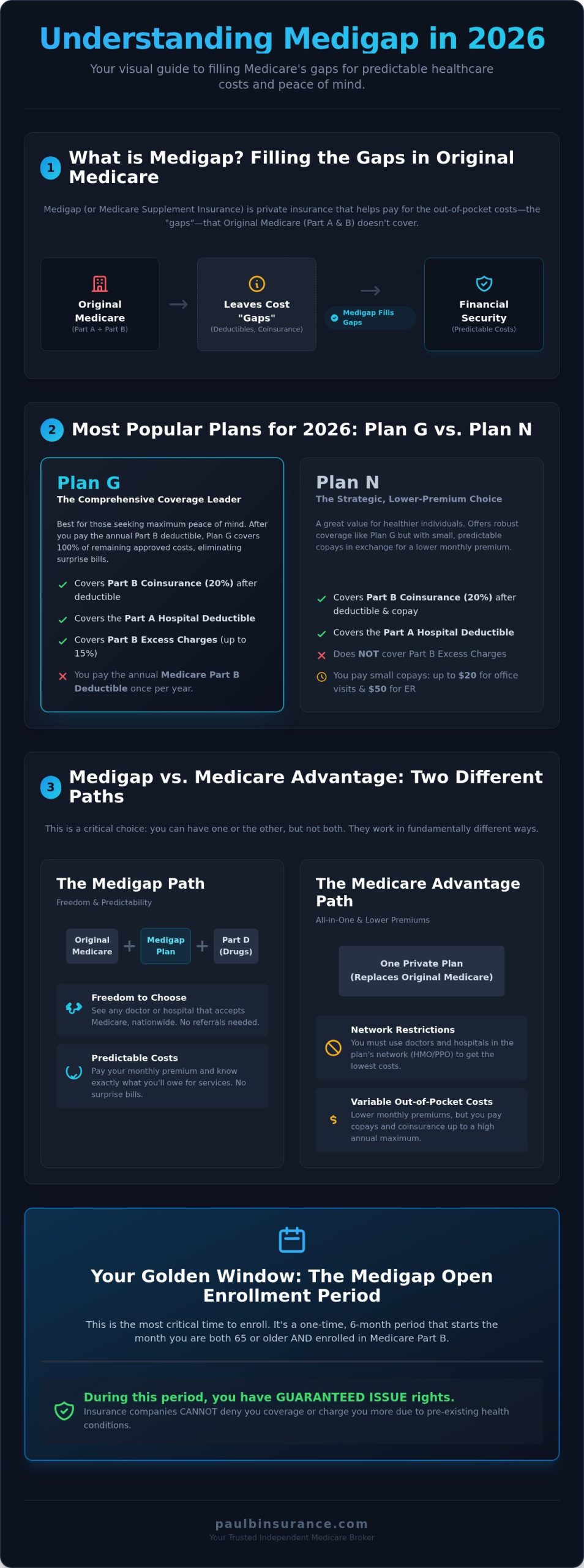
Navigating the world of Medicare can feel overwhelming, especially when you realize that Original Medicare (Parts A and B) doesn’t cover all of your healthcare costs. So, what is Medigap? In simple terms, it’s private health insurance designed specifically to help pay for the costs that Original Medicare leaves behind. You must be enrolled in both Medicare Part A and Part B to be eligible to purchase a policy.
Think of Medigap as a standardized bridge between what Medicare covers and your actual out-of-pocket costs, giving you predictable expenses and valuable peace of mind.
The ‘Gaps’ in Original Medicare Explained
While Medicare provides a strong foundation, it was never designed to cover 100% of your medical bills. These remaining costs are often called “gaps,” and they can lead to significant financial surprises after a hospital stay or medical procedure. Medigap plans help cover costs like:
- Part B Coinsurance: After you meet your annual Part B deductible, you are typically responsible for 20% of the cost for most doctor services, outpatient care, and medical supplies. This has no annual limit.
- The Part A Deductible: This is a substantial deductible you must pay for each hospital stay within a “benefit period.” It is not an annual deductible, meaning you could potentially pay it multiple times in a single year.
By covering these unpredictable expenses, a Medigap policy helps ensure that a health issue doesn’t become a major financial crisis.
Standardization: Why the Plan Letter Matters More Than the Carrier
Here is where the process becomes much simpler and clearer for you. The federal government standardized all Medigap (Medicare supplement insurance) plans, which means the benefits for each plan letter are the same, regardless of which insurance company sells it. For example, a Plan G from Company A offers the exact same core medical benefits as a Plan G from Company B.
This powerful feature empowers you to shop confidently based on two key factors: the monthly premium and the insurance carrier’s reputation for service. You don’t have to worry about comparing confusing coverage charts-you simply choose the plan letter that fits your needs and find the most trusted and cost-effective carrier offering it.
Comparing the Most Popular Medigap Plans in 2026
Navigating the alphabet soup of Medigap plans-from Plan A through Plan N-can feel overwhelming. The good news is that for most new Medicare enrollees in 2026, the choice boils down to two standout options: Plan G and Plan N. These plans offer a fantastic blend of coverage and value, giving you a clear path from confusion to confidence. It’s important to remember that Medigap plans work alongside Original Medicare, and for a clear government overview, you can compare Medigap and Medicare Advantage to understand the core differences. For those eligible for Medicare before January 1, 2020, Plan F is also an option, but for everyone else, G and N are the modern standards.
Plan G: The Comprehensive Coverage Leader
For many seniors, Plan G has become the new gold standard, and for good reason. It offers the most extensive coverage available to new Medicare members. Once you pay your annual Medicare Part B deductible, Plan G covers 100% of the remaining gaps, including coinsurance and copayments. This “first-dollar” coverage (after the deductible) means you experience no-hassle billing and rarely see a bill from your doctor’s office. For those seeking maximum peace of mind, Plan G provides the most predictable financial outcome for your healthcare, eliminating nearly all surprise costs.
Plan N: The Strategic Choice for Lower Premiums
If you are a healthy, budget-conscious senior, Plan N presents a compelling alternative. It provides robust coverage similar to Plan G but with a key difference: in exchange for a lower monthly premium, you agree to small, predictable copayments for certain services. This typically includes:
- Up to a $20 copay for some office visits.
- A $50 copay for emergency room visits (waived if you’re admitted).
One crucial detail about Plan N is that it does not cover Part B “excess charges.” This is a rare situation where a doctor who doesn’t accept Medicare assignment can charge up to 15% over the Medicare-approved amount. While most doctors accept Medicare assignment, it’s an important factor to consider when thinking about what is Medigap coverage that best fits your needs and budget.
Medigap vs. Medicare Advantage: Clearing the Confusion
One of the most common points of confusion in the Medicare maze is the difference between Medigap and Medicare Advantage. Let’s clear this up right away: You cannot have both. They are two entirely different ways to receive your healthcare coverage. Choosing between them often comes down to a simple philosophy: would you rather “pay now” for predictability or “pay later” when you need care?
A Medigap plan works with Original Medicare (Parts A and B). You pay a monthly premium to a private insurance company, and in return, the Medigap plan pays for most of your remaining out-of-pocket costs. In contrast, a Medicare Advantage plan (Part C) replaces your Original Medicare. You’ll often see low or even $0 monthly premiums, but you pay copays and coinsurance as you use services. Understanding what is medigap at its core-a supplement-is the first step to seeing why these two paths are mutually exclusive. As you explore your official Medicare benefits, the Social Security Administration outlines these separate options for receiving your coverage.
Network Restrictions vs. Nationwide Access
With a Medigap plan, your network is nationwide. You have the freedom to see any doctor or visit any hospital in the U.S. that accepts Medicare, no referrals needed. This is crucial for “snowbirds” who spend winters in Florida or anyone who loves to travel. Medicare Advantage plans, however, typically operate with local HMO or PPO networks, meaning you must use their approved providers to receive the lowest costs.
The Long-Term Cost Trap
While Medigap’s monthly premium seems higher at first, it provides powerful financial peace of mind. An Advantage plan might have a low premium, but it comes with an annual out-of-pocket maximum that can exceed $8,000. A serious health issue could leave you with thousands in bills. Furthermore, it can be very difficult to switch from an Advantage plan back to Medigap later in life, as you’ll likely face medical underwriting and could be denied coverage based on your health. This makes your initial choice incredibly important.
When to Enroll: Avoiding Costly Enrollment Mistakes
Understanding what is Medigap is the first step, but knowing when to enroll is just as critical to your financial security. Timing is everything in the world of Medicare, and one specific window offers you a unique advantage. Missing it can lead to higher costs or even being denied coverage later on.
Your most important deadline is the Medigap Open Enrollment Period. Think of this as your one-time, six-month “golden ticket.” It starts on the first day of the month you are both 65 or older and enrolled in Medicare Part B. During this period, insurance companies cannot use medical underwriting. This means they:
- Must sell you any Medigap policy they offer.
- Cannot charge you more because of pre-existing health conditions.
- Cannot make you wait for coverage to start (except for a very limited pre-existing condition waiting period in rare cases).
These protections are called guaranteed issue rights. If you wait and try to apply for a Medigap plan later, you will likely face medical underwriting, where insurers can review your health history, charge you higher premiums, or deny your application outright. For example, if your Part B starts on June 1, 2026, your golden ticket window is from June 1, 2026, to November 30, 2026. Mark this on your calendar!
California’s Birthday Rule and Other State Secrets
Some states offer special enrollment rules that provide extra flexibility. In California, the “Birthday Rule” allows you to switch to another Medigap plan with equal or lesser benefits for 60 days following your birthday each year, without medical questions. New York is even more generous, requiring insurers to offer Medigap plans year-round with guaranteed issue rights.
Moving or Losing Coverage: Trial Rights Explained
Life changes can also grant you guaranteed issue rights outside of your initial window. These “trial rights” are designed to protect you in specific situations. For instance, you may have a right to buy a Medigap plan if you:
- Joined a Medicare Advantage plan when you first became eligible for Medicare and decide to switch back to Original Medicare within the first year.
- Move out of your Medicare Advantage plan’s service area.
- Lose employer group health coverage that was supplementing your Medicare.
Navigating these rules can feel overwhelming, but you don’t have to do it alone. Getting trusted, expert guidance can help you move from confusion to confidence. For personalized support, we invite you to visit paulbinsurance.com.
Why Work with an Independent Medicare Broker?
Navigating the details of what is Medigap can feel overwhelming, but you don’t have to do it alone. The expert you choose to guide you can make all the difference. Many people don’t realize there is a significant distinction between insurance agents.
Some agents are “captive,” meaning they work for a single insurance company and can only offer that company’s products. An independent broker, like Paul B Insurance, works for you. We represent over 40 different carriers, giving us the freedom to provide completely unbiased comparisons.
- Captive Agent: Represents one carrier. Their goal is to sell you their company’s plan.
- Independent Broker: Represents you. Our goal is to find the best plan for your needs and budget, regardless of the carrier.
Because all Medigap plans of the same letter (like Plan G) are standardized by the government, the only difference between carriers is the price. We shop the market to find you the lowest possible rate for the exact same coverage, saving you money without sacrificing benefits. This is the core of our “Modern Medicare Agency” approach: moving you from confusion to confidence with clear, straightforward guidance.
Our support doesn’t stop once you enroll. We are your year-round resource, helping you navigate the inevitable rate increases and ensuring you always have the most cost-effective plan available.
Personalized Guidance vs. 1-800 Numbers
Calling a generic 1-800 number often leads to a rushed, impersonal experience with someone who doesn’t know you. We take a different approach. With over 18 years of experience and more than 5,000 clients served, Paul Barrett provides a personalized review, analyzing your specific doctors, hospitals, and prescription needs to ensure your coverage is a perfect fit. This tailored guidance is something a call center simply cannot offer.
Taking the First Step Toward Confidence
Choosing the right Medigap plan provides incredible peace of mind, knowing you are protected from Medicare’s out-of-pocket costs. You can achieve this same sense of security. Let us simplify the process and help you find the perfect plan with a free, no-obligation consultation. Take the first step toward a confident retirement today.
Schedule your free Medicare consultation with Paul B Insurance today.
Making Your Medigap Decision with Confidence
Navigating the world of Medicare supplements can feel overwhelming, but understanding the fundamentals is your first step toward peace of mind. Remember that these plans work alongside Original Medicare to cover your out-of-pocket costs, and choosing the right one during your key enrollment window is crucial for your financial security. We hope this guide has helped clarify not just what is medigap, but how it provides predictable, reliable healthcare coverage for your future.
You don’t have to sort through this complex decision alone. At Paul B Insurance, we specialize in turning confusion into confidence. With over 18 years of experience, our team has guided more than 5,000 clients through the Medicare maze by providing personalized, unbiased advice. We represent over 40 top-rated insurance carriers, ensuring we find the ideal fit for your unique needs and budget.
Ready to take the next step? Get your free, unbiased Medigap quote from Paul B Insurance today. Your journey to straightforward and dependable healthcare coverage is just a conversation away.
Frequently Asked Questions About Medigap
Is Medigap the same as Medicare Advantage?
This is a very common point of confusion, but the answer is no-they are fundamentally different. A Medigap plan works with Original Medicare to help pay for out-of-pocket costs like deductibles and coinsurance. A Medicare Advantage plan is an alternative to Original Medicare, bundling your benefits into a private plan, often with network restrictions. You cannot have both at the same time, so choosing the right path for your needs is a crucial first step.
Can I be denied Medigap coverage if I have a pre-existing condition?
The timing of your application is critical. During your one-time Medigap Open Enrollment Period, insurance companies cannot deny you coverage or charge you more due to pre-existing conditions. This six-month window starts when you’re 65 or older and enrolled in Medicare Part B. If you apply outside of this protected period, you may have to answer health questions (a process called medical underwriting) and could be denied coverage, so planning ahead is essential.
Does Medigap cover prescription drugs (Part D)?
Medigap plans sold today do not include prescription drug benefits. To get help paying for your medications, you will need to enroll in a separate, standalone Medicare Part D Prescription Drug Plan. Understanding what is Medigap and what it doesn’t cover is key to building complete coverage. We can provide unbiased guidance to help you find a Part D plan that fits your specific prescription needs and budget, ensuring there are no surprises at the pharmacy.
How much does the average Medigap plan cost in 2026?
Medigap premiums vary significantly based on several factors, making a single “average” cost misleading. Your monthly premium in 2026 will depend on the specific plan you choose (e.g., Plan G or N), your location, the insurance carrier, and your age. As an independent agency, we can provide personalized, unbiased quotes from multiple top-rated carriers in your area to find the best value for your unique situation, ensuring you don’t overpay for your coverage.
Do I have to renew my Medigap policy every year?
No, you do not. One of the greatest benefits of a Medigap policy is that it is guaranteed renewable for life. This provides incredible peace of mind, as the insurance company cannot cancel your coverage for any reason as long as you continue to pay your premiums on time. Your plan will automatically renew each year without you having to take any action, even if your health changes, giving you stable, predictable protection.
Does Medigap cover dental, vision, or hearing services?
Medigap policies are designed to cover the gaps in Original Medicare, which typically does not include routine dental, vision, or hearing services. Therefore, Medigap plans do not cover these benefits either. If you need coverage for things like eye exams, glasses, or dental cleanings, you would need to purchase a separate, standalone dental and vision plan. We can help you explore those options to round out your healthcare coverage and find peace of mind.
What happens to my Medigap plan if I move to a different state?
One of the key advantages of Medigap is its portability. Because Medigap plans work with any doctor or hospital nationwide that accepts Medicare, you can almost always keep your exact same policy when you move to a new state. You simply need to notify your insurance company of your new address. Your premium may be adjusted based on your new location, but your trusted coverage will follow you wherever you go, providing seamless protection.
Can I switch from one Medigap plan to another at any time?
Switching Medigap plans is not as simple as it is for other types of Medicare coverage. Outside of your initial enrollment period, you generally do not have the right to switch plans at any time. To change from one Medigap plan to another, you will likely need to answer health questions and pass medical underwriting. This is why making an informed, confident choice from the start is so important-we provide the expert guidance to help you do just that.

Article by
Paul Barrett
Paul Barrett, CMIP is the founder of The Modern Medicare Agency, an independent Medicare-only brokerage based in Melville, NY. With 18 years of Medicare-exclusive experience, a CMIP designation, and more than 5,000 clients served across 37 states, Paul is one of the most credentialed independent Medicare specialists on Long Island — and one of the most direct.
He represents 40+ carriers with no quotas and no allegiances, which means his recommendations are based entirely on what fits each client's specific situation. He is the author of Medicare Mastery Unlocked and host of the Wise Guys Retirement Talk podcast. His content is grounded in primary sources, real carrier intelligence, and 18 years of watching what happens when people get Medicare right — and when they don't.
📞 631-358-5793 | paulbinsurance.com