
Feeling lost in the alphabet soup of Medigap? Plan G, Plan N, Plan F… it’s enough to make anyone’s head spin. If you live in the Golden State, that confusion is often compounded by special rules that don’t apply anywhere else. The fear of choosing the wrong coverage or overpaying is real, but it doesn’t have to be your reality. Finding the right one among the many medicare supplement plans california has to offer should feel empowering, not overwhelming.
That’s precisely why Paul B Insurance created this ultimate 2026 guide. We’re here to provide the straightforward, expert guidance you deserve. We will demystify California’s unique “Birthday Rule,” a powerful tool that gives you an annual window to switch plans with ease. We’ll also break down what each plan letter actually means for your out-of-pocket costs.
Our goal is to help you move from confusion to confidence. By the end of this article, you will have the clarity to compare trusted insurance companies and feel certain you are choosing the perfect plan for your healthcare needs and budget. Let’s make this simple, together.
Key Takeaways
- Understand California’s unique “Birthday Rule” to gain the freedom to switch your Medigap plan annually without health questions.
- Discover the key differences between the three most popular plans (G, N, and F) to see which one best fits your budget and healthcare needs.
- Learn how insurance companies price medicare supplement plans in california to avoid overpaying and find a premium that remains stable over time.
- Find out why the insurance carrier you choose matters just as much as the plan itself and what to look for in a reliable company.
What Are Medigap Plans? A Quick California Refresher
Navigating the costs of healthcare can feel overwhelming, but understanding your options is the first step toward peace of mind. Original Medicare (Part A and Part B) is a fantastic foundation, but it wasn’t designed to cover everything. It leaves behind “gaps” in coverage-costs like deductibles, copayments, and coinsurance that you are responsible for paying out-of-pocket.
This is where Medicare Supplement Insurance, often called Medigap, provides crucial support. These are private insurance policies designed specifically to fill those financial gaps, giving you more predictable healthcare costs. A key point to understand is that all Medigap plans are standardized by the federal government. This means a Plan G from one company has the exact same medical benefits as a Plan G from another. However, the monthly premiums for medicare supplement plans california can vary significantly depending on your zip code and the insurance carrier you choose.
How Medigap Works with Original Medicare
Think of a Medigap plan as a partner to your Original Medicare, not a replacement. To enroll, you must have Medicare Part A and Part B. Once you have a policy, you’ll present both your Medicare card and your Medigap card when you receive care. Medicare pays its share first, and then your Medigap plan pays its share, drastically reducing or even eliminating your out-of-pocket costs. Best of all, you have the freedom to see any doctor or visit any hospital in the U.S. that accepts Medicare.
Standardized Plans Available in California (A-N)
California offers several standardized Medigap plans, identified by letters A through N. While each offers a different level of coverage, a few have become the most popular choices for their comprehensive benefits and value.
- Plan G: The most popular plan for new enrollees. It covers nearly all of your out-of-pocket costs after you meet the annual Medicare Part B deductible.
- Plan N: A great option for those who want lower monthly premiums. It offers robust coverage but requires small copayments for some doctor visits and emergency room trips.
- Plan F: This plan covers 100% of the gaps, including the Part B deductible. However, it is only available to individuals who were eligible for Medicare before January 1, 2020.
Choosing the right one from the available medicare supplement plans california residents have access to depends on your budget, health needs, and desire for predictable costs.
California’s Unique Medigap Rules: The ‘Birthday Rule’ Explained
Navigating the world of Medicare can feel overwhelming, but California residents have a powerful and unique consumer protection on their side: the “Birthday Rule.” This special provision gives you an annual opportunity to review and change your Medigap plan, ensuring you always have the right coverage at the best possible price without having to answer medical questions. It’s one of the most valuable tools you have when managing your medicare supplement plans california.
The core benefit is simple yet profound: you can switch to a different Medigap plan with equal or lesser benefits, and insurance companies cannot deny your application or charge you more based on your health history. This gives you incredible flexibility and control year after year.
For example, imagine you have Medigap Plan G and are paying $190 per month. During your birthday window, you discover another highly-rated insurance company offers the exact same Plan G for $160 per month. You can use the Birthday Rule to switch to the new company and save $360 a year, guaranteed.
How the California Birthday Rule Works
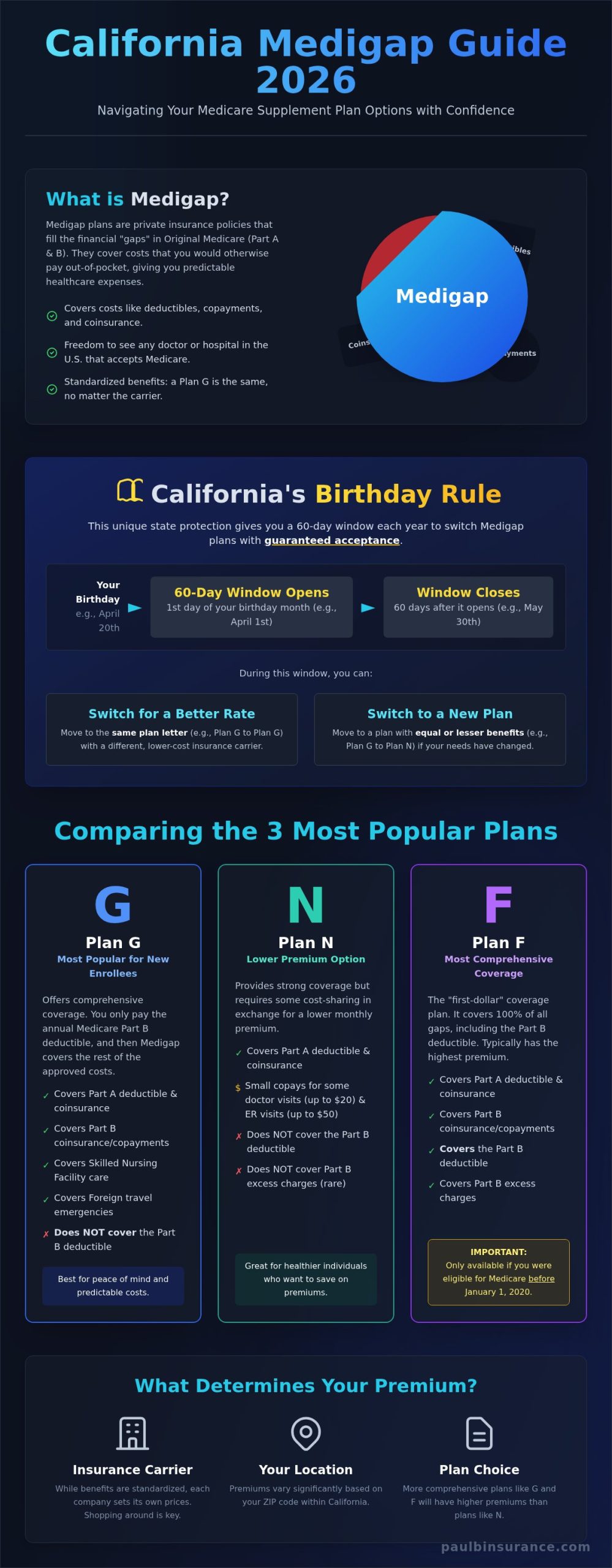
Understanding the timing and rules is key to taking advantage of this benefit. The rule gives you a 60-day window that starts on the first day of your birthday month. For instance, if your birthday is April 20th, your window opens on April 1st and closes on May 30th. During this time, as outlined in the official California Department of Insurance Medigap Guide, you have two primary options:
- Switch to a plan of the same letter: You can move from your current Medigap Plan G to another company’s Plan G to get a better rate.
- Switch to a plan with fewer benefits: If your needs have changed, you can switch from a more comprehensive plan to one with a different letter and lower premiums (e.g., from Plan G to Plan N).
Other Key California Protections
Beyond the Birthday Rule, California provides other guaranteed issue rights for Medigap applicants. These protections apply in specific situations, such as when you lose your employer-sponsored health coverage after turning 65 or if your current plan ends its service in your area. The state also has specific rules that create access to medicare supplement plans california for beneficiaries under 65 who are on Medicare due to a disability. These regulations can be complex and depend entirely on your unique circumstances.
Confused by the rules? An expert can clarify your specific situation.
The 3 Most Popular Medigap Plans in California
Navigating the different medicare supplement plans in California can feel overwhelming, but most people find their perfect fit among three standout options: Plan G, Plan N, and Plan F. These plans are consistently popular because they provide an excellent balance of comprehensive coverage and predictable costs. While national trends, backed by KFF Medigap Enrollment Data, confirm their widespread appeal, the “best” plan is always the one that aligns with your personal health needs and financial comfort level.
Let’s break down the key differences to help you find clarity.
Medigap Plan G: The Go-To for Comprehensive Coverage
Plan G has become the most popular choice for new Medicare enrollees, and for good reason. It covers nearly all the gaps in Original Medicare, leaving you with only one predictable out-of-pocket cost: the annual Medicare Part B deductible. Once you meet that deductible, Plan G pays 100% of your Medicare-approved costs for the rest of the year. It’s an ideal choice for Californians who want peace of mind and minimal financial surprises when they visit the doctor or hospital.
Medigap Plan N: A Lower Premium Option
If you’re looking for a plan with lower monthly premiums and are comfortable with some minor cost-sharing, Plan N is an excellent option. In exchange for a lower premium, you’ll pay small, predictable copayments for certain services (up to $20 for some office visits and up to $50 for an ER visit that doesn’t result in inpatient admission). Plan N does not cover Part B excess charges, but these are very rare in California. This plan is a great fit for healthier individuals who want solid protection without paying for the highest level of coverage.
Medigap Plan F: The ‘First Dollar’ Coverage (Limited Eligibility)
Plan F offers the most comprehensive benefits, covering everything that Original Medicare doesn’t, including the Part B deductible. This is often called “first-dollar” coverage. However, it’s important to know that federal law prohibits Plan F from being sold to anyone who became eligible for Medicare on or after January 1, 2020. If you were eligible before that date, you can still enroll. Often, Plan F has a higher premium than Plan G for very similar coverage, making Plan G the better value for many.
How Medigap Premiums Are Determined in California
One of the most common points of confusion when shopping for medicare supplement plans california is why the price for the exact same plan-say, Plan G-can vary so much between different insurance companies. The answer lies in how each company decides to calculate its premiums. This isn’t just a minor detail; the pricing method a company uses directly impacts how much your rate may increase in the future.
In California, insurers use three primary methods to set their Medigap premiums. Understanding these will empower you to look beyond the initial monthly cost and choose a plan that fits your long-term budget.
Community-Rated Pricing: Paying the Same as Your Neighbors
With this method, every person with the same plan in a specific geographic area pays the same monthly premium, regardless of their age. Think of it like a neighborhood potluck where everyone contributes the same amount. While your premium won’t increase just because you have a birthday, it can still rise due to inflation and other healthcare cost trends.
Issue-Age-Rated Pricing: Locking in Your Starting Rate
Here, your premium is based on your age at the time you first enroll in the policy. Generally, the younger you are when you buy, the lower your premium will be. This is like getting an early-bird ticket to a concert-your price is set when you buy it. Your rate won’t go up because you get older, but it can still increase for other factors like inflation.
Attained-Age-Rated Pricing: A Price That Grows With You
This is often the most affordable option when you first sign up. However, the premium is based on your current age and will increase as you get older. These plans are designed to start low and rise over time, typically on your birthday each year. While attractive initially, it’s crucial to consider whether the potential future increases will fit within your retirement budget.
A comprehensive retirement budget also includes housing, which is often the largest expense. For those exploring their options on the Westside of Los Angeles, you can find out more about local communities and living costs.
Navigating these pricing structures can feel overwhelming, but you don’t have to do it alone. My role is to provide the trusted, unbiased guidance you need to move from confusion to confidence. If you’d like to review your options with a clear, personalized strategy, I’m here to help. You can learn more at paulbinsurance.com.
Finding the Right Medigap Carrier in California
Once you’ve decided on a Medigap plan letter, like Plan G or Plan N, the next step is choosing the insurance company that will provide your coverage. In the Golden State, dozens of companies offer identical, standardized plans, but they are not all created equal. The monthly premium is just one piece of the puzzle; choosing a stable, reliable company is just as important for your long-term peace of mind.
Making an informed decision means looking beyond the price tag. A company with the lowest premium today might have a history of steep rate increases, costing you more down the road. We believe in empowering you with the right information so you can move from confusion to confidence.
Key Factors for Comparing Insurance Companies
When evaluating carriers for medicare supplement plans california, we always analyze these three critical areas:
- Financial Strength: You need a company that will be there to pay your claims for years to come. We look at ratings from independent agencies like A.M. Best, which grade an insurer’s financial stability. An ‘A’ rating or better is a strong indicator of reliability.
- Rate Increase History: A low introductory premium can be tempting, but a company’s rate history tells a more important story. We look for carriers with a track record of stable, predictable rate adjustments, protecting you from sudden and significant price hikes.
- Customer Service: When you have a question or a claim issue, you want helpful and efficient support. We consider a company’s reputation for customer care, looking at reviews and our own experience helping thousands of clients navigate their coverage.
Major Medigap Providers in California
You will find a diverse selection of Medigap coverage from many established carriers in the state. While the “best” company depends entirely on your specific needs and location, some of the well-known providers you may see include:
- Aetna
- Humana
- UnitedHealthcare (AARP)
This list represents just a few examples; numerous other reputable insurance companies also offer Medigap plans throughout California.
Comparing all these options, their rates, and their histories can feel overwhelming. This is where professional, unbiased guidance becomes invaluable. As independent brokers, our loyalty is to you, not to any single insurance company. Paul B Insurance can provide free, unbiased quotes from over 40 carriers in California, helping you find the perfect balance of price, stability, and service.
Making Your California Medigap Choice with Confidence
Navigating Medicare in the Golden State doesn’t have to be a stressful journey. By understanding California’s unique ‘Birthday Rule’ and how different carriers price their plans, you’re already ahead of the curve. The key is remembering that the best of the many medicare supplement plans california has available is the one that truly matches your healthcare needs and financial outlook.
But you don’t have to sort through it all by yourself. Our team has provided patient, expert guidance to over 5,000 California residents, helping them compare 40+ top carriers without bias or pressure. We are dedicated to providing the clarity you deserve and helping you find the right fit for your future.
Ready to move from confusion to confidence? Get your free, unbiased California Medigap plan comparison today.
Making an informed choice gives you peace of mind for the years ahead. You can do this, and we’re here to help you every step of the way.
Frequently Asked Questions
When is the best time to enroll in a Medigap plan in California?
The absolute best time is during your Medigap Open Enrollment Period. This is a one-time, six-month window that starts the month you turn 65 and are enrolled in Medicare Part B. During this protected time, you have a guaranteed right to buy any Medigap plan sold in California without answering health questions. California also offers a “birthday rule,” which gives you a chance to switch plans annually around your birthday, providing valuable flexibility.
Can I be denied a Medigap plan in California due to my health?
You cannot be denied coverage or charged more for pre-existing conditions if you apply during your Medigap Open Enrollment Period. This is your guaranteed issue right. If you apply outside of this specific window, insurance companies can generally require medical underwriting, which means they can review your health history and potentially deny your application. This is why enrolling on time is so critical for securing the best medicare supplement plans california has to offer.
What is the difference between Medicare Supplement and Medicare Advantage in California?
Think of it as two different paths. A Medicare Supplement (Medigap) plan works with Original Medicare, covering “gaps” like deductibles and coinsurance. It gives you the freedom to see any doctor nationwide that accepts Medicare. A Medicare Advantage plan is an alternative to Original Medicare, bundling your benefits into a private plan, often with network restrictions (like an HMO or PPO) and extra perks like dental or vision coverage.
Do I still need a Medicare Part D plan if I have Medigap in California?
Yes, you absolutely do. Medigap plans sold today do not include coverage for prescription drugs. You must enroll in a separate, standalone Medicare Part D plan to get help with your medication costs. Failing to enroll in a Part D plan when you’re first eligible can lead to a permanent late enrollment penalty, so it’s a crucial step in building your complete Medicare coverage. We can provide guidance on finding the right plan for you.
How much do Medigap plans typically cost in California?
The cost of Medigap plans in California varies based on several factors, including your age, your specific location (ZIP code), the plan you choose (e.g., Plan G vs. Plan N), and the insurance carrier. On average, you can expect monthly premiums to range from around $130 to over $300. An independent broker can provide personalized quotes from multiple carriers to help you find the most cost-effective plan that meets your healthcare needs.
If I move to another state, can I keep my California Medigap plan?
Yes, you can. One of the great benefits of Medigap is its portability. Because these plans are standardized at a federal level, your coverage travels with you. As long as you continue to pay your premiums, you can keep your California Medigap plan even if you establish residency in another state. You will, however, need to enroll in a new Medicare Part D plan that serves your new location.

Article by
Paul Barrett
Paul Barrett, CMIP is the founder of The Modern Medicare Agency, an independent Medicare-only brokerage based in Melville, NY. With 18 years of Medicare-exclusive experience, a CMIP designation, and more than 5,000 clients served across 37 states, Paul is one of the most credentialed independent Medicare specialists on Long Island — and one of the most direct.
He represents 40+ carriers with no quotas and no allegiances, which means his recommendations are based entirely on what fits each client's specific situation. He is the author of Medicare Mastery Unlocked and host of the Wise Guys Retirement Talk podcast. His content is grounded in primary sources, real carrier intelligence, and 18 years of watching what happens when people get Medicare right — and when they don't.
📞 631-358-5793 | paulbinsurance.com