




Medicare. Medicaid. The names sound so similar it’s no wonder they cause so much confusion. If you’re feeling overwhelmed trying to figure out which is which-especially when helping a parent navigate their options-please know you are not alone. The fear of choosing the wrong path and facing unexpected medical bills is a very real, stressful concern for countless families trying to do the right thing.
That’s why we created this simple guide. Our promise is to provide the trusted, patient guidance you deserve as you navigate the Medicaid vs. Medicare landscape. We are here to help you move from a place of confusion to one of confidence. In this article, we’ll break down the core differences between these two vital programs in plain English, without any of the complicated jargon that makes things feel so difficult.
By the time you finish reading, you will have a clear understanding of who each program serves, how eligibility works, and which one may be the right fit for your situation. You’ll feel empowered to take the next step toward securing the correct coverage for yourself or your loved one with peace of mind.
Key Takeaways
- Understand the fundamental difference: Medicare is primarily an age-based federal program, while Medicaid is an income-based state-run program.
- Clarify the Medicaid vs. Medicare confusion by learning how eligibility is based on work history for one and financial need for the other.
- Discover if you or a loved one might be “dual eligible,” a status that allows you to have both types of coverage at once for maximum support.
- Learn the correct application process for each program to avoid common mistakes and get the benefits you need without delays.
At a Glance: Medicare vs. Medicaid Side-by-Side Comparison
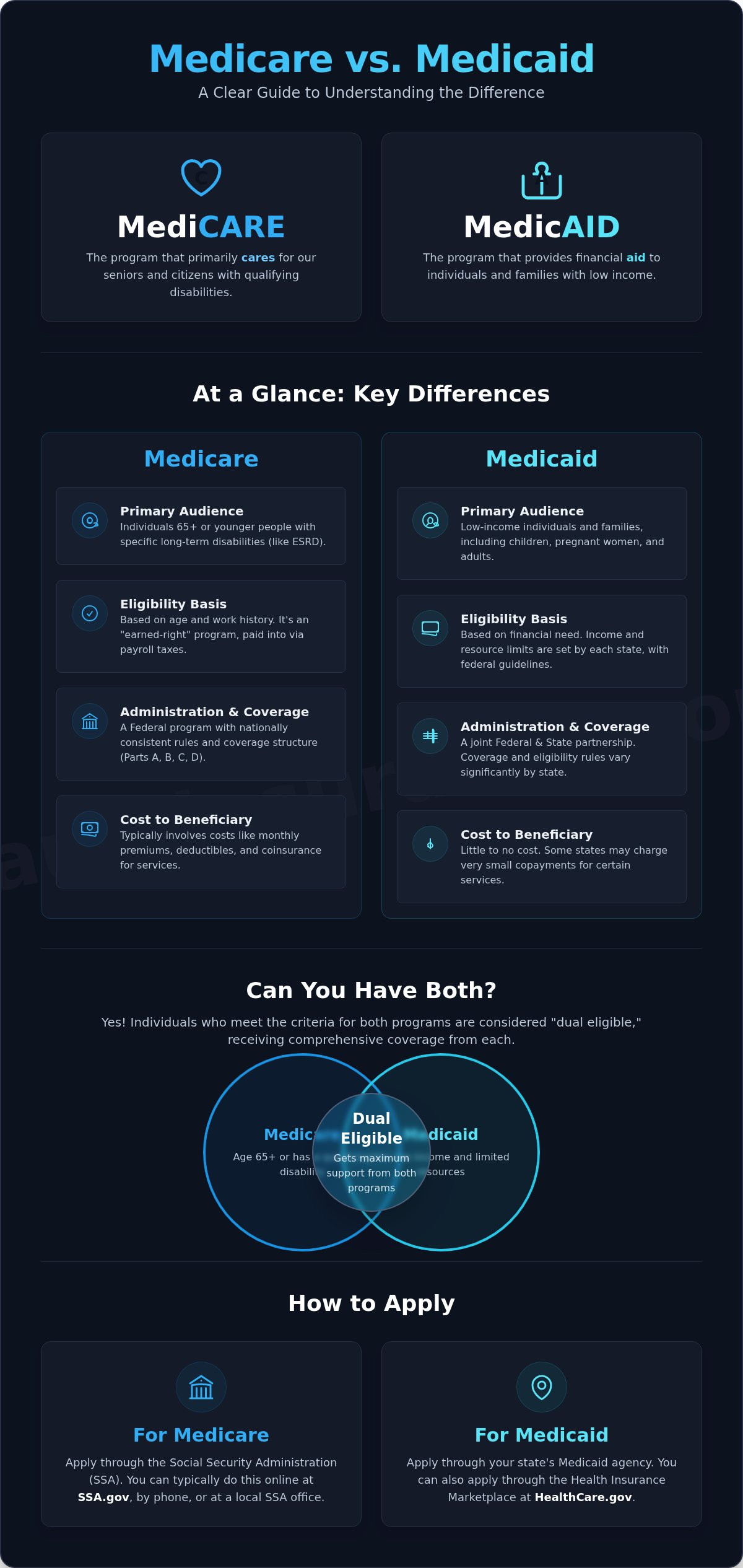
Navigating the world of government health programs can feel overwhelming, and one of the most common points of confusion is the difference between Medicare and Medicaid. While their names sound similar, they are two distinct programs designed to help different groups of people. To bring clarity to the medicaid vs medicare discussion, we’ve created a simple side-by-side chart to break down the essentials and help you move from confusion to confidence.
The main takeaway is this: Medicare is a federal health insurance program you typically earn through work history, primarily for seniors and those with qualifying disabilities. Medicaid is a federal and state assistance program based on financial need.
Key Takeaway: Who is Each Program For?
Medicare is primarily for individuals aged 65 or older, regardless of their income. You generally become eligible by turning 65 and having worked and paid Medicare taxes. It also provides crucial coverage for younger individuals with long-term disabilities or specific conditions like End-Stage Renal Disease (ESRD).
Medicaid, on the other hand, is designed to provide health coverage to individuals and families with low income and limited resources. Because it is jointly funded by federal and state governments, the specific eligibility rules and income thresholds can vary significantly from one state to another. For a deeper dive into its structure, Wikipedia’s explanation of Medicaid offers a comprehensive overview of these state-by-state differences.
The Easiest Way to Remember the Difference
If you’re still trying to keep them straight, here’s a helpful memory trick that has helped many of our clients find clarity:
- Think of MediCARE because the program primarily cares for our elderly and disabled citizens.
- Think of MedicAID because the program provides financial aid to those in need.
This simple distinction-caring for the aged vs. aiding the needy-is the foundation for understanding the medicaid vs medicare landscape and determining which program, if any, is right for you or your loved ones.
What is Medicare? A Deep Dive into the Federal Health Insurance Program
Navigating the differences when comparing medicaid vs medicare can feel overwhelming, but we can simplify it. Let’s start with Medicare. Think of Medicare as a federal health insurance program that you earn throughout your working years. Because it’s a federal program, the rules are generally consistent no matter which state you live in. It is primarily funded by payroll taxes (FICA) paid by you and your employers, as well as monthly premiums paid by beneficiaries. This structure makes it an “earned-right” program, much like Social Security, and as noted in Harvard Health’s guide to Medicare and Medicaid, this work-based eligibility is a fundamental distinction.
Who is Eligible for Medicare?
While Medicare is often associated with retirement, eligibility isn’t based on income but on age, disability, or specific health conditions. You generally qualify for Medicare if you are a U.S. citizen or legal resident and one of the following applies to you:
- You are age 65 or older.
- You are under 65 but have received Social Security Disability Insurance (SSDI) for at least 24 months.
- You are any age and have End-Stage Renal Disease (ESRD) or Amyotrophic Lateral Sclerosis (ALS, also known as Lou Gehrig’s disease).
Understanding the Parts of Medicare (A, B, C, D)
To provide clear guidance, it helps to break Medicare down into its four main parts, often called the “alphabet soup” of healthcare. Each part covers different services:
- Part A (Hospital Insurance): Helps cover inpatient care in a hospital, skilled nursing facility care, hospice care, and home health care.
- Part B (Medical Insurance): Helps cover doctors’ services, outpatient care, medical supplies, and preventive services.
- Part C (Medicare Advantage): An alternative to Original Medicare (Parts A and B), these are private plans that bundle A, B, and often D into one plan.
- Part D (Prescription Drug Coverage): Helps cover the cost of prescription medications.
What Are the Costs of Medicare?
Understanding your potential out-of-pocket costs is key to choosing the right coverage. Medicare costs typically include premiums (a fixed monthly payment), deductibles (what you pay before Medicare starts paying), and coinsurance or copayments (your share of the cost for a service). Most people who have worked and paid Medicare taxes for at least 10 years get Part A premium-free, but everyone pays a monthly premium for Part B and, if chosen, for Part D or a Part C plan.
What is Medicaid? The Joint Federal and State Assistance Program
While Medicare is a federal insurance program you earn through work credits, Medicaid is a different kind of support system entirely. It’s a joint federal and state assistance program designed to provide health coverage to millions of Americans with limited income and resources. This is one of the most fundamental points in the medicaid vs medicare discussion. Because each state administers its own Medicaid program according to federal guidelines, eligibility rules and benefits can vary significantly depending on where you live. As the U.S. Department of Health & Human Services explains, Medicaid is a needs-based program, often covering essential services that Medicare does not, such as long-term nursing home care.
Who is Eligible for Medicaid?
Eligibility for Medicaid is primarily determined by your Modified Adjusted Gross Income (MAGI). The program serves specific groups, including low-income adults, children, pregnant women, and individuals with disabilities. Thanks to the Affordable Care Act (ACA), many states chose to expand their Medicaid programs to cover all adults below a certain income level. Because income limits and requirements are state-specific, it’s crucial to check with your state’s Medicaid agency to get accurate, personalized guidance on whether you qualify.
What Does Medicaid Typically Cover?
Medicaid generally provides a broad range of health services, often more comprehensive than Medicare. While benefits vary by state, they must all cover certain mandatory services to receive federal funding. These typically include:
- Doctor visits and inpatient/outpatient hospital care
- Laboratory and X-ray services
- Long-term services and supports, including nursing home and home care
- Non-emergency medical transportation
What Are the Costs of Medicaid?
For those who qualify, Medicaid is designed to be extremely low-cost or entirely free. The vast majority of beneficiaries pay no monthly premiums. While some states may require very small copayments for certain services, these costs are minimal. The goal is to remove financial barriers to essential healthcare, providing a critical safety net for individuals and families with limited financial means. This low-cost structure is a key differentiator when comparing medicaid vs medicare.
Can You Have Both? Understanding Dual Eligibility
In the often-confusing discussion of medicaid vs medicare, many people are surprised to learn that it’s not always an either/or choice. In fact, millions of Americans qualify for and receive benefits from both programs simultaneously. These individuals are known as “dual eligibles.”
This status is most common for low-income seniors and younger individuals with qualifying disabilities who meet the separate eligibility criteria for both Medicare and Medicaid. For those who qualify, dual eligibility provides a powerful safety net, offering some of the most comprehensive and affordable health coverage available.
How Coverage Works with Both Medicare and Medicaid
When you are dually eligible, Medicare and Medicaid work together in a coordinated way to cover your healthcare costs. The process is straightforward: Medicare always pays first for your medical bills, acting as your primary insurance. Then, Medicaid steps in as the secondary payer to cover costs that Medicare doesn’t.
This secondary coverage from Medicaid often includes:
- Your Medicare Part B (and sometimes Part A) premiums
- Medicare deductibles for hospital and medical services
- Coinsurance and copayments you would otherwise owe
The result is a significant reduction in your financial burden, often leading to little or no out-of-pocket expenses for covered services. This seamless coordination provides invaluable peace of mind, ensuring you can access the care you need without the stress of high costs.
Medicare Savings Programs (MSPs)
Even if you don’t qualify for full Medicaid benefits, you might still get help through a Medicare Savings Program (MSP). These are state-run programs administered by Medicaid and designed specifically to help Medicare beneficiaries with their costs. There are different levels of support, including the Qualified Medicare Beneficiary (QMB), Specified Low-Income Medicare Beneficiary (SLMB), and Qualifying Individual (QI) programs.
The QMB program offers the most comprehensive assistance, paying for your Part A and B premiums, deductibles, and coinsurance. Understanding which program you qualify for can be a challenge, but getting this support can make a world of difference. Confused about MSPs? An expert can help clarify your Medicare costs.
How to Apply and Where to Get Unbiased Help
Understanding the core differences when comparing medicaid vs medicare is the first step. The next is knowing how to apply for the right program. Because these benefits are managed by different government bodies, their application processes are completely separate. Following the correct path is crucial to avoid delays and ensure you get the coverage you need, when you need it.
Applying for Medicare
Enrollment in Original Medicare (Part A and Part B) is handled nationally by the Social Security Administration (SSA). Most people apply during their Initial Enrollment Period (IEP), which is the seven-month window around their 65th birthday. You have three straightforward ways to sign up:
- Online: The fastest and most convenient method is through the Social Security website.
- By Phone: You can call the SSA’s national toll-free number to apply.
- In-Person: Schedule an appointment at your local Social Security office.
Applying for Medicaid
Unlike Medicare, Medicaid is administered at the state level. To apply, you must go through your state’s Medicaid agency. Many states have streamlined this process by using the federal Health Insurance Marketplace at HealthCare.gov. A key advantage of Medicaid is that you can apply at any time of year if your circumstances qualify you for the program-there are no limited enrollment periods to worry about.
Navigating Your Medicare Choices with Confidence
Enrolling in Original Medicare is only the beginning of your journey. You still face a complex maze of choices for your complete healthcare coverage, including Medicare Advantage, Medigap (Supplement), and Prescription Drug plans. This is where the initial question of medicaid vs medicare gives way to a new set of confusing decisions.
Instead of trying to decipher it all alone, you can get trusted, unbiased guidance from an independent Medicare expert. We work for you, not for a single insurance company. Our goal is to help you compare all your options, find a plan that fits your doctors, prescriptions, and budget, and ensure you avoid costly enrollment mistakes. This personalized support comes at no cost to you.
Ready to move from confusion to confidence? Schedule a free, no-obligation consultation to simplify your Medicare journey.
From Confusion to Clarity: Your Path to the Right Coverage
Understanding the medicaid vs medicare landscape is the first critical step toward securing your healthcare future. The key takeaway is simple: Medicare is an earned federal benefit for seniors and those with qualifying disabilities, while Medicaid is a joint federal and state assistance program based on your financial situation. As we’ve covered, some individuals can even qualify for both, unlocking comprehensive dual-eligible benefits. These distinctions are crucial, as they determine everything from your eligibility to your out-of-pocket costs.
But knowing the difference is one thing; applying that knowledge to your personal situation is another. That’s where guidance from a trusted expert makes all the difference. With over 18 years of experience simplifying this complex system, our team has proudly served more than 5,000 clients across 34 states. Our promise is to provide clear, unbiased advice by comparing plans from over 40 different carriers, ensuring you find the perfect fit for your needs and budget.
From Confusion to Confidence: Get a Free Medicare Plan Review Today.
You don’t have to navigate this journey alone. Take the next step with a team that’s dedicated to your peace of mind.
Frequently Asked Questions
Is Medicare or Medicaid better?
This is a common question, but one program isn’t better than the other-they simply serve different people. The Medicaid vs Medicare discussion is about which program fits your unique situation. Medicare is an earned-benefit federal insurance program for those 65 or older or with certain disabilities. Medicaid is a state and federal assistance program based on having a low income. The best program is the one you qualify for that meets your personal healthcare needs.
What happens if my income changes while on Medicaid?
You are required to report any income changes to your state’s Medicaid agency. If your income increases above your state’s limit, you may no longer be eligible for Medicaid coverage. Losing Medicaid is considered a Qualifying Life Event, which triggers a Special Enrollment Period. This allows you to enroll in other health coverage, such as a plan from the Health Insurance Marketplace, without having to wait for the annual open enrollment period.
Can I choose my own doctors with Medicare and Medicaid?
It depends on your specific coverage. With Original Medicare, you can see any doctor in the country that accepts Medicare patients. However, most Medicare Advantage plans and Medicaid plans operate with specific provider networks. To receive full coverage, you generally must use doctors, specialists, and hospitals that are in your plan’s network. It’s always wise to check a plan’s provider directory to ensure your preferred doctors are included.
Do I need to apply for both programs separately if I think I’m dual eligible?
Yes, you must apply for Medicare and Medicaid through two separate processes. Medicare is a federal program, and you enroll through the Social Security Administration. Medicaid is administered at the state level, so you must apply through your state’s specific Medicaid agency. Although the two programs can work together to cover your healthcare costs if you are dual eligible, their application and enrollment processes are completely independent.
What if I don’t qualify for either Medicare or Medicaid?
If you don’t qualify for either program, your best option is likely the Health Insurance Marketplace, established by the Affordable Care Act (ACA). Here, you can shop for health plans from private insurers in your area. Depending on your household income, you may be eligible for premium tax credits (subsidies) that can significantly lower the cost of your monthly premiums, making comprehensive health insurance much more affordable and accessible.
It’s important to note that these options are specific to the U.S. healthcare system. Foreigners navigating insurance requirements in other parts of the world, such as Poland and the Schengen Area, need entirely different solutions. For those situations, specialized providers like Insurance VISA offer health insurance plans designed to meet visa and residency requirements.
Does having Medicaid affect which Medicare Advantage plan I can choose?
Yes, it does significantly. If you are enrolled in both Medicare and Medicaid, you are considered “dual eligible.” This status gives you access to a special type of Medicare Advantage plan called a Dual Eligible Special Needs Plan (D-SNP). These plans are designed to coordinate your benefits from both programs seamlessly. They often include rich extra benefits, such as dental, vision, and transportation, with very low or even $0 out-of-pocket costs.

Article by
Paul Barrett
Paul Barrett, CMIP is the founder of The Modern Medicare Agency, an independent Medicare-only brokerage based in Melville, NY. With 18 years of Medicare-exclusive experience, a CMIP designation, and more than 5,000 clients served across 37 states, Paul is one of the most credentialed independent Medicare specialists on Long Island — and one of the most direct.
He represents 40+ carriers with no quotas and no allegiances, which means his recommendations are based entirely on what fits each client's specific situation. He is the author of Medicare Mastery Unlocked and host of the Wise Guys Retirement Talk podcast. His content is grounded in primary sources, real carrier intelligence, and 18 years of watching what happens when people get Medicare right — and when they don't.
📞 631-358-5793 | paulbinsurance.com