




The plan with the lowest monthly premium might actually be the most expensive choice for your budget this year. It sounds backwards, but as we look at the 2026 healthcare landscape, the "cheaper" option can sometimes lead to more out-of-pocket stress when you least expect it. We understand the sticker shock you likely felt when those 2026 rate notices arrived in your Massapequa mailbox. It’s frustrating to see costs rise while you’re just trying to ensure a visit to St. Joseph Hospital doesn’t drain your savings. When comparing Medigap Plan G vs High deductible plan G in Massapequa NY, the unique community rating rules in New York make the decision even more confusing for seniors.
We’re here to replace that confusion with total confidence. We’ll break down the 2026 costs for both plans, providing a clear break-even calculation so you know exactly which path protects your wallet best. You’ll learn how local doctors view these plans and why one might be a better fit for your specific health needs. We’ve simplified the math and the jargon to give you a clear, stress-free path to the right coverage for your lifestyle. Our goal is to make sure you feel protected and empowered as you make this important choice for your future.
Key Takeaways
-
We break down the 2026 premium changes in Nassau County so you can understand exactly how these shifts affect your monthly budget and peace of mind.
-
Compare the real-world costs of Medigap Plan G vs High deductible plan G in Massapequa NY to see which plan offers the right balance of protection for your health needs.
-
Learn our “Massapequa Math” for the 11758 and 11762 zip codes to help you decide if lower monthly premiums are worth a higher deductible in the long run.
-
See how your coverage works at local facilities like St. Joseph Hospital, ensuring you can keep seeing the doctors you know and trust right here at home.
-
Follow our simple 5-step process to move from confusion to confidence, giving you the clarity you need to make a decision without any pressure or stress.
Table of Contents
-
The 2026 Medigap Landscape in Massapequa: Why the Choice Matters Now
-
Plan G vs. High Deductible Plan G: Understanding the Mechanics
The 2026 Medigap Landscape in Massapequa: Why the Choice Matters Now
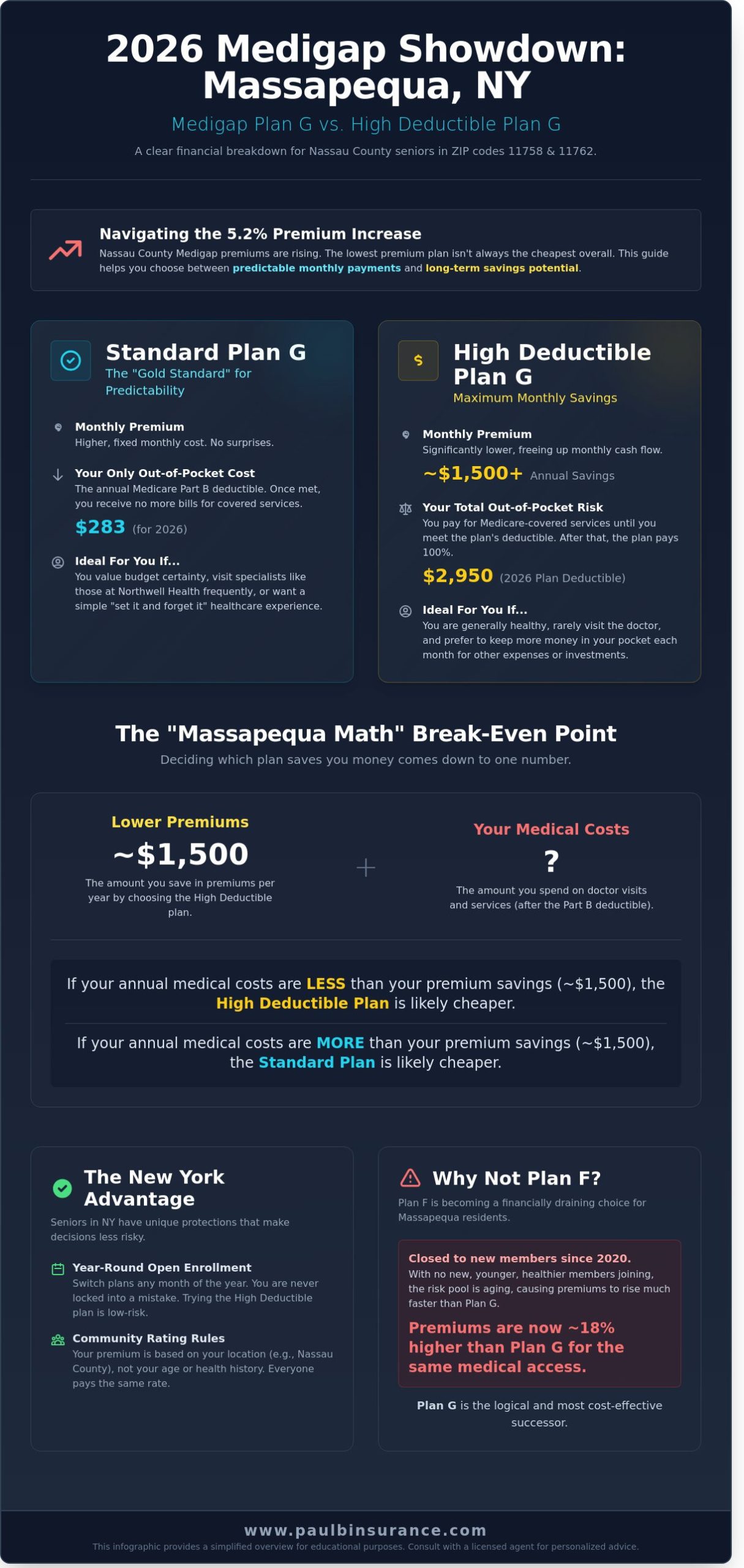
We understand that opening your mail in 2026 can feel like a source of stress rather than a simple daily routine. Many Massapequa residents are noticing a 5.2% average increase in Nassau County Medigap premiums this year. We want to help you make sense of these adjustments so you can stop worrying about your mailbox. Deciding between Medigap Plan G vs High deductible plan G in Massapequa NY is the most frequent conversation we have with our neighbors today. Standard Plan G remains the gold standard for New York seniors because it covers 100% of the gaps in Medicare Part A and B once you meet the annual Part B deductible.
The core choice comes down to a simple mathematical preference. You are choosing between monthly premium certainty and annual deductible flexibility. Standard Plan G offers a predictable monthly bill. You pay more upfront, but your out-of-pocket costs at the doctor or hospital are almost zero. High Deductible Plan G offers a different path. You pay a much lower premium each month, often saving over $1,500 a year in 2026, but you agree to pay for your own medical services until you hit the 2026 deductible of $3,000. We find that for many healthy seniors living near Florence Lake, that extra $125 in monthly cash flow provides a significant sense of financial freedom.
We focus on removing the anxiety from this process by showing you the hard numbers. If you rarely visit the doctor, paying for the "Gold Standard" premium might feel like wasting money. If you have frequent specialist visits at Northwell Health, the standard plan usually wins. We are here to ensure you don’t feel rushed or pressured into a decision that doesn’t fit your actual lifestyle.
New York’s Special Rules for Medigap
Living in New York gives you protections that seniors in most other states simply do not have. We enjoy year-round open enrollment here. This means you can switch your plan at any time during the year without a medical exam or "underwriting." Medigap (Medicare Supplement Insurance) in our state follows strict community rating rules. Your neighbor in Biltmore Shores pays the exact same rate as you do, regardless of their health history or age. These unique laws make testing out a High Deductible Plan G much less risky than it is elsewhere. If you try the high deductible option and realize you would prefer the traditional coverage, we can help you switch back to standard Plan G on the first of any month. You are never locked into a mistake.
Why Plan F is No Longer the Primary Contender
We still see some local residents holding onto Plan F, but the eligibility window for that plan closed for new retirees on January 1, 2020. Since no new, younger members can join those plans, the costs are rising much faster than Plan G. In 2026, some legacy Plan F premiums in Massapequa are 18% higher than Plan G for the exact same medical access. We see Plan G as the logical successor for 95% of our local clients. It offers the same peace of mind without the closed group price hikes that are currently draining local retirement accounts. Comparing Medigap Plan G vs High deductible plan G in Massapequa NY is the best way to ensure your 2026 budget remains secure and predictable.
Plan G vs. High Deductible Plan G: Understanding the Mechanics
When we sit down with neighbors to compare Medigap Plan G vs High deductible plan G in Massapequa NY, the first thing we address is that these two plans are actually siblings. They share the same DNA. Both plans are designed to step in where Original Medicare stops, specifically covering the 20% coinsurance that can otherwise lead to unlimited out-of-pocket costs. Whether you are receiving treatment at St. Joseph Hospital or visiting a local specialist, both plans provide a safety net that protects your life savings from medical inflation.
The core difference lies entirely in how you pay for that protection. As explained on the official Medicare website, Medigap plans are standardized, meaning the benefits for a specific letter plan don’t change from one company to another. For both versions of Plan G, the "coverage" is identical once the deductible is met. They both cover Part A hospital costs, Part B excess charges, and even foreign travel emergencies. The mechanics simply dictate when the insurance company starts picking up the check.
Standard Plan G: The "No-Bill" Experience
Standard Plan G remains the most popular choice for our clients who value total predictability. In 2026, the only gap this plan leaves you with is the annual Part B deductible, which currently sits at $283. Once you pay that initial $283 for the year, you will not receive another bill for any Medicare-covered service. This "no-bill" experience is a massive relief for those who visit specialists frequently or have ongoing health concerns. We find that many Massapequa seniors prefer this because it turns their healthcare into a fixed monthly subscription. You pay your premium, pay your small annual deductible, and then enjoy the peace of mind that comes with knowing your medical expenses are capped for the calendar year.
High Deductible Plan G: How the Deductible Works
High Deductible Plan G is the strategic choice for those who are comfortable taking on some risk in exchange for a much lower monthly premium. For the 2026 calendar year, the high-deductible amount is set at $2,950. This means you are responsible for the first $2,950 of your medical costs before the plan pays a dime. Costs that count toward this limit include your Part B coinsurance and hospital deductibles. We often call the moment you hit that limit the "magic moment" because the plan suddenly transforms. Once that $2,950 threshold is reached, the plan begins paying 100% of your covered costs, exactly like the standard version. It is an effective way to protect against a catastrophic health event while keeping your fixed monthly costs as low as possible.
Choosing between these two options depends on your health history and your comfort with variable costs. If you are healthy and rarely see a doctor, the high-deductible version can save you thousands in premiums over several years. However, if you prefer the security of knowing every bill is covered, the standard plan is usually the winner. If you’re feeling stuck, we can help you compare these costs side-by-side to see which fits your personal budget and lifestyle. We want to move you from a state of confusion to total confidence in your choice.
The "Massapequa Math": Break-Even Analysis for 2026
Deciding between Medigap Plan G vs High deductible plan G in Massapequa NY often feels like a high-stakes math problem. We know that looking at these numbers can feel overwhelming, especially when you are trying to protect your retirement savings. Our goal is to replace that confusion with total confidence by breaking down the actual costs you will see in the 11758 and 11762 zip codes this year. When we look at the numbers for 2026, the choice usually becomes clear once you see the "Premium Savings Gap" laid out on paper.
Real-World Pricing Examples for Long Island
In Massapequa, your monthly budget is often dictated by the high cost of living on Long Island. For 2026, we find that a standard Medigap Plan G premium for a 65-year-old non-smoker typically ranges from $370 to $450 per month. In contrast, the High Deductible Plan G (HDG) is much more affordable, with premiums landing between $80 and $110 each month. This creates a massive monthly savings of roughly $320 that stays in your bank account instead of going to an insurance company. Your total annual premium savings of approximately $3,840 is significantly higher than the official 2026 Medigap high-deductible limits, which sit at $2,950 for the year.
-
Standard Plan G Annual Cost: $4,980 (based on a $415 average)
-
High Deductible Plan G Annual Cost: $1,140 (based on a $95 average)
-
Guaranteed Annual Savings: $3,840
We often ask our clients to consider the worst-case scenario. If you were to face a major medical event in January 2026 and hit your full $2,950 deductible immediately, you would still be "ahead" by the end of the year. Because you saved $3,840 in premiums, you have effectively paid your entire deductible and still kept $900 in your pocket compared to the standard plan. For the healthy Massapequa senior who only visits the doctor a few times a year, the best-case scenario is even better. You could potentially finish 2026 with nearly $3,500 in extra savings.
Finding Your Break-Even Point
To make Medigap Plan G vs High deductible plan G in Massapequa NY "worth it" from a strictly financial perspective, you would need to have enough medical procedures to exceed your premium savings. Since a typical specialist co-pay under Medicare Part B is 20% of the Medicare-approved amount, you would need dozens of office visits or several outpatient procedures before the standard Plan G starts to save you money. In a high-cost area like Nassau County, where every dollar counts, we find that most of our clients prefer to keep their money rather than prepaying for claims they might never file.
We strongly recommend the "Savings Account Strategy" for our HDG clients. Instead of sending $415 to the insurance company, you pay your $95 premium and put the remaining $320 into a dedicated high-yield savings account. This builds a safety net that you control. If you don’t use it for medical bills, that money belongs to you, not the carrier. We are here to help you set up this simple system so you can navigate the Medicare maze with a clear plan and a protected checkbook.
Choosing the Right Plan for Your Massapequa Lifestyle
Deciding between Medigap Plan G vs High deductible plan G in Massapequa NY requires looking closely at your daily routine and your health goals for 2026. We don’t want you to just pick a letter; we want you to pick a strategy that protects your savings. If you spend your Saturday mornings at the Massapequa Preserve or visiting family near the South Oyster Bay, you want health coverage that feels like a safety net, not a source of stress. Your current health status is the biggest driver of this decision. If you have a chronic condition that requires monthly specialist visits, the standard Plan G offers a predictable "one and done" premium structure. For those who rarely see a doctor, the high-deductible version can keep more money in your pocket each month.
Our team at The Modern Medicare Agency often looks at how local facilities like St. Joseph Hospital in Bethpage interact with these plans. Because Medigap plans don’t use provider networks, you have the freedom to choose any doctor who accepts Medicare. This is a massive advantage over restrictive HMO plans. Whether you are seeing a cardiologist in Massapequa Park or a physical therapist near the LIRR station, your coverage travels with you. We believe in providing you with the clarity to make these choices without feeling pressured or rushed.
Lifestyle factors also play a huge role in this choice. If you plan to travel outside of New York or even the United States in 2026, both versions of Plan G provide foreign travel emergency benefits. This is a critical feature that Basic Medicare simply doesn’t offer. We also remind our neighbors that neither plan covers your prescriptions. You must pair your choice with a Medicare Part D plan to ensure your medications are affordable and to avoid the lifetime enrollment penalties that Medicare charges for late sign-ups.
Local Healthcare Considerations
In our experience, the greatest relief for Massapequa seniors is knowing they can keep their trusted local doctors. Both Plan G options allow you to access any provider in Bethpage or Massapequa that takes Medicare. We emphasize this flexibility because it removes the "referral" headache common in other plans. You are the boss of your own healthcare, and we are here to ensure the paperwork doesn’t get in your way.
The "Healthy Senior" Profile for High Deductible Plan G
Who saves the most with the high-deductible route? Typically, it’s the person who hasn’t needed a major medical procedure in the last 36 months. For 2026, the deductible for this plan is set at $2,950. If the monthly premium savings between the two plans is $115, you save $1,380 annually. If you don’t hit that deductible, that money stays in your bank account. To ensure total protection, we suggest adding dental insurance to your package, as oral health becomes even more vital as we age.
We are ready to help you move from confusion to confidence today. Schedule a Call With Paul to find the perfect fit for your needs.
How We Help You Navigate the Medigap Maze in Massapequa
Deciding between Medigap Plan G vs High deductible plan G in Massapequa NY often feels like a heavy weight for seniors. We take that weight off your shoulders by replacing confusion with clarity. Our team has spent over 12 years helping Long Island residents move from uncertainty to total confidence. We use a proven 5-step process to ensure you never feel rushed or pressured into a decision.
Our 5-step path to confidence includes:
-
Initial Discovery: We listen to your health history and budget goals for the 2026 calendar year.
-
Data Analysis: We compare your specific doctors and prescriptions against current plan networks.
-
The Math Check: We run a side-by-side comparison of the standard Plan G premium versus the 2026 High Deductible G limit of $2,950.
-
Seamless Enrollment: We handle the paperwork and digital filings to ensure you avoid late enrollment penalties.
-
Annual Rate Watch: We monitor your premium every October to see if a different carrier offers a lower price for the same coverage.
You might see flashy ads from "captive" agents who only work for one specific insurance company. Those agents can only offer you one brand. Because we’re an independent broker, we work for you. We currently track 18 different carriers in the Massapequa area. This independence allows us to find the most competitive rates available in the 11758 zip code without any bias toward a specific corporation.
Our team is based right here in Melville. We aren’t a faceless call center in a different time zone. We know the local healthcare landscape, from the specialists at St. Joseph Hospital to the primary care groups along Merrick Road. If you have a billing question or a claim issue in the middle of the year, you can call us directly. We provide year-round support to ensure your coverage stays as reliable as the day you signed up.
The Modern Medicare Agency Advantage
We’re committed to providing unbiased, jargon-free guidance. Insurance companies love to use complicated terms to hide price hikes, but we strip that away. We proactively monitor your plan every single year. If a carrier raises rates by more than 8 percent, we’ll reach out to discuss your options. You can do deeper research on your own by visiting our Medigap overview page to see how these plans function in 2026.
Ready to Compare? Schedule Your Call with Paul
The best way to see the actual math for Medigap Plan G vs High deductible plan G in Massapequa NY is through a low-pressure conversation. To prepare for your first consultation, simply have your red, white, and blue Medicare card and your current list of medications ready. We’ll look at the 2026 numbers together and see which version of Plan G fits your lifestyle. Our professional services and expert consultations are provided at no cost to our clients. We’re here to be your advocate and your educator, ensuring you stay protected through every stage of retirement.
Take Control of Your 2026 Medicare Coverage
Choosing between Medigap Plan G vs High deductible plan G in Massapequa NY is one of the most important financial decisions you’ll make this year. Standard Plan G provides total predictability, leaving you with only the $283 Part B deductible to cover. On the other hand, the High Deductible Plan G offers significantly lower monthly premiums for those comfortable with the $2,950 out-of-pocket limit. We’ve helped local neighbors save upwards of $1,100 annually by analyzing these exact numbers. It’s about finding the balance that fits your specific health needs and budget.
Our Melville based team makes this process simple. We compare plans from over 40 insurance carriers to provide unbiased, jargon-free advice tailored to your life. We don’t want you to feel rushed or pressured; we want you to feel protected. Let us handle the complex math so you can enjoy your retirement with peace of mind. You don’t have to navigate this maze alone.
Schedule a Call with Paul to find your perfect 2026 Medigap fit
We’re ready to help you move from confusion to confidence today.
Frequently Asked Questions
What is the exact 2026 deductible for High Deductible Plan G?
The deductible for High Deductible Plan G is $2,950 for the 2026 calendar year. This figure is set by the Centers for Medicare and Medicaid Services and typically increases every January 1st based on national inflation data. You must pay this full amount for Medicare covered services before your Medigap policy begins to pay its share. We help you track these annual adjustments so your budget stays on track without any surprises.
Can I switch from standard Plan G to High Deductible Plan G in Massapequa without a health exam?
Yes, you can switch plans at any time in New York without answering health questions or undergoing a medical exam. New York state law requires "continuous open enrollment," which is a huge win for local residents. This protection ensures you won’t be denied coverage or charged more due to pre-existing conditions. We can help you compare Medigap Plan G vs High deductible plan G in Massapequa NY to see which fits your 2026 budget best.
Does High Deductible Plan G cover my prescriptions at local Massapequa pharmacies?
Medigap plans do not cover retail prescription drugs, regardless of whether you choose the standard or high deductible version. You will need to enroll in a separate stand-alone Part D prescription drug plan to cover medications at local spots like CVS or Walgreens on Merrick Road. We simplify this process by reviewing your current medications. This ensures your Part D plan covers everything you need at the lowest possible cost during 2026.
Is St. Joseph Hospital in Massapequa considered "in-network" for these plans?
St. Joseph Hospital is not "in-network" because Medigap plans do not use restrictive provider networks. You have the freedom to visit any doctor or hospital in the country that accepts Medicare, including St. Joseph’s and other local Northwell facilities. This gives you total control over your healthcare choices. You won’t need referrals or permission from an insurance company to see the specialists you trust for your care, which removes a lot of stress.
What happens if the Medigap deductible increases next year?
If the High Deductible Plan G limit increases, you are responsible for the new, higher amount before your supplemental coverage starts. For example, if the deductible moves from $2,950 in 2026 to a higher number in 2027, your out-of-pocket responsibility grows accordingly. We monitor these changes every year for our clients. This ensures you always have a clear plan for your healthcare spending and aren’t caught off guard by federal adjustments or policy shifts.
Is there a difference in foreign travel emergency coverage between the two plans?
Both Plan G and High Deductible Plan G offer the exact same foreign travel emergency benefits. They cover 80% of the cost for emergency care during the first 60 days of your trip after you pay a small $250 deductible. There is a $50,000 lifetime maximum for this benefit. This provides peace of mind when you travel abroad, knowing you have a safety net for unexpected medical crises while away from home on vacation.
How do I know if I am eligible for High Deductible Plan G in 2026?
You are eligible for High Deductible Plan G if you are enrolled in Medicare Part A and Part B. This plan is available to anyone who turned 65 after January 1, 2020, making it a popular choice for many seniors in our community. We guide you through a simple enrollment process to ensure you meet all federal requirements. Our goal is to move you from confusion to confidence during your 2026 insurance transition.
Why are Medigap premiums in New York higher than in other states?
New York premiums are higher because the state mandates community rating, which means everyone pays the same rate regardless of age or health status. Since insurance companies cannot charge sick people more or deny them coverage, the overall costs for the pool of members are higher. While this makes premiums more expensive than in 40 other states, it provides 100% protection for Massapequa residents who develop serious health issues later in life.

Article by
Paul Barrett
Paul Barrett, CMIP is the founder of The Modern Medicare Agency, an independent Medicare-only brokerage based in Melville, NY. With 18 years of Medicare-exclusive experience, a CMIP designation, and more than 5,000 clients served across 37 states, Paul is one of the most credentialed independent Medicare specialists on Long Island — and one of the most direct.
He represents 40+ carriers with no quotas and no allegiances, which means his recommendations are based entirely on what fits each client's specific situation. He is the author of Medicare Mastery Unlocked and host of the Wise Guys Retirement Talk podcast. His content is grounded in primary sources, real carrier intelligence, and 18 years of watching what happens when people get Medicare right — and when they don't.
📞 631-358-5793 | paulbinsurance.com