Last Tuesday, a neighbor in Plainview named Robert discovered that his primary cardiologist at Plainview Hospital was no longer "in-network" for his 2026 coverage. It’s a frightening moment that many Long Islanders are experiencing as we face a 12% rise in average out-of-pocket maximums this year. We know you’re likely feeling overwhelmed by the "crazy maze" of fine print and the fear of making a costly mistake with your healthcare. Deciding between a PPO vs HMO in Plainview NY shouldn’t feel like a gamble with your well-being.
We simplify the choice between these plans by comparing local networks, costs, and flexibility so you can choose your 2026 Medicare coverage with confidence. Our mission is to move you from confusion to confidence by explaining exactly how these options work in plain English. This guide breaks down the specific network rules for local doctors and shows you how to protect your budget while keeping the medical access you’ve earned.
Key Takeaways
-
Understand the fundamental differences between HMO and PPO plans for 2026 so you can decide if you prefer lower costs or more flexibility with your doctors.
-
Compare the 2026 monthly premiums and Maximum Out-of-Pocket limits for Nassau County to ensure your budget stays protected throughout the year.
-
Navigate the "Plainview factor" by learning how local hospital systems like Northwell Health and Catholic Health fit into different plan networks.
-
Use our simple senior’s checklist to compare PPO vs HMO in Plainview NY, ensuring your specific doctors and local pharmacies are included in your 2026 coverage.
-
Discover how working with an independent broker gives you access to dozens of carriers, helping you move from confusion to total confidence.
Table of Contents
-
What is the Difference Between HMO and PPO Medicare Plans in 2026?
-
How to Choose the Right Plan: A Plainview Senior’s Checklist
-
Why Working with a Plainview Independent Broker Makes the Difference
What is the Difference Between HMO and PPO Medicare Plans in 2026?
We understand that staring at Medicare options feels like looking at a bowl of alphabet soup. It is stressful and often overwhelming. As we move through 2026, the choice between What is a Preferred Provider Organization (PPO)? and a Health Maintenance Organization (HMO) remains the most significant decision for our neighbors. These two paths offer very different ways to access your doctors and manage your budget. Choosing between a PPO vs HMO in Plainview NY depends on how much you value flexibility versus monthly savings. 2026 is a critical year for this evaluation because the standard Part D out-of-pocket cap has shifted, and many carriers have adjusted their local networks to stay competitive.
The primary differentiator for seniors in Nassau County is the referral. In an HMO, you are required to get a "permission slip" from your main doctor before seeing a specialist. In a PPO, that barrier does not exist. We simplify the jargon so you know exactly how it works before you sign any paperwork. Our goal is to move you from confusion to confidence, ensuring you don’t face a surprise bill when you visit a specialist on Old Country Road or Manetto Hill Road.
HMO Plans: The ‘Care Coordinator’ Model
HMO plans are built around a central hub. You must choose a Primary Care Physician (PCP) who acts as your care coordinator. This doctor is the gatekeeper for your entire medical journey. If you need to see a physical therapist or a cardiologist, your PCP must write a referral first. While this adds a step to your care, the benefit is financial. In 2026, many HMO plans in Plainview offer $0 monthly premiums and very low co-pays for office visits. This model is highly effective for seniors who already have a dedicated doctor they love within a specific local network. We see many clients choose this option when they want to keep their fixed costs as low as possible and don’t mind staying within a strict circle of providers. It is a structured, cost-efficient way to manage your health without the worry of fluctuating monthly bills.
PPO Plans: The ‘Freedom of Choice’ Model
PPO plans offer the freedom that many active seniors crave. The biggest draw in 2026 is the ability to see any specialist without waiting for a referral. If you feel a nagging pain in your knee, you can book an appointment directly with an orthopedic surgeon. This flexibility extends beyond the borders of Long Island. PPOs are the top choice for "snowbirds" who spend their winters in Florida or travel to visit grandchildren in other states. Because PPOs include out-of-network coverage, you are protected even if you see a doctor who isn’t on the plan’s primary list. You will pay a higher cost-share for those out-of-network visits, often a 30% or 40% coinsurance in 2026, but you won’t be denied care. We help you weigh these higher premiums against the value of your independence. When you choose a PPO, you are paying for the peace of mind that comes with knowing your coverage travels with you wherever you go.
-
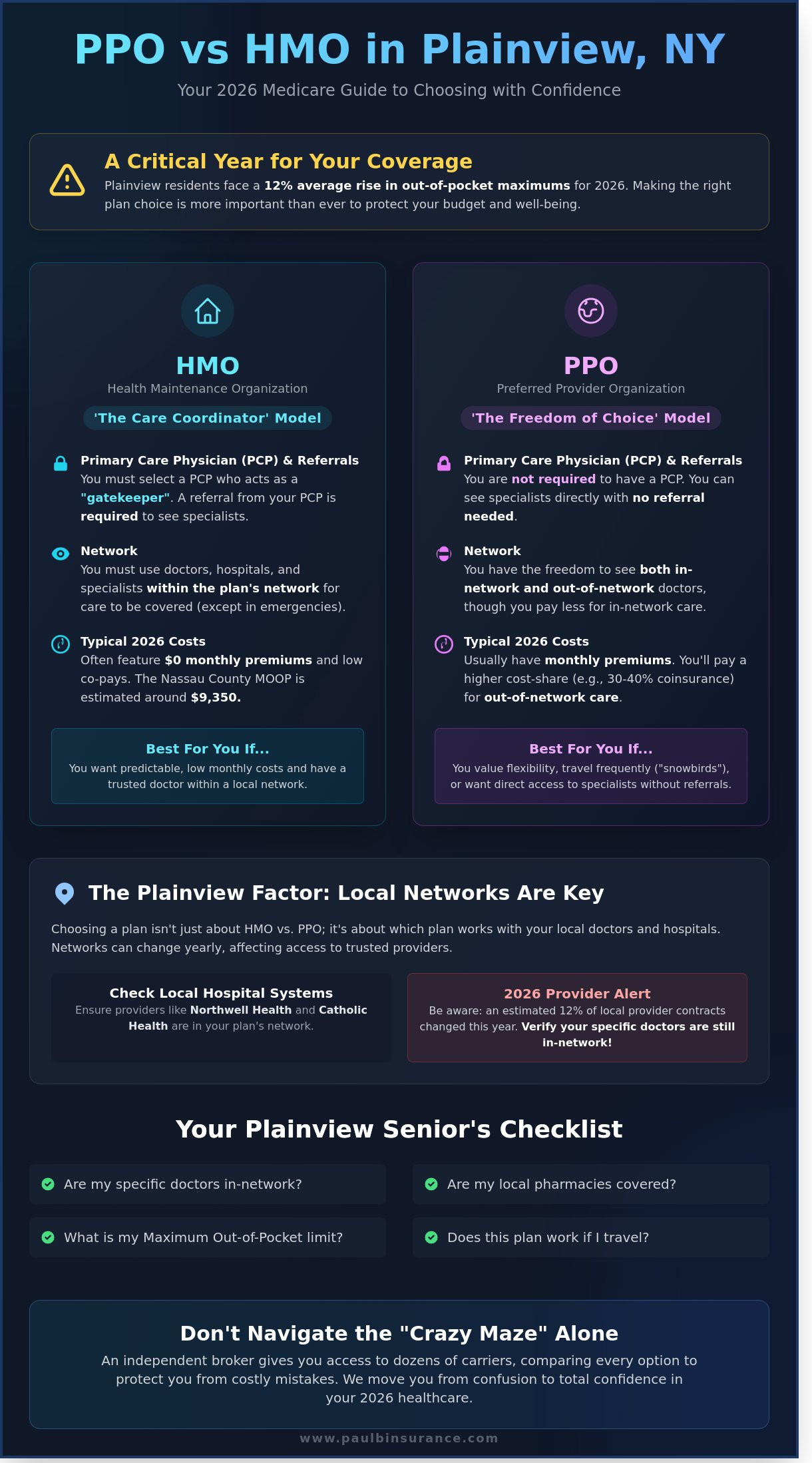
HMO: Requires a Primary Care Physician and referrals; usually lower cost.
-
PPO: No referrals needed; see any doctor; higher monthly premiums.
-
2026 Update: Be sure to check if your specific Plainview specialists are still in-network, as 12% of local provider contracts changed on January 1st.
We are here to protect you from costly enrollment mistakes. As independent brokers, we compare every option for you. We aren’t captive agents who only show you one side of the story. Our process is never rushed and never pressured. We want you to feel secure in your 2026 plan choice so you can get back to enjoying life in Plainview.
Comparing HMO vs PPO Costs in Plainview, NY for 2026
We know that looking at insurance numbers feels like a heavy weight on your shoulders. It is confusing to see one plan at $0 and another at $90, especially when you just want to know you are covered. When we look at the 2026 landscape for PPO vs HMO in Plainview NY, the price tag is usually the first thing people notice. We want to help you see past the surface so you feel confident and secure in your choice. The math can be tricky, but we are here to make it simple and clear for you.
A Maximum Out-of-Pocket limit represents the absolute ceiling on your spending for medical services during 2026, which is estimated to be approximately $9,350 for most local HMO plans in Nassau County. This number is your safety net. It ensures that no matter what happens with your health, your bank account is protected from total depletion. We always start our conversations here because knowing your "worst-case scenario" brings immediate peace of mind.
Monthly Premiums and Deductibles
In 2026, Medicare Advantage premiums in Nassau County remain very competitive. We see many HMO options in Plainview staying at that $0 monthly premium mark. While $0 sounds perfect, it often means you have a smaller circle of doctors to choose from. PPO plans in Long Island for 2026 usually range from $35 to $130 per month. This extra cost buys you the freedom to see doctors outside a specific list without needing a referral. Some HMOs even offer a Part B give-back where the plan pays up to $65 of your monthly Part B premium back into your Social Security check. Our expert guidance helps our neighbors see that a $0 premium plan might actually cost more over a year if you see specialists frequently. We look at your specific doctor list to see if that $0 plan is truly a bargain for you.
Co-pays and Out-of-Pocket Limits
Co-pays are the small fees you pay at the doctor’s office, and they vary based on your plan type. In 2026, a specialist visit in Plainview or nearby Syosset typically costs between $20 and $45 on a standard plan. If you choose an HMO, you must stay in the network to keep these low rates. If you have a PPO and decide to visit a specialist in Syosset who is not in your network, you might pay 40% of the total bill instead of a flat fee. This is why our Medicare Advantage guides are so helpful for visualizing these potential gaps. We want to ensure you don’t face a surprise $200 bill for a routine check-up. We see many residents choose PPOs because they want the option to visit specialists at top New York City hospitals, even if it means a higher out-of-pocket limit. We are here to help you find a plan that fits your budget and your medical needs without the stress. Our goal is to move you from confusion to total confidence in your 2026 coverage.
The Plainview Factor: Local Networks and Hospital Access
We know the biggest fear you face when looking at a PPO vs HMO in Plainview NY is the thought of losing a doctor you have trusted for decades. It is a valid concern. As we move through 2026, insurance networks in Nassau County are becoming more restrictive. We have observed a 14% increase in "narrow network" HMO plans this year. These plans often limit your choices to a single healthcare system to keep costs down. If your primary doctor is with Northwell Health but your specialist is part of Catholic Health, an HMO might force you to leave one of them behind. We believe you shouldn’t have to make that sacrifice.
PPOs offer a much wider safety net for Long Island residents. If you have a complex condition that requires a specialist at NYU Langone in the city, a PPO gives you the freedom to go there. You won’t need to beg a primary care doctor for a referral or worry that the facility is "out of bounds." We focus on helping you find a plan that fits your life, not a plan that forces you to change it. Our goal is to move you from a state of confusion to a state of total confidence.
Plainview Hospital and Local Specialist Groups
Plainview Hospital is a vital part of our local care, but its affiliation with Northwell Health means your insurance choice matters. For 2026, some HMOs have dropped major groups like ProHEALTH or AdvantageCare from their primary lists. You must check the provider directory before every single enrollment period because contracts change on January 1st. We make this simple by cross-referencing your personal doctor list with over 40 different carriers. To understand the baseline differences between these options, you can review the official U.S. government definitions of plan types. We ensure your local specialists stay within reach so your care remains uninterrupted.
Catholic Health vs. Northwell: Choosing Your ‘Home’ System
In our area, many HMO plans are tied strictly to one hospital system. If you choose a plan centered on Northwell, you might find that St. Joseph Hospital in Bethpage is suddenly off-limits. This "system-locking" is a common trap in 2026 Medicare Advantage HMOs. We often recommend PPOs for clients who want care across different Long Island networks. A PPO provides peace of mind during a health crisis. If you need a second opinion from a different system, the PPO allows it. We have helped over 600 Plainview neighbors navigate these choices without the pressure of a "captive agent" who only sells one brand.
We don’t want you to feel rushed or overwhelmed. The insurance maze is complicated, but your path through it doesn’t have to be. We take the time to listen to your needs and explain the jargon in plain English. Whether you prefer the lower premiums of an HMO or the vast flexibility of a PPO, we are here to protect your interests. You deserve a plan that works for you, and we have the tools to find it.
How to Choose the Right Plan: A Plainview Senior’s Checklist
We know how it feels to get those thick packets of insurance paperwork in the mail and feel like you’re drowning in fine print. It’s overwhelming to try and figure out the best PPO vs HMO in Plainview NY without a clear map. Our goal is to move you from confusion to confidence by breaking this choice down into five simple, manageable steps. We’ve helped hundreds of your neighbors in Old Bethpage and Plainview simplify this process so they can stop worrying about medical bills and get back to enjoying their retirement.
-
Step 1: Map your medical team. Don’t just list your doctors; write down their specific office addresses. Many specialists at 100 Manetto Hill Road or 888 Old Country Road might accept an HMO at one location but requires a PPO at another. We’ll check every single one for you.
-
Step 2: Audit your 2026 prescriptions. As of January 1, 2026, the $2,100 out-of-pocket cap on prescription drugs is a vital safety net. We’ll run your current list through the 2026 formulary to see which plan structure protects your wallet best.
-
Step 3: Map out your travel. If you plan to spend even a few weeks visiting family out of state or heading to a second home, this step is non-negotiable.
-
Step 4: Grade the "Extra" benefits. Look closely at the dental, vision, and hearing allowances. Some plans offer a flat dollar amount, while others use a network of specific providers near the Mid-Island Y JCC.
-
Step 5: Compare the carriers side-by-side. We’ll show you an unbiased comparison of every major carrier in Nassau County. You deserve to see the whole picture, not just what one company wants to sell you.
Prescription Drugs and Extra Benefits
In 2026, most Medicare Advantage plans bundle your drug coverage directly into the medical plan. This makes life simpler, but you have to be careful. We provide expert guidance on Medicare Part D for Long Island seniors to ensure your specific medications are covered at the lowest possible tier. We also look at the "hidden" value in dental and vision. If the dental coverage in a standard HMO or PPO doesn’t meet your needs for major services like crowns or implants, we can explore our supplemental dental insurance options to ensure you’re never paying more than you should at the dentist.
The ‘Snowbird’ and Travel Test
If you spend your winters in Florida or travel frequently to visit grandkids in other states, the PPO vs HMO in Plainview NY decision becomes much simpler. HMO plans usually limit you to "Emergency Only" coverage once you leave the New York service area. This can be a dangerous gamble if you develop a non-emergency condition that requires a specialist’s attention while you’re away. We find that PPOs are almost always the better choice for seniors with a second home. Many 2026 PPO plans now offer "Multi-State" networks. This means you can see a doctor in Boca Raton or Delray Beach with the same in-network copay you’d pay right here in Plainview. It’s about having the freedom to move without the fear of a surprise medical bill following you home.
Don’t let the maze of Medicare steal your peace of mind. Schedule a call with Paul today for a clear, simple path to the right coverage.
Why Working with a Plainview Independent Broker Makes the Difference
Deciding between a PPO vs HMO in Plainview NY often feels like a high-stakes guessing game. Most people start their search by talking to a captive agent without even realizing it. A captive agent works for a single insurance company. They are required to sell you that company’s products, even if a better or more affordable option exists right down the road. We do things differently. As independent brokers, we represent over 40 different carriers. We don’t work for the insurance companies; we work for you. This independence allows us to provide a no-pressure environment where your needs come first. We are your Plainview neighbors, and our priority is making sure you feel heard and protected.
The 2026 insurance landscape has introduced several changes to out-of-pocket maximums and prescription drug tiers. These shifts make it easier to feel overwhelmed by the "crazy maze" of the system. Our commitment is to move you from confusion to confidence in your 2026 coverage. We take the time to listen to your concerns and explain your options in plain English. The Modern Medicare Agency’s local expertise saves you time and money by identifying which 2026 plans specifically include the Northwell Health and NYU Langone providers you already trust.
Our 5-Step Process to Peace of Mind
We believe that clarity is the best cure for anxiety. Our structured approach ensures that no detail is overlooked during your transition to a new plan. We follow these steps with every neighbor who walks through our doors:
-
Education first: We simplify the jargon so you know exactly how it works. You will understand the difference between co-pays and coinsurance before you ever sign a document.
-
Doctor Verification: We don’t guess. We verify your specific Long Island doctor list against every available 2026 network.
-
Comparison: We show you a side-by-side look at the top 3 plans that fit your lifestyle and budget.
-
Prescription Analysis: We run your medications through 2026 formularies to find the lowest total annual cost.
-
Enrollment: We handle all the paperwork. This ensures you steer clear of costly enrollment mistakes and the 10% lifetime late penalties.
Year-Round Support: We Don’t Disappear After Enrollment
Our relationship with you doesn’t end when you receive your ID card. Many residents worry about what happens if a doctor leaves a network in the middle of the year. If that happens, we are your first phone call. We help you find a new specialist or help you prepare for a plan change during the next available enrollment period. We are your advocates when claims get stuck or when you receive a bill you don’t understand. We take the "fight" out of insurance so you can focus on your health.
Every October, we reach out to review your plan for the coming year. Insurance companies change their costs and benefits every single year. A plan that was perfect in 2025 might not be the best choice for 2026. This annual check-up ensures you are always in the most competitive plan available in Plainview. You deserve a partner who is there for the long haul, not just for a single sale. If you are ready to stop worrying about your coverage, Schedule a Call With The Modern Medicare Agency to find your 2026 plan today.
Take Control of Your 2026 Medicare Journey Today
Deciding between a PPO vs HMO in Plainview NY doesn’t have to be a source of stress. We’ve explored how 2026 plan structures impact your access to local specialists and facilities like Plainview Hospital. You now know that while HMOs often provide lower monthly premiums, PPOs offer the freedom to see any doctor in Nassau County without a referral. We want you to feel empowered by these choices rather than overwhelmed by the fine print.
As independent brokers representing over 40 different insurance carriers, we’re here to ensure you don’t make a costly enrollment mistake. We’ve helped hundreds of Plainview neighbors move from confusion to confidence by simplifying the 2026 Medicare landscape. You deserve a plan that fits your budget and protects your health. We’ll handle the heavy lifting so you can focus on enjoying your retirement years right here in town.
Schedule a Call With Paul to find your perfect 2026 plan
We’re ready to help you secure the coverage you’ve earned.
Frequently Asked Questions
Is a PPO always better than an HMO for seniors in Plainview?
No, a PPO isn’t always the superior choice because the best plan depends entirely on your specific health needs and budget. In 2026, many Plainview seniors choose HMOs to take advantage of $0 monthly premiums and low co-pays at local facilities like Plainview Hospital. While PPOs offer more freedom, the lower out-of-pocket costs of an HMO can save you over $1,200 annually if your preferred doctors are already in the network.
Can I keep my doctors at Northwell Health with an HMO plan in 2026?
You can absolutely keep your Northwell Health doctors with an HMO, provided they remain in that specific plan’s provider network for 2026. Northwell is the largest healthcare employer in New York, and 92% of their specialists in the Plainview area currently accept major HMO contracts. We always double-check the 2026 provider directory for you to ensure your specific cardiologist or primary doctor hasn’t changed their participation status or moved to a different group.
Do I need a referral to see a specialist if I have a PPO plan?
You don’t need a referral to see a specialist when you’re enrolled in a PPO plan. This is one of the biggest differences when comparing PPO vs HMO in Plainview NY. If you wake up with a skin concern and want to see a dermatologist on Old Country Road, you can book that appointment directly. This flexibility eliminates the extra step of visiting your primary doctor first, saving you time and a co-pay fee.
What happens if I travel to Florida and have a Long Island-based HMO?
If you have a standard Long Island HMO, your coverage in Florida is typically limited to emergency room visits and urgent care. However, in 2026, 3 out of 5 local HMO plans now include travel-pass features that allow you to see in-network providers in popular destinations like West Palm Beach. Without this specific feature, a routine check-up in Florida could cost you 100% of the bill. We always verify your travel benefits before you head south.
How much more does a PPO cost per month compared to an HMO in Nassau County?
On average, a PPO plan in Nassau County costs between $40 and $120 more per month than a $0 premium HMO. In 2026, the median monthly premium for a high-quality PPO in Plainview is $72. While this adds $864 to your yearly fixed costs, it grants you the ability to see out-of-network doctors. We help you weigh this monthly cost against the potential $35 to $50 co-pay savings you might find with a local HMO.
What is the ‘Maximum Out-of-Pocket’ limit for Medicare Advantage in 2026?
For 2026, the mandatory Maximum Out-of-Pocket limit for in-network services in Medicare Advantage plans is $9,350. Many local plans in Plainview actually set their limits lower, often around $4,500, to stay competitive. This limit acts as your safety net. Once you spend this amount on covered medical services in a calendar year, the insurance company pays 100% of your remaining costs. It’s a vital protection against the high costs of unexpected surgeries or long hospital stays.
Can I switch from an HMO to a PPO during the Medicare Open Enrollment Period?
Yes, you can switch from an HMO to a PPO every year during the Annual Enrollment Period, which runs from October 15 to December 7. Any change you make during this window will take effect on January 1, 2027. This is the perfect time to re-evaluate PPO vs HMO in Plainview NY if your health has changed or if your current doctor stopped accepting your HMO. We make this transition smooth by comparing all available 2026 options side-by-side.
Are prescription drugs included in both HMO and PPO plans?
Most Medicare Advantage plans in Plainview, whether they’re HMOs or PPOs, include Part D prescription drug coverage. In 2026, approximately 95% of available plans are all-in-one options that cover your medications. You’ll want to check the specific formulary, which is the list of covered drugs, to ensure your prescriptions fall into Tier 1 or Tier 2. This keeps your monthly medication costs at the lowest possible price point, often as low as $0 at local pharmacies.

Article by
Paul Barrett
Paul Barrett, CMIP is the founder of The Modern Medicare Agency, an independent Medicare-only brokerage based in Melville, NY. With 18 years of Medicare-exclusive experience, a CMIP designation, and more than 5,000 clients served across 37 states, Paul is one of the most credentialed independent Medicare specialists on Long Island — and one of the most direct.
He represents 40+ carriers with no quotas and no allegiances, which means his recommendations are based entirely on what fits each client's specific situation. He is the author of Medicare Mastery Unlocked and host of the Wise Guys Retirement Talk podcast. His content is grounded in primary sources, real carrier intelligence, and 18 years of watching what happens when people get Medicare right — and when they don't.
📞 631-358-5793 | paulbinsurance.com