
On January 12, 2026, a consultant named David realized that being his own boss meant he was also his own HR department, a role he never asked for. As he approached his 65th birthday, the pressure of finding medicare for self-employed individuals over 65 felt more daunting than any tax audit. We understand that when you’re the one steering the ship, the fear of making a permanent enrollment mistake or missing a deadline can be overwhelming. You’ve worked hard to build your independence; you deserve a health plan that supports your flexible lifestyle rather than complicating it.
We’re here to help you move from confusion to confidence by simplifying the 2026 rules. You’ll learn exactly how to time your transition from the Marketplace, how to keep your premiums tax-deductible, and how to avoid the 10 percent Part B penalties that catch so many entrepreneurs off guard. This guide outlines a step by step strategy to ensure your 2026 coverage is as reliable as your business reputation.
Key Takeaways
- Learn how to master your 2026 enrollment timeline to avoid the lifetime surcharges that can quietly drain your business’s bottom line.
- Discover the most effective strategies for medicare for self-employed individuals over 65, ensuring your health coverage supports your unique entrepreneurial lifestyle.
- We compare the freedom of Medigap with the cost-savings of Advantage plans so you can choose the right flexibility for your business travel needs.
- Uncover how to turn your Medicare premiums into tax-deductible business expenses while navigating the 2026 IRMAA rules for high-earning years.
- See how an independent broker serves as your “Outsourced HR Department,” providing the unbiased guidance you need to move from confusion to confidence.
Understanding Medicare Basics for the Self-Employed in 2026
You are the CEO, the marketing department, and the HR director. While running your own business brings incredible freedom, it also means there is no corporate benefits office to guide you through the “crazy maze” of healthcare. Understanding medicare for self-employed individuals over 65 requires looking at your business structure through a new lens. In 2026, this transition is more vital than ever. Significant changes from the Inflation Reduction Act, such as the $2,000 out-of-pocket cap on prescription drugs, are now fully in effect. We want to help you move from a state of confusion to a place of total confidence.
The core difference between an employee-sponsored plan and self-employed coverage is the “creditable” status. When you work for a large firm, they handle the compliance. As an entrepreneur, the responsibility rests on your shoulders. We simplify the jargon so you know exactly how the Medicare Basics apply to your specific situation. This year, we are seeing many solo-professionals realize that their private health plans no longer provide the primary protection they need once they hit that 65-year milestone.
The “Working Past 65” Rule for Entrepreneurs
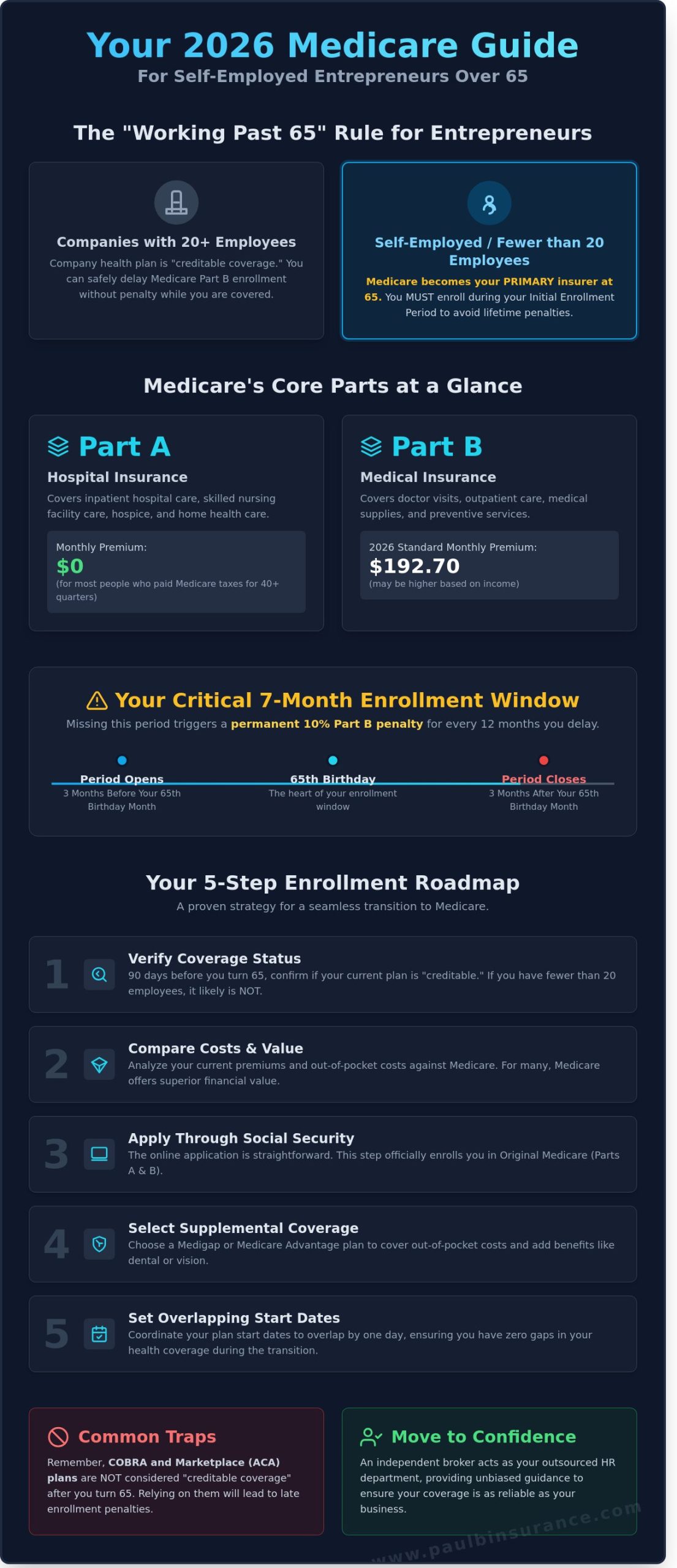
Most people hear they can delay Medicare if they are still working, but this often doesn’t apply to you. If your business has fewer than 20 employees, Medicare typically becomes your primary insurance the moment you turn 65. Because you are your only employee, your private individual plan is considered secondary. If you delay Part B without “creditable” coverage, you risk a 10 percent lifetime late enrollment penalty. We ensure you stay protected and avoid these costly mistakes.
Defining Part A and Part B in Simple Terms
We believe in keeping things straightforward. Part A is your hospital insurance. Since you have likely paid self-employment taxes for at least 40 quarters, your monthly premium for Part A is $0. Part B covers your doctor visits and medical services. For 2026, the standard monthly premium is $192.70. Signing up during your seven-month Initial Enrollment Period is essential. This foundation allows you to eventually add options like Medigap plans to cover the gaps that Medicare leaves behind.
Avoiding Penalties: The Enrollment Timeline for Business Owners
Running a business means you’re used to managing deadlines, but the ones Medicare sets are particularly strict. Missing your window can lead to lifetime surcharges that permanently hurt your bottom line. Most people get a 7-month Initial Enrollment Period (IEP). This starts three months before you turn 65 and ends three months after your birthday month. If you miss this, you might face a 10% permanent penalty on your Part B premium for every year you were eligible but didn’t sign up. Since you’ve been paying into the system through your Self-Employment Tax Obligations for years, we want to make sure you get every benefit you’ve earned without extra costs.
For those still working in 2026, you might qualify for a Special Enrollment Period (SEP). This allows you to sign up later without penalties if you have health coverage through an employer. However, the rules for medicare for self-employed individuals over 65 depend heavily on the size of your company. If you have fewer than 20 employees, Medicare usually becomes your primary insurance at age 65, making enrollment mandatory to avoid gaps. We help you look at the calendar to ensure your transition is seamless and stress-free.
Your 5-Step Enrollment Roadmap
- Step 1: Verify your “creditable coverage” status 90 days before you turn 65. If your group plan has fewer than 20 people, it likely isn’t creditable.
- Step 2: Compare your current plan costs against Medicare Part B. In 2026, many business owners find Medicare offers better value than private individual plans.
- Step 3: Apply through the Social Security website. It’s a simple process that we can walk you through in one short session.
- Step 4: Select your supplemental coverage. You can choose a Medigap plan to keep your out-of-pocket costs predictable.
- Step 5: Set your start dates to overlap by one day so you never lose protection.
The Trap of COBRA and Marketplace Plans
Many business owners think COBRA or a Marketplace plan counts as valid coverage after age 65. It doesn’t. If you stay on COBRA past your initial window, Medicare views you as having no coverage at all. This mistake triggers the late enrollment penalty. Also, those Marketplace tax credits you might currently use usually disappear the month you turn 65. We’ve seen too many people get hit with unexpected bills because they stayed on a private plan too long. We coordinate the end of your private plan so it aligns perfectly with your new Medicare start date. This prevents a gap that could leave you responsible for 100% of a medical bill. If you feel overwhelmed by these dates, you can schedule a call with us to get a clear, personalized timeline.
Advantage vs. Supplement: Which Fits Your Business Lifestyle?
As an entrepreneur, your work doesn’t always stop at the state line. We understand that medicare for self-employed individuals over 65 needs to be as flexible as your daily schedule. Choosing between a Supplement and an Advantage plan isn’t just about the monthly premium. It’s about how you move through your day and where you might need care. We always start by looking at your specific doctor list. This ensures you don’t lose access to the specialists who know your history best.
Your 2026 income also plays a significant role in this decision. Since Medicare looks back at your tax returns from two years ago, your earnings from 2024 will determine if you pay extra for Part B and Part D in 2026. We help you calculate these costs so there are no surprises when your bills arrive. Our goal is to move you from confusion to confidence by showing you exactly how each plan impacts your bottom line.
Medicare Supplement (Medigap) for the Traveling Professional
If your business takes you from New York to Florida or anywhere else in the country, Medigap offers the freedom you need. You can visit any doctor in the U.S. who accepts Medicare. There are no networks to worry about while you are meeting clients or working remotely. We see many consultants choose this for the predictable monthly budgeting. While premiums are higher than Advantage plans, you won’t face many out of pocket surprises during a health crisis. It’s vital to follow the Medicare enrollment rules for self-employed to secure these plans without health questions. You can find specific plan details in our Medigap guide.
Medicare Advantage for the Budget-Conscious Entrepreneur
For those who prefer a lower monthly overhead, Medicare Advantage plans are often a strong fit. These are all-in-one plans that often include dental, vision, and hearing coverage. In 2026, many of these plans maintain $0 or very low monthly premiums. You trade a lower premium for a specific network of doctors and hospitals. We carefully review these networks with you to ensure your local providers are included. This path is often chosen by medicare for self-employed individuals over 65 who want their health, drug, and extra benefits bundled into one package. Check out our Medicare Advantage Guide for 2026 options to see if this fits your current business budget.
- Medigap: Best for those who want total doctor choice and fixed costs.
- Advantage: Best for those who want low premiums and extra perks like dental.
- Doctor Check: We verify your physicians before any plan is selected.
Tax Deductions and Costs: Maximizing Your 2026 Benefits
At The Modern Medicare Agency, we understand that running your own business means you focus on the bottom line. When it comes to medicare for self-employed individuals over 65, the good news is that your healthcare costs can actually work in your favor at tax time. Most of your Medicare premiums, including Part B, Part D, and even Medigap policies, are considered a 100% tax-deductible business expense. This is an “above-the-line” deduction, which means it reduces your adjusted gross income without requiring you to itemize.
One detail we often help our clients manage is the Income
Why an Independent Broker is Your Best Business Partner
As a self-employed professional, you likely miss having a dedicated HR department to handle the fine print of your benefits. We step into that role for you. Managing medicare for self-employed individuals over 65 shouldn’t feel like a second full-time job that pulls you away from your clients. We act as your personal benefits team, ensuring your coverage remains seamless while you focus on growing your business.
There is a major difference between a captive agent and an independent broker. A captive agent works for one insurance company and can only offer you their specific products. If that company’s rates rise in 2026, they can’t move you to a better deal. We work for you, not the insurance carriers. We have the freedom to shop the entire market to find the right fit for your budget and health needs.
We use a proven 5-step process to move you from confusion to confidence:
- Discovery: We learn about your doctors, prescriptions, and lifestyle.
- Analysis: We compare your needs against the 2026 plan data.
- Education: We explain your top three options without the jargon.
- Enrollment: We handle the paperwork and technical hurdles.
- Ongoing Support: We check in every year to ensure your plan still works.
Our support doesn’t end when you sign up. If you receive a confusing bill or a notice from Social Security, you call us. We provide year-round advocacy so you never have to wait on hold with a massive insurance corporation.
Unbiased Guidance from 40+ Carriers
We analyze options from over 40 different insurance companies to ensure you aren’t overpaying. In 2026, plan details and networks often shift. We use advanced tools to scan the entire market in minutes. This allows us to find the most cost-effective medicare for self-employed individuals over 65 based on your specific zip code. We take the “crazy maze” of Medicare and turn it into a straight path forward.
Beyond Health: Dental and Vision for the Self-Employed
Original Medicare has a significant gap: it doesn’t cover routine dental checkups, cleanings, or vision exams. For a business owner, these out-of-pocket costs can add up quickly. We often suggest adding a dental insurance plan to complete your 2026 coverage strategy. This ensures your teeth and eyes are protected just as well as your heart and lungs. Your next step is simple. Schedule a call with Paul today to build your custom 2026 strategy and move forward with total peace of mind.
Take Control of Your 2026 Medicare Strategy
Navigating medicare for self-employed individuals over 65 doesn’t have to feel like a second full-time job. As we move through 2026, your priority is simple: protect your health while maximizing your business tax deductions. We’ve shown you how to avoid the 10% lifetime Part B penalty by hitting your specific enrollment windows; we’ve also explored why your unique business lifestyle dictates whether an Advantage or Supplement plan is your best fit. You’ve worked hard to build your business. Don’t let a complex system drain your resources or your peace of mind.
We’re here to help you move from confusion to confidence with unbiased guidance from over 40 top-rated carriers. Our team is licensed in 34 states for 2026, and we promise a personalized experience where you’re never rushed and never pressured. We’ll simplify the jargon and compare the data to find the plan that protects your bottom line. You’ve earned the right to a clear, simple path forward.
Schedule a Call With Paul – Let’s Build Your Medicare Strategy
You deserve a partner who values your business and your time as much as you do.
Frequently Asked Questions
Do I have to sign up for Medicare at 65 if I am self-employed?
Yes, you generally must enroll in Medicare at 65 because your private self-employed plan isn’t considered “creditable coverage” by the Social Security Administration. If you miss your 7-month Initial Enrollment Period, you’ll face permanent surcharges. We see 15% of solo entrepreneurs accidentally miss this window every year. Enrolling on time ensures you avoid the 10% lifetime penalty that applies for every 12-month period you waited.
Can I keep my Marketplace (ACA) plan instead of Medicare?
You can technically keep your Marketplace plan, but your premium tax credits will stop the moment you become eligible for Medicare Part A. Without those subsidies, your monthly costs could jump by $400 or more in 2026. We recommend switching during your Initial Enrollment Period. It’s the best way to manage medicare for self-employed individuals over 65 without overpaying for private insurance that no longer offers financial help.
Are Medicare premiums tax-deductible for the self-employed?
Yes, you can typically deduct your Medicare premiums as a self-employed health insurance deduction on your 1040 form. This includes premiums for Part B, Part D, and Medigap policies. In 2026, this deduction helps lower your adjusted gross income directly. You don’t even need to itemize your deductions to take advantage of this benefit. It’s a simple way to save thousands on your annual tax bill while staying protected.
What is the penalty for late enrollment if I miss my window?
The late enrollment penalty for Part B is an extra 10% added to your monthly premium for every 12-month period you were eligible but didn’t sign up. This penalty stays with you for the rest of your life. If you wait 24 months, you’ll pay 20% more every month. In 2026, with base premiums estimated around $195.50, a two-year delay would cost you an extra $39.10 every single month.
How does Medicare work with an HSA (Health Savings Account)?
You must stop contributing to your HSA at least 6 months before you apply for Medicare to avoid IRS tax penalties. If you sign up for Medicare at age 65, your contributions should end the month before your birthday. In 2026, the IRS penalty for excess contributions is 6%. You can still use the funds already in your account to pay for Medicare premiums or other qualified medical expenses tax-free.
Which is better for a freelancer: Medicare Advantage or Medigap?
The best choice depends on your travel habits and budget, but Medigap offers more freedom for freelancers who move between states. Medigap allows you to see any doctor in the country who accepts Medicare, while Advantage plans usually restrict you to a local network. If you live in Florida but work in New York for 3 months, a Medigap plan ensures you’re covered everywhere. We help you compare these options so you feel confident.
What happens to my spouse’s coverage if I switch to Medicare?
Your spouse will likely lose their current coverage if they are on your self-employed plan, as Medicare is strictly individual insurance. If your spouse is under 65, they may need to look at a separate Marketplace plan until they reach their own eligibility date. We’ve helped over 200 couples in 2026 navigate this transition to ensure no one is left without a safety net during the switch.
How do I sign up for Medicare if I don’t have an HR department?
You can sign up easily through the Social Security website at ssa.gov or by calling their national toll-free number. Since you don’t have an HR department to handle the paperwork, you’ll need to manage the medicare for self-employed individuals over 65 process yourself during your Initial Enrollment Period. This window starts 3 months before your 65th birthday. We provide a clear 5-step checklist to help you complete the digital application in under 15 minutes.

Article by
Paul Barrett
Paul Barrett, CMIP is the founder of The Modern Medicare Agency, an independent Medicare-only brokerage based in Melville, NY. With 18 years of Medicare-exclusive experience, a CMIP designation, and more than 5,000 clients served across 37 states, Paul is one of the most credentialed independent Medicare specialists on Long Island — and one of the most direct.
He represents 40+ carriers with no quotas and no allegiances, which means his recommendations are based entirely on what fits each client's specific situation. He is the author of Medicare Mastery Unlocked and host of the Wise Guys Retirement Talk podcast. His content is grounded in primary sources, real carrier intelligence, and 18 years of watching what happens when people get Medicare right — and when they don't.
📞 631-358-5793 | paulbinsurance.com