
What if the Medicare plan with the lowest monthly premium for 2026 actually costs you an additional $2,800 in unexpected out-of-network charges? It is a common trap that many seniors face when they prioritize a $0 premium over actual coverage flexibility. You are likely staring at a pile of mail right now, wondering, is a medicare advantage PPO or HMO better for me as you prepare for the upcoming enrollment period. We understand the stress of worrying that a wrong choice might separate you from a specialist you have trusted for over a decade.
We agree that the insurance system feels like a complicated maze designed to keep you confused. You deserve to feel protected and empowered rather than overwhelmed by fine print. We promise to give you a clear, unbiased look at how these plans differ so you can make a decision with total peace of mind. We will walk through the specific 2026 referral rules and network boundaries to ensure you keep your preferred doctors and maintain predictable costs all year long.
Key Takeaways
- We break down the core differences between HMO and PPO plans in 2026, helping you move from confusion to total confidence in your coverage choices.
- Discover how network rules and referral processes affect your daily life, so you can keep seeing the “must-have” doctors who matter most to you.
- We compare the 2026 premiums and out-of-pocket limits to help you finally answer: is a medicare advantage PPO or HMO better for me?
- Use our simple four-question self-assessment to cut through the jargon and find the specific plan that fits your unique lifestyle and health needs.
- Learn how comparing 40+ carriers with an independent advocate protects you from costly enrollment mistakes and ensures unbiased guidance.
Understanding the Choice: HMO and PPO Basics in 2026
Choosing a health plan can feel like you are staring at a bowl of alphabet soup. We know the stress and confusion this causes when you just want to make the right decision for your health. Our goal is to move you from a state of worry to total confidence by explaining how Medicare Advantage works. These plans, also known as Part C, are provided by private insurance companies that must follow rules set by the federal government. Every plan is required to cover everything that Original Medicare Part A and Part B cover, but they often go much further.
In 2026, these plans have evolved to include more “extra” benefits than ever before. Many now offer expanded support for things like grocery deliveries, fitness memberships, and even transportation to your appointments. As you look at your options, you are likely asking: is a medicare advantage PPO or HMO better for me? The choice usually comes down to a trade-off between the lowest possible monthly costs and the freedom to choose your own doctors. We simplify this jargon so you can see exactly which path fits your life.
What is a Medicare HMO?
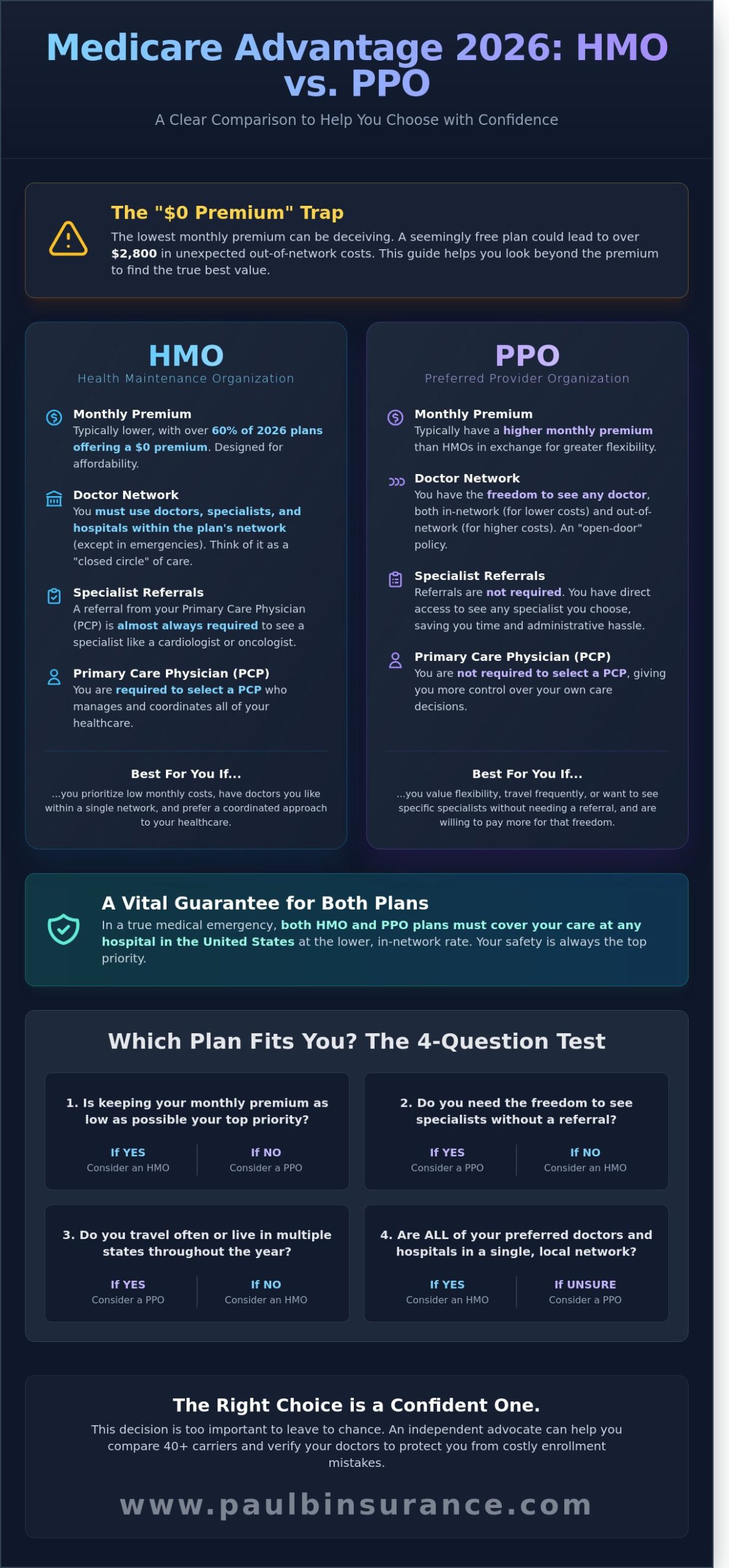
A Health Maintenance Organization (HMO) uses a structured network of local doctors and hospitals to coordinate your care. When you join an HMO in 2026, you will select a Primary Care Physician (PCP) who serves as your main point of contact. If you need to see a specialist, your PCP will need to provide a referral. This organized approach is why HMOs remain the most affordable option this year. Data from early 2026 shows that over 60 percent of HMO plans offer a $0 monthly premium, which helps you keep more of your Social Security check in your pocket.
What is a Medicare PPO?
A Preferred Provider Organization (PPO) gives you more flexibility and control over your healthcare journey. You aren’t required to choose a primary doctor, and you can see a specialist without waiting for a referral. You also have the “preferred” option to see doctors outside of the plan’s network, although you will typically pay a higher co-pay for that privilege. We often suggest PPOs for our clients who travel frequently or spend their winters in a warmer climate. You can learn more about these choices in our comprehensive Medicare Advantage guide. While PPO premiums might be slightly higher than HMOs, the ability to see almost any doctor provides a sense of security that many find invaluable.
The Network Factor: How Each Plan Affects Your Doctor Choices
Choosing a plan often comes down to one simple question: Can I keep my doctor? We know how much those long-standing relationships matter to your peace of mind. In 2026, the network is the list of doctors, hospitals, and pharmacies your plan agrees to pay. An HMO is essentially a closed circle. You must stay within that circle to get coverage. A PPO offers more of an open-door policy. You can visit doctors outside the network, but you will pay a higher share of the cost for that freedom.
When you ask yourself, is a medicare advantage PPO or HMO better for me, the answer depends on your need for flexibility. If your favorite specialist isn’t in a specific HMO network, that plan might not be the right fit. We’ve seen that about 14% of health systems updated their contract terms in early 2026, so checking your specific doctor’s status is more important than ever. We help you move from confusion to confidence by verifying these lists before you sign anything.
Referrals and Specialists
HMO plans use a primary care doctor as a gatekeeper. You usually need this doctor to sign off on a referral before you can see a specialist. This can feel frustrating if you manage a chronic condition and need frequent visits to a neurologist or oncologist. PPOs generally let you book those appointments directly. You skip the middle step and get the care you need faster. This direct access is a major reason why many seniors choose PPOs despite the higher monthly costs.
Going Out-of-Network
If you see a doctor who isn’t on the plan list, an HMO typically provides no coverage. You’ll be responsible for the entire bill yourself. PPOs do provide coverage for out-of-network care, but your co-pay might jump from $25 to $60 or more per visit. A contracted provider is a doctor who has agreed to the plan’s 2026 payment rates. We can help you look up your specific providers in our Medicare Advantage guide to ensure they are still participating in the plans you’re considering.
Both plan types have one vital safety rule in common. If you have a true medical emergency, your plan must cover you at the lower in-network rate. This applies at any emergency room in the country. You don’t have to worry about network lists when your health is in immediate danger. For your routine care, however, determining is a medicare advantage PPO or HMO better for me requires a look at your travel habits and how often you see specialists.
Comparing the Costs: Premiums, Copays, and Out-of-Pocket Limits
Finding the right plan often comes down to your monthly budget and your peace of mind. As we look at the 2026 landscape, many HMO options continue to offer $0 monthly premiums. This makes them a very attractive choice if you want to keep your fixed costs low. However, when you ask, “is a medicare advantage PPO or HMO better for me,” you have to look past the premium. We always remind our clients about the Maximum Out-of-Pocket (MOOP) limit. This is the most you will pay for covered medical services in a calendar year. Once you hit this limit, the plan pays 100% for the rest of the year. In 2026, the mandatory MOOP limit for in-network services is $9,350, though many plans set theirs much lower to stay competitive.
Most of these plans include prescription drug coverage right in the package. We recommend reviewing our Medicare Part D guide to see how these bundled plans compare to stand-alone options. PPOs often come with higher deductibles or coinsurance when you step outside the network. These are the costs that can surprise you if you aren’t careful. We want to make sure you have no surprises.
The Price of Freedom
Choosing a PPO gives you more control over which doctors you see, but it usually comes with a higher price tag. PPO premiums in 2026 often range from $20 to $100 per month depending on your zip code. You also face two different MOOP limits: one for in-network care and a higher “combined” limit for both in and out-of-network care. For example, a specialist visit in 2026 might cost you a $45 copay at an HMO. That same visit might cost $65 at a PPO if you stay in-network, or 40% of the total bill if you go out-of-network.
Value-Added Benefits
Many 2026 plans include dental, vision, and hearing benefits to help you stay healthy. HMOs often provide “richer” versions of these extras because the insurance company saves money by keeping care within a tight network. They pass those savings to you through lower dental deductibles or higher hearing aid allowances. If your chosen plan lacks these extras, you can explore our dental insurance options to fill the gap. Deciding is a medicare advantage PPO or HMO better for me often depends on how much you value these extra perks versus the flexibility of a larger doctor network.
The “Better for Me” Test: 4 Questions to Find Your Match
Deciding which plan fits your life shouldn’t feel like a guessing game. We know the pressure you feel to get this right. To move from confusion to confidence, we recommend asking yourself these four specific questions. Your answers will clarify whether is a medicare advantage PPO or HMO better for me in 2026.
- Question 1: Do you have a “must-have” doctor who is out-of-network? If your specialist of 10 years isn’t in the plan’s directory, an HMO usually won’t cover them. A PPO gives you the flexibility to see them, though you might pay a higher co-pay.
- Question 2: Do you spend several months a year in a different state? We see many “snowbirds” head south for the winter. In 2026, most HMOs still restrict you to local providers for non-emergencies. A PPO is often the safer choice for travelers.
- Question 3: Is a $0 monthly premium your top priority? If you’re on a very tight fixed income, HMOs are hard to beat. Roughly 66% of HMO plans in 2026 carry no monthly premium, while PPOs often charge a small fee for that extra flexibility.
- Question 4: Do you mind needing a referral to see a specialist? Some people find the “gatekeeper” model of an HMO frustrating. If you want to book an appointment with a cardiologist directly without waiting for a primary doctor’s permission, a PPO is your match.
When an HMO is Likely Best
An HMO is a fantastic tool for those who want to keep their healthcare simple and local. It’s ideal if your preferred doctors all work within one large hospital system. Because these plans are so coordinated, they often provide the lowest out-of-pocket costs. In 2026, we’ve found that HMOs frequently include extra perks like comprehensive dental or transportation that PPOs might scale back to keep their premiums low.
When a PPO is Likely Best
A PPO is built for freedom. It’s the right fit if you value choice over the lowest possible price. You can see any specialist without a middleman, which saves time when you’re dealing with complex health issues. If you find that neither of these options provides enough certainty, we often suggest looking into Medicare Supplement (Medigap). Medigap plans allow you to see any doctor in the country who accepts Medicare, removing network worries entirely.
We’re here to make sure you don’t make a costly enrollment mistake. Schedule a call with Paul today to get a personalized comparison of 2026 plans.
Moving from Confusion to Confidence with an Independent Expert
Insurance carrier websites often feel like a maze. They spend millions on advertising to make their specific plan look like the perfect choice for everyone. Looking at a single carrier’s website is like looking at one piece of a 1,000-piece puzzle. You don’t see the whole picture. We take a different approach by analyzing 40+ different carriers side-by-side to find the one that fits your specific 2026 needs. This personalized comparison is the only way to truly answer the question: is a medicare advantage PPO or HMO better for me? We stay true to our “Never Rushed, Never Pressured” philosophy. You deserve the time to understand your options without a ticking clock or a pushy sales pitch.
The Advantage of an Independent Broker
We don’t work for the insurance companies. We work for you. A captive agent can only sell you one brand, but we are independent advocates. If a carrier raises its rates or changes its network in 2026, we have the freedom to find you a better alternative. Our services are 100% free to the client, so you get expert advice without ever seeing a bill from us. We help you avoid enrollment mistakes that could lead to 2026 late penalties, ensuring your transition is smooth and your budget stays protected.
Your 5-Step Path to Peace of Mind
Our process is designed to replace stress with clarity. We’ve simplified everything into five clear steps to get you covered:
- Call: We start by listening to your specific health needs and budget goals.
- Compare: We look at 40+ plans available in your area for 2026.
- Consult: We explain the “why” behind each choice in plain English.
- Choose: You pick the plan that makes you feel most secure.
- Confirm: We handle the paperwork and verify your enrollment is active.
We provide year-round support, not just during the busy enrollment season. If you have a claim issue in July or a doctor’s office question in December, we’re your first call. Our Medicare Advantage guide can help you start this journey today. We’re here to protect your health and your wallet for the long haul. You don’t have to do this alone.
Move From Confusion to Confidence in 2026
Choosing your coverage for 2026 comes down to balancing your budget with the freedom to see your favorite doctors. You’ve seen how HMOs offer streamlined costs while PPOs provide the flexibility to seek care outside a restricted network. The right choice depends entirely on your unique health needs and which specialists you plan to visit this year. Deciding is a medicare advantage PPO or HMO better for me feels overwhelming because the stakes are high, but you don’t have to navigate this maze alone. We’re here to protect you from costly enrollment mistakes and late penalties.
Our team provides independent access to over 40 insurance carriers and holds licenses in 34 states to ensure you get the best support available nationwide. There’s zero cost to you for our expert guidance; we simply want you to feel secure in your decision. We’ll simplify the jargon and find the plan that fits your life perfectly. Schedule a Call With Paul for a 2026 Plan Review and take the first step toward total peace of mind today. You deserve a partner who puts your needs first.
Common Questions About Choosing Your 2026 Medicare Plan
Is a PPO always more expensive than an HMO in 2026?
No, a PPO isn’t always more expensive, but the cost structure is different. In 2026, many PPO plans offer $0 monthly premiums just like HMOs. However, you’ll often pay more when you actually use services. For example, a PPO might charge a $50 copay for an out-of-network specialist, while a local HMO charges only $20 for an in-network visit. We find that PPOs usually have higher deductibles to account for their flexibility.
Can I switch from an HMO to a PPO during the year?
You generally can’t switch plans in the middle of the year unless you qualify for a Special Enrollment Period. Most people make these changes during the Annual Enrollment Period from October 15 to December 7. If you’re already in a Medicare Advantage plan, you can also use the Open Enrollment Period from January 1 to March 31 to switch. Outside these windows, you’re locked into your 2026 choice unless you move to a new service area.
Do I need a referral to see a specialist with a Medicare PPO?
No, you don’t need a referral to see a specialist when you’re enrolled in a Medicare PPO. This is one of the biggest reasons people ask us “is a medicare advantage PPO or HMO better for me” during our consultations. You can book an appointment directly with any cardiologist or surgeon you choose. This saves you the time and stress of waiting for a primary doctor to approve your request, giving you much faster access to care.
What happens if I see an out-of-network doctor on an HMO plan?
If you see an out-of-network doctor on an HMO, the plan typically won’t pay a single cent toward that bill. You’ll be responsible for 100% of the cost, which could be $300 for a simple office visit or thousands for a procedure. The only exceptions in 2026 are for emergency room visits or urgent care when you’re traveling. We always tell our clients that HMOs require strict discipline to stay within the local provider group.
Do both HMO and PPO plans cover prescription drugs?
Yes, about 89% of all Medicare Advantage plans in 2026 include Part D prescription drug coverage. Whether you choose an HMO or a PPO, your medications are usually bundled into the same plan. We’ll help you look at the 2026 formulary to make sure your specific drugs, like Eliquis or generic blood pressure pills, are covered. This keeps everything simple and ensures you don’t have to manage two different insurance companies for your healthcare needs.
Which plan type is better for someone who travels out of state often?
A PPO plan is almost always the better choice for travelers because it offers nationwide coverage. While an HMO restricts you to a local network of doctors, a PPO allows you to see any provider in the country who accepts Medicare. If you spend three months in Florida and the rest of the year in Ohio, a PPO ensures you’re covered in both places. You’ll pay a bit more for out-of-state care, but you won’t be denied coverage.
Is the “Maximum Out-of-Pocket” limit the same for HMOs and PPOs?
No, PPO plans have two separate limits that you need to watch. In 2026, a PPO has an in-network limit and a higher “combined” limit for both in and out-of-network care. For instance, your in-network limit might be $5,000, but your total limit could be $9,350. HMOs only have one limit because they don’t cover out-of-network care. We’ll help you compare these numbers so you can feel confident about your financial protection if a health crisis occurs.
How do I know if my doctor is in the plan’s 2026 network?
We’ll check the most current 2026 provider directories for you to confirm your doctor’s status. It’s important to realize that about 15% of physician contracts change every year, so a doctor who was “in-network” last year might not be today. To be 100% sure, we often call the doctor’s billing office directly with the specific plan code. This extra step removes the guesswork and ensures you can keep the doctors you’ve known and trusted for years.

Article by
Paul Barrett
Paul Barrett, CMIP is the founder of The Modern Medicare Agency, an independent Medicare-only brokerage based in Melville, NY. With 18 years of Medicare-exclusive experience, a CMIP designation, and more than 5,000 clients served across 37 states, Paul is one of the most credentialed independent Medicare specialists on Long Island — and one of the most direct.
He represents 40+ carriers with no quotas and no allegiances, which means his recommendations are based entirely on what fits each client's specific situation. He is the author of Medicare Mastery Unlocked and host of the Wise Guys Retirement Talk podcast. His content is grounded in primary sources, real carrier intelligence, and 18 years of watching what happens when people get Medicare right — and when they don't.
📞 631-358-5793 | paulbinsurance.com