




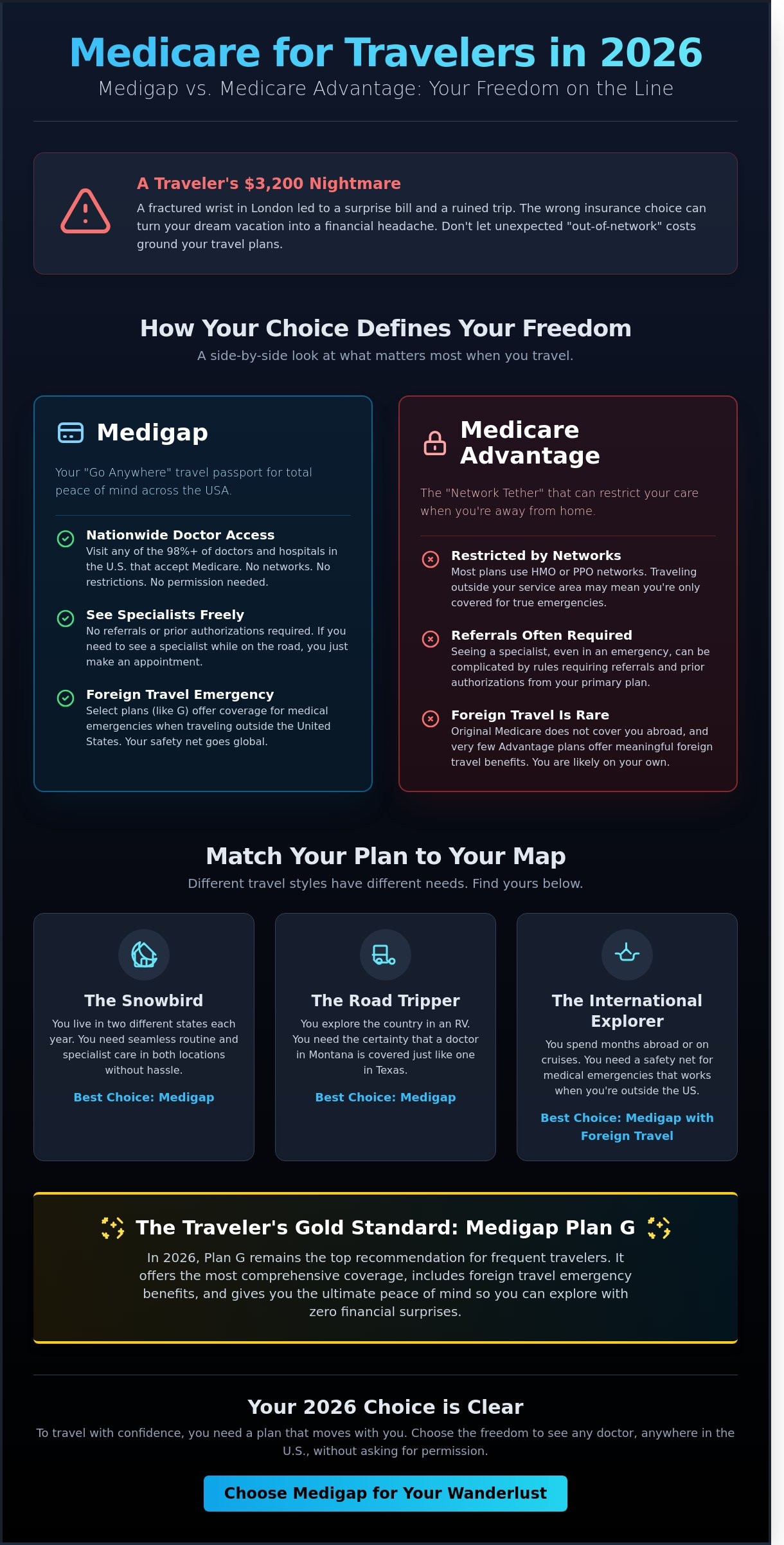
In May 2026, a traveler named Sarah found herself in a London urgent care center with a fractured wrist and a $3,200 bill she didn’t expect. Instead of focusing on her recovery, she spent her flight home anxious about whether her “emergency coverage” was actually a hollow promise. We understand that the fear of being stuck with massive out of network bills can make even a short weekend trip feel risky. When you weigh medigap vs medicare advantage for frequent travelers, you’re really deciding how much freedom you want to pack in your suitcase.
We believe your insurance should work just as hard in a different zip code as it does at your kitchen table. You deserve to know that your costs are predictable and that you can see the best specialists in the country without asking for permission first. We’ll show you how to navigate the 2026 rules so you can travel with total confidence and zero surprises. This guide breaks down exactly which path offers the most protection for your lifestyle, from international benefits to state line transitions.
Key Takeaways
- Learn why Medigap acts as your ultimate “go anywhere” passport, giving you the freedom to visit any doctor in the U.S. who accepts Medicare without needing a referral.
- Understand the limitations of the “network tether” found in Medicare Advantage plans and how to ensure you are covered for more than just emergencies when crossing state lines.
- Discover which specific plans offer “Foreign Travel Emergency” benefits so you can explore the world in 2026 with genuine peace of mind.
- We help you weigh the pros and cons of medigap vs medicare advantage for frequent travelers to find the path that fits your unique lifestyle and budget.
- Follow our simple 5-step process to clear away the 2026 confusion and choose a plan that protects both your health and your wanderlust.
Medicare for Travelers in 2026: Why Your Choice Defines Your Freedom
Planning your retirement travels in 2026 should be about sunrises and bucket lists, not worrying about medical bills. We define portability of care simply. It is your right to see any doctor who accepts Medicare, no matter where you are in the country. This year is a major milestone for everyone in the system. With the 2026 updates to benefit structures fully in place, including the finalized caps on out of pocket costs, choosing between medigap vs medicare advantage for frequent travelers has never been more critical. A simple weekend trip can turn into a $5,000 financial nightmare if you are stuck in a plan that does not follow you across state lines. We want to help you move from confusion to confidence before you ever pack a suitcase.
The ‘Any Doctor’ Rule vs. Network Restrictions
The biggest difference lies in who you can see. With a Medigap plan, you can visit any of the 90% of doctors nationwide who participate in Medicare. There are no networks to worry about. On the other hand, Medicare Advantage plans often use HMO or PPO networks. If you leave your service area, you might only have coverage for emergencies. We always tell our clients to look at their home base first. If your home base changes every six months, a restricted network could be a costly mistake. Understanding how participating providers work in 2026 is the first step toward true freedom.
Common Travel Scenarios We See Every Day
We see three types of travelers every day in our office. Each one has unique needs that require a specific strategy. We simplify the jargon so you know exactly how it works for your lifestyle.
- The Snowbird: You live in Florida for the winter and New York for the summer. In 2026, many Advantage plans still require you to use local providers for routine care, which can be a huge hassle.
- The Road Tripper: You travel across multiple states in an RV. You need the certainty that a doctor in Montana is covered just like one in Texas.
- The International Explorer: You spend months abroad or on cruises. Original Medicare does not cover you outside the U.S., but certain Medigap plans offer foreign travel emergency benefits.
Comparing medigap vs medicare advantage for frequent travelers ensures you do not lose your freedom to explore. You can find more details on how these networks operate in our Medicare Advantage guide. We are here to make sure your plan matches your map.
Medigap Plans: The Ultimate ‘Go Anywhere’ Passport
Choosing between medigap vs medicare advantage for frequent travelers often comes down to one word: freedom. If you spend your retirement exploring the country in an Airstream or flying between family in different states, you need a plan that keeps up with you. Medigap allows you to see any doctor or visit any hospital in the United States, as long as they accept Medicare. This includes over 98% of healthcare providers across the nation in 2026.
We believe your vacation shouldn’t be interrupted by insurance paperwork. With a Medigap plan, you don’t have to worry about “prior authorizations” or getting a referral just to see a specialist while you’re away from home. Your coverage travels with you across every state line. You pay a predictable monthly premium, which means you won’t face a massive, unexpected bill if you trip on a hiking trail or need care in a different time zone. You can learn more about how this works in our guide on What Is Medicare Supplement Insurance?
Why Nationwide Access is a Game Changer
In 2026, Medigap Plan G remains the gold standard for travelers. It offers the most comprehensive coverage for those who want zero surprises. If you have a chronic condition that requires specialized care, Medigap is often our top recommendation. You have the peace of mind knowing that world-class facilities like the Mayo Clinic or Cleveland Clinic are always “in-network” for you. There are no restricted geographic boundaries to trap you. We want you to feel confident that your health is protected, no matter where the map leads you.
Medigap and Domestic Travel: Real-World Ease
Imagine you’re visiting your grandkids in Florida and suddenly need to see a cardiologist for a check-up. With Original Medicare and a Medigap policy, you simply make the appointment. You don’t need to check a provider directory or call your insurance company for permission first. The billing happens seamlessly between states. Medicare pays its share, and your Medigap plan picks up the rest, just like it does at home. If you’re just starting this journey, check out our Medicare Eligibility: A Clear and Simple Guide for 2026 to see when you can join. We are here to help you move from confusion to confidence as you plan your next adventure.
Medicare Advantage and Travel: Navigating the Network Tether
Medicare Advantage plans often feel like a secure safety net until you cross a state line. Most of these plans rely on local or regional networks that expect you to stay close to home for your care. If you have an HMO, your coverage usually stops at the county border for anything that isn’t an emergency. PPO plans offer more flexibility, but the price tag for that freedom is often higher than many expect. When we help clients compare medigap vs medicare advantage for frequent travelers, this network tether is the biggest hurdle we address.
By law, your plan must cover emergency and urgent care anywhere in the United States. If you experience a sudden illness in a different state, you can go to the nearest emergency room. However, routine care is a different story. If you need a follow-up visit or a routine check-up while visiting family across the country, your local plan might not pay anything. In 2026, some carriers have expanded “Visitor/Traveler” programs. These allow you to see specific doctors in other states at in-network rates for up to 12 months, but these programs aren’t available in every zip code. You can find more details in our Medicare Advantage Guide.
The Risks of Out-of-Network Costs
We’ve seen travelers get hit with 40% or 50% coinsurance because they used a doctor outside their PPO network. It’s a heavy financial burden that catches many off guard. Another trap is prior authorization. If you need a specific procedure while traveling, your home-base plan might take 7 to 14 days to approve it. This delay can ruin a trip. We suggest a few steps before you leave:
- Review your plan’s “service area” map to see where your coverage changes.
- Confirm if your plan requires a phone call before seeking urgent care out of state.
- Check if your specific medications are preferred at national pharmacy chains.
2026 Updates: Part D and the Traveler
The biggest win for seniors this year is the $2,000 out-of-pocket cap on prescription drugs. This change, which took full effect in January 2026, means you won’t pay more than $2,000 for your covered medications all year. For travelers, this provides incredible peace of mind. If you need to refill a prescription at a pharmacy in a different state, your costs remain predictable. We suggest using national pharmacy chains to make transfers easier. You can find more details on managing these costs in our guide: Medicare Part D Explained: Your Simple Guide. When weighing medigap vs medicare advantage for frequent travelers, remember that while the drug cap is the same for both, the ease of seeing a doctor remains the primary difference.
International Travel: What Happens When You Leave the U.S.?
Most folks are surprised to learn that Original Medicare stops at the water’s edge. If you are on a cruise in the Mediterranean or visiting family in London, your red, white, and blue card will not help you with a doctor’s bill. It is a scary thought for anyone planning their dream retirement trip. We want to take that weight off your shoulders by explaining how your supplement or advantage plan steps in when you are far from home. Understanding the difference between medigap vs medicare advantage for frequent travelers is the first step toward a stress-free vacation.
Medigap’s Foreign Travel Emergency Benefit
Popular options like Plan G and Plan N include a specific foreign travel emergency benefit. This is a lifeline, but it has specific rules you should know. First, you will pay a $250 deductible for the year. After that, the plan pays 80% of your emergency costs. You are responsible for the remaining 20%. There is also a $50,000 lifetime limit. In 2026, medical costs abroad can climb quickly; a single major surgery could use a large portion of that limit.
An emergency is defined as care that begins during the first 60 days of your trip for an illness or injury that is sudden and unexpected. You will usually have to pay the foreign provider upfront. Keep every receipt and document. You will then file a claim with your Medigap carrier for reimbursement once you return home. We simplify the jargon so you know exactly how to handle these situations before you board your flight.
Medicare Advantage and Worldwide Coverage
Many Medicare Advantage plans offer worldwide emergency and urgent care coverage as a built-in perk. When weighing medigap vs medicare advantage for frequent travelers, you will notice Advantage plans often have their own set of rules for what qualifies as an emergency. Some plans might be more flexible than Medigap, while others are stricter.
One thing Medicare never covers is medical repatriation. This is the expensive process of flying you back to the U.S. in a medical jet. A flight like that from Tokyo or Paris can cost over $125,000 in 2026. Because of the $50,000 Medigap limit and the total lack of repatriation coverage, we always suggest looking into a separate travel insurance policy. It provides a complete safety net so you can focus on the sights instead of the “what-ifs.”
The choice between these plans can feel like a maze, but you do not have to walk it alone. We are here to help you move from confusion to confidence. Compare Medigap plans with an expert today to see which one fits your travel lifestyle.
From Confusion to Confidence: Making Your Final Choice
Deciding between medigap vs medicare advantage for frequent travelers often comes down to a simple choice between predictable costs and total freedom. We know the weight of this decision. In 2026, the average monthly premium for a Medigap Plan G might range from $175 to $235, but it buys you the ability to visit any specialist in the country without a referral. You don’t want to be hiking in the Blue Ridge Mountains and worrying if the local clinic is “in-network.” We help you weigh that monthly premium against the potential for surprise bills that can happen with Advantage plans when you leave your home zip code.
We use a proven 5-step process to audit your travel plans against 40+ different insurance carriers. This isn’t a one-size-fits-all approach. We look at your destination list, your specific prescriptions for 2026, and your health history. Working with an independent broker is essential because we aren’t tied to one company. We show you the whole picture, ensuring you don’t fall into the trap of a “captive agent” who can only offer you one brand’s limited network. You can learn more about how this works in our comprehensive Medigap guide.
Questions We Ask to Find Your Perfect Fit
We start by getting to know your lifestyle. These three questions often clear the fog immediately:
- How many months of the year will you be away from your primary residence? If you spend more than six months in a second home, some Advantage plans may automatically disenroll you.
- Do you have preferred doctors or hospitals in multiple states? If you see a specialist in Florida and a primary doctor in New York, Medigap is almost always the safer bet.
- What is your comfort level with ‘surprise’ out-of-pocket costs while on vacation? Advantage plans often have lower premiums but can lead to a $400 co-pay for an out-of-network emergency visit.
Your Next Step: Schedule a Call With Paul
We simplify the jargon so you can focus on packing your bags. You won’t find any high-pressure sales tactics here. We act as your advocate, helping you compare all your options with total transparency. Our support doesn’t end when you sign up. If you get sick while traveling in 2026, we are the ones you call to help navigate the billing. We want you to feel protected and empowered every time you cross a state line. Schedule your unbiased Medicare review today and move forward with clarity.
Take the Road Less Traveled With Total Confidence
Your 2026 travel plans shouldn’t be limited by a zip code or a provider network. Deciding between medigap vs medicare advantage for frequent travelers is about protecting your health whether you’re in Florida, Alaska, or crossing international borders. We know that Medigap plans offer the freedom to see any doctor in the country who accepts Medicare; this is vital for those spending months away from home. Medicare Advantage networks often feel restrictive, and missing a single out-of-network detail could lead to thousands in unexpected bills.
We’re here to help you move from confusion to confidence. Our team provides unbiased guidance and access to 40+ insurance carriers to ensure your coverage fits your lifestyle. We are currently licensed in 34+ states, giving us the nationwide reach to support your journey. Don’t let the complex Medicare system slow you down or lead to costly enrollment mistakes.
Schedule a Call With Paul to Find Your Travel-Ready Plan
We’ll handle the paperwork and the jargon so you can focus on your next destination. You deserve a partner who protects your health and your freedom every mile of the way.
Frequently Asked Questions
Does Medigap cover me if I go on a cruise?
Yes, Medigap covers you on a cruise if the ship is in U.S. territorial waters or docked at a U.S. port. If you’re in international waters, common 2026 plans like Plan G or Plan N provide foreign travel emergency benefits. These plans pay 80% of billed charges for medical emergencies after you meet a $250 annual deductible. This coverage lasts for the first 60 days of your trip and has a $50,000 lifetime limit.
Can I use my Medicare Advantage plan in another state for a routine check-up?
You generally cannot use a Medicare Advantage plan for routine check-ups outside your service area unless you have a PPO with out-of-network benefits. In 2026, most HMO plans require you to see local doctors for non-emergency care. If you visit a doctor in another state for a physical, you might pay 100% of the bill. When weighing medigap vs medicare advantage for frequent travelers, this lack of flexibility is a common reason why people choose Medigap.
Is emergency room care covered everywhere in the U.S. with Medicare Advantage?
Yes, federal law requires every Medicare Advantage plan to cover emergency room visits anywhere in the United States at the same cost-sharing rate as your home network. Whether you are in a hospital in Florida or a clinic in Alaska, your plan must treat the visit as an emergency. In 2026, the typical ER copayment for Advantage plans ranges between $90 and $120. You don’t need prior authorization for life-threatening situations while traveling.
What is the best Medigap plan for international travelers in 2026?
Plan G is the top choice for international travelers in 2026 because it offers the most comprehensive supplement coverage available to new beneficiaries. It includes the standard foreign travel emergency benefit which covers 80% of costs for the first 60 days abroad. While Plan N is also popular, Plan G provides more peace of mind by covering all Part B excess charges. This ensures you won’t face unexpected bills from doctors who charge more than the Medicare-approved amount.
Do I need to notify my Medicare plan before I go on a long trip?
You don’t need to notify Medicare if you have a Medigap plan, but it’s a good idea to call your Medicare Advantage provider before leaving for more than 30 days. Some Advantage plans have traveler or visitor programs that allow you to see specific doctors in other regions for up to 12 months. If you stay outside your service area for more than 6 months without such a program, your plan might automatically disenroll you.
What happens if my Medicare Advantage plan doesn’t have a ‘traveler’ program?
If your Medicare Advantage plan lacks a traveler program, you’re limited to emergency and urgently needed care while away from home. You’ll have to pay the full cost for routine services like blood tests or specialist consultations. This is a vital factor when comparing medigap vs medicare advantage for frequent travelers. Without a specific travel benefit, your 2026 plan won’t cover any maintenance care until you return to your home network zip code.
How do I get my prescriptions filled while traveling across the country?
We recommend using a national pharmacy chain like CVS or Walgreens to ensure your prescriptions are easy to fill across the country. Most Part D plans in 2026 have preferred networks with these large retailers, keeping your copays low. If you’re going to a remote area, you can request a 90-day vacation override from your insurer. This allows you to pick up a three-month supply before you depart so you never run out of medication.

Article by
Paul Barrett
Paul Barrett, CMIP is the founder of The Modern Medicare Agency, an independent Medicare-only brokerage based in Melville, NY. With 18 years of Medicare-exclusive experience, a CMIP designation, and more than 5,000 clients served across 37 states, Paul is one of the most credentialed independent Medicare specialists on Long Island — and one of the most direct.
He represents 40+ carriers with no quotas and no allegiances, which means his recommendations are based entirely on what fits each client's specific situation. He is the author of Medicare Mastery Unlocked and host of the Wise Guys Retirement Talk podcast. His content is grounded in primary sources, real carrier intelligence, and 18 years of watching what happens when people get Medicare right — and when they don't.
📞 631-358-5793 | paulbinsurance.com