




Last Tuesday, a client named Martha called us from her home in Ohio, worried that a heart procedure she had in August 2025 would make it impossible to change her coverage. She felt stuck, fearing that insurance companies would reject her or charge a fortune because of her medical past. We know how heavy that weight feels. It’s common to feel like the system is working against you when you’re just trying to find some stability. You deserve to feel confident about your healthcare, not anxious about a list of medical questions.
We’re here to help you move from confusion to confidence. In this 2026 guide, you’ll learn how to manage medicare supplement underwriting for pre-existing conditions so you can get the Medigap coverage you need. We’ll show you exactly how to find a plan that accepts your health history and secure predictable costs for your future. We’ll start by explaining the specific enrollment windows that protect you from health questions and then look at your options if those dates have already passed.
Key Takeaways
- Discover how to use your 2026 “golden windows” to bypass medical questions entirely and guarantee your coverage regardless of your health history.
- We explain the three main parts of the evaluation process so you can prepare for pharmacy checks and phone interviews with complete peace of mind.
- Learn the proven strategies we use for medicare supplement underwriting for pre-existing conditions, including how to time your application to match 2026 carrier rules.
- Identify which insurance companies have more flexible standards this year, allowing you to secure the plan you want even if you’ve been turned down before.
- Follow our step-by-step guide to move from confusion to confidence, ensuring you avoid costly enrollment mistakes while locking in stable rates for the future.
What is Medicare Supplement Underwriting in 2026?
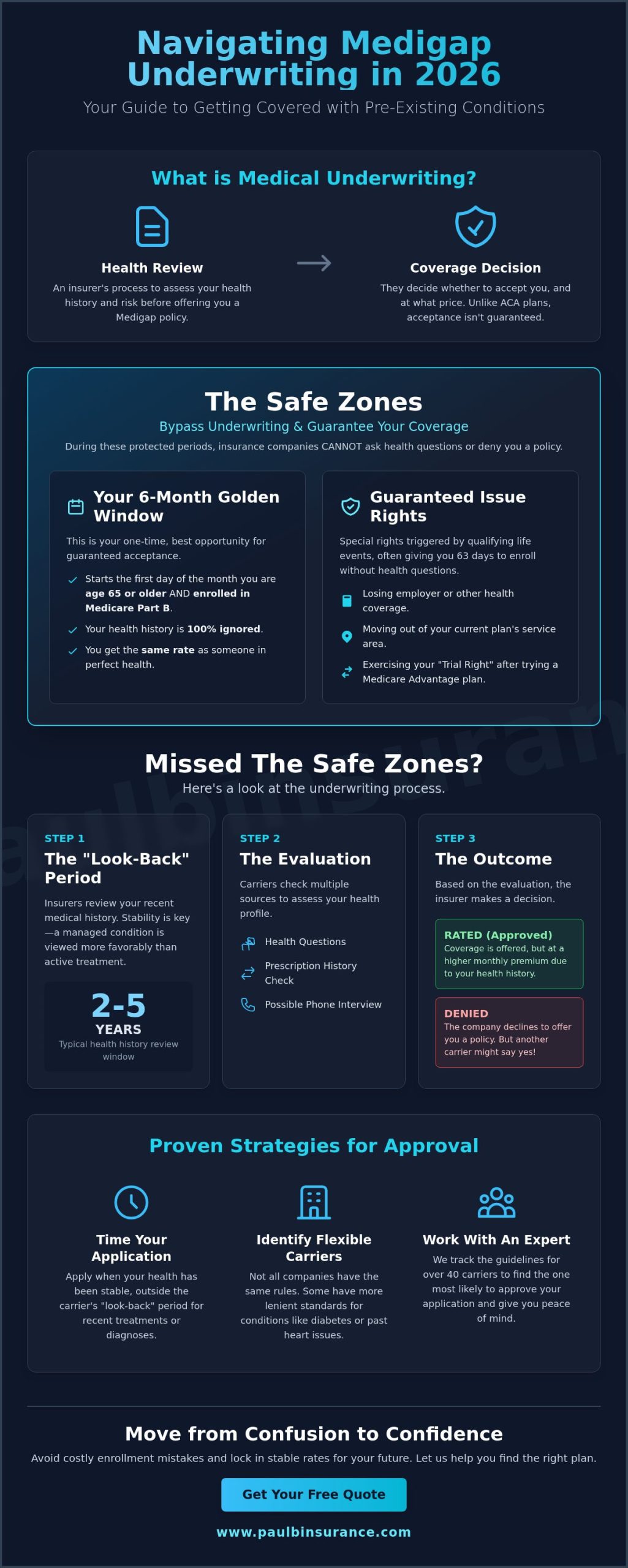
We know the Medicare system can feel like a confusing maze. If you’re looking for a plan in 2026, the term underwriting might sound intimidating. Simply put, medical underwriting is the process private insurance companies use to look at your health risk and decide if they can offer you coverage. Unlike the rules you might know from the Affordable Care Act (ACA), Medigap policies are not required to accept every applicant outside of specific enrollment windows. This means your health history actually matters when you apply.
In 2026, we’ve seen several carriers adjust their standards. The most important thing to understand is the difference between being rated and being denied. If a carrier rates you, they’ve decided to offer you coverage but will charge a higher monthly premium because of your health history. A denial means the company has declined to offer a policy at all. Because we track the guidelines for over 40 different carriers, we can often find a path forward even when one company says no. Our goal is to move you from a state of confusion to a state of confidence by finding the right fit for your needs.
We help you understand medicare supplement underwriting for pre-existing conditions so you don’t have to guess. While the ACA prevents insurers from denying coverage for pre-existing issues, Medigap rules are different. If you miss your initial Open Enrollment period, insurers can ask about your health. We simplify this jargon so you know exactly how it works before you ever submit an application.
The “Look-Back” Period Explained
A look-back period is a specific window of health history insurers review to determine your eligibility. In 2026, most insurance companies look at the last 2 to 5 years of your medical records. They’re specifically looking for stability. A condition you’ve managed successfully for years is treated much differently than an active treatment or a pending surgery. We review these timelines with you to ensure we apply at the most favorable time for your health profile.
Common Pre-Existing Conditions and Medigap
Carriers look at chronic conditions like diabetes or heart disease differently than they look at acute issues like a recent broken bone. Your prescription drug history plays a massive role here too. Insurers check a national database to see every medication you’ve filled in the last few years. If one carrier sees a specific medication as a “decline,” another might see it as acceptable. You can find more details on how these plans fit into your coverage on our Medigap information page. We use our expertise to navigate these nuances for you, ensuring you aren’t stuck with a plan that doesn’t serve your health or your budget.
The Safe Zones: When Underwriting is Prohibited
We know that the thought of a health exam can feel like a barrier to getting the care you deserve. It’s a common worry for many of the folks we help every day, especially when you are managing chronic health issues. However, there are specific times when the insurance companies cannot ask you a single health question. We call these “Safe Zones.” During these windows, medicare supplement underwriting for pre-existing conditions is completely prohibited by law. This means you are guaranteed a plan at the same price as someone in perfect health.
Your Initial 6-Month Medigap Open Enrollment
Your first and best window is the Medigap Open Enrollment Period. This six-month window starts the very first day of the month you are both age 65 and enrolled in Medicare Part B. It’s a one-time “golden window” that you should never let pass. During this time, your health history is 100% ignored. Whether you have chronic conditions or recent surgeries, the company must accept your application. We strongly encourage you to look at our Medigap guide to see how this timeline fits your specific situation. Waiting even a month past this window can change your options significantly.
Guaranteed Issue Rights and Qualifying Events
Life changes, and sometimes those changes trigger federal protections called Guaranteed Issue (GI) rights. If you lose your employer-sponsored coverage or if you move out of your current plan’s service area, you often have 63 days to join a Medigap plan without any health checks. Another vital protection is the “Trial Right.” If you joined a Medicare Advantage plan when you first became eligible but decide to switch back to Original Medicare within the first 12 months, you have a right to buy a Medigap policy. This is crucial because a KFF analysis of Medigap and pre-existing conditions shows that without these protections, finding affordable coverage can be nearly impossible for many beneficiaries once they are already sick.
In 2026, we are seeing more states adopt “Birthday Rules” or anniversary periods to help residents. States like California, Oregon, and Illinois now allow you to switch plans around your birthday without medicare supplement underwriting for pre-existing conditions. This trend is growing, with 12 states now offering some form of annual enrollment protection as of January 2026. We keep a close eye on these changing laws so you don’t have to worry about the fine print. If you are feeling overwhelmed by these rules, you can schedule a quick chat with us to see if you live in a state with these extra layers of security right now.
What to Expect During the Underwriting Process
Entering the process of a medical review can feel like walking through a maze. We want to clear that path for you. In 2026, the process for medicare supplement underwriting for pre-existing conditions is built on three main pillars: your written application, an automated pharmacy background check, and a brief phone interview. We help you prepare for all three so there are no surprises or hidden hurdles.
Most modern carriers use “knock-out” questions to streamline their decisions. These are simple yes-or-no queries about serious health events, such as a heart attack or an active cancer diagnosis within the last 24 months. If you answer “yes” to certain items, the computer might issue an instant decline. This is why we review your health history before you hit the submit button. We also look at the role of the Medical Information Bureau (MIB). This is a shared database that insurance companies use to verify your medical history. If there is a discrepancy between your application and the MIB data, it often causes delays. Honesty is your best strategy here. Being upfront helps us find the right carrier for your specific needs without the stress of a sudden rejection.
The Medical Questionnaire
This part of the application covers your basic health profile. You will list your height, weight, and any tobacco use within the last 12 months. Carriers are looking for stability in your health. They will ask if you have any surgeries planned for the 2026 calendar year or if you have been hospitalized recently. When you list your medications, you should be precise. We suggest having your actual pill bottles in front of you. This ensures the pharmacy background check matches what you’ve reported, which builds immediate trust with the underwriter.
The Underwriting Phone Interview
If the carrier needs more detail, they will schedule a 10 to 15 minute call. The interviewer isn’t just checking facts; they are listening for clarity and consistency. We recommend explaining your health in terms of “maintenance” versus “emergency” treatments. For example, taking a daily pill for blood pressure is seen differently than a trip to the ER for a cardiac event. Have your notes ready with specific dates and dosages. Having this info at your fingertips shows you are managing your health proactively. It moves you from a place of confusion to a place of confidence. If you want to see which plans might be a fit for your health profile, you can explore our Medigap options to learn more.
Strategies for Getting Approved with Pre-Existing Conditions
We know how heavy it feels to worry about your health history. It’s frustrating to think your past might block your future security. But here is some good news: a “no” from one company is often just a detour, not a dead end. Finding the right medicare supplement underwriting for pre-existing conditions is about strategy, not luck. We help you look at the big picture to find a path forward.
One effective method involves timing your application perfectly. Many carriers use a “look-back window” to check your medical history. If a carrier has a two-year look-back for a specific surgery, applying 25 months after that procedure can mean the difference between a decline and an approval. We also look at state-specific laws. In 2026, several states continue to offer “Birthday Rules” or “Anniversary Rules” that allow you to switch plans without any health questions at all. If you live in a state like California or Oregon, these windows are your golden ticket to better coverage.
Sometimes, we suggest an “Advantage First” strategy. If your current health makes a Supplement plan impossible today, you can use a Medicare Advantage plan as a bridge. This keeps you covered while you wait for a health condition to stabilize or for a look-back period to expire. Our goal is to simplify the complex world of medicare supplement underwriting for pre-existing conditions so you can breathe easier.
Carrier Variations in 2026
Every insurance company sets its own internal health standards. This is why Carrier A might decline an applicant for insulin-dependent diabetes while Carrier B accepts them without a second thought. In 2026, we’ve seen some carriers become more “liberal” with heart conditions as long as there have been no new events in 12 months. We use “pre-screening” to check your health profile against these internal guides before you ever fill out an official application. It saves you time and protects your record.
The Role of an Independent Broker
We work for you, not the insurance companies. Because we have experience with over 40 different carriers, we know exactly where to take your specific health profile to find a “yes.” We help you avoid the “rejection trail.” If you apply to the wrong company and get a denial, that record can sometimes make other companies more hesitant. We act as your advocate to ensure your first application is your best shot at success. We simplify the jargon so you know exactly how it works and feel confident in your choice.
Ready to see which carriers are the best fit for your health history? Schedule a consultation with our team to start your journey from confusion to confidence.
From Confusion to Confidence: Securing Your 2026 Coverage
We’ve walked through the complex details of how your health history impacts your choices. Securing the right plan in 2026 involves a clear, three-step pathway. First, we identify your specific enrollment window. Second, we look honestly at your current health status. Third, we find the carrier that views your specific history most favorably. This year is a pivotal time for Medigap stability. With the 2026 Medicare updates now in full effect, including the $2,000 out-of-pocket cap on prescription drugs, many carriers have adjusted their rates. We help you find a stable plan that won’t surprise you with a massive premium hike next year.
Your Personalized 2026 Medicare Plan
We strip away the confusing language to show you exactly where you stand. You shouldn’t have to wonder if a heart condition or a past surgery will disqualify you from better coverage. The rules surrounding medicare supplement underwriting for pre-existing conditions can feel like a barrier, but they’re often just a hurdle we can clear together. We take the weight off your shoulders by pre-screening your health before you ever submit an official application. This protects your record and gives you a clear answer on your eligibility.
Our goal is to move you from feeling stressed about your health history to feeling protected by a plan that fits your budget. In 2026, we’ve seen a 4.2% average shift in premiums across several major carriers. Knowing which companies are maintaining stable rates for people with your specific health profile is the key to long-term peace of mind. You can stop worrying about the “what ifs” and start focusing on your health. Schedule a call with us to move from uncertainty to a concrete plan of action.
Why The Modern Medicare Agency is Different
We aren’t here to push one specific company or a “one size fits all” solution. As independent advocates, we work for you, not the big insurance corporations. Captive agents only show you one menu; we show you the entire market. Our team specializes in medicare supplement underwriting for pre-existing conditions, ensuring you find a path to coverage even when other agencies say it’s impossible. We pride ourselves on a “never rushed, never pressured” approach that puts your needs first.
Our support doesn’t end when you sign the paperwork. We stay by your side year-round to ensure your coverage remains the right fit as your health needs evolve. If a better option opens up in 2027 or beyond, we’ll be the first to let you know. If you’re ready to leave the confusion behind and secure your future, it’s time to take the next step. You can Schedule a Call With Paul today to start your personal health pre-screen and get the clarity you deserve.
Take the Next Step Toward Secure Coverage
Navigating the insurance maze doesn’t have to feel like a struggle against the system. We’ve shown you that timing your application correctly and knowing your rights can make all the difference in 2026. Whether you’re in a safe zone or need to navigate medicare supplement underwriting for pre-existing conditions, there’s always a path forward. We’re here to turn that path into a simple, stress-free journey. You don’t have to guess which carriers will accept your history when you have an expert advocate in your corner.
We’ve helped thousands of people move from confusion to confidence by providing clear, unbiased advice. With access to over 40 top-rated insurance carriers and licenses in 34+ states like NY, FL, and CA, we find the options that captive agents simply can’t offer. Our goal is to protect your health and your wallet from costly mistakes. We’ll stay by your side until you feel completely certain about your choice.
Schedule a Call With Paul for a Free Health Pre-Screen today to get started. We’re ready to help you secure the peace of mind you deserve.
Frequently Asked Questions
Can I be denied a Medicare Supplement plan because of high blood pressure?
You generally won’t be denied for high blood pressure as long as it’s well-controlled with medication and your dosage hasn’t changed in the last 12 months. Most insurance companies view stable hypertension as a standard risk in 2026. However, if your blood pressure remains high despite treatment or has caused other complications, a carrier might decline your application. We help you compare different carriers because each one has its own specific list of “knockout” medications.
How far back do Medigap insurance companies look at my medical records in 2026?
Most Medigap insurance companies look back at your medical records for the past 2 to 5 years. During the medicare supplement underwriting for pre-existing conditions, they specifically look for chronic issues like cancer, heart disease, or recent surgeries. We review these look-back periods with you so there are no surprises during the process. Some companies only ask about the last 24 months, while others want a full 60-month history of your health.
What happens if I miss my Open Enrollment Period and have a heart condition?
If you miss your 6-month Open Enrollment Period, you’ll likely have to answer health questions, and a heart condition could lead to a denial. Without a “Guaranteed Issue” right, companies can charge you more or refuse coverage entirely based on your heart history. We look for specific carriers that might be more lenient with certain cardiac conditions. It’s vital to act quickly because waiting even one month past your deadline changes the rules completely.
Is there a waiting period for pre-existing conditions if I am approved for Medigap?
Yes, companies can technically impose a 6-month waiting period for pre-existing conditions if you didn’t have “creditable coverage” before joining. However, if you had health insurance for at least 63 days before enrolling, this waiting period is almost always waived. In 2026, we ensure your prior coverage is documented correctly so you aren’t left unprotected. This prevents you from paying for a plan that won’t cover your current treatments right away.
Are there any Medicare Supplement plans that do not require medical underwriting?
No specific Medigap plan letter is always exempt from underwriting, but your enrollment timing makes the difference. During your initial 6-month Open Enrollment or a Guaranteed Issue window, every plan is available without any health questions at all. We guide you through these specific windows so you don’t have to worry about your medical history. Outside of these times, you’ll almost always face a health review to get approved for a new policy.
Can I switch from one Medigap plan to another if my health has declined?
Switching plans can be difficult if your health has declined because most states allow companies to use medical underwriting for new applicants. If you’re outside a special enrollment period, the new company can turn you down for your chronic conditions. We check if you live in one of the few states with “Blue to Blue” rules or annual switching windows. These rules allow you to move between plans without answering a single health question.
What is the “Birthday Rule” and does it apply to my state in 2026?
The Birthday Rule allows you to switch to a plan of equal or lesser benefits around your birthday without any medical questions. As of 2026, states like California, Oregon, Illinois, Nevada, and Idaho have versions of this rule in place. We help you track these dates so you can lower your premium even if your health isn’t perfect. It’s a powerful tool that gives you back control over your monthly costs without the fear of being denied.
Do I have to answer health questions if I am moving from a Medicare Advantage plan?
You usually have to answer health questions when moving from Medicare Advantage to a Medigap plan unless you’re in a “Trial Right” period. This trial period typically lasts for the first 12 months you’re on a Medicare Advantage plan. If you’ve been on Advantage for several years, you’ll likely face medicare supplement underwriting for pre-existing conditions. We simplify this process by identifying which carriers are most likely to accept your specific health profile and medical history.

Article by
Paul Barrett
Paul Barrett, CMIP is the founder of The Modern Medicare Agency, an independent Medicare-only brokerage based in Melville, NY. With 18 years of Medicare-exclusive experience, a CMIP designation, and more than 5,000 clients served across 37 states, Paul is one of the most credentialed independent Medicare specialists on Long Island — and one of the most direct.
He represents 40+ carriers with no quotas and no allegiances, which means his recommendations are based entirely on what fits each client's specific situation. He is the author of Medicare Mastery Unlocked and host of the Wise Guys Retirement Talk podcast. His content is grounded in primary sources, real carrier intelligence, and 18 years of watching what happens when people get Medicare right — and when they don't.
📞 631-358-5793 | paulbinsurance.com