
Last September, Mary sat at her kitchen table staring at a thick envelope, feeling that familiar knot of anxiety. She worried her trusted doctor might leave her network or that her monthly premiums would jump higher than her fixed income could handle. We understand that feeling because the insurance system often feels like a maze designed to confuse you. It’s stressful to wonder if your coverage will still protect you when January 1, 2026, rolls around.
We believe you deserve clarity instead of confusion. That’s why we’ve provided this guide to have the medicare annual notice of change explained in plain English. We’ll show you exactly how to use this document to protect your health and your wallet. You’ll learn which specific pages to focus on so you can verify your doctors remain in-network and confirm your medications fall under the new $2,100 out-of-pocket cap. We’re going to help you move from a place of worry to total confidence in your 2026 coverage.
Key Takeaways
- Understand why the ANOC is your most important document for 2026 and how it highlights specific changes to your benefits and costs.
- We have the medicare annual notice of change explained so you can easily spot rising premiums or deductibles without getting lost in insurance jargon.
- Learn the difference between the ANOC highlights reel and the full Evidence of Coverage rulebook to save time during your plan review.
- Follow our step-by-step checklist to compare your 2025 and 2026 costs side-by-side using the “Summary of Changes” table.
- Discover how an unbiased review from an independent broker can help you feel confident that your plan remains the best fit for your budget.
What is the Medicare Annual Notice of Change (ANOC)?
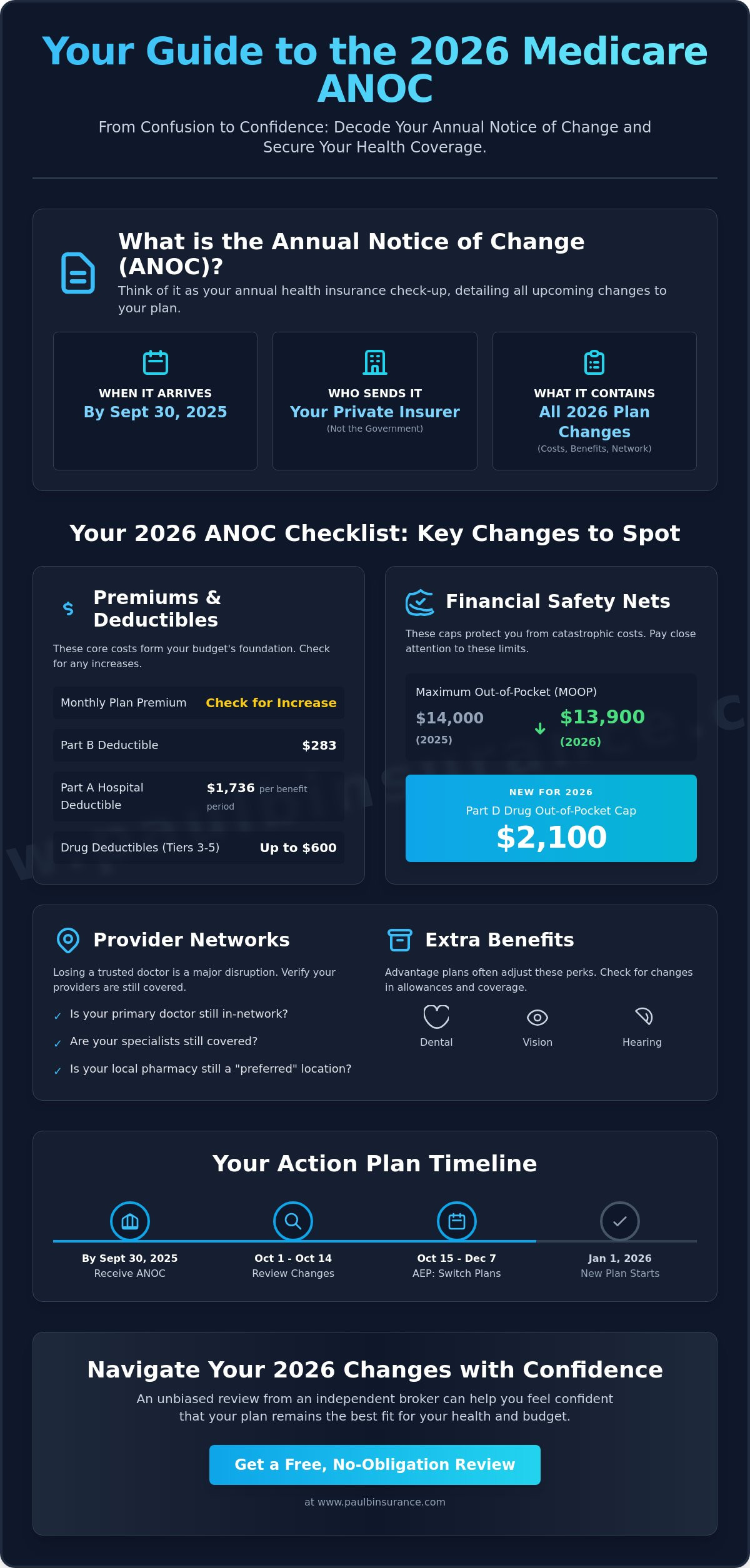
Think of the ANOC as your annual health insurance check-up. It is a document sent by your Medicare Advantage or Part D provider. It lists exactly how your plan’s costs and benefits changed for the current 2026 year. Because insurance companies adjust their coverage every year, this letter was their way of letting you know what to expect starting January 1, 2026. We know these documents can look like junk mail, but they are actually your first line of defense against rising costs.
You received this notice by September 30, 2025. Receiving it then gave you a two-week head start before the Annual Enrollment Period (AEP) began on October 15. We want you to use this information to review your options without any pressure. Having the medicare annual notice of change explained helps you understand why your current premiums or copays might have shifted. It is the best tool we have to ensure your 2026 coverage remains affordable and reliable throughout the year.
Who sends the ANOC letter?
It’s a common mistake to look for this in a government envelope. This letter comes directly from your private insurance carrier, not the Social Security office or CMS. If you’ve gone green, you likely found a digital version in your email inbox. If you have an Advantage plan and a separate Drug plan, you probably noticed two separate notices. We often tell our clients to keep these in a dedicated folder so they don’t get lost in the shuffle of daily mail.
Why this letter is your most important piece of mail this fall
We see many seniors get hit with billing surprises in January because they didn’t review this document. It flags if your monthly premium went up or if your specialist copays changed. For 2026, it was especially vital to check if your favorite doctor or local pharmacy remained in the plan’s network. Networks change frequently; we don’t want you to lose a provider you’ve trusted for years just because a contract wasn’t renewed.
This letter is your annual opportunity to ensure your coverage still fits your life. For example, with the $2,100 out-of-pocket cap for Part D drugs in 2026, many plans adjusted their formulary or tiers. We view the ANOC as a roadmap. It helps us determine if your current plan is still a “best-buy” or if there’s a more efficient way to protect your budget. Our goal is to move you from a state of confusion to total confidence, making sure you’re never rushed or pressured into a plan that doesn’t serve you.
Key Changes to Look for in Your 2026 ANOC
Opening that thick envelope shouldn’t feel like a gamble. When you look at your 2026 notice, the first thing we want you to check is your monthly premium. While you are already paying the standard Part B premium of $202.90 this year, additional plan costs can sneak up on you. Having the medicare annual notice of change explained ensures you don’t miss these small but significant adjustments. Even if your premium stayed stable, you might see a change in your Part B deductible, which sits at $283 for 2026. Spotting these shifts now prevents a stressful surprise when your bank statement arrives in January.
The Maximum Out-of-Pocket (MOOP) limit is another critical number to find. This is your financial safety net. It represents the absolute most you will pay for covered medical services in a single year. For 2026, some plans have actually decreased this limit to $13,900, down from $14,000 in 2025. This is especially vital to track because of the new $2,100 out-of-pocket cap for Part D drugs. To manage this new cap, some plans have increased their drug deductibles for Tiers 3, 4, and 5 to $600. We want to make sure your plan still offers the protection you expect, especially with the Part A inpatient hospital deductible reaching $1,736 per benefit period this year.
Provider and Pharmacy Network Updates
Insurance companies often change which doctors and hospitals are considered in-network for the new year. You must verify if your preferred local pharmacy is still a “preferred” cost-sharing location, as using a non-preferred pharmacy could significantly increase your copays. We know that keeping a trusted doctor in your network is the number one reason people choose to stay with their current plans. If you notice your physician is no longer listed in your 2026 notice, it’s a great time to schedule a call with us to explore other options that include your providers. Having your medicare annual notice of change explained by an expert can help you verify these networks quickly.
Changes to Extra Benefits (Dental, Vision, and Hearing)
Advantage plans frequently tweak their “extra” benefits to stay competitive in the market. You should check for new limits on dental insurance or vision hardware allowances in your 2026 notice. Some plans have added innovative benefits this year, such as specialized transportation to medical appointments or meal delivery after a hospital stay. We want to make sure these lifestyle benefits still align with your needs. We simplify the jargon so you know exactly how these “extras” work for your specific health goals. We believe you deserve a plan that covers the whole you, not just the basics.
ANOC vs. EOC: Understanding the Difference
Receiving a large stack of papers in the mail can feel overwhelming. We often see our clients get confused by the two different documents that arrive each fall. To make it simple, think of the Annual Notice of Change (ANOC) as the highlights reel of your plan. It only focuses on what is actually changing for the 2026 plan year. If your premium is staying the same but your specialist copay is increasing from $40 to $55, the ANOC will call that out specifically. Having the medicare annual notice of change explained this way helps you save hours of unnecessary reading.
The Evidence of Coverage (EOC), on the other hand, is the full rulebook. It is a massive document that often spans over 150 pages. It covers every single detail, benefit, and legal rule of your plan. While the ANOC shows you the “new” stuff, the EOC explains everything that stayed the same too. We recommend starting with the ANOC every single time. It is designed to be a shortcut, showing you the most vital information such as the new $2,100 Part D out-of-pocket cap for 2026 or changes to your provider network.
You should only reach for the EOC when you need a deep dive into a very specific or rare medical service. For example, if you need to know the exact rules for a specific type of durable medical equipment or a rare surgical procedure, the EOC will have those answers. For your annual “health insurance check-up,” the ANOC provides more than enough information to help you decide if you need to switch plans during the Annual Enrollment Period.
Why you usually receive both at the same time
Federal law requires insurance carriers to provide the full rules alongside the summary of changes. This is why you often receive both documents in the same package or digital notification by September 30. Don’t let the sheer size of the EOC intimidate you. It’s there as a reference guide, not a mandatory cover-to-cover read. We suggest keeping both documents in a safe folder or a dedicated digital file until the end of the 2026 plan year. Having them handy ensures you can verify your benefits if a billing question arises next July or August.
If you find yourself staring at these documents and feeling stressed, remember that you don’t have to do this alone. We provide unbiased guidance to help you make sense of the fine print. Our goal is to move you from confusion to confidence, ensuring you have the right Medicare Advantage or drug coverage for your specific budget. We simplify the jargon so you know exactly how your plan works for you.
Your Step-by-Step Checklist After Receiving the ANOC
We want to help you move from confusion to confidence by giving you a clear path forward. Once you open that envelope, don’t feel like you have to read every single page. Instead, flip directly to the “Summary of Changes” table. This table is usually located within the first few pages. It is designed to be a side-by-side comparison that shows your 2025 plan details next to your new 2026 numbers. Having the medicare annual notice of change explained in this simple format makes it much easier to spot where your budget might be impacted.
Follow these five steps to ensure your coverage remains the right fit for your life:
- Compare the costs: Look at your monthly premium and your Part D deductible. With the new $2,100 out-of-pocket cap for drugs in 2026, some plans have adjusted their deductibles to the maximum limit of $600.
- Review your medications: Check the “Formulary” section. Make sure your specific prescriptions haven’t moved to a higher cost tier or been removed from the list entirely.
- Verify your doctors: Use the provider directory link found in the notice. Confirm that your primary doctor and any specialists you see regularly are still in-network for 2026.
- Check your “extras”: Look for changes in dental, vision, or hearing benefits. Some plans may have reduced their over-the-counter (OTC) allowances for the new year.
- Mark your calendar: You have until October 15 to decide if you want to explore other options before the Annual Enrollment Period officially begins.
What to do if you didn’t receive your ANOC
If your notice hasn’t arrived by the first week of October, you should call your insurance carrier immediately. Most companies also post a digital PDF version of this document inside your online member portal. We also recommend that you verify your current mailing address with your carrier to avoid missing any future legal notices. Staying proactive ensures you aren’t left guessing about your 2026 costs when January arrives.
Making the decision: Stay or Switch?
We believe in giving you unbiased guidance so you can make the best choice for your unique situation. If the changes in your ANOC are minor and your trusted doctors are staying in the network, you don’t need to do anything. Your plan will automatically renew on January 1, 2026. However, if your costs are rising significantly or your medications are no longer covered affordably, it’s time to compare Medicare Advantage plans. Remember, you have until December 7 to make a final choice. If you feel overwhelmed by the options, Schedule a Call With Paul to get a clear, expert review of your 2026 coverage.
How We Help You Navigate Your 2026 Medicare Changes
We know that navigating the insurance system can feel like walking through a thick fog. Between the industry jargon and the constant stack of mail, it’s easy to feel overwhelmed. Our mission is to clear that fog for you. We offer unbiased reviews of your ANOC to see if your current plan is still the best value for your 2026 health needs. Having the medicare annual notice of change explained by a dedicated expert means you don’t have to guess if you’re making the right choice for your budget.
As independent brokers, we don’t work for the insurance companies. We work for you. While a captive agent might only show you one or two options from a single company, we look at over 40 different carriers. This independence allows us to compare the new $2,100 out-of-pocket drug cap across various plans to find the one that actually saves you the most money. We simplify the jargon so you know exactly how the 2026 changes affect your wallet. Our goal is to move you from confusion to confidence without any pressure or rush.
The benefit of an independent Medicare broker
Choosing a plan is about more than just the monthly premium. It’s about making sure your life stays predictable and your health is protected. We can quickly check Medicare Part D drug lists across multiple plans to ensure your specific prescriptions are covered at the lowest possible cost. If you find that your current Advantage plan isn’t the right fit anymore, we can also discuss Medigap options for 2026. These supplement plans offer a different kind of security that many of our clients prefer for long-term peace of mind and fixed costs.
Schedule your 2026 plan review today
We encourage you not to wait until the December 7th deadline. As the end of the Annual Enrollment Period approaches, the system gets crowded and the process can feel frantic. We prefer a different approach. We provide a calm, patient environment where you can ask all your “what if” questions. Whether you’re worried about losing a trusted doctor or facing higher specialist copays, we’re here to protect and empower you. You deserve a guide who is never rushed and never pressured. To get started, Schedule a Call With Paul to review your ANOC together and secure your 2026 coverage today.
Take Control of Your 2026 Coverage Today
Your health and your budget are too important to leave to chance. By now, you’ve seen how the ANOC acts as your roadmap for the coming year, flagging rising premiums and network shifts before they take effect on January 1, 2026. Having the medicare annual notice of change explained gives you the power to stay ahead of the insurance companies. You don’t have to settle for a plan that no longer fits your needs or your wallet.
We’re here to make this process simple and stress-free. As independent brokers licensed in 34 states, we represent over 40 insurance carriers to ensure you get unbiased guidance. We don’t just help you during the busy enrollment season; we provide year-round support whenever you have a question. Let us review your 2026 ANOC for free; Schedule a Call With Paul today!
You’ve worked hard for your retirement. We’re honored to help you protect it. Let’s move from confusion to confidence together, ensuring you feel secure in your coverage for the entire year ahead.
Frequently Asked Questions
What happens if I ignore my Medicare Annual Notice of Change?
If you choose to ignore this notice, you’ll be automatically re-enrolled in your current plan for the 2026 calendar year. While this might seem convenient, it’s risky because you’re accepting all new costs and network changes without reviewing them. If your plan was discontinued, you might even be placed into a different plan that doesn’t fit your specific health needs or budget.
Can my Medicare plan premiums go down in the ANOC?
Yes, it’s possible for premiums to decrease, although they more commonly stay the same or increase. Insurance carriers adjust their rates every year to stay competitive in the market. We’ve seen cases where a lower monthly premium is balanced out by higher copays for specialist visits, so it’s vital to look at the total cost, not just the monthly bill.
Why did my doctor leave my Medicare Advantage network for 2026?
Doctors and insurance companies renegotiate their contracts annually, and sometimes they simply can’t agree on payment terms. This is a business decision between the provider and the carrier, but it feels very personal when it’s your trusted physician. If your doctor left the network, we can help you search through 40 other carriers to find a plan where they are still participating.
Is the ANOC the same thing as the Open Enrollment period?
No, the ANOC is a document you receive, while the Annual Enrollment Period (AEP) is the window of time when you can actually make changes. Your notice arrives by September 30 to give you a head start. The AEP officially runs from October 15 to December 7, which is when you can use the information in your notice to switch to a better plan.
What should I do if my medication is no longer on the plan formulary?
You should immediately look for a new Part D or Advantage plan that covers your specific prescriptions. Having the medicare annual notice of change explained helps you spot these drug list removals before you’re stuck at the pharmacy counter in January. You can also talk to your doctor about switching to a generic alternative that might be on a lower cost-sharing tier.
Can I switch to a Medigap plan after reading my ANOC?
Yes, you can apply for a Medigap plan at any time, but keep in mind that you may have to answer health questions to qualify. Many seniors decide to move from an Advantage plan to a Supplement plan after seeing their 2026 out-of-pocket costs rise. We can help you compare these options to see if a Medigap plan offers the long-term stability you’re looking for.
Does the ANOC apply to Original Medicare (Part A and Part B)?
No, this notice is only sent to people enrolled in private Medicare Advantage or Part D plans. If you only have Original Medicare, your costs are determined by the government. For 2026, the government set the Part B deductible at $283 and the Part A inpatient hospital deductible at $1,736 per benefit period. You won’t receive a formal ANOC for these specific government-set rates.

Article by
Paul Barrett
Paul Barrett, CMIP is the founder of The Modern Medicare Agency, an independent Medicare-only brokerage based in Melville, NY. With 18 years of Medicare-exclusive experience, a CMIP designation, and more than 5,000 clients served across 37 states, Paul is one of the most credentialed independent Medicare specialists on Long Island — and one of the most direct.
He represents 40+ carriers with no quotas and no allegiances, which means his recommendations are based entirely on what fits each client's specific situation. He is the author of Medicare Mastery Unlocked and host of the Wise Guys Retirement Talk podcast. His content is grounded in primary sources, real carrier intelligence, and 18 years of watching what happens when people get Medicare right — and when they don't.
📞 631-358-5793 | paulbinsurance.com