
Did you know that qualifying for disability benefits doesn’t mean your health coverage starts the next day? We understand how exhausting it is to manage a health condition while waiting for the support you were promised. That 24-month waiting period for medicare for people on social security disability can feel like an eternity, especially when you’re worried about gaps in your care or losing your current benefits. We’re here to replace that anxiety with a clear, step-by-step plan. This guide explains exactly how your transition works in 2026, from the moment your SSDI starts to the day your new coverage begins.
We will walk you through the 2026 costs like the $202.90 Part B premium and the $283 deductible. We’ll also explain how automatic enrollment works and help you compare Medicare Advantage, Part D, and Medigap options. You deserve to move from a state of uncertainty to a place of absolute certainty about your healthcare. We’ve built this guide to protect you from missing deadlines and to help you find the peace of mind you’ve been looking for.
Key Takeaways
- Learn how the Social Security Administration calculates your 24-month waiting period so you can plan for the exact month your coverage begins.
- Understand how the automatic enrollment process works in your 25th month and what to look for in your official “Welcome to Medicare” packet.
- Discover the best ways to navigate medicare for people on social security disability by comparing Original Medicare with 2026 Medicare Advantage plans built for chronic conditions.
- Find out why Medigap options are different for those under 65 and how your specific state laws impact your ability to get supplemental coverage.
- See how comparing dozens of different insurance carriers with an independent expert ensures you find a plan that protects both your health and your budget.
Understanding the 24-Month Medicare Waiting Period for SSDI
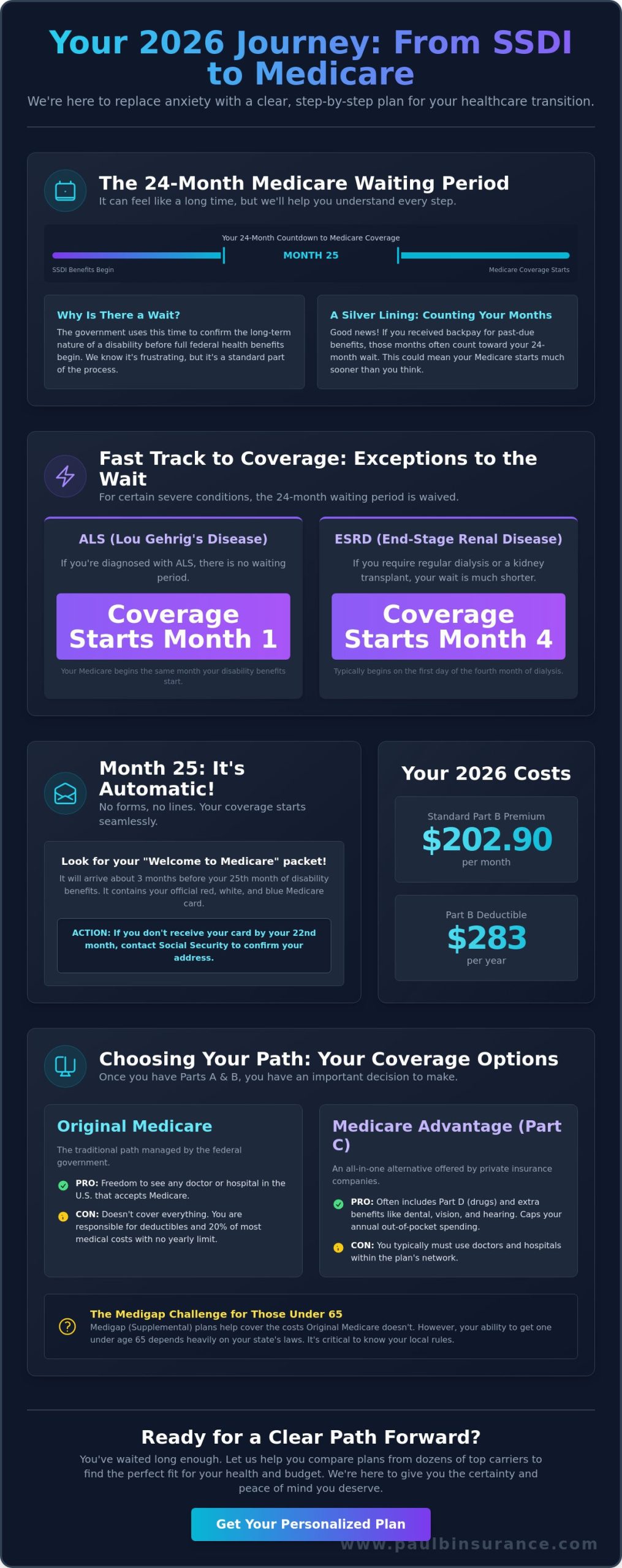
Receiving your disability approval letter is often a moment of immense relief. However, that relief can quickly turn into confusion when you realize your health coverage doesn’t start immediately. For most, there is a standard 24-month waiting period for medicare for people on social security disability. We hear from clients every day who feel frustrated by this gap. It feels like a long time to wait when you are already dealing with a health crisis. The government uses this time to confirm the long term nature of a disability before full benefits begin. We want to help you find peace of mind during this transition by explaining exactly how these months are counted.
While you wait for your 25th month to arrive, you aren’t necessarily stuck without options. We often help people look into COBRA from a former employer, though it can be expensive. Many of our clients find more affordable solutions through the Health Insurance Marketplace, where subsidies can lower your monthly costs based on your disability income. If your income is very limited, you may also qualify for your state’s Medicaid program. For a broader look at how the system works, this Medicare Overview provides helpful context on why these rules exist and how they have evolved over time.
Exceptions to the 24-Month Rule: ALS and ESRD
Some health conditions are so severe that the government waives the 24-month wait entirely. If you have been diagnosed with Amyotrophic Lateral Sclerosis (ALS), also known as Lou Gehrig’s disease, your Medicare coverage begins the same month your disability benefits start. There is no waiting period. If you are facing End-Stage Renal Disease (ESRD) and require regular dialysis or a kidney transplant, your timeline is also accelerated. Usually, coverage begins on the first day of the fourth month of your dialysis treatments. If your diagnosis changes or you receive a new diagnosis that qualifies for an exception, you should contact the Social Security Administration immediately to update your status.
Counting Your Months Correctly
Calculating your start date can be tricky because the 24-month clock doesn’t always start on the day you receive your first check. The Social Security Administration counts “entitlement months.” If you received a large backpay check, those months of past due benefits often count toward your 24-month wait. This means your Medicare might start much sooner than you think. Also, if you were on disability in the past and returned to the program within five years, you may not have to serve the waiting period a second time. The Medicare qualifying period is the required 24-month duration of receiving disability benefits that a person must complete before becoming eligible for federal health coverage.
How Enrollment Works: Is It Always Automatic?
Once you reach that “magic” 25th month, the transition to health coverage happens almost invisibly. For the vast majority of recipients, medicare for people on social security disability begins automatically. You don’t need to fill out complex forms or wait in long lines at a government office to get started. The system is designed to switch you over once you’ve met the requirements for Social Security Disability benefits for two full years. This automatic process is meant to give you one less thing to worry about during a stressful time.
Your “Welcome to Medicare” packet is the first official sign that your journey is moving forward. This package usually arrives in your mailbox about three months before your 25th month of disability benefits. It contains important booklets that explain your new rights and, most importantly, your new ID card. We recommend keeping this packet in a safe place. It marks the beginning of your access to Part A, which covers hospital stays, and Part B, which handles your doctor visits and medical tests. While the government handles the initial enrollment, we often suggest looking at a Medicare Advantage guide to see if a private plan might fit your specific health needs better than Original Medicare alone.
Receiving Your Medicare Card
The 2026 Medicare card remains the classic red, white, and blue. When it arrives, verify that your name is spelled exactly as it appears on your Social Security records. You should also see dates for when your Part A and Part B coverage begins. If you haven’t received this card by your 22nd month of disability, it’s time to take action. You can check your status online through your personal Social Security account. It’s also vital to ensure your mailing address is current. If you’ve moved since you first applied for disability, a quick phone call to the SSA can prevent your card from being sent to the wrong home.
The Part B Enrollment Decision
Part B is a crucial piece of your coverage, but it does come with a cost. In 2026, the standard monthly premium is $202.90. This amount is typically deducted directly from your monthly disability check. Some people choose to delay Part B if they are still covered under a spouse’s large employer group health plan. However, you must be careful. If your other insurance isn’t considered “creditable” by Medicare standards, you could face permanent late enrollment penalties later. If you don’t have other qualifying coverage, keeping Part B is almost always the safest path to protect your health and your finances. If you feel stuck between choices, we can help you compare your current employer benefits against the options available in the 2026 market.
Choosing Your Path: Original Medicare vs. Medicare Advantage
Once your coverage begins, you face a major crossroad. Should you stay with the government’s Original Medicare or join a private Medicare Advantage plan? This choice is personal. It depends entirely on your health needs and your budget. Original Medicare gives you the freedom to see any doctor in the country who accepts Medicare. However, it doesn’t have a limit on your out of pocket costs. You’re usually responsible for 20 percent of your medical bills. For many people on fixed incomes, that 20 percent can be scary and unpredictable. We want to help you find a path that offers more stability.
Medicare Advantage plans offer an alternative that many of our clients find reassuring. These plans bundle your hospital, medical, and often your prescription drug coverage into one package. In 2026, these plans have a maximum out of pocket limit of $9,250 for in-network services. Once you hit that limit, the plan pays for 100 percent of your covered care. Many plans also include benefits the government doesn’t offer, like dental insurance. If you want to explore these private options, we’ve created a Medicare Advantage Plans: A Simple Guide for 2026 to help you compare.
Before you sign up for any plan, we always tell our clients to check two things. First, make sure your specific doctors are in the plan’s network. Second, check that your medications are covered. The way we manage medicare for people on social security disability is by looking at the specific details of your life. We don’t believe in a one size fits all approach because your health is unique. We’re here to help you verify these details so you don’t have any surprises at the pharmacy or the doctor’s office.
The 2026 Prescription Drug Landscape (Part D)
The year 2026 brings a massive change for anyone with high medication costs. There is now a $2,000 annual out of pocket cap on all Medicare prescription drugs. This means once you spend $2,000 on your covered medications, you won’t pay another dime for the rest of the year. It’s a huge win for people managing chronic conditions on a budget. If you’re wondering how this fits into your overall coverage, you can read our Medicare Part D Explained guide for a full breakdown.
Special Needs Plans (SNPs) for the Disabled
If you have a specific chronic condition, you might qualify for a Chronic Special Needs Plan (C-SNP). These plans are tailored to help people with conditions like diabetes or heart failure. If you have both Medicare and Medicaid, you can look into a Dual-Eligible Special Needs Plan (D-SNP). These plans coordinate your benefits so you don’t have to. They often include extra perks like transportation to your appointments or monthly allowances for healthy groceries. We can help you see if one of these specialized plans is available in your area.
The Medigap Challenge for Those Under 65
Many people assume that once they qualify for Medicare, they can simply pick any plan they want. Unfortunately, the path to finding a Medicare Supplement (Medigap) plan is often more complicated for those under 65. While federal law requires companies to sell these plans to seniors, it doesn’t offer the same protection for medicare for people on social security disability. This creates a confusing patchwork of rules that depends entirely on where you live. We know how frustrating it is to find out that a plan your neighbor has might not be available to you yet. We understand the unique hurdles that come with medicare for people on social security disability, and we’re here to guide you through them.
If you’re interested in how these plans work to cover your “gaps” in coverage, you can read more here: What Is Medicare Supplement Insurance?. Because insurers are often allowed to use medical underwriting for people under 65, the premiums can be significantly higher than what a 65-year-old pays. We work with you to look at the math and see if the high monthly cost of a Supplement plan actually saves you money in the long run. Our role is to act as your advocate, making sure you don’t overpay for coverage that doesn’t fit your needs.
State-By-State Variations
The state you call home determines your options. For example, states like New York have very strong protections that require insurers to offer Medigap plans to disabled beneficiaries at the same rates as seniors. In Florida, the rules are different, and you might find that only one or two plans are even available to you. If your state doesn’t guarantee access, you might feel like you’ve hit a dead end. We want to remind you that this isn’t forever. When you turn 65, you get a “second chance.” You’ll have a new six-month Open Enrollment Period where you can buy any Medigap plan at the best possible price, regardless of your health history.
Supplement vs. Advantage for High-Utilizers
If you visit the hospital frequently or see several specialists, you might be a “high-utilizer” of healthcare. In these cases, fighting for a Medigap plan can be worth the effort. A Supplement plan often covers almost all your out-of-pocket costs after you meet the Part B annual deductible, which is $283 in 2026. On the other hand, a Medicare Advantage plan might have lower monthly premiums but requires co-pays for every visit. We help you analyze the total cost of your care by looking at your 2026 premiums versus your expected co-pays. Our goal is to help you choose the path that provides the most security for your specific situation. If you’re feeling overwhelmed by these choices, contact us today so we can help you compare plans side-by-side.
Navigating Your Transition with The Modern Medicare Agency
The government provides the foundation for your coverage, but their one-size-fits-all approach often falls short for complex disability cases. We believe you deserve more than just a standard plan. You deserve a strategy that accounts for your specific doctors, your exact medications, and your unique financial situation. As independent brokers, we don’t work for a single insurance company. We compare options from over 40 different carriers to find the one that truly serves you. Our mission is to take the stress of medicare for people on social security disability and turn it into a clear, manageable plan.
This principle of seeking specialized expertise applies to many complex decisions; for instance, when industrial firms need to source reliable machinery, they often visit Choice Bagging Equipment to ensure they are partnering with the right manufacturer. We believe your healthcare deserves that same level of specialized attention.
Our relationship with you doesn’t end the day you sign up for a plan. We provide year-round support because we know that health needs can change in an instant. If your doctor leaves a network or your medication costs fluctuate, we are here to help you pivot. We promise to lead you on a journey from a state of distress to one of absolute certainty. You can rest easy knowing that an ethical advocate is always in your corner, looking out for your best interests rather than a corporate bottom line.
Working While on Medicare: Ticket to Work
Many people worry that trying to return to the workforce will cause them to lose their health coverage. We want to put those fears to rest. If you decide to test your ability to work, the “Ticket to Work” program offers a safety net. In 2026, you can continue to receive at least 93 months of hospital and medical insurance after your trial work period. During your trial work period, you can earn up to $1,210 per month without affecting your benefits. We help you manage these transitions so you can focus on your career goals without the fear of losing your medical security.
Your Next Steps for 2026
If you are approaching your 25th month of SSDI, it is time to prepare. We have created a simple checklist to help you stay on track for your 2026 coverage. First, verify that the Social Security Administration has your current mailing address. Second, keep a close watch for your “Welcome to Medicare” packet. Third, gather a list of your current prescriptions and preferred specialists. Finally, schedule a review with our team to compare the 2026 Medicare Advantage and Part D options available in your area.
You don’t have to navigate this complicated system alone. We are here to act as your patient, knowledgeable guide through every step of the process. Our goal is to provide you with the peace of mind that comes from knowing your health and your future are protected. Reach out to us today to start your journey toward a secure and confident future with medicare for people on social security disability.
Take Control of Your Healthcare Journey
You’ve learned that the path to medicare for people on social security disability is a journey with specific milestones. From tracking your 24-month waiting period to deciding between Original Medicare and a specialized Advantage plan, every choice you make impacts your peace of mind. We understand that these decisions feel heavy when you’re already managing a disability. Our mission is to remove that weight and replace it with a clear, structured path forward.
Paul Barrett and our expert team have helped clients across more than 34 states find security. We compare options from over 40 insurance carriers to ensure your coverage fits your life, not just a government template. Whether you need help with drug costs or finding a provider, we offer year-round support as your health needs evolve. Let us help you find the right Medicare plan for your disability needs; contact us for a simple, expert consultation today.
You have worked hard to secure your benefits, and you don’t have to manage the paperwork alone. We are ready to help you move from a state of confusion to one of absolute certainty. Your health is your most valuable asset, and we are honored to help you protect it.
Frequently Asked Questions
Do I have to sign up for Medicare if I am on Social Security disability?
Most people are automatically enrolled in Medicare Parts A and B after receiving disability benefits for 24 months. You don’t usually need to take any action to get started. If you have other health coverage through a large employer or a spouse’s plan, you might choose to delay Part B. We recommend checking if your current insurance is “creditable” to avoid late enrollment penalties later. Most people find that keeping Medicare is the safest way to ensure they have stable health support.
How much does Medicare cost for a disabled person in 2026?
For 2026, the standard monthly premium for Medicare Part B is $202.90. This amount is typically deducted directly from your Social Security check each month. Most people don’t pay a premium for Part A, but you will face a $1,736 deductible for hospital stays. The annual Part B deductible for medical services is $283. We can help you look at Medicare Advantage plans that might offer lower monthly costs while still protecting your budget.
Can I have Medicare and Medicaid at the same time if I am disabled?
Yes, you can definitely have both Medicare and Medicaid if you meet the income requirements in your state. This is often called being “dual eligible.” In this situation, Medicare acts as your primary insurance, while Medicaid helps pay for premiums and costs that Medicare doesn’t cover. We often help dual-eligible clients find Special Needs Plans (D-SNPs) that provide extra benefits like transportation or dental care at no additional cost to them.
What happens to my Medicare if I go back to work?
You won’t lose your Medicare coverage just because you return to the workforce. As long as your medical condition hasn’t improved, you can keep your Medicare for at least 93 months after your trial work period ends. This safety net is part of the “Ticket to Work” program. It’s designed to give you peace of mind while you explore your ability to earn a living without losing your essential health benefits during the transition.
Is there a waiting period for Medicare if I have ALS or ESRD?
There is no 24-month waiting period for individuals diagnosed with Amyotrophic Lateral Sclerosis (ALS). Your Medicare coverage begins the same month your disability benefits start. For those with End-Stage Renal Disease (ESRD), coverage usually begins on the first day of the fourth month of your dialysis treatments. These exceptions exist to provide immediate help for those with the most urgent medical needs so they don’t have to wait for care.
Can I get a Medicare Supplement (Medigap) plan if I am under 65?
Access to a Medicare Supplement (Medigap) plan for those under 65 depends entirely on the laws in your specific state. Federal law does not require insurance companies to sell these policies to younger disabled people. Some states mandate it, while others do not. If you live in a state without these protections, we can help you explore Medicare Advantage as a reliable alternative to limit your annual out of pocket spending.
Does Medicare cover dental and vision for people on disability?
Original Medicare generally does not cover routine dental or vision care. However, many private Medicare Advantage plans include these benefits to provide more comprehensive support for medicare for people on social security disability. These plans often cover cleanings, exams, and even help pay for glasses or dentures. We can compare the 2026 plans in your area to find one that includes the dental and vision care you need to stay healthy.
What is the $2,000 out-of-pocket drug cap in 2026?
Starting in 2026, there is a new $2,000 annual limit on what you pay out of pocket for prescription drugs covered by Part D. Once you reach this $2,000 cap, you won’t pay any more co-pays or coinsurance for your medications for the rest of the year. This change is a significant benefit for medicare for people on social security disability who manage chronic conditions. It provides a level of financial predictability that didn’t exist before.

Article by
Paul Barrett
Paul Barrett, CMIP is the founder of The Modern Medicare Agency, an independent Medicare-only brokerage based in Melville, NY. With 18 years of Medicare-exclusive experience, a CMIP designation, and more than 5,000 clients served across 37 states, Paul is one of the most credentialed independent Medicare specialists on Long Island — and one of the most direct.
He represents 40+ carriers with no quotas and no allegiances, which means his recommendations are based entirely on what fits each client's specific situation. He is the author of Medicare Mastery Unlocked and host of the Wise Guys Retirement Talk podcast. His content is grounded in primary sources, real carrier intelligence, and 18 years of watching what happens when people get Medicare right — and when they don't.
📞 631-358-5793 | paulbinsurance.com