
What if the confusing document sitting on your kitchen table isn’t a bill at all, but actually a powerful shield for your bank account? We know that opening government mail often feels overwhelming, especially when you see large numbers listed under “amount billed.” It’s completely natural to feel a flash of stress when you’re trying to figure out if you’re being overcharged or if your medical identity is secure. Understanding my medicare summary notice shouldn’t feel like learning a foreign language, yet the complex layout can make anyone feel uneasy.
We’re here to help you decode these statements so you can spot errors, confirm that Medicare paid your doctor, and finally find total peace of mind. You deserve to know exactly how much you owe out-of-pocket without any guesswork. In this 2026 guide, we’ll walk through the recent changes to the 180-day paper mailing cycle and explain how the new $2,100 prescription drug cap appears on your notice. We’ll show you how to transform that stack of paperwork into a clear, manageable record of your health coverage.
Key Takeaways
- Learn why the most important step in reading your statement is remembering it is not a bill. This simple rule helps remove the stress of seeing high numbers on the page.
- We provide a clear walkthrough for understanding my medicare summary notice so you can easily tell the difference between what a doctor charged and what Medicare approved.
- Find out whether you should expect a government notice or a private insurance statement based on your specific plan type in 2026.
- Discover how to use a personal Healthcare Log to catch billing errors and protect your identity from medical fraud.
- Learn how we can serve as your personal advocate to make sure your Medigap or Advantage plan is paying its fair share for your care.
What Is a Medicare Summary Notice (MSN) and Why Did I Receive It?
The Medicare Summary Notice (MSN) is often the most misunderstood piece of mail in your house. It arrives in a large envelope, filled with tables and dollar amounts that can look quite intimidating. At its heart, the MSN is simply a summary of all the services and supplies billed to Medicare on your behalf over a specific period. If you have Original Medicare, this document serves as your official record for Part A and Part B claims. It’s a way for the government to show you what was processed, but it’s also a tool for you to verify that the care you received matches what’s being reported.
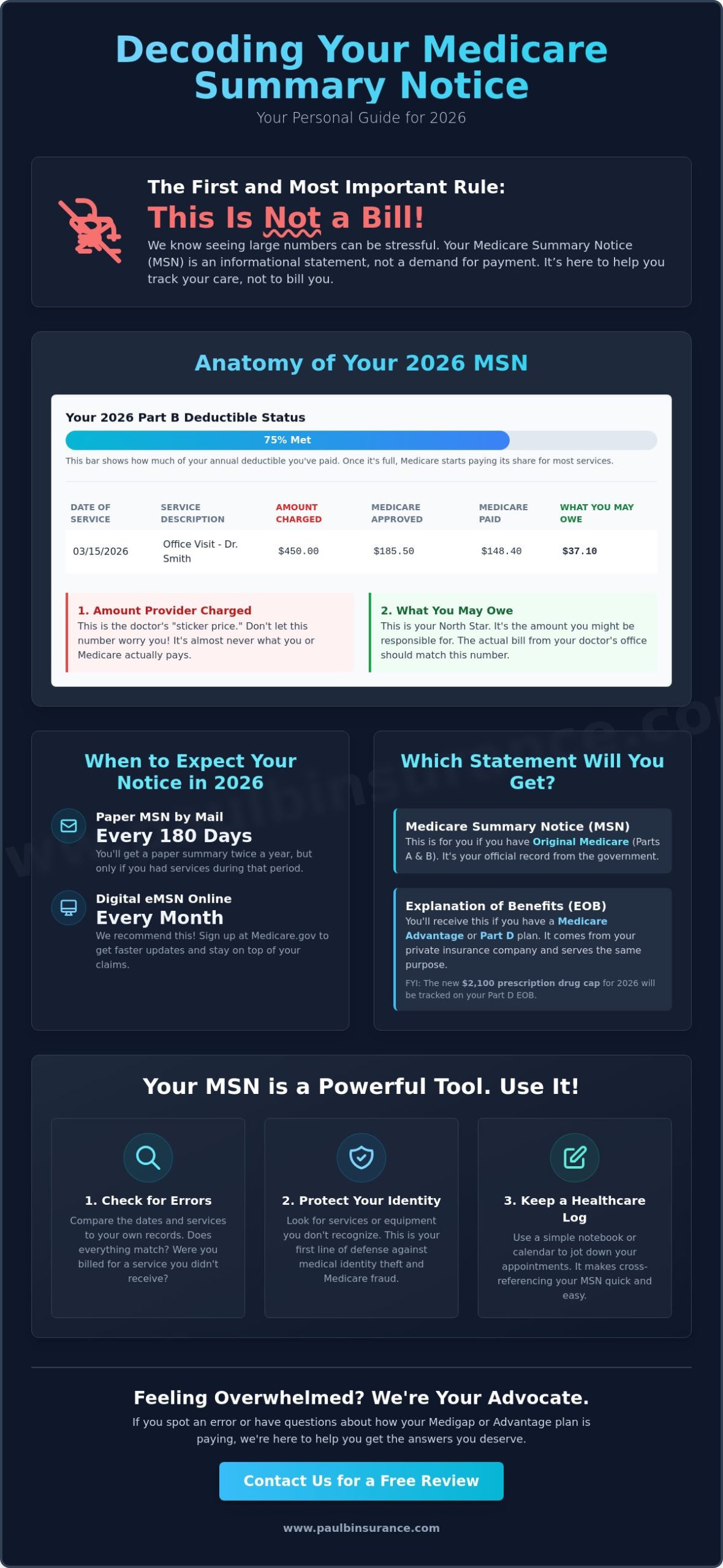
The most important thing to remember is the “Not a Bill” rule. We see many people feel a rush of anxiety when they see a large “Amount Billed” figure. Please take a deep breath; this notice is an information statement, not a request for payment. It exists to show you what your doctors charged, what Medicare paid, and what you might eventually owe your provider. It’s your window into how the Medicare program is handling your healthcare costs. By reviewing it, you’re taking the first step toward true financial clarity.
In 2026, the way you receive this information has changed. While you might be used to getting these in the mail more frequently, paper MSNs are now mailed every 180 days. This shift to a six-month cycle is part of a larger effort to encourage the use of “eMSNs.” If you’ve signed up for electronic delivery through your Medicare.gov account, you actually get these updates every single month. This digital shift makes understanding my medicare summary notice much faster and helps you stay on top of your claims in real-time without waiting for a stack of paper to arrive twice a year.
The Purpose of the MSN in 2026
Think of the MSN as a detailed receipt for your healthcare journey. It does more than just list visits; it tracks your deductible progress for the 2026 calendar year. By looking at your notice, you can see exactly how close you are to meeting your out-of-pocket requirements. This transparency is vital for protecting the Medicare trust fund and ensuring that every dollar is accounted for. When you spend time understanding my medicare summary notice, you’re acting as a final line of defense against billing errors. This is especially important for those who use a Medigap plan to cover their remaining costs, as your supplement relies on the accuracy of these Medicare claims.
When to Expect Your Notice
If you prefer paper, you’ll see your notice in your mailbox twice a year, provided that services were actually billed during those six months. If you haven’t visited a doctor or used a medical service, you won’t receive a notice at all. We recommend checking your Medicare portal if you want to see your claims sooner. You can view your claim status daily online, which is a great way to confirm that a recent doctor visit was processed correctly. This proactive approach removes the stress of waiting for a semi-annual mailer to find out if your claims were approved.
How to Read Your Medicare Summary Notice Without the Stress
Opening your MSN often feels like staring at a complex puzzle. We’re here to help you piece it together. When you’re focused on understanding my medicare summary notice, the first thing to do is ignore the total dollar amounts for a moment. Instead, look at the layout. The document is split into two main parts: the high-level summary and the granular details. By focusing on one section at a time, you can remove the anxiety that comes with government paperwork.
You’ll see several columns that often cause confusion. The “Amount Provider Charged” is simply the sticker price your doctor sent to Medicare. Don’t let this number scare you; it’s rarely what anyone actually pays. The “Medicare Approved Amount” is the lower, negotiated rate that Medicare recognizes for that service. The “Amount Medicare Paid” is the portion the government covered. Finally, the “Maximum You May Be Billed” column is your North Star. This is the exact amount you might owe out-of-pocket. It’s the most important number on the page because it tells you exactly what to expect when the actual bill arrives from your doctor.
The Summary Page: Your Big Picture
The summary page is your 30,000-foot view of your healthcare costs. It features a table called the Service Summary. This section shows you at a glance whether you’ve met your 2026 deductible. If the tracking bar is full, Medicare has started paying its share for your covered services. This page is designed to give you quick answers without making you dig through pages of fine print. It’s the best place to start if you just want to confirm that your claims are moving through the system correctly.
Decoding the Detailed Claim Information
The detailed pages break down every single visit by the date of service and the provider’s name. Pay close attention to the “Notes” column. These are small alphanumeric codes that explain why a claim was handled a certain way. If you see a “Non-covered” item, don’t panic. It often means a specific service didn’t meet Medicare’s criteria for that particular visit. If these codes leave you feeling stuck, we can help you review your coverage options to ensure you aren’t left with unexpected costs from these non-covered items. We believe that clarity is the best cure for the stress of medical billing.
MSN vs. EOB: Which Statement Should You Be Looking For?
One of the most common sources of confusion we see is the arrival of multiple different statements in the mail. It can feel like you’re drowning in paperwork. Understanding my medicare summary notice becomes much simpler when you realize it only tracks services covered by the government. If you have a Medigap plan, you might actually receive two different documents for the same doctor visit. First, you’ll get your MSN from the government showing what they paid. Later, you’ll receive a separate statement from your private insurance company confirming they covered the “gap” in costs. Keeping these together helps you see the full picture of your coverage.
Your prescriptions follow a different path. Because drug coverage is handled through private companies, you won’t see your medications on your standard MSN. Instead, you’ll receive a monthly statement for Medicare Part D called an Explanation of Benefits (EOB). In 2026, this document is more important than ever because it tracks your progress toward the $2,100 out-of-pocket cap. We recommend keeping a simple folder labeled “Medical Statements” to separate your government notices from your private insurance EOBs. This small step can remove a massive amount of stress from your monthly routine.
The Original Medicare MSN (Parts A and B)
The MSN is strictly for hospital and medical services processed through the federal government. A helpful tip for identification is to look for the color; Part B notices are typically blue-tinted. This document is your official record for things like doctor visits, lab tests, and hospital stays. If you ever feel unsure about the totals or “Notes” codes on these pages, we’re here to help you review them. Our goal is to ensure you feel confident that every claim is accurate and that your benefits are working exactly as they should.
The Medicare Advantage Explanation of Benefits
If you’ve chosen a Medicare Advantage plan, your experience will be a bit different. You won’t receive a quarterly MSN for your medical care. Instead, your private insurance company will send you an EOB. These statements often arrive monthly, providing a more frequent update on your spending. A key benefit of the EOB is that it includes details for extra services like dental or vision care that aren’t found on a standard government notice. We can help you compare these statements against your plan benefits to make sure you’re getting the full value of your coverage.
Using Your MSN to Spot Errors, Overcharges, and Fraud
Your MSN is more than just a list of past appointments; it’s your personal financial shield. While most medical providers are honest, mistakes happen frequently in a system as large as Medicare. In fact, billions of dollars are lost each year to improper payments, which are often just simple documentation errors rather than intentional fraud. We recommend keeping a “Healthcare Log,” which can be a simple calendar where you jot down your doctor visits and any equipment you receive. This habit makes understanding my medicare summary notice much easier because you have your own reliable record to compare against the government’s statement.
Protecting yourself starts with a few simple checks. First, verify that the dates of service on the notice match your actual doctor visits. Second, look for “double billing,” where the same procedure or lab test appears twice on the same day. Third, keep an eye out for “phantom” services or equipment. If you see a charge for a back brace, wheelchair, or walker that you never ordered or received, it could be a sign of medical identity theft. If you spot a suspicious charge, don’t panic. Most issues are clerical. Contact your provider’s billing office first; they can often resolve a simple typo or duplicate entry in minutes.
If you find that billing errors are becoming a recurring headache, we can help you find a Medicare Supplement plan that offers more predictable costs and administrative support.
Common Billing Errors to Watch For
There are three specific errors that frequently pop up on statements in 2026. The first is “upcoding,” which happens when a provider bills for a more expensive, complex service than what you actually received. For example, a quick five-minute check-up shouldn’t be billed as an hour-long consultation. The second is “phantom billing” for appointments you cancelled or missed. Finally, simple typos are a leading cause of claim denials. A single wrong digit in your Medicare number or a misspelled name can cause the entire system to reject your claim, leaving you with a confusing “non-covered” notice.
How to File an Appeal If Your Claim Is Denied
If you see a charge that Medicare refused to pay and you believe the decision was wrong, you have the right to push back. Flip to the last page of your notice to find the “How to Appeal” section. You have a 120-day window from the date you received the MSN to file a request for a redetermination. An appeal is your right to ask Medicare to reconsider a payment decision. This process ensures that you aren’t held responsible for costs that should have been covered by your benefits. Understanding my medicare summary notice gives you the confidence to stand up for your rights and protect your retirement savings.
Managing Your Medicare Paperwork with The Modern Medicare Agency
Navigating the healthcare system in 2026 shouldn’t feel like a solo journey through a mountain of paperwork. We know that even after reading this guide, the actual notices you receive can still feel heavy and confusing. Our mission is to act as your personal advocate, taking the weight off your shoulders. When you’re focused on understanding my medicare summary notice, we step in to provide the clarity you deserve. We don’t just help you pick a plan; we stay by your side to make sure that plan is actually working the way it’s supposed to. This journey from uncertainty to absolute certainty is what we provide every day.
Working with an independent broker offers a layer of protection you won’t find with a restricted representative who only has limited options. Because we are autonomous and aren’t tied to a single insurance company, our only priority is your best interest. We can review your MSN to ensure your Medigap or Advantage plan is processing claims correctly. If a billing headache arises, you don’t have to face the insurance carrier alone. We’re here for year-round support, providing a consistent point of contact long after enrollment season has ended. We believe in building a relationship based on trust and reliable support.
How We Help You Review Your Statements
We’ve developed a methodical process for sitting down with our clients to “translate” their notices into plain English. If you find a charge that doesn’t look right, we don’t just tell you to call Medicare. We help you communicate directly with insurance carriers to investigate and fix clerical errors. Our goal is your total peace of mind. We want you to feel secure knowing that your financial protection is in expert hands. This isn’t just about paperwork; it’s about making sure you are treated fairly by the system. Understanding my medicare summary notice becomes a simple task when you have a dedicated partner to walk you through every line.
Choosing Plans That Simplify Your Billing
Some plans are naturally easier to manage than others. In the 2026 plan landscape, certain options offer more streamlined billing and much clearer statements that reduce the risk of confusion. We can help you identify these user-friendly choices during our review. Having a dedicated Medicare broker who understands these nuances ensures you aren’t surprised by a complex bill later. We act as your champion in a system that often feels impersonal. If you’re ready to replace stress with certainty, contact us today for a stress-free Medicare review.
Take Control of Your Medicare Journey
Your journey from confusion to clarity starts with a few simple steps. By now, you know that the “Amount Billed” isn’t a debt you owe. It’s just the starting point for Medicare’s payment process. Whether you’re viewing your monthly eMSN online or waiting for your semi-annual paper statement, you have the tools to spot errors and protect your identity. Understanding my medicare summary notice is your best defense against the billing mistakes that can happen in the complex 2026 healthcare system. You don’t have to manage these documents alone or feel stressed every time a blue-tinted envelope arrives in your mailbox.
As independent brokers representing over 40 carriers, we offer the personalized, year-round support you need to stay confident. We’re experts in the 2026 Medicare landscape and are committed to serving as your dedicated advocate. We can help you find plans that simplify your billing and ensure your coverage is working exactly as promised. Let us help you make sense of your Medicare paperwork; schedule a review today! You’ve worked hard for your benefits, and we’re here to help you protect them with total peace of mind.
Frequently Asked Questions
Is the Medicare Summary Notice a bill that I need to pay?
No, the Medicare Summary Notice is not a bill. It is an information statement that acts as a receipt for the services and supplies you received over a specific period. You should wait until you receive an actual bill from your doctor or hospital before you make any payments. We recommend comparing the “Maximum You May Be Billed” column on your notice to the final bill from your provider to make sure the amounts match.
How often will I receive my Medicare Summary Notice in 2026?
In 2026, paper notices are mailed every 180 days, which is twice a year. This is a change from previous years when they arrived more frequently. If you want to see your claims sooner, you can sign up for electronic notices through your secure Medicare account. These digital versions, called eMSNs, are updated every month, making understanding my medicare summary notice a much more frequent and manageable task for your records.
What should I do if I find an error on my Medicare Summary Notice?
You should contact your doctor’s billing office first to see if the error was a simple clerical mistake. Many issues, like duplicate charges or the wrong date of service, can be fixed quickly by the provider. If they cannot resolve the problem, you have the right to file an appeal. You must start this process within 120 days of the date you received the notice to ensure Medicare reconsidered the payment decision.
Why did I receive an MSN if I have a Medicare Advantage plan?
You generally receive an MSN only if you are in Original Medicare. If you have a Medicare Advantage plan, you should receive an Explanation of Benefits (EOB) from your private insurance company instead. If an MSN arrives, it might be because you recently switched plans or had a specific service that was still processed through the government. We can help you look at your current plan to see why a notice was generated for your care.
Can I receive my Medicare Summary Notice electronically?
Yes, you can sign up for electronic delivery at Medicare.gov to receive your notices via email. Choosing this option allows you to see your claims every month rather than waiting for the 180-day paper mailing cycle. It is a secure way to track your healthcare spending and reduces the risk of medical identity theft from paper mail. We often suggest this digital route for clients who want to stay updated on their deductible progress in real time.
What is the difference between an MSN and an EOB?
The difference lies in who sends the document and which part of Medicare it covers. An MSN is sent by the federal government for Part A and Part B services under Original Medicare. An EOB is sent by a private insurance company for those with Medicare Advantage or Part D plans. Both documents show what was billed and what you owe, but they follow different schedules and have slightly different layouts depending on the insurance carrier.
How long should I keep my Medicare Summary Notices in my records?
We suggest keeping your notices for at least three to six years. This timeframe aligns with the standard period for maintaining medical and tax records. Keeping these documents helps you if a billing dispute arises later or if you need to verify your out-of-pocket spending for a specific year. If you use the electronic version, you can simply save the digital files to a secure folder on your computer to save physical space in your home.
What does it mean if my MSN says a claim was denied?
A denied claim means Medicare has declined to pay for a service or piece of equipment. This doesn’t always mean you are responsible for the full cost; it often means Medicare needs more information from your doctor. Understanding my medicare summary notice involves looking at the “Notes” section to find the specific code explaining the denial. Once you know the reason, you can work with your provider to resubmit the claim or file an official appeal.

Article by
Paul Barrett
Paul Barrett, CMIP is the founder of The Modern Medicare Agency, an independent Medicare-only brokerage based in Melville, NY. With 18 years of Medicare-exclusive experience, a CMIP designation, and more than 5,000 clients served across 37 states, Paul is one of the most credentialed independent Medicare specialists on Long Island — and one of the most direct.
He represents 40+ carriers with no quotas and no allegiances, which means his recommendations are based entirely on what fits each client's specific situation. He is the author of Medicare Mastery Unlocked and host of the Wise Guys Retirement Talk podcast. His content is grounded in primary sources, real carrier intelligence, and 18 years of watching what happens when people get Medicare right — and when they don't.
📞 631-358-5793 | paulbinsurance.com