




What if the most confusing two years of your life could actually be a clear, manageable path toward the healthcare security you deserve? We know that waiting for your benefits while managing a disability often feels like standing in a long line with no end in sight. It’s stressful to worry about rising medical costs while living on a fixed SSDI benefit, which averages about $1,630 per month in 2026. Understanding medicare eligibility for under 65 disability shouldn’t feel like solving a complex puzzle without the instructions.
You deserve to feel confident that your doctors and medications are covered without breaking your budget. We’re going to show you exactly how the 24-month waiting period works and what to do if you have a condition like ALS or ESRD that lets you skip the wait. This guide explains the difference between Medicare Advantage and Supplement options for 2026, including details on the $202.90 Part B premium and the $283 deductible. We’ll provide a clear, step-by-step timeline so you can move from a state of uncertainty to total peace of mind.
Key Takeaways
- Learn how your SSDI benefits determine your medicare eligibility for under 65 disability and how to track your specific enrollment date.
- We explain the 24-month waiting period rules. This helps you avoid stressful gaps in your healthcare while you transition from other coverage.
- Compare Medicare Advantage and Supplement options to see which path provides the most security and value for your specific health needs.
- Discover how the new $2,000 annual cap on prescription drugs in 2026 offers you much-needed financial relief and peace of mind.
- Find out how we’ll act as your personal advocate by comparing dozens of plans to find the right fit for your budget.
Understanding Medicare Eligibility for Those Under 65 with a Disability
Many people believe that health coverage through Medicare is reserved strictly for those celebrating their 65th birthday. That isn’t the case. In 2026, millions of Americans under 65 rely on this program as a vital safety net. If you are living with a long-term disability, understanding medicare eligibility for under 65 disability is the first step toward finding the security you need. It’s often a relief to learn that you don’t have to wait until retirement to access these benefits. We view Medicare as a promise of protection for everyone who qualifies, regardless of their age. It provides a foundation of care that helps you manage your health with confidence and dignity.
The SSDI Connection: How Social Security Triggers Medicare
Your path to coverage is usually tied directly to your Social Security Disability Insurance (SSDI) benefits. For 2026, the Substantial Gainful Activity (SGA) limit for non-blind individuals is $1,690 per month. Once you have received SSDI for 24 months, the system recognizes your need for stable healthcare. For a helpful Medicare program overview, you can see how the system has expanded over decades to protect those with disabilities. We often see neighbors surprised by how the process works behind the scenes. Enrollment is typically automatic. You’ll receive your red, white, and blue card in the mail about three months before your 25th month of disability benefits. We want to clarify that Supplemental Security Income (SSI) usually doesn’t trigger Medicare. It often leads to Medicaid instead. Keeping these two programs straight is one of the first things we help our clients do to ensure they get the right support.
Special Conditions: ALS and ESRD Fast-Tracks
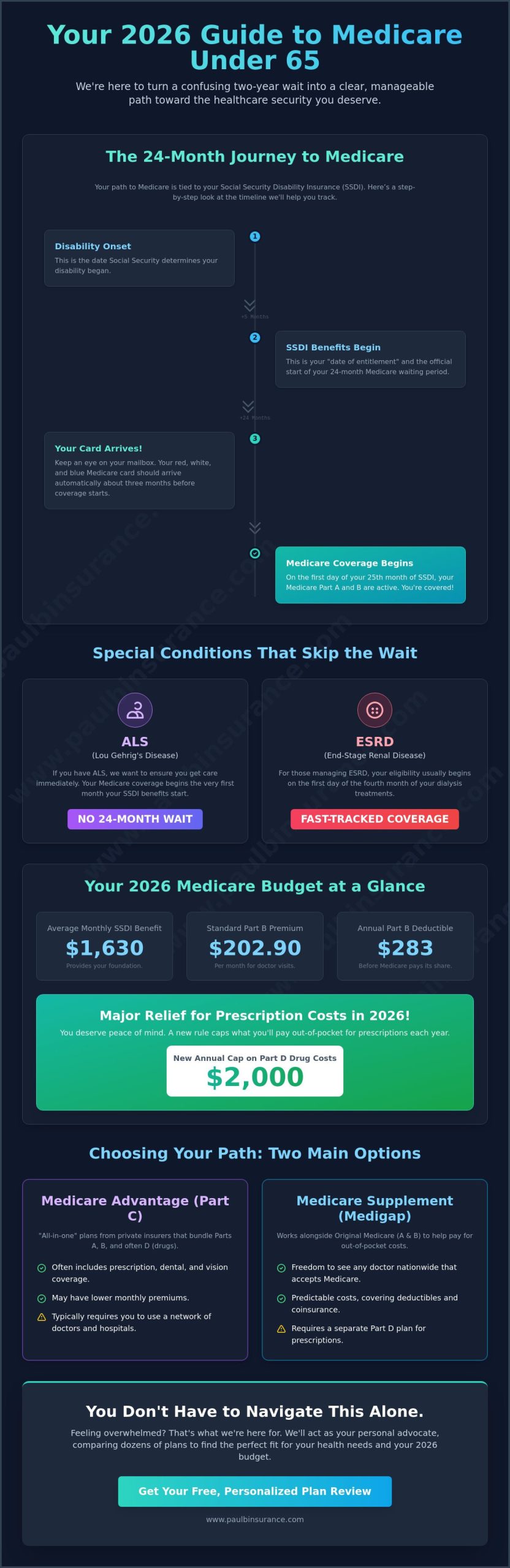
Some health journeys require a much faster response. If you’ve been diagnosed with Amyotrophic Lateral Sclerosis (ALS), your coverage begins the very first month your SSDI benefits start. There is no two-year wait for you. For those managing End-Stage Renal Disease (ESRD), eligibility usually begins on the first day of the fourth month of your dialysis treatments. We help families navigate these urgent timelines to ensure no gap in life-saving care. These rules are in place to protect you during an already difficult time. You shouldn’t have to worry about paperwork when you are focusing on your health. We act as your advocate to make sure every detail is handled correctly from day one. Our goal is to remove the stress of the system so you can focus on what matters most.
The 24-Month Waiting Period: When Does Your Coverage Actually Start?
Waiting is often the hardest part of any journey. For many of our clients, the 24-month rule feels like a long, confusing hurdle. We understand that managing a disability is already a full-time job. You shouldn’t have to guess when your healthcare will finally arrive. This waiting period is a standard part of Medicare eligibility for people with disabilities. It acts as a bridge between your previous coverage and your new path. Knowing exactly when your “effective date” begins is the first step toward true peace of mind.
Counting the Months: From SSDI Award to Medicare Start
We want to help you find your start date so you can plan with certainty. It’s simpler than it looks when you break it down into steps. First, look at your SSDI award letter to find your “date of entitlement.” This is usually five months after the date Social Security determined your disability began. Next, add exactly 24 months to that date. This is the day your Medicare Part A and Part B coverage begins. Finally, keep an eye on your mailbox. Your Medicare card usually arrives about three months before your 25th month of benefits. Enrollment is automatic, so you don’t need to fill out extra forms or worry about missing a deadline. We’ve seen how this clarity helps people breathe a little easier as they look toward 2026.
What to Do During the Wait
Two years is a long time to go without a plan. You have several options to stay protected while you wait for medicare eligibility for under 65 disability to kick in. If you have employer coverage or COBRA, you can often keep it until Medicare starts. Many people also find value in Marketplace (ACA) plans. Since the average SSDI benefit is projected to be $1,630 per month in 2026, you might qualify for subsidies that make these plans very affordable. You should also check if you qualify for Medicaid in your state as a secondary or interim option. If you feel overwhelmed by these choices, we are here to help. You can explore your options with us to ensure you never face a gap in your care. Having a bridge to your future coverage makes the wait much easier to handle. Our goal is to make sure you feel protected every single month of this transition.
Comparing Your Coverage Options: Medicare Advantage vs. Medigap Under 65
Once you’ve confirmed your medicare eligibility for under 65 disability, the next big question is which plan to choose. It’s a common source of stress. Many people assume they have the same options as their parents who retired at 65. Unfortunately, the rules are quite different for younger beneficiaries. We want to help you see the full picture so you can make a choice that protects your health and your budget. Our goal is to find the path that offers you the lowest out-of-pocket costs while keeping you connected to your trusted doctors.
In 2026, the maximum out-of-pocket limit for in-network services in Medicare Advantage plans is $9,250. While this number might seem high, it provides a vital safety net that Original Medicare does not offer on its own. We spend a lot of time comparing these limits against the cost of monthly premiums to ensure you aren’t overpaying for your security. Every dollar counts when you are living on a fixed disability income.
The Medigap Challenge for Younger Beneficiaries
Federal law does not require insurance companies to sell Medigap policies to people under 65. This creates a “Medigap Gap” that varies wildly from state to state. In many states where these plans are available for younger beneficiaries, the premiums are significantly higher than what a 65-year-old would pay. We often see premiums that are double or even triple the standard rate. You can learn more about how these supplements function in our Medigap guide. Because of these high costs and limited availability, many people find that a supplement isn’t the most practical choice before they turn 65.
Why Medicare Advantage is Often the Primary Choice
Because of the challenges with supplements, Medicare Advantage plans are often the most accessible path for our clients under 65. These plans must accept you regardless of your specific disability or health status. In 2026, 67% of all Medicare Advantage plans with prescription drug coverage have no additional monthly premium beyond the standard Part B cost of $202.90. These plans often combine your medical coverage with vision, dental, and Part D prescription drug coverage into one simple package. You can read our Medicare Advantage Guide to understand how network rules work this year. We focus on finding a plan where your specialists are in-network so your care remains seamless and affordable.
Planning Your 2026 Transition: Costs and Prescription Savings
2026 is a breakthrough year for anyone managing health costs on a fixed income. We’ve seen so many people struggle with the “donut hole” in the past, but those days are finally over. The new $2,000 cap on prescription drug costs is a game-changer for your financial peace of mind. This means you have a clear, predictable limit on what you’ll spend at the pharmacy each year. It’s one of the most significant benefits that comes with your medicare eligibility for under 65 disability. We want to help you understand how these changes fit into your monthly budget so you can focus on your health instead of your bills.
The New $2,000 Prescription Drug Cap
Starting in 2026, you’ll never have to pay more than $2,000 out-of-pocket for covered drugs in a single calendar year. This new rule replaces a complicated system with a much simpler, safer limit. For our clients who require expensive specialty medications, this change provides a massive sense of security. Once you hit that $2,000 limit, your plan pays 100% of your covered drug costs for the rest of the year. We can help you run a “Part D checkup” to ensure your specific meds are on your plan’s list. This step is vital to making sure you don’t have any surprises at the pharmacy counter. You can compare Part D coverage options with us to find the most cost-effective plan for your needs.
Budgeting for Premiums and Deductibles in 2026
Managing your budget requires looking at the full picture of 2026 costs. The standard Part B monthly premium is $202.90, and the annual deductible is $283. If you need to stay in the hospital, the Part A deductible is $1,736 per benefit period. We know these numbers can feel heavy when you’re living on an average SSDI benefit of $1,630 per month. However, you might not have to pay the full amount. We often find that our clients qualify for “Extra Help,” a program that lowers drug costs and premiums for those with limited income. We can also help you check if you qualify for a Medicare Savings Program in your state. These programs can often pay your Part B premiums for you, keeping more money in your pocket each month. Our goal is to connect you with every available resource to make your transition into Medicare as smooth as possible.
How We Help You Navigate Under-65 Medicare Enrollment
We know that managing your health is already a full-time job. You shouldn’t have to spend your precious energy deciphering government manuals or waiting on hold for hours. When you are dealing with medicare eligibility for under 65 disability, the system can feel like a maze designed to keep you out. At The Modern Medicare Agency, we act as your personal advocate and guide through every turn. Our services are entirely free to you. We believe everyone deserves expert advice without a price tag attached. Our mission is to move you from a state of confusion to one of complete certainty so you can focus on what matters most.
Unbiased Guidance Across 40+ Carriers
As independent brokers, we don’t work for a single insurance company. We work for you. While some representatives can only offer plans from one carrier, we compare options from over 40 different providers side-by-side. We look at Medicare Advantage and Medigap plans to see which one fits your specific 2026 budget. We also double-check that your specialists and primary care doctors are in the network you choose. This level of detail ensures you keep the medical team you trust. We take the time to explain the fine print in plain English so you never feel pressured or confused. We believe that an informed client is a protected client, which is why we prioritize education over high-pressure tactics.
Your Advocate Beyond the Initial Enrollment
Medicare rules change every year. In 2026, we’ve seen major shifts like the new drug cap that we discussed earlier. We keep you informed about how these changes affect your specific coverage throughout the year. If you ever run into a billing issue or a denied claim, we are the first call you make. We step in to help resolve the problem so you don’t have to fight the insurance companies alone. Our goal is to take the stress out of the process entirely. We stay with you year-round to ensure your medicare eligibility for under 65 disability leads to lasting security. You have a dedicated partner in this journey. We are committed to protecting your interests and your health every step of the way. We want you to feel empowered by your choices, knowing that an ethical expert is standing right beside you.
Take the Next Step Toward Your Peace of Mind
Navigating medicare eligibility for under 65 disability doesn’t have to be a lonely or stressful process. We’ve explored how the 24-month waiting period works and why 2026 is such a historic year for prescription drug savings with the new $2,000 out-of-pocket cap. Whether you’re counting down the months until your coverage starts or trying to decide if Medicare Advantage or a Supplement plan fits your lifestyle, you now have the tools to plan with confidence. You’ve worked hard to manage your health, and you deserve a system that works just as hard for you.
We are here to make sure you never feel overwhelmed by the details again. Our team provides expert guidance across more than 34 states and compares options from over 40 insurance carriers to find your perfect match. We don’t just help you sign up; we stay by your side with year-round advocacy and support. Let us help you find the right Medicare plan for your needs—contact us for a free consultation today. You’ve already taken the first step by learning your options, and we’re ready to help you finish the journey with total certainty.
Frequently Asked Questions
Do I automatically get Medicare if I am on disability?
Yes, you’ll be enrolled automatically once you’ve received Social Security Disability Insurance (SSDI) benefits for 24 months. You don’t need to worry about filing extra applications for Part A and Part B. The government tracks your timeline and will mail your Medicare card to you about three months before your 25th month of benefits begins. This automatic process is a key part of medicare eligibility for under 65 disability, ensuring you don’t face a gap in your protection.
Can I keep my employer insurance and have Medicare at the same time?
You can often keep both, but the size of your employer determines which plan pays your medical bills first. If your company has 100 or more employees, your employer group health plan is usually the primary payer, and Medicare acts as secondary coverage. For smaller companies with fewer than 100 employees, Medicare typically becomes your primary insurance. We can help you coordinate these benefits so you don’t accidentally pay more than necessary for your care.
What happens to my Medicare if I go back to work while disabled?
You can keep your Medicare coverage for at least 93 months after your nine-month Trial Work Period ends. In 2026, a trial work month is triggered if your earnings exceed $1,210. This rule allows you to test your ability to return to the workforce without the immediate fear of losing your health insurance. Even if your monthly SSDI checks stop because of your income, your Medicare remains active as long as you’re still medically disabled.
Is there a waiting period for Medicare if I have ALS?
No, there is no 24-month waiting period for individuals diagnosed with Amyotrophic Lateral Sclerosis (ALS). Your Medicare coverage is fast-tracked and begins the very first month your SSDI benefits start. This exception is designed to provide immediate relief and access to specialized care during a difficult time. We prioritize helping families with ALS navigate their plan choices quickly to ensure their life-saving treatments and equipment are covered from the very first day.
Can I get a Medigap plan if I am under 65 and disabled?
Whether you can buy a Medigap policy depends on the specific laws in your state. While federal law doesn’t require insurance companies to sell these supplements to people under 65, many states have created their own rules to protect younger beneficiaries. We’ve found that in states where they are available, the premiums can be significantly higher than those for seniors. We’ll check the current 2026 availability in your area to see if a supplement or an Advantage plan is your best path.
How much does Medicare cost for a disabled person under 65 in 2026?
In 2026, the standard monthly premium for Medicare Part B is $202.90, and the annual deductible is $283. If you require a stay in a skilled nursing facility, the daily coinsurance for days 21 through 100 is $217.00. Most people don’t pay a premium for Part A, but you’ll still need to budget for the $1,736 inpatient hospital deductible. We can help you explore Medicare Savings Programs that may pay these costs for you if your income meets certain limits.
What is the $2,000 drug cap in 2026 and how does it help me?
The $2,000 cap is a new annual limit on what you pay out-of-pocket for covered prescription drugs. Once you reach this $2,000 limit in 2026, you won’t have to pay any copays or coinsurance for your medications for the rest of the year. This change is incredibly helpful if you rely on expensive specialty drugs to manage your disability. It replaces the old, confusing “donut hole” system with a clear, predictable safety net that protects your fixed monthly income.
Do I need to sign up for Part D if I have Medicare through disability?
While Part D is technically voluntary, we strongly recommend getting it to avoid a lifetime late-enrollment penalty. If you go without “creditable” drug coverage for 63 days or more after your medicare eligibility for under 65 disability begins, your future premiums will be permanently higher. Most of our clients choose a Medicare Advantage plan that includes drug coverage or a standalone Part D plan. This ensures your medications are affordable while protecting you from unnecessary government penalties down the road.

Article by
Paul Barrett
Paul Barrett, CMIP is the founder of The Modern Medicare Agency, an independent Medicare-only brokerage based in Melville, NY. With 18 years of Medicare-exclusive experience, a CMIP designation, and more than 5,000 clients served across 37 states, Paul is one of the most credentialed independent Medicare specialists on Long Island — and one of the most direct.
He represents 40+ carriers with no quotas and no allegiances, which means his recommendations are based entirely on what fits each client's specific situation. He is the author of Medicare Mastery Unlocked and host of the Wise Guys Retirement Talk podcast. His content is grounded in primary sources, real carrier intelligence, and 18 years of watching what happens when people get Medicare right — and when they don't.
📞 631-358-5793 | paulbinsurance.com