
What if the secret to a stress-free retirement isn’t just the size of your nest egg, but how well you’ve insulated it from the 2026 Medicare price hikes? We know that managing healthcare costs in retirement with medicare feels overwhelming when you see the standard Part B premium rise to $202.90 and the Part A hospital deductible climb to $1,736. It’s completely natural to feel anxious about the Medicare Cliff or IRMAA surcharges while you’re trying to make your savings last. You deserve a plan that offers security rather than constant surprises.
We’re here to show you how to protect your hard-earned savings by matching the right coverage with reliable income strategies. In this guide, we’ll clarify the differences between Medicare Advantage and Medigap plans while explaining how tools like annuities can create a predictable budget for your care. This approach shields you from catastrophic out-of-pocket expenses and restores your peace of mind.
Key Takeaways
- Understand why the 2026 increases in premiums and deductibles mean that “free” Medicare is a myth you need to plan for today.
- We’ll help you decide between the lower premiums of Medicare Advantage and the predictable, near-zero out-of-pocket costs of a Medigap plan.
- Learn how the new $2,000 out-of-pocket limit on prescription drugs changes the way you approach managing healthcare costs in retirement with medicare.
- Discover how to use annuities to create a “healthcare pension” that keeps your premiums paid even when the market is volatile.
- See why having access to over 40 different insurance carriers is the only way to ensure you aren’t overpaying for your essential coverage.
The Real Cost of Healthcare in 2026: Why Medicare Isn’t ‘Free’
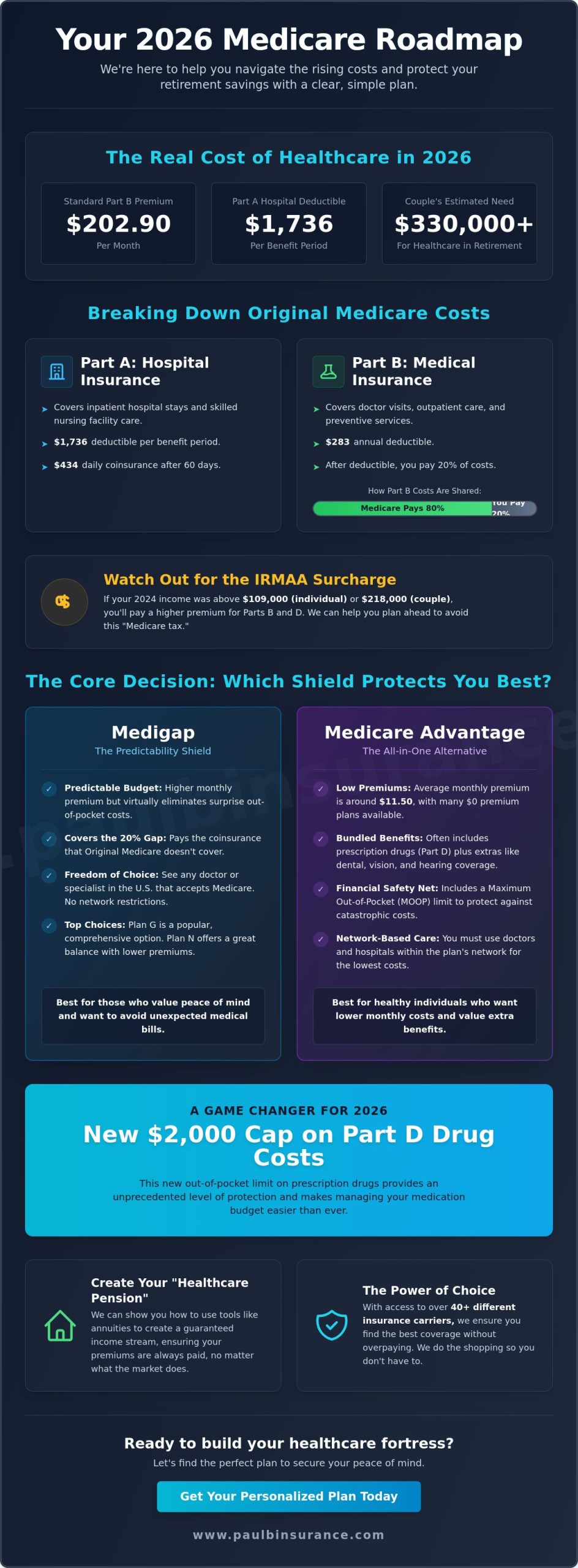
Many retirees enter their golden years expecting the government to pick up the full tab for their medical needs. In 2026, the reality is quite different. While the Medicare program provides a vital safety net, it’s rarely “free.” We often see families surprised by a monthly medical burn rate that exceeds their initial budget. Recent data suggests a retired couple may need over $330,000 just to cover healthcare expenses throughout retirement. This “hidden” price tag comes from a combination of premiums, deductibles, and services that original Medicare simply doesn’t cover. Managing healthcare costs in retirement with medicare requires looking past the surface to see how inflation is driving up the cost of everyday medical services and prescription drugs.
Breaking Down the Medicare Parts
Understanding your costs starts with knowing the difference between Part A and Part B. Part A covers hospital stays, but it comes with a $1,736 deductible for each benefit period in 2026. If you stay longer than 60 days, you’ll face a daily coinsurance of $434. Part B is the foundation of your outpatient costs in 2026. It covers your doctor visits and tests, but you’ll pay a standard monthly premium of $202.90. You also have to meet a $283 annual deductible before Part B starts its 80/20 cost-sharing. We want to help you plan for these fixed numbers so they don’t disrupt your lifestyle.
The IRMAA Factor: Are You Paying More?
If your income is higher, you might face the Income Related Monthly Adjustment Amount, or IRMAA. This is essentially a surcharge on your Part B and Part D premiums. For 2026, these extra costs trigger if your modified adjusted gross income from 2024 was over $109,000 as an individual or $218,000 for a married couple. Because the government looks back two years at your tax returns, Medicare eligibility planning should actually start long before you blow out 65 candles. Avoiding this “Medicare tax” is a huge part of managing healthcare costs in retirement with medicare. We focus on these details so you can enjoy your retirement with one less thing to worry about.
Medicare Advantage vs. Medigap: Which Shield Protects Your Savings Best?
Choosing between Medicare Advantage and Medigap is often a choice between a predictable monthly bill and a “pay-as-you-go” model. We want to help you understand how each path impacts your ability to stay within your budget. In 2026, the average premium for a Medicare Advantage plan with drug coverage has dropped to about $11.50 per month. This looks attractive on paper, but it comes with variable costs. On the other hand, Medigap requires a higher monthly premium but eliminates most of the surprise bills that can derail your finances. When managing healthcare costs in retirement with medicare, we always suggest looking at the Maximum Out-of-Pocket (MOOP) limits first. These limits represent the “worst-case scenario” for your wallet if you face a serious illness.
Finding the right balance depends on your health needs and your comfort with risk. You can check the official Medicare costs to see how these parts interact with your standard Part B premium. If you prefer knowing exactly what you’ll owe every month, Medigap is likely your best bet. If you are generally healthy and want lower monthly costs with some extra perks, an Advantage plan might fit your lifestyle better. This strategy is a cornerstone of managing healthcare costs in retirement with medicare because it removes the fear of the unknown.
The Medigap Safety Net
We consider Medicare Supplement insurance the gold standard for anyone who values budget predictability. These plans work alongside original Medicare to pick up the 20% coinsurance that the government doesn’t pay. Plan G remains a top choice because it covers everything except the Part B deductible. For those who want slightly lower premiums, Plan N is a great middle ground; however, it does involve small co-pays for some doctor visits. Medigap is often the safest choice for clients with chronic conditions because it allows you to see any doctor in the country who accepts Medicare without worrying about network walls.
Advantage Plans: The All-in-One Alternative
Our 2026 Medicare Advantage Guide highlights how these plans often include “extras” like dental, vision, and hearing coverage. This all-in-one approach can simplify your life, but it requires a trade-off. You must stay within a specific network of doctors, and some insurers are reducing their service areas in 2026. It’s essential to audit the plan’s drug list, or formulary, every year to ensure your medications are still covered at a price you can afford. If you feel stuck between these two choices, we can help you compare your options to find the most secure fit for your future.
Managing Out-of-Pocket Risks: Part D and Dental Gaps
Managing healthcare costs in retirement with medicare often feels like hitting a moving target, particularly regarding prescription drugs. For years, the “Donut Hole” created a period of high costs that drained savings just when people needed help the most. In 2026, that anxiety is finally a thing of the past. The Inflation Reduction Act has completely redesigned the Medicare Part D landscape. We now have a clear ceiling on what you’ll pay at the pharmacy counter, which makes your monthly budget much easier to manage.
The New Part D Landscape in 2026
The most significant change this year is the permanent elimination of the coverage gap. Instead of worrying about shifting percentages of cost-sharing, you now have a streamlined path to catastrophic coverage. For 2026 retirees, your total out-of-pocket spending on covered prescription drugs is capped at exactly $2,000 for the entire year. This cap provides a level of financial certainty we haven’t seen in the history of the program. Even with this protection, we still recommend an annual review of your plan. Average premiums for stand-alone drug plans have decreased to $34.50 per month in 2026. However, because formularies change, staying with the same carrier could still cost you thousands if your specific medication moves to a higher tier. We compare over 40 different carriers to ensure you pay the lowest net price for your specific prescriptions.
Ancillary Costs: Dental, Vision, and Hearing
While drug costs are more predictable, many people are still caught off guard by the “Smile Gap.” Original Medicare doesn’t cover routine dental, vision, or hearing care. This means a single root canal or a new pair of hearing aids can become a major unplanned expense. Incorporating dental insurance into your 2026 budget is a critical step in protecting your lifestyle. Some Medicare Advantage plans include these benefits, but they often have low annual maximums that might not cover a major procedure. We often help clients structure “total care” bundles using stand-alone plans. This ensures they have robust coverage that actually pays for high-cost services when they need them most. Managing healthcare costs in retirement with medicare is about looking at the whole picture, not just your doctor visits. We’re here to help you bridge these gaps so your savings stay exactly where they belong.
Strategic Funding: Using Annuities to Guarantee Healthcare Income
We’ve discussed the rising costs of Part B and the new drug caps, but knowing the numbers is only half the battle. The real challenge is ensuring the money is there every single month, regardless of what the stock market does. Managing healthcare costs in retirement with medicare becomes much easier when you have a “safe” income floor. We often help clients set up a Fixed Annuity specifically designed to act as a healthcare pension. This guaranteed check arrives like clockwork. It covers your monthly premiums so you never have to worry about a market dip affecting your access to care. There is a profound sense of psychological safety that comes from knowing your medical bills are paid by a guaranteed check before you even wake up on the first of the month.
Are Annuities a Safe Investment for Healthcare Costs?
Psychological safety is the biggest benefit here, but the financial mechanics are just as important. In 2026, many of our clients prefer Fixed and Indexed annuities because they offer principal protection. This means your initial investment stays safe while still earning interest. You can also benefit from what’s called the “exclusion ratio.” This allows a portion of your annuity payout to be received as a tax-advantaged return of principal. It is a powerful way to stretch your dollars when paying for medical bills. We prioritize your security by only working with carriers that hold an “A” rating or higher from A.M. Best. This ensures the company backing your income is financially rock-solid for the long haul.
The 5-Step Income-to-Healthcare Match
Creating a predictable budget is a methodical process. We follow these five steps to align your income with your medical needs:
- Step 1: Total your projected 2026 Medicare premiums, including Part B and any supplemental coverage.
- Step 2: Add your expected out-of-pocket maximum (MOOP) to account for potential emergencies.
- Step 3: Structure an annuity to generate that exact monthly amount, creating your personal health fund.
- Step 4: Verify the carrier’s financial strength to ensure long-term reliability.
- Step 5: Review the plan annually with an independent Medicare broker to adjust for any 2027 changes.
This integrated approach turns managing healthcare costs in retirement with medicare from a source of stress into a structured, manageable plan. If you want to see how a guaranteed income stream can simplify your retirement, we can help you explore our annuity options today to build your own healthcare pension.
Building Your Healthcare Fortress: The Path to Peace of Mind
Retiring safely in 2026 requires more than a single insurance policy. It requires a fortress built on three sturdy pillars: reliable income, comprehensive health coverage, and life insurance to protect your legacy. Managing healthcare costs in retirement with medicare is a journey that we take together. We move you from a state of confusion to one of absolute certainty by looking at the whole picture. Many people make the mistake of talking to a “captive” agent who only represents one brand. This limits your options and often leads to higher costs. We provide access to over 40 different carriers. This independence allows us to find the lowest price and the best fit for your specific needs.
The Value of an Independent Advisor
Our promise is simple. We provide a space with no jargon and no pressure. We act as your advocate and educator. While a big brand representative is restricted by what they can offer, we are autonomous. This means our priority is always you. Our support does not end when you sign your application. We provide year-round help to ensure your coverage remains the best value as the market shifts in 2027 and beyond. Having a dedicated expert in your corner removes the anxiety from a difficult process.
Taking the First Step
If you are turning 65 in 2026, your planning should start exactly three months before your birthday. This is your window to enroll in Part A and Part B without penalties. We recommend following this simple checklist to ensure you are prepared:
- Verify your enrollment window: Mark the three months before your 65th birthday on your calendar.
- Review your 2024 tax returns: These documents determine if you will pay IRMAA surcharges on your 2026 premiums.
- List your priorities: Decide if you prefer the fixed costs of a Supplement plan or the extra benefits of an Advantage plan.
- Gather your medications: Have a list of your prescriptions ready to check against the new 2026 formularies.
Managing healthcare costs in retirement with medicare is much easier when you have a structured path to follow. When you schedule your no-cost review, we will sit down together and look at every option available to you. We will compare the 40+ carriers we represent to find the plan that protects your savings and your health. Let us help you find peace of mind; contact us today for your personal Medicare review.
Secure Your Future with Confidence
The road to a secure retirement is much smoother when you have a clear map. We’ve explored how the 2026 Medicare landscape brings both challenges, like the $202.90 Part B premium, and new protections, like the $2,000 drug spending cap. Managing healthcare costs in retirement with medicare doesn’t have to be a source of constant stress. By combining the right supplemental coverage with guaranteed income from an annuity, you can transform medical bills into a predictable monthly budget. You deserve to focus on enjoying your time rather than worrying about the next hospital deductible.
You don’t have to navigate these complex choices alone. Our team provides independent and unbiased guidance to help you find the perfect fit. We offer specialized expertise in all 2026 Medicare changes and provide access to over 40 top insurance carriers. This variety ensures you never have to settle for a plan that doesn’t meet your specific needs. Ready to secure your retirement healthcare? Contact our expert team for a clear, simple plan today! We’re ready to help you move from uncertainty to peace of mind. Your journey to a protected future starts here.
Frequently Asked Questions
How much should I budget monthly for Medicare in 2026?
At a minimum, you should budget $202.90 for your standard Part B premium and approximately $34.50 for a stand-alone Part D prescription drug plan. If you choose a Medicare Supplement or an Advantage plan, you’ll need to add those specific monthly premiums to your total. Managing healthcare costs in retirement with medicare is much simpler when you also set aside funds for the $283 annual Part B deductible and any potential co-pays.
Can I use an HSA to pay for my Medicare premiums?
You can use your Health Savings Account (HSA) to pay for Part B, Part D, and Medicare Advantage premiums tax-free. However, the law does not allow you to use HSA funds to pay for Medigap (Medicare Supplement) premiums. We suggest using your HSA for other out-of-pocket needs, like dental care or vision exams, while using a different income stream for your supplement coverage.
What is the safest way to guarantee I can always afford my Medigap premium?
The most reliable method is to structure a Fixed Annuity that generates a monthly check specifically to cover your premium costs. This creates a “healthcare pension” that remains steady even when the stock market is volatile. Knowing your Medigap bill is automatically covered by a guaranteed income stream provides incredible peace of mind and keeps your coverage secure.
Does Medicare cover long-term care or nursing homes in 2026?
Medicare does not cover long-term custodial care or traditional nursing home stays. It only pays for skilled nursing facility care for a short time following a qualifying hospital stay. In 2026, you will owe a daily coinsurance of $217.00 for days 21 through 100 of your stay. For help with extended care needs, we often recommend looking into life insurance policies that include long-term care riders.
Is it better to have a low premium or a low out-of-pocket maximum?
The right choice depends on your health history and your desire for budget certainty. A low out-of-pocket maximum, typical of Medigap plans, is usually better for those who want to avoid large, unexpected medical bills. If you are generally healthy and prefer to keep your monthly costs as low as possible, a Medicare Advantage plan might be the better fit, as long as you are comfortable with “pay-as-you-go” costs when you see a doctor.
What happens to my healthcare costs if my income increases in retirement?
If your income rises above certain thresholds, you will face IRMAA surcharges that increase your Part B and Part D premiums. For 2026, these extra costs trigger if your modified adjusted gross income from 2024 was over $109,000 for individuals or $218,000 for couples. Managing healthcare costs in retirement with medicare requires watching these income brackets closely to avoid these significant monthly surcharges.
Can an annuity help me avoid IRMAA surcharges?
Annuities generally do not help you avoid IRMAA because the income they pay out counts toward your modified adjusted gross income. While they won’t lower the surcharge itself, they are excellent tools for providing the extra cash needed to pay those higher premiums. We can help you structure an annuity payout that specifically accounts for any potential “Medicare tax” you might owe based on your income levels.
How often should I review my Medicare Advantage or Part D plan?
You should review your coverage every single year during the Annual Enrollment Period. Plans often change their drug lists, provider networks, and premium costs for the coming year. We offer a no-cost review each autumn to ensure your medications are still covered at the lowest price and that your doctors are still in your plan’s network.

Article by
Paul Barrett
Paul Barrett, CMIP is the founder of The Modern Medicare Agency, an independent Medicare-only brokerage based in Melville, NY. With 18 years of Medicare-exclusive experience, a CMIP designation, and more than 5,000 clients served across 37 states, Paul is one of the most credentialed independent Medicare specialists on Long Island — and one of the most direct.
He represents 40+ carriers with no quotas and no allegiances, which means his recommendations are based entirely on what fits each client's specific situation. He is the author of Medicare Mastery Unlocked and host of the Wise Guys Retirement Talk podcast. His content is grounded in primary sources, real carrier intelligence, and 18 years of watching what happens when people get Medicare right — and when they don't.
📞 631-358-5793 | paulbinsurance.com