




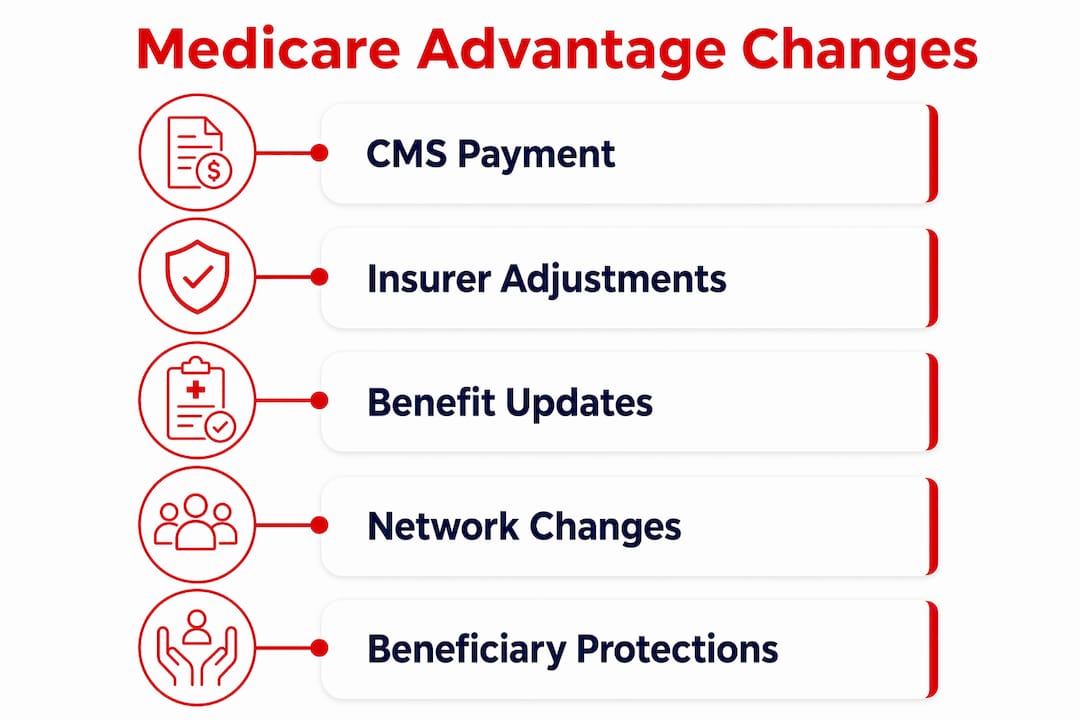
Medicare Advantage plans change yearly because the Centers for Medicare & Medicaid Services (CMS) resets payment rates, risk adjustment models, and plan contracts every January 1, forcing insurers to redesign benefits, costs, and provider networks for the coming year. This annual reset is not a flaw in the system. It is how the program balances federal funding, insurer sustainability, and beneficiary choice. If you are approaching Medicare eligibility or already enrolled, understanding why medicare advantage plans change yearly protects you from surprises and helps you make smarter decisions during open enrollment. The rules, the money, and the market all shift together, and knowing how they connect puts you in control.
Why Medicare Advantage plans change yearly: the CMS payment cycle
The single biggest driver of annual changes in Medicare Advantage is CMS’s payment rate announcement. Every year, CMS publishes an Advance Notice and then a final Rate Announcement that sets how much the federal government will pay private insurers per enrollee for the coming plan year. For 2027, CMS projected a 0.09% net average increase in the Advance Notice before finalizing a 2.48% increase totaling over $13 billion in payments. That gap between the preliminary and final numbers illustrates how much insurer planning depends on a moving target.
When payment rates rise modestly, insurers have less room to offer rich supplemental benefits like dental, vision, or gym memberships. When rates fall or grow slower than healthcare costs, insurers respond by trimming benefits, raising premiums, or narrowing networks. The connection between federal payment policy and your plan’s out-of-pocket costs is direct and measurable.

CMS also updates risk adjustment methodologies each year to improve payment accuracy. The 2027 updates include excluding unlinked chart review diagnoses and recalibrating models to current cost data. This matters because risk adjustment determines how much extra payment an insurer receives for enrollees with chronic conditions. Recalibrating those models changes insurer revenue forecasts even when a beneficiary’s health stays exactly the same.
CMS frames these annual payment updates as necessary to keep the program stable and sustainable long term. The practical result for you is that your plan’s structure next year reflects decisions made in Washington months before open enrollment begins.
- Payment rate changes affect premiums and cost-sharing directly
- Risk adjustment recalibrations shift insurer revenue without any change to your health
- CMS policy goals around program sustainability drive benefit design decisions
- The gap between Advance Notice and final Rate Announcement creates planning uncertainty for insurers
Pro Tip: Watch for CMS’s final Rate Announcement each April. It signals whether insurers will be expanding or contracting benefits for the following plan year, giving you a six-month heads-up before the Annual Enrollment Period opens in October.
How insurers adjust benefits, networks, and plan availability each year
Insurers do not passively absorb CMS payment changes. They respond by redesigning plans, renegotiating provider contracts, adjusting drug formularies, and in some cases exiting markets entirely. These insurer-level decisions are the second major reason for yearly changes in Medicare Advantage.
The scale of market disruption in recent years has been significant. In 2025, 13% of individual MA-PD enrollees faced plan terminations as insurers reduced plan offerings after slower federal payment growth. A Johns Hopkins Bloomberg School analysis found that roughly 1 in 10 non-employer HMO and PPO Medicare Advantage enrollees faced forced disenrollment in 2026 due to plan exits in their county. Forced disenrollment is not just an inconvenience. It disrupts relationships with specialists, interrupts prescription coverage, and forces rushed enrollment decisions.
The table below shows the most common types of annual plan changes and what they mean for you.
| Type of change | What it means for you |
|---|---|
| Premium increase or decrease | Your monthly cost changes; review your budget before auto-renewing |
| Formulary tier shifts | Your drug may move to a higher cost-sharing tier, raising your out-of-pocket spending |
| Network narrowing | Your current doctor or specialist may no longer be in-network |
| Supplemental benefit changes | Dental, vision, or hearing benefits may be added, reduced, or eliminated |
| Plan termination or market exit | You must actively enroll in a new plan or you revert to Original Medicare |
Supplemental benefits are particularly volatile. Insurers add dental and vision coverage to attract enrollees when payment rates are favorable, then scale those benefits back when margins tighten. Checking your plan’s network changes before the Annual Enrollment Period closes is not optional. It is the most practical step you can take to protect continuity of care.
Rising healthcare utilization combined with slower federal payment growth creates a structural pressure that pushes insurers toward plan reductions year after year. This is not unique to any single insurer. It is a market-wide response to the economics of the program.
What protections exist for beneficiaries amid yearly plan changes
Federal rules provide meaningful stability within each plan year, even though the plan itself can change at renewal. Benefits, costs, and rules are locked in for the current plan year starting January 1. No insurer can drop a benefit or raise your cost-sharing mid-year. That protection is absolute and governed by your Evidence of Coverage document.
Before each new plan year, your insurer must send you an Annual Notice of Change (ANOC). This document spells out every benefit, cost, and network change taking effect on January 1. Comparing your ANOC to your current Evidence of Coverage is the fastest way to spot problems before they affect your care. The ANOC arrives by September 30 each year, giving you time to act during the Annual Enrollment Period, which runs October 15 through December 7.
If you miss the Annual Enrollment Period or your plan exits your market, you still have options:
- Medicare Advantage Open Enrollment Period (OEP): Runs January 1 through March 31 each year. You can make one plan change during this window, with the new coverage taking effect the first of the following month.
- Special Enrollment Periods (SEPs): Triggered by qualifying events such as losing network access to your primary care provider, moving out of your plan’s service area, or your plan receiving a low CMS quality rating. SEPs give you a defined window to switch plans outside the standard enrollment calendar.
- Five-star SEP: If a five-star rated plan is available in your area, you can switch to it once between December 8 and November 30 of the following year.
Pro Tip: Keep your ANOC and your current Evidence of Coverage side by side. Highlight any line where the numbers or terms differ. Those differences are your action items before December 7.
Understanding your special enrollment period options is especially important in years when your plan makes significant changes or exits your market entirely.
How to evaluate and respond to Medicare Advantage plan changes each year
Knowing why annual changes in Medicare plans happen is useful. Knowing what to do about them is what protects your coverage and your wallet. The evaluation process starts the moment your ANOC arrives in late September.
- Read the ANOC immediately. Do not file it away. Look specifically at premium changes, drug formulary tier shifts, and any network modifications. These three areas account for the majority of financial surprises beneficiaries face after January 1.
- Verify your doctors are still in-network. Use your insurer’s online directory or call the provider directly. Directories are not always updated in real time, so a phone call to your specialist’s billing office is the most reliable confirmation. Paulbinsurance has a straightforward guide on finding in-network doctors that walks through this process step by step.
- Check your prescriptions against the new formulary. Drug tier changes are one of the most common and costly surprises. If a medication moves from Tier 2 to Tier 4, your annual cost could increase by hundreds of dollars. Reviewing Medicare plan prescription coverage before re-enrolling can prevent that outcome.
- Compare competing plans during AEP. Do not assume your current plan is still the best fit. Use Medicare’s Plan Finder tool at Medicare.gov or work with an independent agent who can compare options across multiple carriers without a conflict of interest.
- Act before December 7. Changes made during the Annual Enrollment Period take effect January 1. Missing this window means living with your current plan’s changes for another full year, or waiting for the OEP window in January through March.
Because MA plan contracts reset each year, treating annual review as a routine task rather than a crisis response is the most effective long-term strategy.
Key takeaways
Medicare Advantage plans change yearly because CMS resets payment rates and risk adjustment models annually, and insurers redesign benefits, networks, and plan availability in direct response to those financial and regulatory shifts.
| Point | Details |
|---|---|
| CMS drives the cycle | Annual payment rate announcements and risk adjustment updates force insurers to rebuild plan structures each year. |
| Insurers respond with real changes | Networks narrow, formularies shift, and some plans exit markets entirely, as seen when 13% of MA-PD enrollees faced terminations in 2025. |
| Your benefits are locked in-year | No insurer can change your benefits or costs mid-year; the Evidence of Coverage governs the full plan year starting January 1. |
| ANOC is your early warning system | The Annual Notice of Change arrives by September 30 and details every change taking effect January 1. Read it immediately. |
| You have multiple enrollment windows | The AEP, OEP, and qualifying SEPs give you structured opportunities to respond to plan changes without being locked in permanently. |
What I’ve learned after nearly two decades of Medicare plan changes
I have been helping Medicare consumers since 2007, and the single most consistent mistake I see is passive re-enrollment. People get their ANOC, set it on the counter, and assume their plan is fine because it was fine last year. That assumption has cost real people real money, sometimes thousands of dollars in unexpected drug costs or out-of-network bills.
Here is what most articles will not tell you: not all annual changes are bad. Some years, CMS payment increases allow insurers to add benefits or reduce premiums. I have seen clients end up with better dental coverage and lower costs simply because they took 30 minutes to compare plans during AEP. The annual reset is a two-way door.
The other thing I want you to understand is that the reasons for yearly changes in Medicare Advantage are structural, not arbitrary. CMS is managing a program that covers tens of millions of people. When it updates risk adjustment models or recalibrates payment rates, it is responding to real data about how healthcare costs are moving. Insurers are responding to those same signals. You are not being singled out. You are participating in a market that reprices itself every year.
What I tell every client: treat October 15 like a financial check-up date. Pull out your ANOC, verify your doctors and drugs, and spend an hour comparing your options. If you want a second set of eyes, that is exactly what independent agents at Paulbinsurance are here for. We compare plans across carriers with no loyalty to any single insurer, which means our only goal is finding what actually works for you.
— Paul
Let Paulbinsurance help you navigate this year’s plan changes
Every October, the Medicare Advantage market reshapes itself. New premiums, new formularies, new networks. It is a lot to sort through on your own, especially when the stakes are your healthcare coverage for the next 12 months.

At Paulbinsurance, our independent agents specialize in Medicare Advantage plan updates and have been doing this work since 2007. We compare plans across multiple carriers, check your specific doctors and prescriptions, and walk you through every enrollment window available to you. Whether you are reviewing your current plan or choosing Medicare coverage for the first time, start with our Medicare Advantage plan reviews guide or explore strategies for managing healthcare costs in retirement. Education first, always.
FAQ
Why do Medicare Advantage plans change every year?
Medicare Advantage plans change yearly because CMS resets payment rates, risk adjustment models, and plan contracts each January 1, requiring insurers to redesign benefits, costs, and provider networks for the new plan year.
Can my Medicare Advantage plan drop a benefit mid-year?
No. Benefits, costs, and coverage rules are locked in for the plan year starting January 1 and cannot be changed until the next renewal cycle.
What is the Annual Notice of Change and why does it matter?
The Annual Notice of Change (ANOC) is a document your insurer must send by September 30 each year detailing every benefit, cost, and network change taking effect January 1. Comparing it to your current Evidence of Coverage is how you catch problems before they affect your care.
What can I do if my Medicare Advantage plan exits my market?
If your plan terminates, you qualify for a Special Enrollment Period to switch to a new plan. You can also use the Medicare Advantage OEP from January 1 through March 31 to make one plan change.
How often should I review my Medicare Advantage plan?
Review your plan every year when your ANOC arrives in late September. Because MA plan contracts reset annually, a plan that was the best fit last year may no longer be optimal after benefit and network changes take effect.