




Last week, a gentleman named David called us, his voice tight with worry as he asked if his heart condition would prevent him from finding medicare supplement plans for pre-existing conditions. He was terrified that his medical history would lead to an automatic rejection or leave him facing the $1,736 Part A hospital deductible alone. We know exactly how that anxiety feels. It’s exhausting to manage a chronic illness while wondering if your health history makes you uninsurable in the eyes of big insurance companies. You deserve to feel protected, not penalized, for health challenges you didn’t choose.
The good news is that we can help you secure comprehensive Medigap coverage in 2026 without the stress of medical underwriting. We’ll show you how to use your enrollment windows and guaranteed issue rights to bypass health questions entirely. This guide explains the simple steps to finding a plan that covers your specific doctors and treatments, ensuring your medical bills don’t lead to financial ruin. We’ll walk you through the timing secrets and state specific rules, like the new 2026 changes in Minnesota, so you can move from a state of uncertainty to one of total peace of mind.
Key Takeaways
- Learn how your six month Open Enrollment window acts as a legal shield, allowing you to secure any plan regardless of your health history.
- Discover the specific life events that grant you guaranteed issue rights, ensuring you can transition to a new plan without answering medical questions.
- We will show you how to navigate medicare supplement plans for pre-existing conditions to avoid the six month waiting period for chronic care.
- Understand what medical underwriting looks like in 2026 and how to prepare for health related questions if you miss your initial window.
- Find out how an independent advocate can help you compare options to ensure your specific doctors and treatments remain covered.
Understanding Pre-Existing Conditions and Medicare Supplement Eligibility
We often hear from people who feel like their health history is a heavy weight they have to carry into retirement. If you are managing a condition like diabetes or heart disease, you might worry that the door to quality coverage is locked. In 2026, a pre-existing condition is simply any health issue you had before your new insurance policy starts. It is a broad definition, but it shouldn’t be a source of fear. We are here to help you see that your past health does not have to dictate your future financial security.
Original Medicare (Parts A and B) is wonderful because it doesn’t look at your health history. It covers your treatments from day one. However, Medicare only pays about 80% of your medical bills. That remaining 20% can be a financial disaster for someone with a chronic illness. This is why Understanding Medigap Plans is so important. While Original Medicare accepts you regardless of health, getting into a Medigap plan is about “guaranteed entry.” This is where the confusion about medicare supplement plans for pre-existing conditions often begins. If you have this right, the insurance company cannot say no to you. We focus on these plans because they turn unpredictable medical bills into one steady, manageable monthly payment.
Common Conditions That Raise Questions
Insurers typically look closely at chronic conditions such as COPD, diabetes, or heart disease. They use a “look-back” period, which is usually the six months before your policy begins. During this time, they check if you received treatment or medical advice for a specific condition. It’s a common misconception that having one of these conditions automatically means you’ll pay a higher premium. If you apply during your Open Enrollment period, your health doesn’t change your price at all. You get the same rate as someone in perfect health. We believe in transparency, and we want you to know that your current health doesn’t always lead to higher costs.
Medigap vs. Medicare Advantage for Chronic Illness
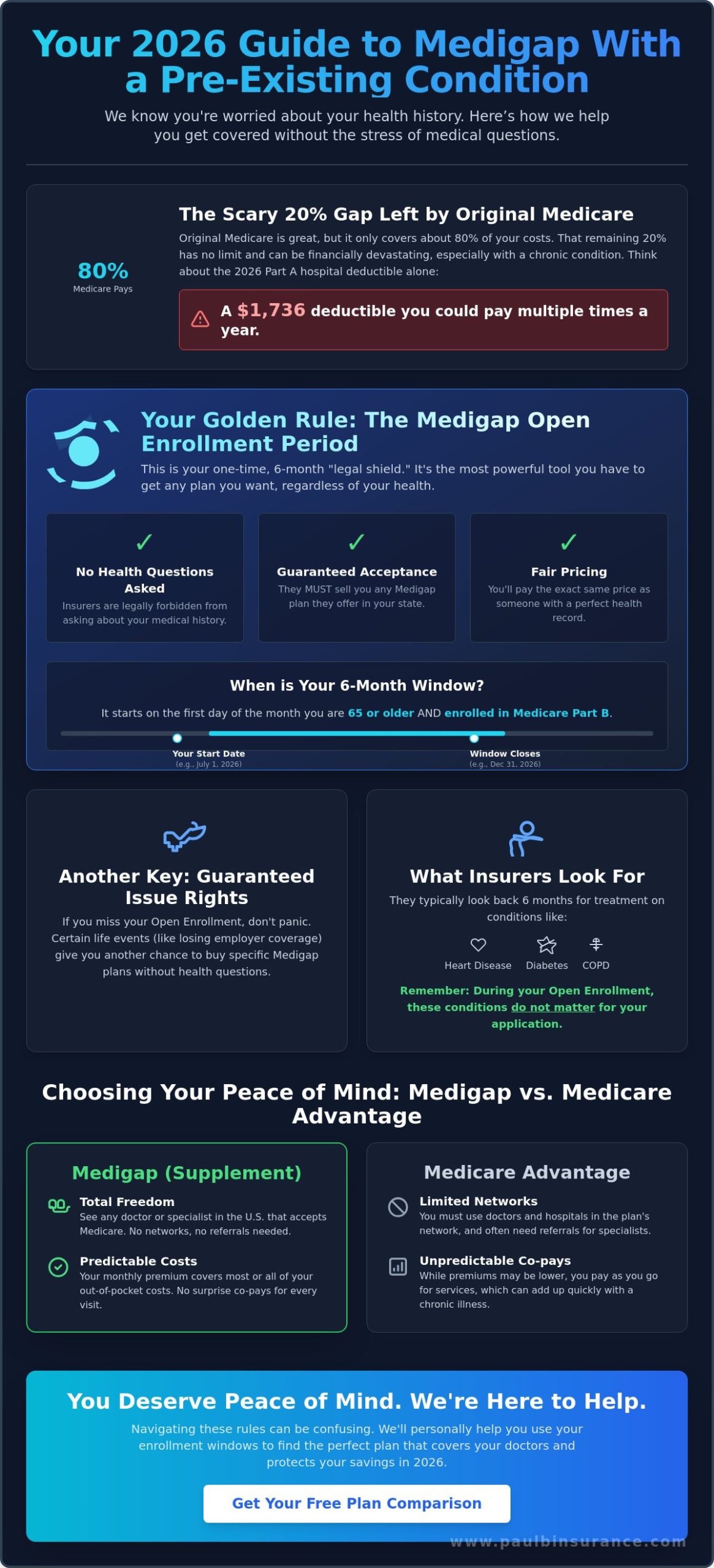
When you are managing a long-term illness, freedom is your greatest asset. With Medigap, you can see any specialist in the country who accepts Medicare. There are no networks to worry about and no “gatekeepers” standing between you and your doctor. While our Medicare Advantage Guide explains other options, many of our clients prefer Medigap because it replaces unpredictable co-pays with a fixed cost. This is especially vital in 2026. Even though prescription drug costs are now capped at $2,000 out-of-pocket, your hospital and doctor costs still have no limit under Original Medicare alone. For example, the Part A deductible is $1,736 per benefit period in 2026. Without a supplement, you could pay that multiple times a year. Medigap provides the ceiling you need to protect your savings.
The Medigap Open Enrollment Period: Your Most Powerful Protection
We often call the Medigap Open Enrollment Period the “Golden Rule” of Medicare for a reason. It is the most powerful tool you have to protect your health and your wallet. This six-month window acts as a legal shield that keeps insurance companies from looking at your medical records. It’s your one-time chance to get the coverage you need without your health history being used against you. Even with the standard Part B premium rising to $202.90 in 2026, the value of this window remains unmatched because it guarantees you access to the most comprehensive plans available.
To find your specific start date in 2026, look at your Medicare card. Your window begins the first day of the month you are both 65 or older and signed up for Part B. If your Part B starts on July 1, 2026, your window lasts until December 31, 2026. We always recommend acting as early as possible. Even if you feel perfectly healthy today, you can’t predict what 2027 or 2028 will bring. This shield doesn’t come back once it’s gone, so securing your spot now is the best way to ensure you aren’t locked out later due to a new diagnosis.
The “No Health Questions” Guarantee
When you apply during this specific time, you have what we call guaranteed issue rights. This means insurance companies must sell you any policy they offer in your state. They can’t ask about your heart health, your blood sugar, or any past surgeries. During this window, an insurer cannot charge you more or deny you coverage, regardless of your medical history. This is especially helpful for those who worked past age 65 and are just now starting Part B in 2026. You get your own fresh six-month window to find the right medicare supplement plans for pre-existing conditions without any stress or anxiety.
Waiting Periods for Pre-Existing Conditions
There is a common myth that you must wait six months for your plan to cover your existing health issues. In reality, this only happens if you haven’t had “creditable coverage” before joining Medicare. If you’ve had health insurance through an employer or a union for at least six months without a break longer than 63 days, that waiting period is usually waived entirely. We help our clients gather the right letters from their previous insurance companies to prove this prior coverage. It’s a simple step that ensures your new plan starts paying for your treatments and your $283 Part B deductible immediately. If you have questions about your specific timeline, feel free to reach out to us for a conversation.
Guaranteed Issue Rights: Getting Covered Outside Your Initial Window
We know the fear that comes with a major life change, like losing your job-based health insurance or moving to a new state. You might worry that these transitions will leave you exposed to high medical costs because of your health history. Thankfully, the law provides safety nets called Guaranteed Issue rights. These rights force insurance companies to offer you medicare supplement plans for pre-existing conditions even if you are outside your initial six-month window. It’s our mission to help you identify these moments so you never have to face a medical crisis without a shield.
If you lose your employer coverage in 2026, you generally have 63 days from the day your coverage ends to apply for a Medigap plan. This is a critical timeframe that requires quick action. We see many people who are surprised to learn that even the loss of COBRA counts as a qualifying event. In fact, research suggests that about 15% of clients are expected to use the end of COBRA as their path into a supplement plan this year. Another common situation is moving out of your current plan’s service area. If your Medicare Advantage plan no longer serves your new zip code, you have a right to switch to a Medigap policy without a health exam.
The 12-Month Trial Right Explained
Many of our clients feel “stuck” in a Medicare Advantage plan, fearing they can’t leave because of their health. This is where the 12-month trial right becomes a lifesaver. If you joined an Advantage plan for the first time and decide within the first year that it isn’t the right fit, you can switch back to Original Medicare. You can find more technical details in the Official Guide to Medigap Policies, but the core benefit is simple. You can reclaim a Medigap plan without a physical exam or health questions. We help you time this move perfectly to ensure there’s no gap in your coverage, keeping you protected from the $283 Part B deductible and other out-of-pocket costs.
State-Specific “Birthday Rules” in 2026
In 2026, where you live matters more than ever. Several states have created extra protections that go beyond federal laws. States like California, Oregon, Idaho, Illinois, Louisiana, and Nevada have adopted “Birthday Rules.” These allow you to switch to a different Medigap plan with equal or lesser benefits around the time of your birthday, regardless of your health. We also see exciting changes in Minnesota, where a new law starting in August 2026 provides a one-time window for those aged 65 to 70 to enroll even with chronic conditions. We stay on top of these local shifts so we can help you leverage every legal advantage available in your home state.
Navigating Medical Underwriting: What Happens if You Miss Your Window?
We understand that realizing you’ve missed your initial enrollment window can feel like a door has slammed shut. It’s a common source of anxiety, especially if you’re managing health issues that require regular care. However, missing that six-month shield doesn’t mean you’re stuck without options. It just means the process of joining a plan changes. In 2026, medical underwriting is the standard path for many people looking to switch their coverage or join a supplement plan later in life. It is essentially a health questionnaire that carriers use to decide if they can accept your application. While this sounds intimidating, it is often much simpler than people imagine.
During the underwriting process, you’ll be asked about your height, weight, and tobacco use. You will also answer questions about specific diagnoses like heart disease, cancer, or chronic kidney issues. Most applications focus on your health history over the last two years. The insurance company wants to see if your conditions are stable. They aren’t looking for perfection; they’re looking for predictability. It’s a pass or fail system, but every company has a different definition of what “passing” looks like. This is why one “No” from a specific carrier is never the final word on your insurability.
The Strategy of Carrier Comparison
Every insurance company has its own unique risk profile. This is why Company A might reject an applicant with a specific heart condition while Company B welcomes them with open arms. We’ve seen this happen countless times. Some carriers are more lenient with well-managed diabetes, while others focus heavily on your prescription drug history. They look at the medications you’ve been prescribed over the last few years to get a clear picture of your health journey. Because we work with over 40 different carriers, we can help you skip the guesswork. We look for the “Yes” by matching your specific medical history to the carrier most likely to accept it. One rejection is never the end of the road for finding medicare supplement plans for pre-existing conditions.
Preparing for the Underwriting Phone Call
Sometimes, a carrier will want to speak with you directly to clarify a few points on your application. This is a standard part of the process in 2026. We recommend having a list of your current medications and the dates of any recent procedures ready before the call starts. Be honest and clear about your history. Underwriting is not a trial; it is a process of finding the carrier whose risk profile matches your health journey. If you’re feeling overwhelmed by the thought of these questions, you don’t have to do it alone. We can help you review your options and find a carrier that values your business. If you are ready to see which plans might work for you, let us help you compare Medigap options today.
How We Help You Secure the Right Coverage Regardless of Your Health
We believe that finding the right insurance should be a journey toward certainty, not a path filled with obstacles. When you work with a restricted representative, you only see the limited options they are allowed to sell. This can be a major disadvantage when you are looking for medicare supplement plans for pre-existing conditions. As an independent agency, we serve you instead of the insurance companies. We have the freedom to look at the entire market to find the plan that fits your health needs and your budget. Our goal is to remove the stress of the system so you can focus on what truly matters, which is your health and your family.
In 2026, the landscape of Medicare has changed to offer better protection. The new $2,000 out-of-pocket cap on Medicare Part D is a massive relief for those managing chronic illnesses. However, it is important to remember that this cap only applies to your prescriptions. It doesn’t protect you from the 20% co-insurance or the $1,736 Part A hospital deductible. This is why a Medigap plan is more vital than ever. We help you see how these different pieces fit together, ensuring your total medical costs are predictable and your savings are protected from high bills.
Our Multi-Carrier Approach
We have access to over 40 different carriers. This allows us to find the most competitive rates for medicare supplement plans for pre-existing conditions in your specific area. We don’t just stop at the supplement plan. We cross-reference your current medications with available Part D plans to ensure your prescriptions are covered at the lowest possible price. We also make sure your dental and vision needs are met, providing a complete circle of protection for your retirement. This methodical approach ensures that no part of your health is left to chance.
Your Path to Peace of Mind Starts Here
Our process is designed to be simple and logical. We start by listening to your concerns and understanding your health history. Then, we provide an unbiased comparison of the plans that offer you the best protection. We handle the paperwork and follow up with the carriers so you don’t have to deal with the bureaucracy. Even after your card arrives, we are here to support you. Whether you have a question about a bill or need to review your coverage next year, we remain your dedicated advocate. If you are ready to move from uncertainty to a clear plan for your future, schedule your Medicare consultation today.
Move From Uncertainty to Total Peace of Mind
You should never feel that your health history is a barrier to the care you deserve. We’ve explored how your six month enrollment shield and legal rights protect you from high costs in 2026. Even if you’ve missed those windows, we can help. Our multi carrier strategy finds the right fit for your unique situation. We represent over 40 top rated insurance carriers to ensure you have the best choices. Paul Barrett and our expert team serve clients in over 34 states, providing the personalized support needed to navigate medicare supplement plans for pre-existing conditions.
We invite you to reach out for one of our zero cost consultations. Let’s remove the anxiety from this process together. You focus on your health while we handle the system. Your journey to certainty starts with a single conversation. Let us help you find the perfect plan for your health needs. We are ready to be your advocate and guide you toward a future of security and health.
Frequently Asked Questions
Can I be denied a Medicare Supplement plan due to a pre-existing condition?
You cannot be denied coverage if you apply during your six month Medigap Open Enrollment Period. This window is your legal protection, and companies must accept you regardless of your health history. If you apply outside of this window or another protected period, an insurance company can use medical underwriting to decide whether to accept your application based on your health journey.
Is there a waiting period for pre-existing conditions under Medigap?
A waiting period of up to six months is possible, but it is often waived entirely for our clients. If you had at least six months of continuous health coverage before joining, the insurer usually cannot make you wait for treatments related to your existing conditions. We help you gather the necessary proof of prior coverage to ensure your benefits start on day one without any gaps in care.
Can I switch Medigap plans if I have a heart condition or cancer?
You can switch plans without health questions if you live in a state with “Birthday Rules” or if you qualify for a Guaranteed Issue right. In states like California or Nevada, you have a yearly window to move to a plan with similar benefits. If you don’t live in one of these states, we can help you find specific carriers that are more accepting of your health history through the underwriting process.
Does Medicare Advantage have different rules for pre-existing conditions?
Medicare Advantage plans must accept you regardless of your health history as long as you are enrolled in Parts A and B. They do not use medical underwriting or ask health questions during enrollment. While this makes joining easy, these plans use provider networks and co-pays. Many people managing chronic illnesses still prefer the freedom and fixed costs of medicare supplement plans for pre-existing conditions.
What happens if I miss my Medigap Open Enrollment Period?
If you miss this window, you lose your automatic right to buy a policy without answering health questions. However, you aren’t out of options. You can still apply for coverage, and we will work with you to find a carrier whose underwriting rules match your health profile. We represent over 40 carriers to find the one most likely to offer you a “Yes” even after your initial window has closed.
Are some Medigap plans better for chronic illnesses than others?
Plan G is often the top choice for those with chronic illnesses because it offers the most comprehensive coverage. Once you meet the $283 Part B deductible for 2026, Plan G covers 100% of your remaining Medicare-covered medical bills. This creates a predictable budget, which is much easier to manage than the variable co-pays found in other types of insurance plans.
How does the 2026 Part D cap affect my Medigap choice?
The new $2,000 out-of-pocket cap on prescriptions provides a much-needed safety net for your pharmacy costs. Since your medication expenses are now limited by law, you may find it easier to fit a comprehensive Medigap plan into your monthly budget. Combining a strong supplement with a Part D plan ensures that both your medical treatments and your prescriptions have a clear financial ceiling.
Do I need to undergo a physical exam to get a Medicare Supplement plan?
No, you do not need a physical exam to apply for a medicare supplement plans for pre-existing conditions. Underwriting usually involves a health questionnaire and a review of your past prescriptions. We guide you through this process and help you prepare your information so the insurance company gets a clear and accurate picture of your health without the need for a doctor visit.

Article by
Paul Barrett
Paul Barrett, CMIP is the founder of The Modern Medicare Agency, an independent Medicare-only brokerage based in Melville, NY. With 18 years of Medicare-exclusive experience, a CMIP designation, and more than 5,000 clients served across 37 states, Paul is one of the most credentialed independent Medicare specialists on Long Island — and one of the most direct.
He represents 40+ carriers with no quotas and no allegiances, which means his recommendations are based entirely on what fits each client's specific situation. He is the author of Medicare Mastery Unlocked and host of the Wise Guys Retirement Talk podcast. His content is grounded in primary sources, real carrier intelligence, and 18 years of watching what happens when people get Medicare right — and when they don't.
📞 631-358-5793 | paulbinsurance.com