
Did you know that 98% of individual Medicare Advantage plans now offer dental coverage, but only a fraction of those will pay for a crown or a high-quality hearing aid without a massive bill? It’s a frustrating reality many of our clients face when they realize that “coverage” doesn’t always mean “paid for.” Finding the right medicare advantage plans with dental and hearing aid coverage in 2026 feels more complicated than ever. You might be worried about losing the audiologist you trust or facing that $9,250 out-of-pocket maximum if your health needs change.
No, Medigap plans are designed to cover the “gaps” in Original Medicare, like the $1,736 Part A deductible, but they don’t include routine dental or hearing extras. If you choose a Medigap plan for its predictable medical costs, you’ll need to look elsewhere for your teeth and ears. We often help our clients bridge this gap by adding a standalone dental insurance plan to their coverage, or you can discover more about AmeriPlan Dental Plust to see if a discount program is the right fit for you.
We understand how overwhelming it is to stare at a stack of brochures and wonder if your dentist is still in-network. You deserve a plan that protects your health and your wallet, moving you from a state of uncertainty to total confidence. In this guide, we’ll show you how to find the best dental and hearing benefits for your specific needs in 2026. We’ll compare the latest network changes and explain how to secure low co-pays for the technology you need to stay connected to your world.
Key Takeaways
- Understand why Original Medicare still leaves ears and teeth as “missing pieces” in your healthcare and how to bridge that gap.
- Learn how to evaluate medicare advantage plans with dental and hearing aid coverage by focusing on specific technology tiers and benefit categories rather than just low premiums.
- Discover how to avoid the “annual maximum” trap so you aren’t left paying for major dental work like crowns or bridges out of your own pocket.
- Use our simple 2026 checklist to verify that your favorite dentist and audiologist are in-network before you sign up for a new plan.
- See how an independent expert can remove the stress of your search by comparing options across dozens of different insurance carriers to find your best fit.
Why Ears and Teeth are Often the “Missing Piece” in Medicare
It’s a common story we hear from our clients every day. You’ve worked hard, you’ve paid into the system for years, and you naturally expect your health to be fully protected. Then, you visit the dentist for a routine cleaning or mention to your doctor that you’re struggling to follow conversations at family dinners. That’s when the realization hits. Original Medicare has a significant gap when it involves your teeth and ears. We see so many seniors in 2026 struggling with unexpected dental costs because they didn’t realize routine care wasn’t part of the initial package. It’s a stressful discovery, but we’re here to help you find a better way forward.
This gap exists because of how the federal laws were originally written. Medicare was built to handle “medically necessary” emergencies. Unfortunately, routine maintenance for your hearing and dental health was left on the sidelines. To fill this void, many people now look toward medicare advantage plans with dental and hearing aid coverage. You might wonder, What is Medicare Advantage? Simply put, it’s a private insurance alternative that bundles your hospital and medical coverage into one plan, frequently adding those “missing pieces” like dental and hearing that you actually need to enjoy your daily life.
The Limitations of Original Medicare Part A and B
Original Medicare is divided into two parts, but neither provides the routine support most of us need as we age. Part A only steps in for dental work if it’s an emergency performed in a hospital setting. Part B excludes routine cleanings, extractions, and hearing aids entirely. Even if you have Medicare Supplement insurance, those plans are specifically designed to cover the “gaps” in your hospital and doctor bills, such as the $1,736 Part A deductible. They usually don’t cover routine wellness extras. This leaves you responsible for 100% of the cost for a new pair of hearing aids or a standard filling unless you have a plan designed to cover them.
The Rise of “Whole-Person” Coverage in 2026
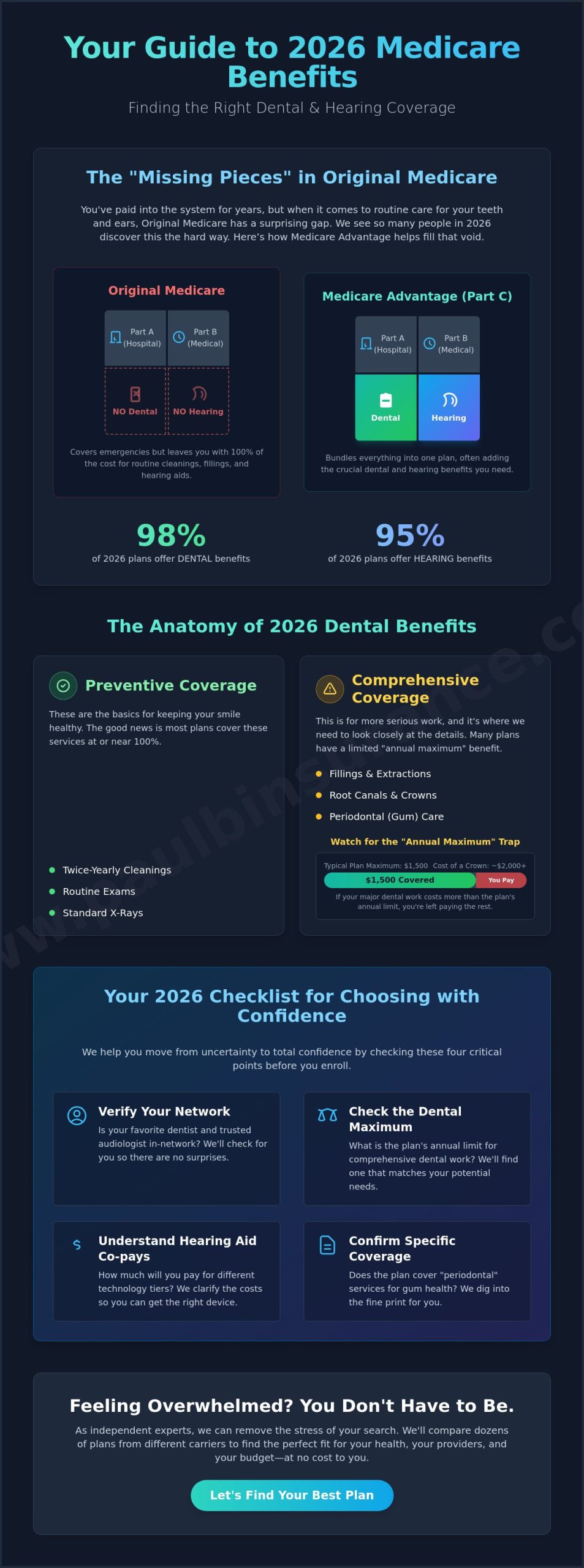
By 2026, the insurance world has finally started to catch up with what we’ve always known: your body isn’t made of separate, unrelated parts. We know that poor dental health is often linked to heart disease and that untreated hearing loss can lead to social isolation. Today’s medicare advantage plans with dental and hearing aid coverage reflect this shift toward integrated health. In 2026, 98% of individual plans include dental benefits, and 95% offer hearing exams or aid coverage. We help you move beyond limited coverage to a state of total wellness. We want to ensure your plan reflects the high value you place on your quality of life, from clear conversations to a healthy smile.
The Anatomy of 2026 Dental and Hearing Aid Benefits
When you look at the brochures for medicare advantage plans with dental and hearing aid coverage in 2026, the word “included” appears everywhere. But we know that “included” is a broad term. It’s like saying a car includes “wheels.” You need to know if those wheels are designed for a highway or a golf cart. To find the right fit, we have to look at the specific anatomy of these benefits. While 98% of plans offer dental and 95% offer hearing support this year, the quality of that support varies wildly between carriers.
We often see people choose a plan based on a zero-dollar premium, only to find out later that their “coverage” doesn’t actually pay for the expensive work they need. A recent KFF analysis of dental and hearing costs highlights how these out-of-pocket expenses can stack up if you aren’t careful. We want to help you avoid those surprises by looking deeper into the plan’s structure.
Preventive vs. Comprehensive Dental Coverage
Dental benefits in 2026 are usually split into two distinct buckets. Preventive coverage is the basic stuff. It covers your twice-yearly cleanings, routine exams, and standard X-rays. Most plans cover these at 100%. However, the real value lies in comprehensive coverage. This is what pays for fillings, root canals, and crowns. Some higher-tier plans even include help for implants, which are becoming more common in 2026. We always remind our clients to check for “periodontal” coverage specifically. If you have a history of gum disease, you need a plan that covers deep cleanings, not just the surface-level ones. If you’re worried about major procedures, you might also want to explore a standalone dental insurance plan to see which option offers the most protection for your budget.
Understanding Hearing Aid Tiers and Co-pays
Hearing aid coverage has become much more standardized in 2026, but technology levels still matter. Most plans categorize devices into tiers: Standard, Advanced, and Premium. A Standard device might have a very low co-pay, but it may struggle in a noisy restaurant. Premium devices offer the best clarity but come with a higher fixed co-pay per ear. We also look for plans that include the “extras” that make life easier. This includes recharging stations, a multi-year supply of batteries, and, most importantly, the fitting fees. Some plans charge you every time you visit the audiologist for an adjustment. We prefer plans that include follow-up care in the initial cost so you can get your devices tuned perfectly without a new bill every time.
Comparing the “Fine Print”: Networks, Caps, and Co-pays
Reading the fine print of an insurance summary can feel like trying to solve a puzzle with missing pieces. We see this confusion every day when clients look at medicare advantage plans with dental and hearing aid coverage. Most people naturally focus on the monthly premium, but the real cost of your care is often hidden in the network rules and annual caps. We want to help you peel back those layers so you aren’t surprised by a bill when you’re sitting in the dentist’s chair. It’s about moving you from a state of worry to a state of certainty.
One of the biggest hurdles we help our clients clear is the “Annual Maximum” trap. This is the total amount the insurance company will pay for your dental work in a single year. If you have a plan with a $1,000 limit and you need two crowns, you’ll likely hit that ceiling quickly. Once you pass it, you’re responsible for every dollar after that. The American Dental Association on Medicare Advantage points out that because these plans are run by private companies, the rules on these caps can vary significantly. We prioritize finding plans with higher annual limits for our clients because we want you to have a safety net that actually catches you.
How Annual Maximums Impact Your Wallet
In 2026, the difference between a standard plan and a high-value plan often comes down to the dollar limit. Consider these two scenarios we often compare for our clients:
- The $1,500 Cap: This might cover your cleanings and a simple filling, but a single root canal and crown could exhaust your entire benefit for the year.
- The $3,000 Cap: This higher limit provides much more breathing room for major procedures or unexpected dental emergencies.
We also look for plans that offer “carryover” benefits. This is a newer feature in some 2026 plans that allows you to roll over a portion of your unused dental limit to the next year. It’s a great way to save up for a larger procedure you know you’ll need down the road.
Provider Networks for Audiologists and Dentists
Finding a plan is only half the battle; you also need to make sure your doctors are on the list. HMO plans generally require you to stay within a strict network to get coverage. If your long-term dentist isn’t on that list, you’ll pay the full price yourself. This is why we often recommend PPO plans for medicare advantage plans with dental and hearing aid coverage. PPOs offer the flexibility to see out-of-network providers, though you might pay a slightly higher co-pay. Some plans even offer “Direct Member Reimbursement,” which allows you to pay your dentist directly and get paid back by the insurance company later. You can use our Medicare Advantage Guide to help verify if your current providers are included before you make a switch.
Your 2026 Checklist for Choosing the Right Coverage
Choosing the right plan shouldn’t feel like a guessing game. We’ve developed a simple four-step checklist to help you find the best medicare advantage plans with dental and hearing aid coverage for your life in 2026. This process moves you away from the stress of the unknown and toward a clear, logical decision. We believe that when you have the right information, the confusion disappears, leaving you with total peace of mind.
- Step 1: List your “Must-Have” procedures. Don’t just think about standard cleanings. If your dentist mentioned a potential bridge or a root canal during your last visit, write that down now so we can ensure it’s covered.
- Step 2: Verify your network. Call your current dentist and audiologist to confirm they are participating in the specific 2026 networks you are considering.
- Step 3: Compare the “True Cost.” This means looking beyond the monthly premium to see what you’ll actually pay when you use your benefits.
- Step 4: Check for “Extras.” Many 2026 plans include Over-the-Counter (OTC) allowances that can be used to pay for hearing aid batteries or specialized oral health supplies.
Evaluating Your Specific Health Needs
We suggest you start by auditing your dental history. Look back at the last three years to see how often you’ve needed more than a simple cleaning. This history is the best predictor for what you’ll need next year. We also recommend getting a professional hearing test before you commit to a plan. Knowing the exact level of technology you need helps us find a plan that covers that specific tier without overcharging you for features you don’t use. True Cost is the sum of premiums and expected out-of-pocket expenses.
Tools for a Stress-Free Comparison
It’s easy to get distracted by the flashy promises in TV commercials. Those ads often highlight a single benefit while ignoring the high deductibles or limited networks that could cost you thousands later. We use our own internal tools to scan over 40 different insurance carriers simultaneously. This allows us to compare the fine print side-by-side so you don’t have to spend hours on hold. Sometimes, a Medicare Advantage plan might not be the perfect fit for your specific dental needs. In those cases, we might suggest looking at a standalone dental insurance plan to fill those gaps. If you’re feeling overwhelmed, let us help you compare medicare advantage plans with dental and hearing aid coverage to find the security you’ve been looking for.
How an Independent Broker Simplifies the Search
Searching for the perfect coverage shouldn’t feel like a lonely journey through a maze of fine print. When you look for medicare advantage plans with dental and hearing aid coverage, you’ll encounter two types of people who want to help. The first is a captive agent. These professionals work for a single insurance company. Their job is to sell you that company’s specific product, even if a competitor offers a higher dental cap or better hearing aid technology. We believe you deserve better than limited options. You deserve a champion who looks at the whole picture.
The second type is an independent broker, which is who we are. We don’t work for the insurance companies; we work for you. Our mission is to move you from a state of distress to one of absolute certainty. We act as your personal advocate and educator throughout the entire process. We look at the entire market to find the plan that fits your life, not the other way around. Our support doesn’t end when you sign your name. We provide year-round assistance to help you use your benefits and resolve any confusion that might arise during the year.
Why 40+ Carriers Beat Just One
We compare options from Aetna, UHC, and dozens of other carriers side-by-side. This unbiased approach is essential because every company has different rules for 2026. One might have an excellent network for dentists but a high co-pay for hearing aids. Another might offer the exact “comprehensive” dental bucket you need for an upcoming crown. Having an advocate who isn’t tied to one brand means you get the full picture. For a deeper look at how we protect your interests, you can read our Medicare Broker guide. We take the time to explain every detail in accessible terms so you feel empowered to choose.
Your Next Steps to Certainty
We invite you to schedule a simple, no-pressure consultation with us. It’s a conversation, not a sales pitch. To make our first call most effective, bring a list of your current prescriptions and the names of your favorite dentists and audiologists. We’ll use our internal tools to verify their network status and compare the “True Cost” of every available plan. You don’t have to do this alone. We’re here to guide you every step of the way, ensuring you find medicare advantage plans with dental and hearing aid coverage that provide the security and peace of mind you’ve earned.
Secure Your Health and Your Smile for 2026
You now have the knowledge to look beyond simple advertisements and find the true value in your health benefits. We’ve explored how understanding annual maximums and verifying provider networks can save you thousands in out-of-pocket costs. By focusing on comprehensive dental and the right hearing aid technology, you’re protecting your quality of life for years to come. Finding the right medicare advantage plans with dental and hearing aid coverage is the final step in moving from uncertainty to total confidence.
We’re here to make that final step easy. As an independent brokerage, we represent over 40 different carriers and provide unbiased guidance to clients in over 34 states. Our expert support doesn’t end when you enroll; we stay by your side to ensure your plan continues to meet your needs. You’ve done the hard work of learning the system. Now, let us handle the complex comparisons for you.
Compare 40+ Medicare Advantage Plans with an Expert Today
You deserve a partner who prioritizes your health over insurance company quotas. We’re ready to help you find a plan that lets you keep your favorite dentist and enjoy clear conversations with your family. Your peace of mind is just one conversation away.
Frequently Asked Questions
Do Medicare Advantage plans cover dental implants in 2026?
Yes, many comprehensive medicare advantage plans with dental and hearing aid coverage now include dental implants as part of their major restorative services. It’s a significant change we’ve seen in 2026 as carriers recognize that implants are often the best long-term solution for dental health. However, these procedures are almost always subject to your plan’s annual maximum benefit limit, which might be around $2,000 or $3,000.
We always encourage you to check if the plan requires prior authorization before the surgery begins. Because implants are expensive, some plans might only cover a portion of the cost, leaving you with a co-insurance payment. We can help you look at the specific “Summary of Benefits” for any plan you’re considering to ensure implants aren’t tucked away in the exclusions list.
Is there a waiting period for dental work on Medicare Advantage?
Most Medicare Advantage plans in 2026 do not have waiting periods for preventive care like cleanings or exams. You can typically use those benefits the very first day your plan becomes active. For major work like crowns, bridges, or root canals, some plans used to require a six-month wait, but many 2026 carriers have removed these requirements to stay competitive in the market.
If you have an urgent dental need, we focus on finding “day one” coverage for you. It’s important to remember that even without a waiting period, you still need to follow network rules to get the lowest price. We’ll help you verify that your plan allows for immediate access to comprehensive care so you don’t have to delay necessary treatments.
Can I keep my current dentist if I join a Medicare Advantage plan?
You can keep your current dentist only if they are a participating provider in the plan’s specific network. This is why we often recommend PPO plans for our clients who have a long-standing relationship with their dentist. A PPO gives you the flexibility to see providers outside the network, though you’ll usually pay a bit more for the visit than if you stayed in-network.
If you choose an HMO plan, you’ll likely have to leave your current dentist if they aren’t on the approved list. Before you make a switch, we can use our tools to search the 2026 provider directories for you. This simple step removes the fear of losing a doctor you trust and ensures your transition to a new plan is completely stress-free.
How often can I get new hearing aids with my plan?
Most plans in 2026 allow you to get a new set of hearing aids every one to three years. The exact frequency depends on the specific insurance carrier you choose. We see many plans that offer a “per ear” benefit, providing a fixed co-pay for each device to help keep your technology up to date as your hearing needs change.
Because hearing technology evolves quickly, having a plan that allows for frequent upgrades is a huge advantage. We look for options that include follow-up visits for fittings and adjustments during that first year. This ensures your new devices work perfectly for your specific environment without causing you extra out-of-pocket expenses for every office visit.
What is the difference between an HMO and a PPO for dental care?
The main difference lies in your freedom to choose your dentist and how much you’ll pay for out-of-network care. An HMO plan generally requires you to stay within a strict network of providers, and it won’t pay anything if you see a dentist who isn’t on their list. This can be frustrating if your favorite dentist decides to leave the network mid-year.
A PPO plan is much more flexible and is often the preferred choice for our clients. It allows you to see any licensed dentist, though you’ll receive the highest level of coverage by staying in-network. If your dentist is out-of-network, the plan will still pay a portion of the bill, but you’ll be responsible for the difference. We can help you weigh these costs to see which structure fits your budget.
Does Medicare Advantage cover the cost of hearing aid batteries?
Many medicare advantage plans with dental and hearing aid coverage in 2026 include a multi-year supply of batteries with your new devices. If your plan doesn’t include them directly, you can often use your monthly or quarterly Over-the-Counter (OTC) allowance to buy them. This is a great way to use your extra benefits to cover everyday health costs.
We also see a growing trend in 2026 toward rechargeable hearing aids. Many plans now offer these as a standard option, which removes the need to buy or change small batteries entirely. If you prefer the convenience of recharging your devices overnight, we can help you find a plan that includes the recharging station at no extra cost to you.
What happens if my dentist leaves the plan network mid-year?
If your dentist leaves the network mid-year, your costs will likely change depending on the type of plan you have. In an HMO, the plan will stop paying for your visits entirely, and you’ll need to select a new in-network dentist to keep your coverage. This can be a jarring experience, but we’re here to help you find a new provider who meets our high standards for care.
If you have a PPO plan, you can continue seeing that dentist, but you’ll move from “in-network” to “out-of-network” status. This usually means your co-pay will increase, and you might have to pay the dentist upfront and ask the insurance company for reimbursement. We provide year-round support to help you handle these transitions so you never feel like you’re navigating the system alone.
Can I get dental and hearing coverage if I choose a Medigap plan instead?
No, Medigap plans are designed to cover the “gaps” in Original Medicare, like the $1,736 Part A deductible, but they don’t include routine dental or hearing extras. If you choose a Medigap plan for its predictable medical costs, you’ll need to look elsewhere for your teeth and ears. We often help our clients bridge this gap by adding a standalone dental insurance plan to their coverage.
This “hybrid” approach gives you the best of both worlds. You get the robust medical protection of a Medigap plan and the specific dental and hearing benefits you need through a separate policy. We can compare these standalone options alongside Medicare Advantage to see which path provides the most peace of mind for your specific health needs in 2026.

Article by
Paul Barrett
Paul Barrett, CMIP is the founder of The Modern Medicare Agency, an independent Medicare-only brokerage based in Melville, NY. With 18 years of Medicare-exclusive experience, a CMIP designation, and more than 5,000 clients served across 37 states, Paul is one of the most credentialed independent Medicare specialists on Long Island — and one of the most direct.
He represents 40+ carriers with no quotas and no allegiances, which means his recommendations are based entirely on what fits each client's specific situation. He is the author of Medicare Mastery Unlocked and host of the Wise Guys Retirement Talk podcast. His content is grounded in primary sources, real carrier intelligence, and 18 years of watching what happens when people get Medicare right — and when they don't.
📞 631-358-5793 | paulbinsurance.com