
Medicare hospice coverage is a Medicare Part A benefit that provides comprehensive comfort-focused care to individuals with a terminal illness and a physician-certified prognosis of six months or less. To qualify, you must be enrolled in Medicare Part A, have a doctor certify your terminal diagnosis, and formally elect the hospice benefit through a Medicare-certified hospice provider. This article breaks down exactly what services are covered, what you pay out of pocket, how long coverage lasts, and how hospice care coordinates with your other Medicare benefits so you can make informed decisions for yourself or a loved one.
What does Medicare hospice coverage include?
Medicare hospice coverage is not a single service. It is a documented care model built around an individualized written plan developed by an interdisciplinary team that includes nurses, physicians, social workers, aides, counselors, and therapists. That team works directly with you, your family, and your attending physician to design care around your specific needs.
The benefit covers a wide range of services under that plan:
- Nursing services provided by registered nurses and licensed practical nurses
- Physician services from the hospice medical director and your attending physician
- Medical equipment such as wheelchairs, hospital beds, and oxygen
- Prescription drugs for pain relief and symptom management related to the terminal illness
- Physical, occupational, and speech therapy when needed for comfort
- Medical social services to help with emotional and practical needs
- Spiritual counseling and chaplain services
- Grief and bereavement support for the patient and family
Medicare pays a daily rate to hospice providers that covers all services outlined in your plan of care. The focus is entirely on comfort, pain control, and quality of life rather than curative treatment.
The four levels of hospice care Medicare covers

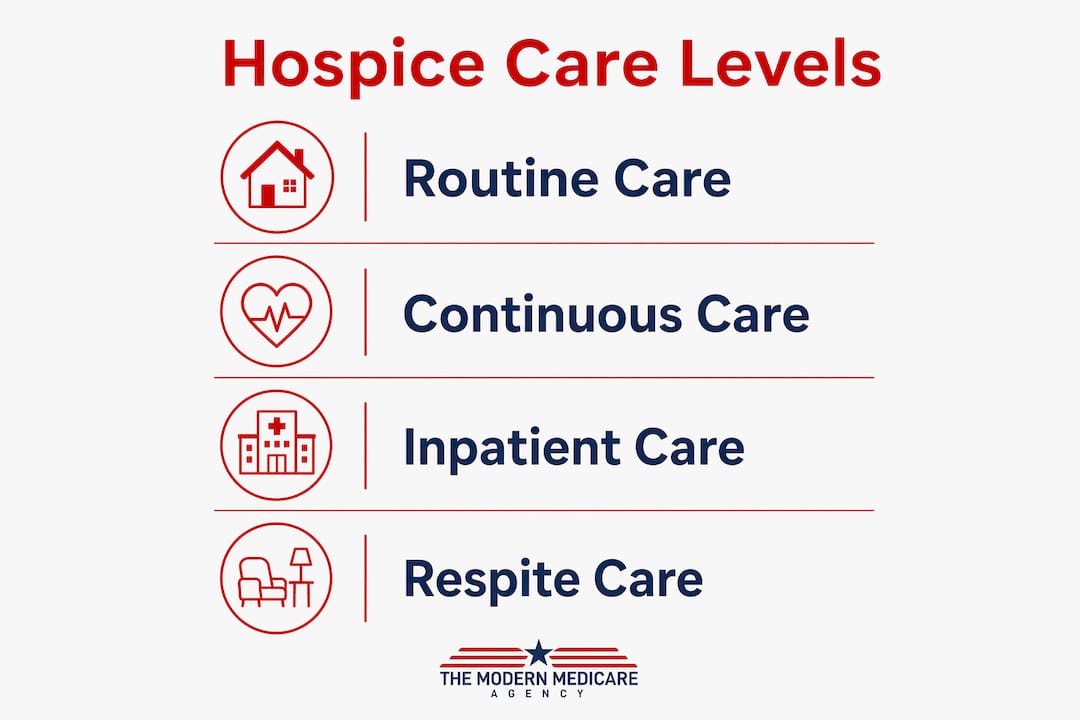
Medicare recognizes four distinct levels of hospice care, each designed for a different clinical situation:
| Level of Care | What It Means |
|---|---|
| Routine home care | Standard daily hospice care provided at home or in a facility |
| Continuous home care | Intensive nursing care at home during a medical crisis |
| General inpatient care | Short-term inpatient care for pain or symptom control not manageable at home |
| Respite care | Short-term inpatient relief to give family caregivers a temporary break |
Pro Tip: If a symptom crisis occurs at home, ask your hospice nurse about continuous home care. Many families don’t realize this level exists and end up calling 911 instead, which can complicate your hospice election.
How much does Medicare hospice coverage cost?
Most hospice services cost you nothing out of pocket. That is one of the most underappreciated aspects of the Medicare coverage for end-of-life care. However, there are two specific cost-sharing situations you should know about.
First, you may pay up to $5 per prescription for drugs related to pain and symptom relief during routine or continuous home care. That cap is low by any standard, but it is worth confirming with your hospice pharmacy so there are no surprises at pickup.
Second, if you use inpatient respite care, Medicare charges 5% coinsurance based on the Medicare-established rate for that care. This amount is capped by the annual inpatient deductible, so your total exposure is limited.
The cost area that catches most families off guard is room and board. Medicare does not cover room and board if you receive hospice care in a nursing home or assisted living facility. Medicare pays for the clinical hospice services delivered there, but the facility’s charges for lodging and meals are billed separately to you or your family. This distinction matters enormously when planning finances for a loved one in a care facility. For a deeper look at what Medicare actually pays in nursing settings, the Paulbinsurance guide on nursing home coverage lays it out clearly.
Here is a quick summary of what Medicare hospice does and does not cover cost-wise:
- Covered at no cost: Nursing visits, physician services, medical equipment, most therapies, counseling, bereavement support
- Small copay: Prescription drugs for symptom management (up to $5 per prescription)
- 5% coinsurance: Inpatient respite care, capped by the annual inpatient deductible
- Not covered: Room and board in nursing homes or assisted living facilities
- Still covered under Parts A and B: Medical treatment for conditions unrelated to the terminal illness
Who qualifies for Medicare hospice and how long does coverage last?
Eligibility for Medicare hospice rests on three requirements. You must be enrolled in Medicare Part A, have a physician certify that your terminal illness carries a prognosis of six months or less if the illness runs its normal course, and you must formally elect the hospice benefit by signing an election statement with a Medicare-certified hospice provider.
That “six months or less” prognosis is a clinical estimate, not a hard deadline. Patients who live longer than expected can remain on hospice as long as they continue to meet clinical criteria. Here is how the benefit periods work:
- First benefit period: 90 days. Your attending physician and hospice medical director certify your terminal prognosis at the start.
- Second benefit period: Another 90 days. Recertification by the hospice physician or medical director is required.
- Subsequent benefit periods: Unlimited 60-day periods. Each requires recertification, and after the second 90-day period, recertification requires a face-to-face clinical encounter documented by the hospice physician or nurse practitioner.
- Revocation: You can revoke the hospice benefit at any time. Doing so forfeits the remaining days in your current benefit period, but standard Medicare resumes immediately for your illness. You can re-elect hospice again in the future.
Pro Tip: Revocation is a strategic decision with real trade-offs. If a patient wants to pursue a new treatment option, revoking hospice allows that. But timing matters. Talk with your hospice team and a Medicare advisor before signing a revocation form so you understand exactly what you are giving up and when you can re-enroll.
The recertification process is one area where timely documentation is critical. Delays in paperwork between benefit periods can create billing gaps that are difficult to resolve after the fact. Staying ahead of recertification deadlines protects your coverage continuity.
Does hospice mean all your Medicare coverage stops?
This is one of the most persistent misconceptions about what is hospice under Medicare, and it causes real harm when families make decisions based on it. The answer is no. Medicare Parts A and B continue to cover medical care for conditions unrelated to your terminal illness throughout your hospice enrollment.
Here is how the split works in practice:
- Hospice benefit covers: All care related to your terminal illness and conditions associated with it, as outlined in your plan of care
- Medicare Part A and B cover: Hospital stays, doctor visits, and treatments for unrelated conditions (for example, a broken hip or a urinary tract infection that is not connected to your terminal diagnosis)
- Medicare Part D covers: Prescription drugs for conditions unrelated to the terminal illness
The hospice team and your other healthcare providers are expected to coordinate care so nothing falls through the gaps. If you are unsure whether a specific treatment or condition falls under your hospice plan or regular Medicare, ask your hospice social worker or case manager directly. They are required to clarify this for you. One of the most common Medicare mistakes seniors make is assuming hospice enrollment cancels all other coverage, which leads them to skip necessary treatment for unrelated conditions.
Key takeaways
Medicare hospice coverage is a Medicare Part A benefit that covers comfort-focused care for terminal illness at minimal out-of-pocket cost, with benefit periods that can extend indefinitely as long as clinical criteria are met.
| Point | Details |
|---|---|
| Part A benefit | Hospice coverage requires Medicare Part A enrollment and physician certification of terminal illness. |
| Low out-of-pocket cost | Most services are free; only a $5 drug copay and 5% respite coinsurance apply. |
| Room and board not covered | Facility lodging and meals in nursing homes or assisted living are billed separately. |
| Unlimited benefit periods | After two 90-day periods, unlimited 60-day periods are available with recertification. |
| Other Medicare continues | Parts A, B, and D still cover conditions unrelated to the terminal illness during hospice. |
What I’ve learned after nearly 20 years helping families navigate hospice decisions
I have been working with Medicare consumers since 2007, and hospice coverage is one of the areas where I see the most confusion and the most emotional weight. Families are often dealing with an incredibly difficult time while also trying to decode a benefits system that was not designed for clarity.
The single biggest practical mistake I see is families not confirming that their chosen hospice provider is Medicare-certified before care begins. A provider can look legitimate and still not be certified, which means Medicare will not pay and the family gets a bill they never expected. Always verify certification directly through Medicare before signing an election statement.
The second issue is the room and board surprise. I have sat with families who assumed Medicare covered everything once hospice was elected. When the nursing facility bill arrived, it felt like a betrayal. It is not a flaw in the system so much as a gap in communication. Ask the hospice coordinator on day one to walk you through exactly which charges Medicare covers and which ones the facility will bill separately.
The third thing I want you to know is that hospice is not giving up. It is a different kind of fighting. It fights for dignity, comfort, and time with the people you love. Patients who elect hospice early often report better quality of life than those who delay. The benefit is there for you. Use it fully, ask every question, and do not let paperwork anxiety get in the way of the care you deserve.
— Paul
Get expert help understanding your Medicare options
Navigating Medicare hospice coverage and related benefits is a lot to take on alone, especially when the stakes are this high. At Paulbinsurance, our team of independent Medicare specialists has been helping seniors understand their coverage since 2007. We believe you make better decisions when you fully understand your options.

Whether you are exploring hospice care benefits under Medicare, sorting out Medicare Advantage versus Original Medicare, or trying to understand how Part D fits into your situation, we are here to walk you through it without the jargon. Start with our Medicare guide for seniors for a plain-language overview of how all the pieces fit together. Then reach out to speak with one of our advisors directly. There is no pressure and no cost for the conversation.
FAQ
What is the Medicare hospice benefit?
The Medicare hospice benefit is a Medicare Part A program that covers comfort-focused care for individuals with a terminal illness and a prognosis of six months or less. It includes nursing, medical equipment, prescription drugs for symptom management, counseling, and bereavement support delivered through a Medicare-certified hospice provider.
Does Medicare pay 100% of hospice costs?
Medicare covers nearly all hospice costs. The only cost-sharing is a copay of up to $5 per prescription for pain and symptom drugs and 5% coinsurance for inpatient respite care. Room and board in a nursing home or assisted living facility is not covered by the hospice benefit and is billed separately.
How long can you stay on Medicare hospice?
There is no fixed time limit. Coverage begins with two 90-day benefit periods, followed by unlimited 60-day periods as long as you continue to meet clinical criteria. A face-to-face recertification encounter is required after the second 90-day period to confirm ongoing eligibility.
Can you leave hospice and go back to regular Medicare?
Yes. You can revoke the hospice benefit at any time. Standard Medicare resumes immediately for your illness, and you can re-elect hospice in the future if your situation changes.
Does hospice enrollment affect Medicare Part D coverage?
Medicare Part D continues to cover prescription drugs for conditions unrelated to your terminal illness during hospice enrollment. Drugs related to the terminal illness and its symptoms are covered directly by the hospice benefit, not Part D.