




What if you could look at your 2026 healthcare bills and feel a sense of relief instead of a knot in your stomach? We know that the “alphabet soup” of Medicare can feel like a puzzle that is nearly impossible to solve, especially when you are trying to balance a fixed income. It is completely normal to feel a bit of anxiety when you hear that the Part B premium has reached $202.90 or that the hospital deductible is now $1,736. However, understanding medicare copays and deductibles is the most effective way to protect yourself from the fear of hidden costs during a hospital stay.
We believe that everyone deserves a clear path to financial security, and we are here to act as your patient guide through these changes. We promise to break down the 2026 cost structure in simple terms to help you move from confusion to complete certainty. In this guide, we will explain the difference between a copay and coinsurance, show you how the 2.8% Social Security adjustment fits into your plan, and help you find a strategy that limits your out-of-pocket exposure. You don’t have to face these complex numbers alone; we will show you exactly how to build a predictable budget for the year ahead.
Key Takeaways
- Learn how understanding medicare copays and deductibles helps you turn unpredictable medical bills into a steady, manageable monthly budget.
- Discover how the 2026 $2,100 out-of-pocket threshold for prescription drugs provides a vital safety net for your annual pharmacy costs.
- Compare the differences between Medicare Advantage and Supplement plans to see which structure offers you the most financial peace of mind.
- Protect your savings by identifying common myths about spending limits and coverage gaps that often catch beneficiaries off guard.
- Find out why an independent expert can offer more security and choice than a representative who is restricted to just one insurance company.
The 2026 Medicare Cost Landscape: Terms You Need to Know
It is a common misconception that Medicare is free because you paid taxes during your working years. We often speak with folks who are startled by their first medical bill after retirement. The reality is that the Medicare program overview shows a system built on cost-sharing. Understanding medicare copays and deductibles is the first step toward peace of mind. A deductible is simply the amount you must pay out of your own pocket before the insurance company starts to contribute. Once you meet that, you will usually face a copay, which is a fixed dollar amount, or coinsurance, which is a percentage of the total cost. We find that most people prefer a flat copay because it makes budgeting much easier than trying to guess what 20% of a large hospital bill might be.
Breaking Down the 2026 Part A Hospital Deductible
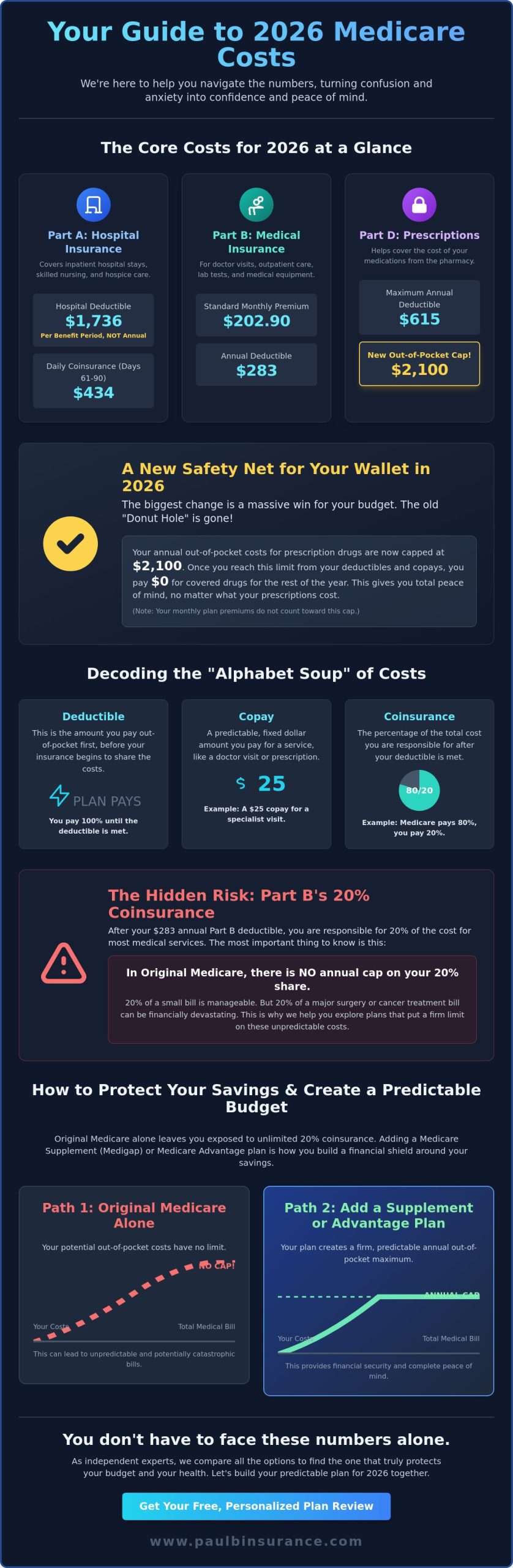
The Part A deductible for 2026 is $1,736. Most people think this is an annual fee like your car insurance, but it actually applies to every “benefit period.” This is a detail that many other guides miss. A benefit period begins the day you enter the hospital and ends when you’ve been out for 60 days in a row. If you are admitted in January and then have another separate stay in July, you might have to pay that $1,736 twice. For hospital stays that last longer than 60 days, you’ll face daily coinsurance rates of $434 for days 61 through 90. These costs can add up fast, which is why we help you look for ways to protect your savings.
Medicare Part B: The 20% Coinsurance Rule
Medicare Part B covers your doctor visits, lab tests, and outpatient care. In 2026, the annual deductible for these services is $283. This amount resets every January 1st. After you’ve paid that initial $283, the 20% coinsurance rule kicks in. Medicare pays 80%, and you are responsible for the remaining 20%. This 20% applies to everything from a routine specialist visit to expensive surgeries or durable medical equipment. Because there is no cap on that 20% in Original Medicare, many of our clients choose to explore Medicare Supplement (Medigap) Plans to help eliminate these unpredictable costs. We want to make sure you aren’t left holding a bill that keeps growing without a limit.
Medicare Part D and Prescription Drug Costs in 2026
Pharmacy counters are often where the most stress happens. We’ve seen many people wait in line, only to be shocked by a price tag they didn’t expect. In 2026, the maximum annual deductible for any Part D plan is $615. This is the most a plan can ask you to pay before your coverage starts. While that might sound high, it’s just one piece of the puzzle when you’re understanding medicare copays and deductibles. You can find the full breakdown of these official Medicare costs online, but we want to focus on how these changes actually protect your wallet and your peace of mind.
The New 2026 $2,100 Prescription Cap
The biggest news for 2026 is the new out-of-pocket cap. For years, beneficiaries worried about the “Donut Hole,” a confusing gap where costs could suddenly spike. That is officially a thing of the past. Now, your annual out-of-pocket costs for prescriptions are capped at $2,100. Once you hit this limit, you won’t pay a single penny for your covered drugs for the rest of the year. If you take expensive maintenance medications, this change is a massive win for your budget. What exactly counts toward that $2,100 limit? Your deductible and your copays for covered drugs all move you closer to that safety net. However, your monthly plan premiums do not count toward this total. It’s a structured path that ensures no one is wiped out financially by a single diagnosis.
Copay Tiers: Preferred vs. Non-Preferred Drugs
Even with the cap, your monthly copays depend on which “tier” your drug falls into. Tier 1 usually covers low-cost generics, while Tier 5 is reserved for high-cost specialty drugs. We often find that using a “preferred pharmacy” can lower these individual copays significantly. It’s why we recommend an annual check of your plan’s formulary. Many people don’t realize that plans can change which drugs they cover every single year. A medication that was Tier 2 last year might move to Tier 4 in 2026. This is why we stay by your side as an advocate. We don’t want you to find out about a price hike while you’re standing at the pharmacy window. You can learn more about how these plans work in our guide to Medicare Part D Explained. If you’re feeling overwhelmed by your current drug costs, we can help you review your 2026 plan options to see if a different formulary fits your needs better.
Advantage vs. Supplement: How Your Plan Choice Changes Your Costs
Choosing between a Medicare Advantage plan and a Medicare Supplement plan is the most significant decision you’ll make for your 2026 health budget. Each path offers a different way to handle your medical bills. One path prioritizes low monthly costs, while the other focuses on total predictability. We want to help you decide which one gives you the most peace of mind. Understanding medicare copays and deductibles becomes much simpler once you realize that Original Medicare is missing a “safety net,” which is a cap on your annual spending. Both of these plan types provide that missing protection, but they do it in very different ways. You can find a deeper comparison in our guide, Advantage vs. Supplement: Which Is Right For You?
Medigap: The ‘No Surprise’ Strategy
Many of our clients choose a Medicare Supplement plan because they want to know exactly what they will owe each month. If you choose Plan G, for example, your plan covers the entire $1,736 Part A hospital deductible for you. You won’t have to worry about large hospital bills or the 20% coinsurance we discussed earlier. While Medigap plan costs vary depending on where you live, the benefit is always the same. You pay a monthly premium to eliminate the fear of unexpected medical costs. It is a great fit if you prefer a fixed budget. You can learn more in our Simple Guide to Medigap.
Medicare Advantage: The ‘Pay-As-You-Go’ Strategy
Medicare Advantage plans often have very low or even $0 monthly premiums. This sounds helpful for a fixed income, but it’s important to remember you are trading that low premium for copays. You might pay a flat fee for every doctor visit or a daily rate for a hospital stay. The most important feature here is the Maximum Out-of-Pocket (MOOP) limit. This is the “safety net” that Original Medicare doesn’t have. Once your copays reach this limit, the plan pays 100% of your costs for the rest of the year. However, you must stay within the plan’s network of doctors to keep your costs low. Going out-of-network can lead to much higher bills or no coverage at all. We want to make sure you choose a plan that includes your favorite doctors and protects your savings.
Common Medicare Cost Myths That Could Hurt Your Budget
We often meet people who feel they’ve done everything right, only to be blindsided by a rule they didn’t know existed. These misunderstandings can lead to significant stress when a medical bill arrives. Our mission is to act as your advocate, shining a light on these hidden financial traps before they can impact your savings. Understanding medicare copays and deductibles is about more than just knowing the numbers; it’s about knowing how the system actually works in the real world. We want to clear up three common myths that we see every day.
The first myth is the belief that Medicare has a yearly limit on your spending. Many people assume it works like the insurance they had while working, where you hit a certain amount and then pay nothing. In Original Medicare, this is simply not true. Another common myth is that your Medicare Supplement plan will cover your prescription drug copays. It won’t. Those costs are handled entirely by your Part D plan. Finally, some believe that if they are healthy and don’t visit the doctor, they don’t have to pay anything. Even if you don’t use a single medical service, you are still responsible for your monthly Part B premium, which is $202.90 in 2026.
The Truth About Original Medicare’s Lack of a Cap
In previous sections, we mentioned the 20% coinsurance rule for Part B. It’s vital to understand that this 20% has no ceiling. If you only have Original Medicare and face a major health event, your costs could be devastating. For example, if you require a complex surgery that costs $100,000, your 20% share would be $20,000. Without a supplement or an Advantage plan to provide an out-of-pocket maximum, you are responsible for every penny of that amount. This is why “going bare” with only Original Medicare is one of the biggest financial risks you can take.
The Part B Penalty Trap
Delaying your enrollment in Medicare Part B can be an expensive mistake that follows you forever. If you don’t sign up when you are first eligible and don’t have other “creditable” coverage, you’ll face a lifetime 10% premium penalty for every 12-month period you waited. In 2026, that penalty would add an extra $20.29 to your monthly bill for just one year of delay. These costs are often overlooked by beginners, but they can significantly strain a fixed-income budget over time. You can learn more about how to avoid these timing errors in our Medicare basics guide. If you aren’t sure whether your current coverage counts as creditable, we can help you review your 2026 coverage options to ensure you stay protected from these permanent penalties.
How an Independent Broker Simplifies Your 2026 Planning
We understand that after reading about all these numbers, you might feel like you’re back at the beginning. That’s why we don’t expect you to do this alone. A ‘captive agent’ is someone who works for just one insurance company. They can only offer you the plans that their company sells, even if a better or cheaper option exists elsewhere. We take a different approach. As independent advocates, we work for you, not the insurance companies. We believe that understanding medicare copays and deductibles shouldn’t be your full-time job. Our process is designed to take the weight off your shoulders. We look at your specific doctors, your medications, and your monthly budget to find the ‘sweet spot’ that gives you the most protection for every dollar.
Our support doesn’t end when you sign your name. We provide year-round protection to ensure you stay on the right path. If a plan changes its drug list or a doctor leaves a network, we are here to guide you through the next steps. We’ve helped thousands of people move from a state of distress to one of complete certainty. You deserve a partner who prioritizes your needs over a sales quota.
Unbiased Comparisons Across 40+ Carriers
Our team uses the latest 2026 data to run side-by-side comparisons across more than 40 different carriers. This ensures that you aren’t just getting a plan that is ‘good enough,’ but one that is perfectly tailored to your life. Because the insurance carriers pay us for our work, our services come at no cost to you. You are always our boss. We prioritize your financial security over any company’s targets. You can explore how we evaluate these choices in our Medicare Advantage Guide.
The Journey to Peace of Mind Starts Here
The path from confusion to a clear 2026 plan starts with a simple conversation. During your first consultation, we’ll listen to your concerns and review your health needs without any high-pressure tactics. We want to help you build a budget that removes the fear of hidden costs. You’ve worked hard for your retirement, and we are here to protect it. By understanding medicare copays and deductibles with an expert by your side, you can stop worrying and start enjoying the peace of mind you deserve. We’ve got your back through every change the year may bring.
Take Control of Your 2026 Healthcare Journey
You’ve taken a major step toward financial security today. We know the 2026 numbers can seem daunting, but you now have the tools to look past the confusion. Remember that you don’t have to choose between your health and your savings. Whether you prefer a predictable Supplement plan or a low-premium Advantage plan, the right choice is the one that lets you sleep soundly. By understanding medicare copays and deductibles, you can turn a mountain of rules into a clear roadmap for your retirement.
We’re here to make the rest of the process just as simple. As independent brokers with access to 40+ carriers, we serve clients in over 34 states with personalized care. We offer year-round support at no cost because you deserve a dedicated advocate. Let us help you find the perfect 2026 plan for your budget; click here to connect with a friendly expert. We look forward to helping you move from uncertainty to complete peace of mind.
Frequently Asked Questions
What is the Medicare Part B deductible for 2026?
The Part B deductible for 2026 is $283. This is the annual amount you must pay for medical services, like doctor visits and lab tests, before Medicare begins paying its 80% share. Since this amount resets every January 1st, we recommend factoring it into your early-year budget. It’s a small increase from previous years, but it’s an essential number to know for your financial planning.
Does Medicare Part A have a deductible every time I go to the hospital?
You don’t pay the Part A deductible every time you enter the hospital, but you do pay it for every “benefit period.” In 2026, this deductible is $1,736. A benefit period starts the day you are admitted and ends once you’ve been out of inpatient care for 60 days in a row. If you are readmitted after that 60-day window, a new period begins and you’ll pay the deductible again.
Is there a maximum out-of-pocket limit for Original Medicare in 2026?
No, Original Medicare has no annual limit on what you pay out-of-pocket. This is why understanding medicare copays and deductibles is so vital for your peace of mind. Without a Medigap plan to cover these costs or a Medicare Advantage plan to provide a federally mandated cap, your 20% coinsurance responsibilities could grow indefinitely. We help you find plans that add this missing safety net to your coverage.
How much are Medicare copays for doctor visits?
In Original Medicare, you generally pay 20% of the Medicare-approved amount for each visit after meeting your Part B deductible. If you choose a Medicare Advantage plan, you’ll typically pay a fixed flat fee instead, such as $10 or $20 per visit. These fixed costs often make it much easier for those on a fixed income to predict their monthly healthcare spending without any surprises.
Can I use my Medigap plan to pay for my Part D drug deductibles?
No, Medigap plans are designed to work only with Medicare Part A and Part B. They cannot be used to pay for prescription drug deductibles, copays, or coinsurance. To manage your pharmacy costs, you will need a separate Part D plan or a Medicare Advantage plan that includes drug coverage. We can help you review your medications to ensure your drug plan and supplement work together perfectly.
What happens if I can’t afford my Medicare deductibles?
There are several assistance programs available, such as “Extra Help” for prescription drug costs and Medicare Savings Programs for Part A and B expenses. These programs are based on your income and assets. We can help you determine if you qualify for these state and federal resources. Our mission is to ensure you feel protected and supported, regardless of your financial situation.

Article by
Paul Barrett
Paul Barrett, CMIP is the founder of The Modern Medicare Agency, an independent Medicare-only brokerage based in Melville, NY. With 18 years of Medicare-exclusive experience, a CMIP designation, and more than 5,000 clients served across 37 states, Paul is one of the most credentialed independent Medicare specialists on Long Island — and one of the most direct.
He represents 40+ carriers with no quotas and no allegiances, which means his recommendations are based entirely on what fits each client's specific situation. He is the author of Medicare Mastery Unlocked and host of the Wise Guys Retirement Talk podcast. His content is grounded in primary sources, real carrier intelligence, and 18 years of watching what happens when people get Medicare right — and when they don't.
📞 631-358-5793 | paulbinsurance.com