




Imagine sitting at your kitchen table, staring at two different government websites and wondering which one actually holds the key to your healthcare future. If you’ve found yourself asking, “how to check my medicare enrollment status” without getting a straight answer, you aren’t alone. It’s stressful to feel like you’re caught in a gap between the Social Security Administration and Medicare.gov, especially when your peace of mind depends on knowing you’re covered for 2026. We understand that this transition can feel like a maze, but we’re here to help you find the exit.
We believe that securing your health shouldn’t feel like a second job. We agree that the process is often more complicated than it needs to be, but we promise to simplify it for you today. In this guide, we’ll show you exactly where your application stands and clarify when you can expect your physical Medicare card to arrive in the mail. Once we confirm your status, we’ll also outline the simple steps to choose the right supplemental coverage so you aren’t left responsible for the 2026 Part B deductible of $283 on your own. Let’s move from uncertainty to total confidence together.
Key Takeaways
- We’ll walk you through the 2026 processing windows so you know exactly when to expect your approval and your new card.
- Learn how to check my medicare enrollment status by moving step-by-step from the Social Security portal to your official Medicare.gov account.
- Find out how to verify your private Medicare Advantage or Part D coverage using the specific confirmation letter sent by your insurance carrier.
- We’ll help you spot common application mistakes and navigate the unique hurdles that come with enrolling while you are still working past age 65.
- Discover how to turn your “confirmed” status into total peace of mind by planning for the costs that Original Medicare doesn’t cover.
Understanding the Medicare Enrollment Timeline in 2026
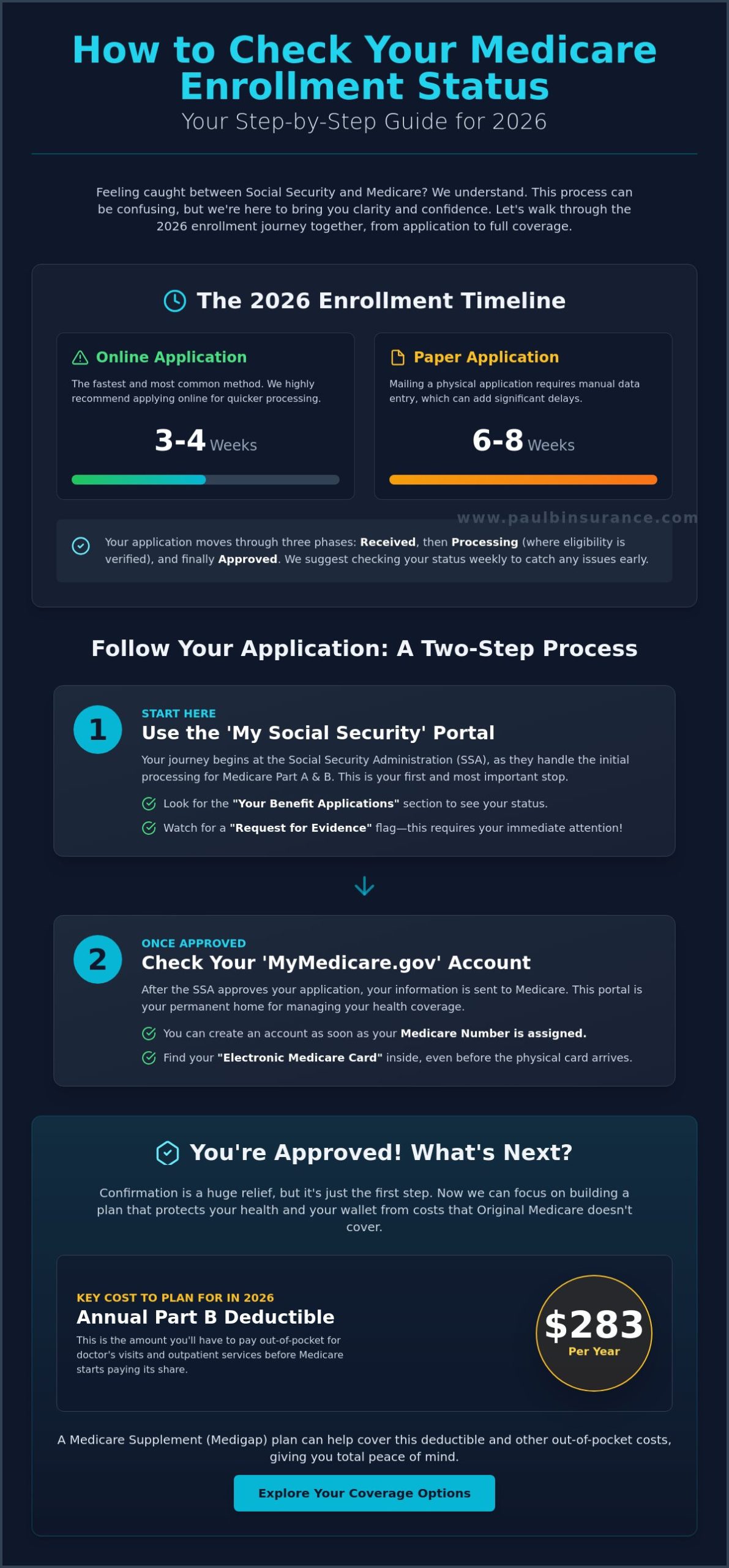
Waiting for your healthcare coverage to go live can feel like holding your breath. We know that the silence from government agencies often feels like a lack of progress, but there is a method to the rhythm of 2026 enrollments. Since its creation, Medicare has evolved into a multi-part system that requires careful coordination between Social Security and health officials. If you are currently wondering how to check my medicare enrollment status, the first thing to understand is that your timeline is unique to you. Most applications move through three distinct phases. First, your file is marked as “Received,” meaning it’s in the system. Then it moves to “Processing,” where a caseworker verifies your work history and eligibility. Finally, you hit “Approved,” which is when your official Medicare number is generated. We recommend checking your status at least once a week during this window. It’s the best way to catch any requests for more information before they turn into long delays.
How long does Medicare processing usually take?
In 2026, most people who apply online see their status move from “Received” to “Approved” within three to four weeks. However, if you chose to mail in a paper application, that window can easily stretch to six or eight weeks because of manual data entry. Your 65th birthday is the anchor for this entire process. If you apply during the first three months of your Initial Enrollment Period, your coverage typically starts on the first day of your birth month. If you wait until the month you turn 65 or later, you might experience a “Pending” status that lingers. This usually happens because of seasonal surges in applications or missing documentation regarding your prior employer coverage. Knowing how to check my medicare enrollment status regularly helps you stay ahead of these common bottlenecks.
Why knowing your status early provides peace of mind
Getting a head start on your status check isn’t just about being organized; it’s about protecting your wallet. Once you know your Part A and Part B are active, you can begin looking at Medicare Supplement (Medigap) Plans to help cover the costs that Original Medicare leaves behind. For example, you’ll want to be ready for the 2026 Part B deductible of $283. Knowing your effective date early allows you to talk to your current doctors and ensure they are ready to bill your new plan. It removes the “waiting game” stress and lets you focus on your health instead of paperwork. We’ve seen that clients who track their status proactively feel much more in control of their transition. It gives you the time needed to ensure your doctors and specialists are ready for your new coverage on day one.
Step-by-Step: Checking Your Part A and Part B Status
One of the biggest sources of stress we see is the confusion between the two different websites involved in your journey. If you’re wondering how to check my medicare enrollment status, the answer begins with a two-step dance between government portals. You don’t just “check Medicare” in one place; you follow your application as it moves from the people who verify your identity to the people who manage your healthcare. We want to make sure you’re looking at the right screen at the right time so you don’t waste hours clicking through menus that don’t apply to you yet.
Using the My Social Security Portal
Your journey starts at the Social Security Administration because they handle the initial processing of your Part A and Part B benefits. In 2026, you’ll likely use the updated Login.gov security features to access your account. This extra layer of protection ensures your private information stays secure, even if it adds a few minutes to your first login. Once you’re inside, look for the “Your Benefit Applications” section. You’ll see a status column that often displays a progress bar like “Step 2 of 3.” This is also where you’ll find any “Request for Evidence” flags. If the SSA needs a copy of your birth certificate or proof of current employment, they’ll post it here. We suggest checking this weekly to ensure a small paperwork request doesn’t stall your entire enrollment.
Checking via MyMedicare.gov
Once the Social Security Administration marks your application as “Approved,” your focus should shift to MyMedicare.gov. This is your permanent home for managing your health coverage. You can create this account as soon as your Medicare Number is assigned, even before your physical card arrives in the mail. Inside your profile, you’ll find your “Electronic Medicare Card,” which you can print or save to your phone immediately. Pay close attention to the “Effective Date” listed in your profile. This is the exact day your coverage begins. Knowing this date is vital because it tells you exactly when you can start using your Medicare Supplement (Medigap) Plans to help cover your out-of-pocket costs. If you notice your mailing address is incorrect in this portal, update it immediately to ensure your physical card reaches your mailbox safely.
Keep your application confirmation number in a safe place during this entire process. If you ever need to call a representative, having that number ready will save you a significant amount of time. We’ve found that having these digital tools at your fingertips is the fastest way to replace anxiety with a clear plan of action. Once you see that “Active” status on Medicare.gov, you’ve successfully built the foundation of your 2026 healthcare plan.
How to Verify Your Medicare Advantage or Part D Status
Checking your status for a private plan works a bit differently than checking your Part A or Part B. While the government manages your foundational benefits, private insurance companies handle your extra coverage. If you are trying to figure out how to check my medicare enrollment status for these specific plans, you’ll need to look in two places: the insurance company and the federal database. We suggest waiting at least 7 to 10 days after you submit your application before you start making calls. This gives the system enough time to sync your information across all platforms. It’s a common point of confusion, but remember that a private company can’t officially enroll you until the Centers for Medicare & Medicaid Services (CMS) gives them the green light.
Contacting the Private Insurance Carrier Directly
Your first point of contact should always be the insurance company you chose. Once they receive your application, they are required to send you a “Confirmation of Enrollment” letter. This document is your proof that the carrier has accepted your request. We recommend calling their member services department if you haven’t received this letter within two weeks. Ask them specifically if your enrollment is “pending” or “active” in their internal system. This is also the perfect time to double-check that your favorite doctors and your specific prescriptions are still fully covered for the 2026 plan year. If the carrier has no record of you after 10 days, it’s a signal that something might have gone wrong with the submission process. We’ve seen cases where a simple typo on a birthdate can pause an entire application, so a quick phone call can save you weeks of waiting.
Using the Medicare Plan Finder Tool
Even if a private company says you’re enrolled, the federal government must also recognize the change. You can verify this by using the official Medicare account login. Once you’re inside, the Plan Finder tool will show you your “Plan of Record.” This is the definitive source of truth that doctors and pharmacies use to verify your benefits. If you see your new Medicare Advantage Plan or Medicare Part D plan listed there, you can rest easy. The system is updated to reflect your 2026 coverage. This portal will also alert you if you’ve been “disenrolled” from a previous plan. This disenrollment happens automatically when your new coverage is approved, so don’t be alarmed if you see a notice saying a previous plan is ending. Checking this tool is the most reliable way to answer the question of how to check my medicare enrollment status because it shows you exactly what the federal system sees. If the information on Medicare.gov doesn’t match what your insurance company told you, it’s time to reach out for a deeper look into your file.
Troubleshooting Common Enrollment Delays and Issues
It’s frustrating to see a screen that doesn’t move. If you’ve been searching for how to check my medicare enrollment status only to find a “Pending” message that hasn’t changed in weeks, you might feel like your application has disappeared into a black hole. We understand that this silence creates anxiety, especially when you’re counting down the days until your current coverage ends. Most 2026 delays aren’t caused by a lack of eligibility. Instead, they usually stem from small technical glitches or missing forms that pause the gears of the Social Security Administration. Knowing the difference between a “Rejected” status and a “Denied” status is the first step toward fixing the problem. A rejection usually means there was a typo, while a denial means the system thinks you don’t meet the requirements yet.
What to do if your status says “Pending” for too long
We generally follow the “30-Day Rule” with our clients. If your application has been in a pending state for more than a month, it’s time to take action. You can start by requesting a status update from your local Social Security office. Sometimes, a file just needs a gentle nudge from a representative to move to the next stage. If you’re still working past 65, this is where things often get stuck. The government needs to verify that you had “creditable coverage” so they don’t charge you a late enrollment penalty. If the process feels too overwhelming, you can always reach out to an independent Medicare broker who can help advocate for you and identify exactly where the bottleneck is happening.
Correcting Common Application Mistakes
A simple typo in your Social Security Number or a misspelled street address can stop an application in its tracks. If you catch an error after you’ve submitted, don’t try to submit a second application. This often creates a “duplicate file” error that takes even longer to resolve. Instead, contact the SSA to provide the correct information. For those transitioning from a group health plan, the most common hurdle in 2026 is a missing Form CMS-L564. This form, which your employer must sign, proves you’ve been covered since you turned 65. Without it, your Part B enrollment might be rejected. We recommend having a digital copy of this form ready to upload immediately to clear any flags on your account. Once these technical hurdles are cleared, your status should move toward “Approved” quite quickly.
If you’ve successfully cleared your enrollment hurdles and want to ensure you’re fully protected from high out-of-pocket costs, we can help you find a Medicare Supplement plan that fits your budget and your needs for the coming year.
From Status Check to Security: Your Next Steps in 2026
Once you’ve mastered how to check my medicare enrollment status and confirmed your coverage is active, you’ve reached a major milestone. We know the relief that comes with seeing that “Active” status for the first time. However, we want to make sure you don’t view this as the finish line. Original Medicare is a vital foundation, but it’s rarely enough to cover everything on its own. In 2026, relying solely on Part A and Part B could leave you responsible for the $1,736 Part A hospital deductible or the 20% coinsurance for every doctor visit you have. We view Part A and Part B as the starting point of your journey, not the destination. Our mission is to help you move from simply being “enrolled” to being fully “protected.”
Understanding Your Medicare Card and Effective Dates
Your new red, white, and blue card is your passport to the healthcare system. It contains your unique Medicare Number, which is a combination of letters and numbers that belongs only to you. You’ll also see two different effective dates: one for Part A and one for Part B. We always remind our clients that the Part B effective date is the most important number on that card. It dictates exactly when you can start using your benefits and when you are eligible to add more coverage. If you’ve looked into how to check my medicare enrollment status and seen your number online, you can actually use it for appointments even before the physical card arrives in your mailbox. Just print a temporary copy from your Medicare.gov account to show your providers.
Finding the Right Supplemental Coverage
Now that your foundation is set, it’s time to choose the “walls and roof” of your plan. You generally have two paths to take. You can choose a Medigap plan to work alongside Original Medicare and provide predictable monthly costs. Or, you might find that a Medicare Advantage plan is a better fit, especially since 96% of beneficiaries have access to a $0 premium option in 2026. We take the stress out of this decision by comparing over 40 different carriers for you. As an independent agency, we don’t work for the insurance companies; we work for you. We’ll help you look at the fine print so you can enjoy your retirement with total peace of mind. Our support doesn’t end when you sign up. We stay by your side year-round to ensure your coverage continues to meet your needs as the system changes.
- Foundation: Original Medicare Parts A and B.
- Protection: Adding a Medigap or Advantage plan.
- Security: Having an expert guide to navigate the 2026 changes.
Your Path to a Worry-Free 2026
Securing your health coverage is a journey from uncertainty to total confidence. We’ve shown you exactly how to check my medicare enrollment status by navigating the Social Security and Medicare.gov portals with ease. You now know how to spot common 2026 application delays and when to expect your physical card to arrive. Remember, your “active” status is the foundation, but your next steps determine your true financial security. Whether you’re comparing supplemental plans or verifying your drug coverage, you don’t have to do it alone.
Confused about your status or what comes next? Let us help you navigate your Medicare journey with clarity and peace of mind. As independent brokers, we represent over 40 different carriers and provide support across 34+ states. We offer personalized, unbiased guidance at no cost to you, ensuring you get the protection you deserve without the high-pressure tactics. Your health is too important to leave to chance. Let’s work together to make your 2026 transition simple and secure. You’ve got this, and we’re right here beside you.
Frequently Asked Questions
How long does it take for Medicare to show as active online?
It typically takes about 3 to 4 weeks for your status to show as active on Medicare.gov if you applied online. If you used a paper application, this timeframe can extend to 8 weeks due to manual processing. We recommend checking your portal regularly once you enter your Initial Enrollment Period. This helps you stay informed as the system updates your 2026 coverage details.
Can I check my Medicare status without a Social Security account?
You can check your status by calling the Social Security Administration at 1-800-772-1213 or visiting a local office in person. While a “My Social Security” account is the fastest way to see updates, we understand that not everyone wants to manage things digitally. If you choose to call, have your application confirmation number ready to help the representative find your file quickly.
What does “Step 2 of 3” mean on my Social Security application status?
“Step 2 of 3” means a representative is currently reviewing your application to ensure you meet all eligibility requirements. This is the stage where most of the work happens, such as verifying your work history and age. Don’t worry if your status stays here for a week or two. It’s a normal part of the process before your file moves to the final approval stage.
Will Medicare notify me when my application is approved?
Yes, you’ll receive an official “Welcome to Medicare” packet in the mail once your application is approved. This packet contains important information about your coverage and your new Medicare Number. If you provided an email address during your online application, you might also receive a digital notification. We suggest keeping an eye on both your inbox and your physical mailbox during your enrollment window.
What should I do if my Medicare enrollment status is denied?
If you see a denied status, the first step is to wait for the official letter explaining the specific reason for the decision. Many denials are simply due to missing information or a misunderstanding about your current employer coverage. Once you have the letter, we can help you file an appeal or resubmit the necessary forms to get your 2026 coverage back on track.
How do I check the status of my Medicare Advantage plan enrollment?
To find out how to check my medicare enrollment status for a private plan, you should contact the insurance company directly. They are responsible for processing your Medicare Advantage or Part D application. You can also log in to Medicare.gov to see if the plan appears as your “Plan of Record.” This ensures that both the carrier and the federal government have you in their systems for 2026.
Can an insurance agent check my Medicare status for me?
An independent agent cannot log in to your personal Social Security account for privacy reasons, but we can help you verify the status of your private plan applications. We work closely with carriers to track the progress of your Medicare Advantage or Part D enrollments. If you’re feeling stuck, we can often call the insurance company on your behalf to get a clear update on your file’s progress.
How soon after checking my status will I receive my Medicare card?
You’ll typically receive your physical red, white, and blue card within 30 days after your application is marked as “Approved.” If you need to see a doctor before the card arrives, you can print a temporary version from your Medicare.gov account. This allows you to use your 2026 benefits immediately without waiting for the mail to arrive. We’re here to help if your card seems to be taking longer than expected.

Article by
Paul Barrett
Paul Barrett, CMIP is the founder of The Modern Medicare Agency, an independent Medicare-only brokerage based in Melville, NY. With 18 years of Medicare-exclusive experience, a CMIP designation, and more than 5,000 clients served across 37 states, Paul is one of the most credentialed independent Medicare specialists on Long Island — and one of the most direct.
He represents 40+ carriers with no quotas and no allegiances, which means his recommendations are based entirely on what fits each client's specific situation. He is the author of Medicare Mastery Unlocked and host of the Wise Guys Retirement Talk podcast. His content is grounded in primary sources, real carrier intelligence, and 18 years of watching what happens when people get Medicare right — and when they don't.
📞 631-358-5793 | paulbinsurance.com