
Medicare vision coverage for disabled individuals is defined as a limited set of medically necessary eye care services under Original Medicare, with broader routine care available only through Medicare Advantage plans. If you receive Social Security Disability Insurance (SSDI) and are working through what your eyes are actually covered for, the answer depends heavily on which part of Medicare you have and whether your eye condition qualifies as a medical diagnosis rather than a routine vision need. Medicare vision coverage disability explained correctly means understanding that the program draws a sharp line between treating eye disease and correcting your eyesight. That distinction controls nearly every coverage decision you will face.
What vision services does Original Medicare cover for disabled beneficiaries?
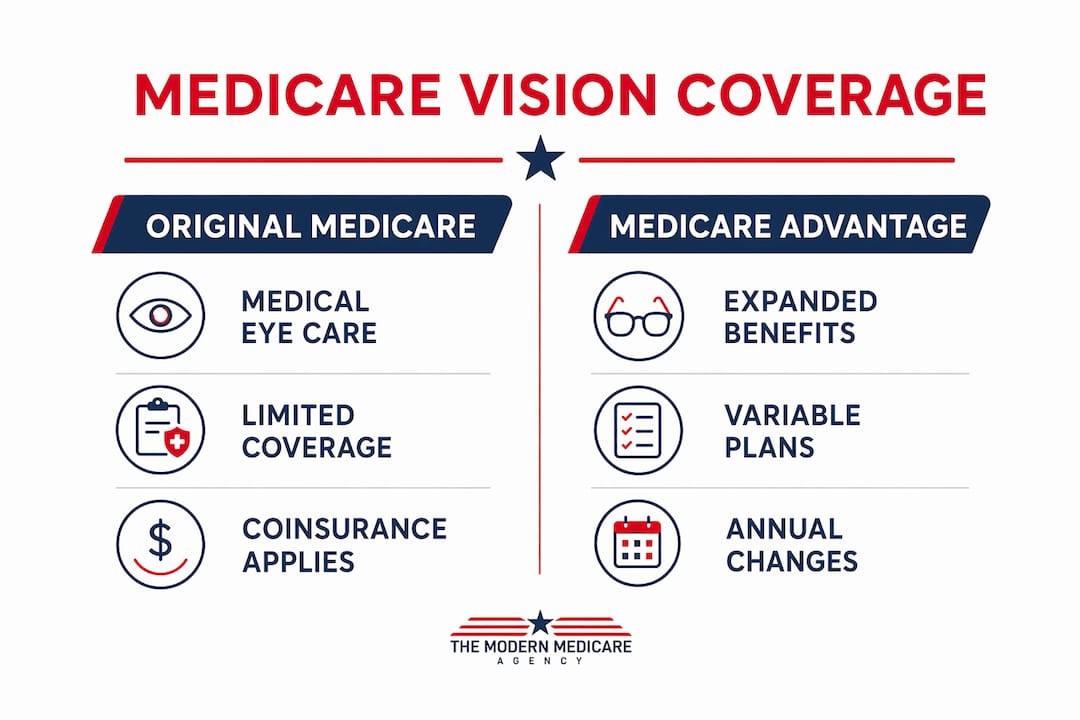
Original Medicare covers eye care only when it is medically necessary. That means the service must be tied directly to diagnosing or treating an illness or injury, not simply correcting how well you see.
Medicare Part B covers the following specific vision services:
- Glaucoma screenings once per year for people at high risk, including those with diabetes or a family history of glaucoma
- Diabetic retinopathy exams annually for people with diabetes, making vision coverage for diabetics one of the more concrete benefits under Part B
- Cataract surgery follow-up eyewear, specifically one pair of glasses or contact lenses after medically necessary cataract surgery
- Eye prostheses for people who have lost an eye
- Treatments for macular degeneration and other diagnosed eye diseases, including injections and laser procedures
Routine eye exams for eyeglasses or contact lenses are not covered under Original Medicare. If your doctor orders a refraction test to update your glasses prescription, Medicare will not pay for it. Providers can and do bill refraction separately as a non-covered service, which catches many people off guard.
When Medicare does cover a vision service, you pay 20% coinsurance after meeting your Part B deductible. That cost-sharing applies whether you are 65 or receiving Medicare because of a disability. Your disability status changes when you become eligible for Medicare, but it does not expand the list of covered vision services under Original Medicare.

Pro Tip: Ask your eye doctor before every appointment whether the visit is being billed as a medical eye exam or a routine vision exam. The billing code determines what Medicare pays and what you owe.
How do Medicare Advantage plans expand vision coverage options?
Medicare Advantage (Part C) plans are required to cover everything Original Medicare covers, but most go further by adding routine vision benefits. Many MA plans include routine annual eye exams and eyewear allowances, typically capped around $150 to $200 per year. That cap covers a basic pair of frames and lenses or contact lenses at in-network providers.
Here is what routine vision coverage under a Medicare Advantage plan often includes:
- One comprehensive eye exam per year at no cost or a low copay
- An eyewear allowance for frames, lenses, or contacts
- Discounts on lens upgrades such as progressive lenses or anti-reflective coatings
- Access to a network of optometrists and ophthalmologists
The catch is that these benefits are not standardized. Coverage and provider networks vary significantly by plan and location. A plan in one county may offer a $200 eyewear allowance while a plan in the next county offers nothing beyond what Original Medicare covers.
Vision benefits in MA plans can change yearly, which means a plan that served you well in 2025 may reduce its eyewear allowance or drop a provider from its network in 2026. That is not a hypothetical. It happens regularly. Reviewing your plan during the Annual Enrollment Period, which runs from october 15 through december 7 each year, is the only way to catch those changes before they cost you money.
Pro Tip: Pull your plan’s Summary of Benefits document each fall and look specifically at the vision section. Compare the eyewear allowance, exam copay, and in-network provider list against what you used the prior year. Changes to any of those three items affect your out-of-pocket costs directly.
For a deeper look at why these plans shift annually, the Paulbinsurance guide on why Medicare Advantage plans change walks through the mechanics in plain language.
What eligibility criteria apply to disabled individuals seeking Medicare vision benefits?
Medicare eligibility for people with disabilities follows a specific timeline. Medicare coverage begins after 24 months of receiving SSDI payments. The clock starts the month your SSDI benefits begin, not the month you applied or were approved. Two exceptions exist: people diagnosed with ALS receive Medicare immediately upon SSDI approval, and people with End-Stage Renal Disease (ESRD) qualify through a separate pathway.
Once enrolled, disabled beneficiaries face the same Original Medicare vision exclusions as people who qualify at 65. About 8.3 million disabled beneficiaries are in this position. Being disabled does not unlock additional vision benefits under Original Medicare.
When vision impairment itself is the basis for a disability claim, the Social Security Administration uses a specific standard:
- Statutory blindness is defined as central visual acuity of 20/200 or less in the better eye with corrective lenses, or a visual field of 20 degrees or less.
- Functional vision limitations that fall short of statutory blindness can still qualify if they prevent you from sustaining full-time work.
- Residual functional capacity (RFC) assessments evaluate what tasks you can still perform despite your vision limitations. The RFC standard looks at your ability to read, use a computer, drive, and navigate safely.
- Combined impairments matter. Ocular pain, photosensitivity, and medication side effects that affect vision are all relevant to an RFC assessment and should be documented thoroughly.
Successful disability claims involving vision require detailed medical evidence of functional capacity limitations, not just a visual acuity score. A reading of 20/100 with glasses tells an adjudicator one number. A record showing you cannot read standard print for more than 20 minutes without debilitating pain tells a complete story.
For people under 65 navigating both disability status and Medicare enrollment, the Paulbinsurance resource on Medicare supplement plans for the disabled under 65 covers supplement options that can reduce out-of-pocket costs.
What additional resources exist for vision care gaps?
Original Medicare leaves real gaps in eye care for disabled beneficiaries. Several programs exist specifically to fill those gaps.
EyeCare America, a program of the American Academy of Ophthalmology, provides free eye exams and up to one year of care at no out-of-pocket cost to qualifying seniors and people with diabetes. Lions Club International runs vision programs in most states that provide free or low-cost eyeglasses to people who cannot afford them. Both programs operate through local chapters and referrals.
Beyond nonprofit programs, several coverage pathways are worth evaluating:
- Medicaid dual eligibility: If your income is low enough to qualify for both Medicare and Medicaid, your state Medicaid program may cover routine eye exams and eyewear that Medicare does not.
- State vision assistance programs: Many states run their own programs for low-income residents with vision needs. Eligibility and benefits vary by state.
- Supplemental vision insurance riders: Some private insurers offer standalone vision plans or riders that cover routine exams and eyewear for a monthly premium, typically $10 to $20 per month.
- Medicare Supplement (Medigap) plans: These plans cover cost-sharing for Medicare-approved services but do not add routine vision benefits. They reduce what you pay for covered medical eye care, not uncovered routine care.
When evaluating your options during Medicare plan selection, the most practical approach is to list your specific vision needs first. If you have diabetes, confirm that your plan covers annual diabetic eye exams under Part B. If you need new glasses every year, calculate whether a Medicare Advantage plan’s eyewear allowance offsets any premium difference compared to Original Medicare. The math is straightforward once you have the numbers in front of you.
The Paulbinsurance page on Medicare eye exam coverage breaks down exactly which exams are covered and which are not, with specific examples for common conditions.
Key Takeaways
Medicare vision coverage for disabled beneficiaries is limited to medically necessary services under Original Medicare, with routine eye care available only through Medicare Advantage plans that must be reviewed annually.
| Point | Details |
|---|---|
| Original Medicare covers medical eye care only | Glaucoma tests, diabetic retinopathy exams, and post-cataract eyewear are covered; routine exams are not. |
| Medicare Advantage adds routine vision benefits | Many plans include annual eye exams and eyewear allowances around $150 to $200, but benefits vary by plan. |
| Disability eligibility requires 24 months of SSDI | ALS and ESRD are exceptions; disability status does not expand Original Medicare vision coverage. |
| Annual plan review is non-negotiable | MA vision benefits can change each year, so reviewing during open enrollment protects your coverage. |
| Documentation drives disability claims | Functional capacity evidence, not just acuity scores, determines success in vision-related disability claims. |
What I have learned after years of helping disabled Medicare enrollees
The single biggest mistake I see disabled beneficiaries make is assuming that having Medicare means their eye care is covered. It does not. Original Medicare was built around hospital and physician services. Vision, dental, and hearing were left out of the original 1965 design, and that gap has never been fully closed for people on standard Original Medicare.
What surprises people even more is the refraction billing issue. A person goes in for a medically necessary eye exam related to their diabetes, and the doctor also checks their glasses prescription during the same visit. Medicare pays for the medical portion. The refraction gets billed separately as a non-covered service. Nobody warned them. That $25 to $45 charge shows up later and feels like a mistake. It is not a mistake. It is how the billing rules work, and knowing it in advance changes nothing about the care but eliminates the confusion.
The other thing I push hard on is documentation for anyone whose disability involves vision. I have seen claims denied because the medical record only contained a visual acuity number. Acuity alone does not tell the full story of how someone functions. If your eyes cause pain under fluorescent lights, if you cannot read a computer screen for more than 30 minutes, if driving at night is impossible, all of that needs to be in your chart. Legal advocates consistently find that documenting all symptoms affecting functional vision is what separates approved claims from denied ones.
My honest advice: treat your Medicare plan selection like a financial decision, not a paperwork task. Pull the Summary of Benefits. Look at the vision section specifically. If you wear glasses or have a diagnosed eye condition, the difference between the right plan and the wrong one can be hundreds of dollars per year.
— Paul
How Paulbinsurance helps you find the right Medicare vision coverage
Choosing a Medicare plan when you have a disability and specific vision needs is not a one-size-fits-all decision. The right plan depends on your diagnosis, your doctors, your prescriptions, and how often you need eye care.

Paulbinsurance specializes in helping Medicare enrollees with disabilities compare their real options. The team reviews Medicare Advantage plans with vision benefits side by side, checks provider networks against your current doctors, and explains exactly what each plan covers for eye care before you commit. If you are under 65 and on Medicare due to disability, or if you are approaching your 24-month SSDI mark, now is the right time to get a clear picture of your coverage options. Reach out to Paulbinsurance for a no-pressure conversation about what works best for your situation.
FAQ
Does Medicare cover routine eye exams for disabled people?
Original Medicare does not cover routine eye exams for glasses or contacts, regardless of disability status. Medicare Advantage plans often include routine annual exams as an added benefit.
When does Medicare start for someone on SSDI?
Medicare begins after 24 months of receiving SSDI payments, with immediate coverage for ALS patients and a separate eligibility pathway for ESRD.
What eye conditions does Medicare Part B cover?
Part B covers glaucoma screenings, diabetic retinopathy exams, macular degeneration treatments, and one pair of corrective lenses after cataract surgery.
Can I appeal a denied Medicare vision claim?
Yes. If Medicare denies a vision-related claim, you have the right to appeal. Strong appeals include detailed clinical documentation of functional limitations, not just a visual acuity reading. The Paulbinsurance guide on appealing a denied Medicare claim outlines each step in the process.
How do I find a Medicare Advantage plan with good vision benefits?
Compare plans during the Annual Enrollment Period by reviewing each plan’s Summary of Benefits and checking the eyewear allowance, exam copay, and in-network eye care providers. Benefits vary by county, so local plan comparison is the only reliable method.
Recommended
- Medicare for Blind Seniors: Benefits, Eligibility, and Enrollment Guidance – The Modern Medicare Agency
- Medicare Disability Benefits Explained: A Clear Guide to Eligibility, Coverage, and Enrollment – The Modern Medicare Agency
- Medicare Eligibility for Under 65 Disability: A Clear Guide for 2026
- Medicare Part D Benefits for Disabled Enrollees: 2026 Guide