
Did you know that Medicare loses an estimated $60 billion every single year to fraud and scams? It is a staggering figure that shows just how sophisticated these criminals have become in 2026, often using AI-generated voices to mimic official agencies. We understand that your phone ringing with an “urgent” update about your $2,100 Part D cap can feel incredibly stressful. You want to protect your benefits, but it’s hard to know who to trust when you’re being pressured. This guide will teach you exactly how to avoid medicare scams and fraud so you can keep your identity and your hard-earned benefits safe.
We believe that navigating your healthcare should bring you peace of mind, not a headache. Whether you’re worried about “free” medical equipment offers or you’re confused by high-pressure marketing mail, we’re here to help. In this guide, we’ll walk you through a simple framework to identify a scammer instantly. We’ll explain why official representatives won’t call you unsolicited and show you how to verify any request. By the end of this article, you’ll have a clear, step-by-step path to staying secure and certain about your coverage.
Key Takeaways
- Learn the difference between Medicare fraud and scams so you can protect your personal information and your benefits.
- Identify specific 2026 threats like the “New Medicare Card” scam and misleading offers for “free” genetic testing kits.
- Discover our simple “Stop-Check-Verify” safety framework for how to avoid medicare scams and fraud when you receive unexpected calls or mail.
- Understand why official Medicare employees will never call you out of the blue to ask for your Social Security or bank account numbers.
- See how working with an independent broker provides a safe harbor, giving you an expert filter to separate real benefits from high-pressure sales tactics.
Understanding Medicare Fraud and Scams in 2026
We want you to feel confident every time you look at your medical statements. To do that, it’s helpful to know the difference between fraud and a scam. Medicare fraud happens when a person or company bills the government for medical services, equipment, or tests you never actually received. Scams, on the other hand, are the clever tricks people use to steal your Medicare number or personal data. Both are serious, and both can disrupt your access to the care you deserve.
In 2026, these tactics have become much more sophisticated. Fraudsters now use digital tools like AI-generated voices to sound like official government workers. They might even spoof their caller ID so it looks like “Medicare” is calling your phone. This is why learning how to avoid medicare scams and fraud is so vital for your security. If a scammer gets your information, they can exhaust your benefit limits. This could leave you without the coverage you need for a real surgery or prescription later in the year.
The Real Cost of Medicare Fraud
The financial impact of these crimes is truly massive. Every year, Medicare loses an estimated $60 billion to these illegal activities. While that number feels distant, the personal cost is very real. When someone uses your information, it’s called medical identity theft. We define medical identity theft as the unauthorized use of your Medicare number to bill for fake services.
This doesn’t just cost the government money; it messes up your permanent medical records. You can find a deep dive into these different types of illegal activities by Understanding Medicare Fraud and how it impacts the system. In 2026 alone, the Justice Department charged hundreds of individuals in schemes involving over $6.5 billion in false claims. These aren’t just small mistakes. They are organized efforts that put your peace of mind and your health history at risk.
Why Scammers Target Seniors
We know how overwhelming your mailbox gets, especially during the Open Enrollment period from October 15 to December 7. Scammers wait for this time of year because they know you’re already thinking about your coverage. They take advantage of the confusion caused by the mountain of marketing mail and high-pressure sales tactics you encounter. It’s a stressful time, and scammers use that stress to their advantage.
It’s common to feel anxious or even a bit embarrassed if you’ve answered one of these calls. Please know that being targeted is not your fault. Scammers are professional manipulators who spend all day practicing how to trick honest people. Our goal is to act as your safe harbor. We want to help you filter out the noise so you can focus on what actually matters for your health. By staying informed, you can spot the red flags before they become a problem.
Common Medicare Scams to Watch Out For
We want to help you stay ahead of the curve. In 2026, the most dangerous scams aren’t just letters in the mail; they are high-tech attempts to steal your identity. Knowing how to avoid medicare scams and fraud starts with recognizing that scammers are now using deepfake technology. They can clone the voice of a government official or even a family member to create a false sense of urgency. If you receive a call that sounds like a loved one in trouble asking for your Medicare number, hang up and call that person back on their known number. These AI-powered robocalls are a major reason why seniors lost over $100 million to fraud last year.
Another common trick involves “validation” emails. You might get a message stating your Medicare Advantage plan will be canceled unless you click a link to verify your data. These links lead to fake websites designed to look exactly like official portals. They often use high-pressure language to make you act quickly without thinking. We are here to act as your personal filter; if you ever feel unsure about a message you’ve received, please reach out to us first.
The “New Plastic Card” Deception
You may have heard rumors about Medicare switching to “chip” or “metal” cards for better security. We want to be clear: Medicare is not issuing new cards in 2026. Your current paper card is all you need to access your benefits, including your Medicare Supplement Insurance. Scammers often call claiming you must pay a “processing fee” for a new plastic card to avoid losing your coverage. This is a lie. Medicare will never call you to ask for your number just to send you a card. If someone asks for your bank details for a “card upgrade,” hang up immediately.
Free Medical Equipment and Testing Scams
Have you ever been offered a “free” back brace or a DNA testing kit at a senior center or through a social media ad? These offers are often a front for fraud. Scammers use your information to bill Medicare Part D or other parts of the program for expensive items you never receive. In some cases, they send low-quality items that your doctor didn’t prescribe. This can use up your benefits and make it harder for you to get equipment your actual doctor orders later.
To stay truly safe, we recommend checking the CMS Fraud Prevention Toolkit for the latest official updates on current schemes. Only accept medical supplies or tests that your primary doctor has ordered for you. If an offer sounds too good to be true, it probably is. We take pride in helping our clients see through these promises to find honest coverage. If you ever feel pressured by a salesperson, comparing plans with an independent expert can help you find the truth without the stress.
How to Tell If a Contact is Truly from Medicare
We know how unsettling it feels when your phone rings and the caller ID says “Medicare Support.” You want to be helpful, but you also want to protect your identity. The most important rule to remember is that Medicare will almost never call you unless you called them first. If you haven’t reached out to 1-800-MEDICARE recently, any “official” call you get is likely a trick. Real government employees already have your information on file. They will never ask for your bank account details or your Social Security number over the phone to “verify” your account.
It’s also vital to know that legitimate agents cannot come to your home uninvited to sell you a plan. We only speak with you when you’ve asked for our help. This is a major difference between a dedicated advocate and a scammer. While the Medicare Fraud Strike Force works year-round to stop these criminals, knowing these boundaries is your first step in learning how to avoid medicare scams and fraud. Official mail will always come from the Department of Health and Human Services or the Centers for Medicare & Medicaid Services (CMS).
Red Flags in Phone Calls and Emails
Scammers love to use fear. If a caller threatens to cancel your benefits unless you “act now,” hang up. They might even ask for payment via wire transfer, gift cards, or even cryptocurrency. Medicare will never ask for these types of payments. In your email inbox, look for poor grammar or generic greetings like “Dear Medicare Member.” These are classic signs of a phishing attempt. If you’re ever in doubt, don’t click any links. Instead, reach out to a trusted expert who can help you verify the message safely. We want to remove that anxiety from your day and replace it with certainty.
What Legitimate Communication Looks Like
Most of your real Medicare business happens through the mail. Every year, you’ll receive the “Medicare & You” handbook, which contains the latest 2026 updates on premiums and deductibles. You should also look for your Medicare Summary Notice (MSN). This statement shows exactly what was billed to your account. If you have a Medicare Advantage plan, you’ll receive communications directly from your specific insurance carrier. We can help you organize this mail so you always know what’s official and what’s just marketing noise. Having a clear path forward is the best way to maintain your peace of mind and keep your benefits secure.
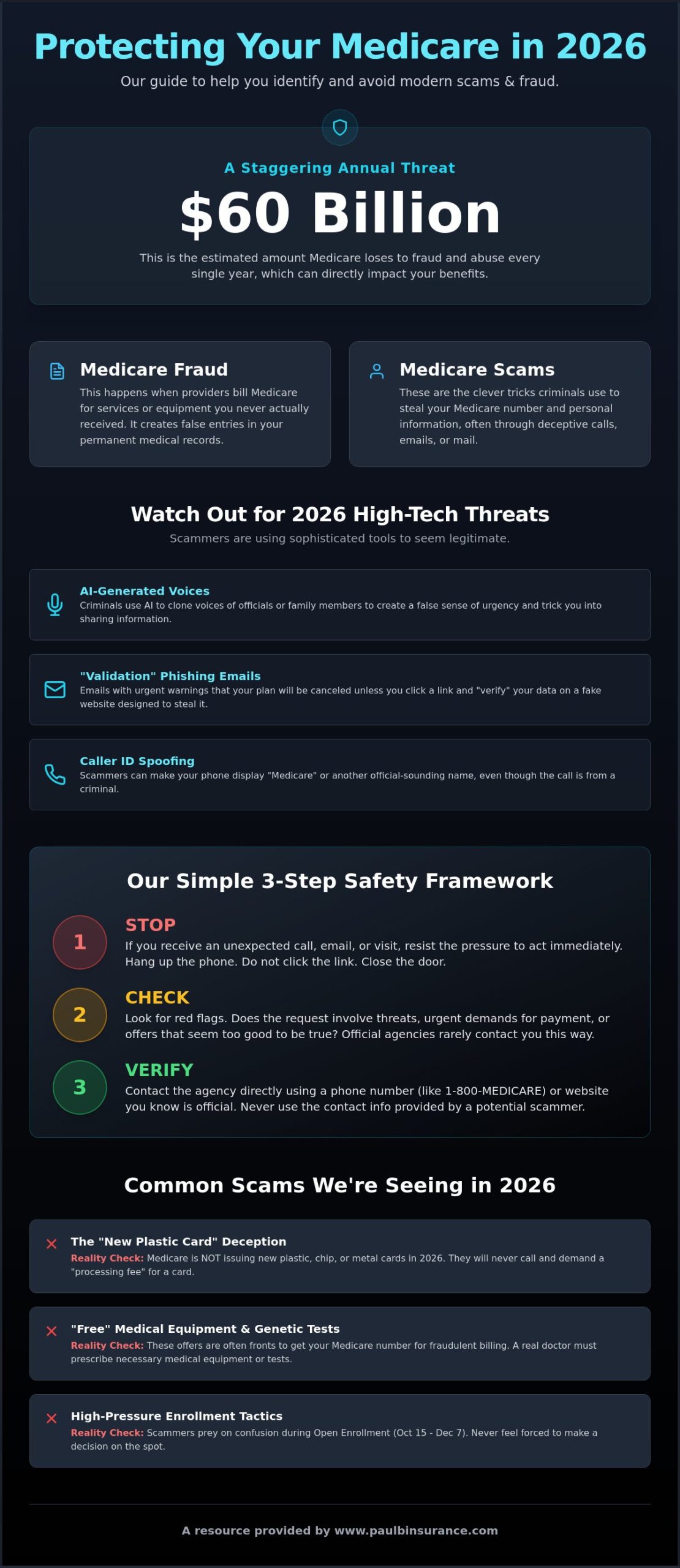
Our “Stop-Check-Verify” Guide to Staying Safe
We want to give you a simple, reliable tool you can use the next time your phone rings or a strange email lands in your inbox. It’s called the “Stop-Check-Verify” method. This framework is designed to move you from a state of uncertainty to one of complete control. Knowing how to avoid medicare scams and fraud in the moment is much easier when you have a clear plan to follow. It removes the pressure to make a quick decision and puts the power back in your hands.
First, you must STOP. If someone calls, texts, or emails you unexpectedly, do not give out any personal information. It doesn’t matter how official they sound or what “urgent” problem they claim to have with your 2026 benefits. Scammers often create a false sense of panic to stop you from thinking clearly. Simply hanging up or closing the email is your strongest defense. You are never being rude by protecting your identity.
Next, you should CHECK your records. We recommend looking at your Medicare Summary Notice (MSN) every time it arrives in the mail. This document is your primary defense against billing fraud. It allows you to see exactly what services were charged to your account and by whom. If you see something that doesn’t look right, it’s time to take the next step.
To better understand the complex systems that healthcare providers use to manage these records accurately and prevent errors, you can check out Tausch Medical.
Finally, you need to VERIFY. Never use a phone number provided by a suspicious caller or a link in an unsolicited email. Instead, call a trusted source directly. You can reach out to us, your independent broker, or call 1-800-MEDICARE to confirm if a request is real. If you suspect you’ve been targeted, you should also REPORT the incident to the Senior Medicare Patrol (SMP). Reporting helps protect your neighbors by flagging new schemes for authorities.
How to Read Your Medicare Summary Notice (MSN)
It is easy to feel overwhelmed by government paperwork. One common mistake is thinking your MSN is a bill you have to pay. It isn’t. It is actually a log of what was billed to Medicare on your behalf. Look closely at the “Services Provided” column. We suggest you highlight any doctor names or facility locations that you don’t recognize. If you didn’t visit that office or receive that test in 2026, someone else might be using your Medicare number. Keeping these notices organized helps us help you if a discrepancy ever arises.
Reporting Fraud: Who to Call
If you find an error or suspect a scam, please report it. You can contact the OIG Hotline at 1-800-HHS-TIPS or your local Senior Medicare Patrol. Even if you didn’t lose any money or give away your data, reporting the attempt is incredibly helpful. It allows the government to track new 2026 scam patterns and warn other seniors before they become victims. Reporting turns you from a potential target into a protector of your community. We take pride in acting as a safe harbor for our clients. If you’ve received a suspicious call and aren’t sure what to do next, you can contact us for expert guidance at no cost to you.
How an Independent Broker Protects You
We want to be your personal filter in a world of high-pressure sales and confusing mailers. When your phone rings with a “too good to be true” offer, it’s hard to know if you’re speaking to a legitimate representative or a fraudster. This is where we step in. As independent brokers, we have the freedom to compare plans from over 40 different carriers. We aren’t here to push a single company; we’re here to find the truth for you. Learning how to avoid medicare scams and fraud becomes much simpler when you have a dedicated advocate who puts your needs first.
One of the biggest risks in 2026 is the “one-and-done” nature of scammers. They want to get your Medicare number and disappear as quickly as possible. We offer a completely different experience. We provide a consistent, reliable point of contact so you always know exactly who you are talking to. Our goal is your long-term peace of mind. We want to ensure you are in the right plan for the right reasons, without the stress of wondering if you’ve been misled. By acting as your safe harbor, we remove the anxiety from the process and replace it with certainty.
The Shield of Independence
We are not tied to any single insurance company. This independence is your greatest protection. Because we don’t work for the carriers, we have no incentive to mislead you or hide the fine print. We provide empathetic, year-round support that lasts long after your plan is chosen. If you ever receive a suspicious mailer or a high-pressure phone call, you can simply call us. We’ll help you verify if the offer is real or just another scam. Our services are provided at no cost to you, which removes any financial friction from getting the honest, expert advice you deserve.
Your Next Steps for a Secure 2026
Taking action today can prevent a major headache tomorrow. We recommend starting with a thorough review of your current plan with a trusted expert. This ensures your coverage still fits your health needs and budget for the remainder of 2026. Next, make it a habit to store your Medicare card in a safe place at home rather than carrying it in your wallet. You only need to bring it with you for your first visit to a new doctor or a new pharmacy. Finally, we invite you to reach out to us for a no-pressure consultation. Whether you want to explore Medicare Supplement plans or simply verify that your current coverage is secure, we are here to help you move from a state of distress to one of total certainty.
Take Control of Your Medicare Security Today
You’ve taken a significant step toward protecting your future by learning these 2026 safety tactics. Remember that your Medicare card is the key to your benefits; keeping it secure is your first line of defense. By using the “Stop-Check-Verify” method we discussed, you can handle any suspicious contact with complete confidence. Understanding how to avoid medicare scams and fraud doesn’t have to be a source of stress when you have a clear, logical plan to follow.
We are here to act as your dedicated advocate and safe harbor. As independent brokers, we provide personalized support across 34+ states and represent more than 40 carriers to give you unbiased advice. Our expert guidance comes at no cost to you, removing any worry about financial friction or high-pressure sales. Let us help you navigate Medicare safely; schedule a free consultation with our experts today. You’ve worked hard for your benefits, and you deserve to feel certain about your coverage every single day.
Frequently Asked Questions
Does Medicare call you to offer a new card with a chip?
No, Medicare is not issuing new “chip” or “metal” cards in 2026. If you receive a call from someone claiming you need a new card for security reasons, it is a scam. Official representatives will never call you unsolicited to ask for your personal data. Hang up immediately if someone asks for a processing fee for a new card. Your current paper card is all you need for your benefits.
What should I do if I accidentally gave my Medicare number to a scammer?
You should call 1-800-MEDICARE right away to report the incident and request a new Medicare number. This is a vital step in learning how to avoid medicare scams and fraud from causing further damage to your records. We also suggest contacting the Senior Medicare Patrol to flag the scam. Review your upcoming Medicare Summary Notices closely to ensure no fraudulent services are billed to your account.
Can a Medicare agent come to my house without an appointment?
No, a legitimate Medicare agent will never come to your home uninvited. Federal rules strictly prohibit insurance agents from making unannounced visits to sell plans. We only meet with you if you have specifically requested an appointment. If someone knocks on your door claiming to be from Medicare without an invitation, do not let them in and report the visit to local authorities.
Are “free” genetic tests offered at community events legitimate?
Most “free” genetic tests offered at senior centers or fairs are fraudulent schemes. These scammers use your Medicare number to bill the government for thousands of dollars in unnecessary tests. You should only accept medical testing that has been ordered by your primary care physician. If an offer sounds too good to be true, it likely is. Protecting your number ensures your 2026 benefit limits remain available for your real health needs.
How can I tell the difference between a scam and a real Medicare Advantage ad?
Real ads focus on specific benefits and carrier names, while scams often use vague, high-pressure language. Be wary of ads promising “free groceries” or “cash back” that don’t name a specific plan. We can help you filter these messages. As independent brokers, we compare plans from 40+ carriers to show you what is actually available in your area without the misleading hype. This transparency helps you stay certain about your choices.
What is the Senior Medicare Patrol and how can they help me?
The Senior Medicare Patrol (SMP) is a national program that empowers seniors to prevent, detect, and report healthcare fraud. They provide free education and can help you if you suspect you’ve been a victim of a scam. We often work alongside these resources to ensure our clients have a safe harbor for their questions. They are a wonderful partner in the fight against 2026 identity theft and billing errors.
Is it safe to give my Medicare number to a local pharmacy?
It is safe to provide your number to your local pharmacy when you are picking up a prescription. Pharmacies need this information to process your 2026 Part D benefits correctly. However, you should never give your number to someone who calls you claiming to be from your pharmacy. If you get a call asking for your Medicare card details to “update your file,” hang up and call your local pharmacist back directly using their known number.
Can I change my Medicare plan if I was tricked into joining a scam plan?
Yes, you may be able to switch plans through a Special Enrollment Period if you were a victim of misleading marketing. The Centers for Medicare & Medicaid Services often grants these exceptions to help those who were tricked by fraudulent sales tactics. We can help you review your situation and see if you qualify for a change. Our goal is to ensure you are in the right plan for the right reasons, giving you total peace of mind.

Article by
Paul Barrett
Paul Barrett, CMIP is the founder of The Modern Medicare Agency, an independent Medicare-only brokerage based in Melville, NY. With 18 years of Medicare-exclusive experience, a CMIP designation, and more than 5,000 clients served across 37 states, Paul is one of the most credentialed independent Medicare specialists on Long Island — and one of the most direct.
He represents 40+ carriers with no quotas and no allegiances, which means his recommendations are based entirely on what fits each client's specific situation. He is the author of Medicare Mastery Unlocked and host of the Wise Guys Retirement Talk podcast. His content is grounded in primary sources, real carrier intelligence, and 18 years of watching what happens when people get Medicare right — and when they don't.
📞 631-358-5793 | paulbinsurance.com