




What if your retirement savings didn’t have to be a “nursing home fund” that disappears the moment you need care? It’s a heavy burden many feel in 2026, especially as the average price for a private nursing home room has climbed to between $10,000 and $12,000 per month. You’ve worked hard for your independence, so it’s completely natural to worry about Medicare gaps or the $1,736 Part A deductible draining your legacy. You want to protect your spouse and ensure you aren’t a financial burden on your children.
We’re here to help you move from a state of uncertainty to total clarity. This guide explores how using annuities to cover healthcare costs in retirement can act as a reliable safety net against 2026 inflation and rising care prices. You’ll discover how to turn a portion of your savings into a guaranteed stream of income that stays steady even when health needs change. We’ll walk you through the simple steps to shield your assets, bridge the Medicare gap, and create a plan that keeps you in control of your future.
Key Takeaways
- Understand why Medicare Advantage and Medigap have limits in 2026 and why you need a secondary shield for expensive long-term care needs.
- Learn how using annuities to cover healthcare costs in retirement can provide a guaranteed income stream specifically designed to pay for home care or facility stays.
- Compare traditional insurance against modern hybrid annuities to find a solution where you don’t “lose” your premiums if you never end up needing care.
- Discover why inflation protection is essential for ensuring your 2026 plan keeps up with the rising prices of medical services in the decades to come.
- See how an independent broker can help you compare over 40 different carriers to find a reliable plan that puts your family’s needs first.
The 2026 Retirement Reality: Why Medicare Isn’t Enough for Every Healthcare Cost
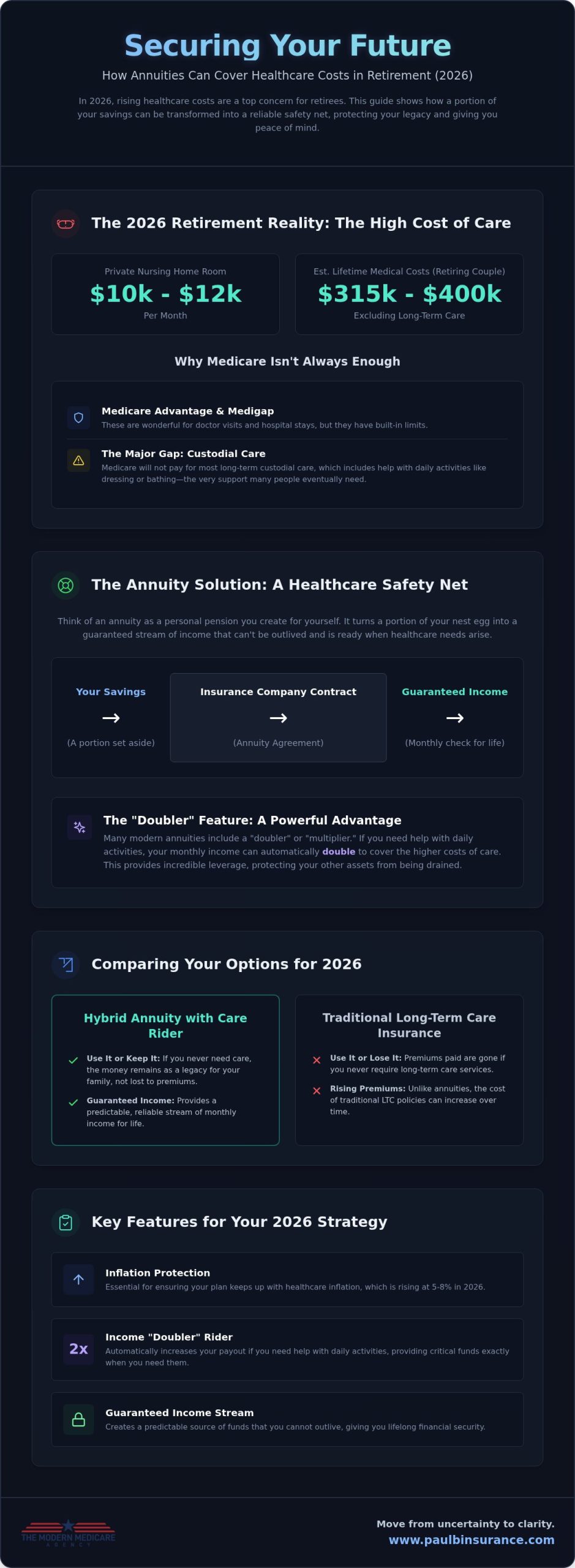
You’ve probably noticed that things look a bit different in 2026. Healthcare prices are climbing faster than ever, and even with a solid plan, the numbers can feel overwhelming. A couple retiring this year can expect to spend between $315,000 and $400,000 on medical costs over their lifetime. That doesn’t even include long-term care. It’s a lot to process. We see many seniors feeling that familiar sting of anxiety, wondering if their savings will survive a single health crisis or a decade of rising costs.
While Medicare Advantage and Medigap do a wonderful job of covering doctor visits and hospital stays, they aren’t designed to cover every single expense. There are “hidden” costs that often catch families off guard, potentially draining assets meant for your spouse or children. This is where the idea of using annuities to cover healthcare costs in retirement becomes so valuable. Think of it as a dedicated bucket of money that’s always there when Medicare says “no,” providing a shield against the unpredictable nature of aging.
The Gaps in Medicare Coverage
Medicare Part A and Part B have clear boundaries that haven’t disappeared with the new year. In 2026, the Part A deductible has risen to $1,736 per benefit period, and the standard Part B premium is now $202.90 per month. These are predictable, but what about the costs that aren’t on the list? Medicare won’t pay for most long-term custodial care, which is the type of help you need with daily activities like dressing or bathing. Many people start by looking at Medicare Supplement insurance as their first line of defense. It’s a great choice for medical gaps, but even the best supplement won’t pay for a $12,000-a-month nursing home bill.
Why 2026 Is a Turning Point for Retirees
This year, we’re seeing healthcare inflation rise at a rate of 5% to 8%, which is much faster than the general economy. The cost of hiring a home health aide or moving into assisted living has reached a point where “hoping for the best” is no longer a sustainable plan. You need a predictable source of funds that can’t be outlived. By setting up a life annuity, you create a contract for guaranteed income. It moves you from a state of worry to a state of certainty. You’ll know that regardless of what happens with the economy or your health, you have a specific fund ready to handle those gaps in coverage, including dental insurance needs or vision care that government plans often overlook.
How Annuities Transform Into a Healthcare Safety Net
Think of an annuity as a personal pension you create for yourself. At its core, it is a simple contract where you provide a sum of money to an insurance company, and in return, they promise to send you a check every month for the rest of your life. While many people use this for basic living expenses, using annuities to cover healthcare costs in retirement has become a vital strategy in 2026. It turns a portion of your savings into a dedicated shield that stands between your assets and the rising price of care.
What makes this work so well today are the specific features designed for health needs. Many modern annuities include what’s known as a “doubler” or “multiplier.” If you reach a point where you need help with basic tasks, the insurance company can actually double your monthly income to help pay for those bills. This provides an incredible amount of leverage. You aren’t just spending your own dollar; you’re spending the insurance company’s money to protect your family’s legacy. Knowing that your care is essentially pre-paid removes the heavy weight of anxiety from your shoulders.
What is a Healthcare-Focused Annuity?
Not all annuities are the same. Some are built for immediate income, while others are designed to grow over time before you touch them. In 2026, many retirees choose to annuitize a specific portion of their nest egg specifically for medical gaps. A healthcare rider is an optional add-on that increases your payout if you cannot perform daily activities. This feature ensures that if you ever need a home health aide or a stay in a facility, your income automatically adjusts to meet that higher demand. You don’t have to sell off your home or other investments to stay afloat.
Guaranteed Income vs. Emergency Savings
Relying solely on a traditional savings account for medical bills is a risky move in 2026. With private nursing home rooms now costing between $10,000 and $12,000 per month, even a substantial “rainy day” fund can vanish in less than a year. Most people look at a variety of payment sources when planning for the future, but few offer the same security as a guaranteed check. By pooling risk with an insurance carrier, you get more value for your dollar. You don’t have to watch your bank balance dwindle every time a bill arrives. If you want to see how these options fit your specific situation, you can always connect with an independent guide to compare different plans. This methodical approach replaces the stress of the unknown with a clear, structured path toward financial certainty.
Comparing Your Options: Annuities vs. Traditional Long-Term Care Insurance
Choosing how to fund your future care is one of the most important decisions you’ll make this year. For a long time, traditional long-term care (LTC) insurance was the only real option. However, in 2026, many retirees are finding that these older policies don’t always fit their needs or their budgets. While traditional insurance provides a specific pool of money for care, it often comes with high premiums that can increase over time. This creates a sense of uncertainty that many of our clients want to avoid. You want a plan that feels like a solid foundation, not a growing expense.
By using annuities to cover healthcare costs in retirement, you’re choosing a path that prioritizes asset protection. Statistics show that approximately 70% of people who reach age 65 will eventually need some form of long-term care. While that number is high, there’s still a 30% chance you might never need a nursing home or a home health aide. Hybrid annuities are designed for this exact reality. They offer the best of both worlds by providing a death benefit or a return of your principal if the healthcare funds are never used. It’s about making sure your hard-earned money stays where it belongs: with you and your family.
The “Use It or Lose It” Dilemma
The biggest frustration with standalone LTC policies is the “use it or lose it” nature of the contract. It works much like your car or home insurance; if you pay premiums for twenty years and never file a claim, that money is simply gone. In 2026, we believe your retirement strategy should be more efficient. An annuity preserves your principal for your beneficiaries. If you stay healthy and never need the “doubler” or healthcare riders we discussed earlier, the remaining balance goes to your spouse or heirs. You shouldn’t lose your investment just because you stayed healthy.
Health Underwriting Simplified
Another major hurdle with traditional insurance is the medical exam. These policies often have very strict health requirements, making them difficult to get if you have pre-existing conditions. Modern annuities are different. Many use a “simplified issue” process that focuses on your ability to perform daily activities rather than a deep dive into your entire medical history. This makes them much more accessible for seniors who want protection but might have been turned down elsewhere. Working with an independent medicare broker is essential for comparing these rules across different carriers. We help you find the companies that are most welcoming to your specific health profile, moving you from a state of rejection to one of total financial certainty.
Building Your 2026 Healthcare Strategy: Key Features to Look For
Setting up a plan for the future is more than just picking a product. It’s about building a strategy that stays strong as you age. When we talk about using annuities to cover healthcare costs in retirement, we look for features that adapt to your real life. For example, inflation protection is non-negotiable in 2026. Medical costs are rising by 5% to 8% annually. You need to ensure the $2,000 monthly benefit you set up today still has the same buying power in 2036. Without this, your safety net could slowly shrink just when you need it most.
Flexibility is another pillar of a good plan. Most people prefer to stay in their own homes as long as possible. You should verify that your plan allows you to access funds for home health aides, not just nursing home facilities. We also prioritize spousal protection. If you’re the primary earner, you want to ensure that if something happens to you, the income stream continues for your partner. This creates a legacy of care that outlasts any single health event. It’s about moving from a state of worry to one of total certainty for both of you.
The 2026 Checklist for Annuity Riders
Before you sign a contract, run through this simple checklist to ensure your needs are met. First, does it cover home health care and assisted living? Some older plans were very restrictive, but modern options are much more open. Second, check for a “waiver of premium.” This ensures that if you become disabled, you don’t have to keep making payments to keep your coverage active. Finally, look at the elimination period. This is the waiting period before benefits start. In 2026, many retirees choose a 90-day window to balance cost and immediate access.
Coordinating with Your Medicare Plan
Your annuity shouldn’t exist in a vacuum. It works best when it’s synced with your other coverage. You can use your guaranteed income to pay for Medicare Part D premiums and the rising cost of prescription drugs. It’s also smart to match your annuity payout to your Medicare Advantage out-of-pocket maximum. If your plan has a $5,000 or $6,000 limit, having a fund ready to cover that amount provides total peace of mind. This ensures your insurance “puzzle” fits together perfectly without any missing pieces.
The most important step is seeking independent advice. Captive agents are often restricted to a single company’s products. An independent broker, however, can compare 40 or more carriers to find the exact fit for your budget. If you’re ready to see how these pieces fit together for you, let’s build your 2026 strategy together. We’ll help you navigate the options without any high-pressure tactics.
Finding Peace of Mind: How The Modern Medicare Agency Simplifies Your Planning
Planning for your future shouldn’t feel like a second job. In 2026, the rules around insurance and healthcare seem to change every time you turn on the news. It’s completely normal to feel a bit of “information overload” when you’re trying to figure out the best way to protect your savings. We believe that the journey from confusion to certainty starts with having a patient, knowledgeable guide by your side. You deserve to feel empowered, not pressured, as you make these big decisions for your family.
Our relationship with you doesn’t end once your plan is in place. Health needs change, and the insurance landscape in 34 plus states continues to evolve. We provide year-round support to ensure your strategy stays as effective as the day you started. If a new regulation drops or your health status shifts, we’re just a phone call away to help you adjust. This ongoing care is what transforms a simple insurance contract into a true lifetime safety net.
Personalized, Unbiased Guidance
Paul Barrett and the entire team at The Modern Medicare Agency are committed to an educational approach. We remove the high-pressure sales tactics that often make these conversations so stressful. Instead, we sit down with you to look at all your options in one clear, side-by-side comparison. We are educators first, helping you understand every fine print detail so there are no surprises down the road. Our goal is to make sure you walk away feeling confident that your spouse and your legacy are fully protected.
Your Next Steps to a Secure Retirement
The most costly mistake we see people make is waiting until a health crisis actually happens to start their planning. By the time you’re facing a $10,000 monthly nursing home bill, your options for using annuities to cover healthcare costs in retirement become much more limited. Taking action now, while you are healthy and in control, is the best way to lock in the lowest rates and the best features. You can start with a simple, no-obligation review of your current coverage to see where the gaps might be. If you’re ready to move toward a state of total financial certainty, Schedule a friendly chat with a Medicare expert today. We’ll help you build a plan that lets you enjoy your retirement without the weight of “what if” hanging over your head.
Take Control of Your 2026 Healthcare Future
The 2026 reality requires a more thoughtful approach than simply relying on basic Medicare. Between rising nursing home costs and the gaps in traditional coverage, having a dedicated source of funds isn’t just a luxury; it’s a way to protect your independence. By using annuities to cover healthcare costs in retirement, you’re creating a predictable stream of income that can double when you need it most. This strategy ensures that your spouse stays protected and your hard-earned assets stay in your family.
You don’t have to navigate these complex choices alone. Our team provides personalized guidance across 34 plus states, helping you see how Medicare and annuities work together for a truly holistic plan. As independent brokers, we compare over 40 different carriers to find the exact features that fit your specific health and budget needs. Let us help you build your 2026 healthcare safety net. Click here for a free consultation. You deserve the peace of mind that comes from knowing your future is secure.
Frequently Asked Questions
Can I use an annuity to pay for home health care in 2026?
Yes, you can certainly use your annuity to pay for home health care. In 2026, part-time home care can cost between $2,000 and $3,500 per month. Many modern annuities include riders that allow you to access your funds or receive increased monthly payments specifically to cover these expenses. This flexibility helps you stay in the comfort of your own home while receiving the support you need.
What is the difference between a long-term care rider and a standalone LTC policy?
A long-term care rider is an optional add-on to an annuity, while a standalone policy is a separate insurance product. With a rider, you still have an income-generating asset even if you never need care. Standalone policies are often “use it or lose it,” meaning your premiums are gone if you stay healthy. Using annuities to cover healthcare costs in retirement through a rider ensures your money stays in your hands or goes to your heirs.
Is the income from a healthcare annuity taxable?
The tax treatment of your annuity income depends on how the account was funded. Usually, the portion of your payment that represents earned interest is taxed as ordinary income. However, if your annuity has a qualified long-term care rider, the benefits used for medical care may sometimes be received tax-free. It’s always a good idea to chat with a professional to see how 2026 tax rules apply to your specific plan.
Do I need a medical exam to get an annuity with a healthcare rider?
Most annuities with healthcare riders don’t require a traditional medical exam with blood work or physicals. Instead, insurance companies often use a “simplified issue” process. They’ll ask a few questions about your health and your ability to perform daily activities, like dressing or walking. This makes it much easier for seniors with minor health issues to qualify for protection compared to traditional long-term care insurance.
Can an annuity help me stay in my home longer as I age?
Yes, an annuity can be a powerful tool to help you age in place. By providing a guaranteed monthly check, you have the dedicated funds to pay for home modifications or professional caregivers. Since 70% of people over 65 will eventually need some form of care, having this reliable income means you won’t have to rely on family or move to a facility prematurely due to a lack of funds.
What happens to the money in my annuity if I never need long-term care?
If you never end up needing long-term care, the money in your annuity remains yours to use as regular retirement income. Unlike traditional insurance where you might feel like you “wasted” your premiums, an annuity continues to provide financial security. Any remaining balance at the end of your life can typically be passed on to your spouse or children, ensuring your hard-earned savings stay within your family.
How much of my retirement savings should I put into an annuity for healthcare?
The right amount varies for everyone, but many experts suggest looking at your potential gaps. Since a couple retiring in 2026 might spend up to $400,000 on healthcare, you’ll want to cover the portion Medicare doesn’t touch. We often help clients look at their total “puzzle” to decide which piece should be annuitized. Using annuities to cover healthcare costs in retirement is about balance, ensuring you have enough for both medical needs and daily enjoyment.
Can I add a healthcare rider to an annuity I already own?
Typically, you can’t add a healthcare rider to an existing annuity contract once it has been issued. These features are usually chosen at the very beginning. However, you may be able to move your current funds into a new annuity that includes these benefits through a tax-free “1035 exchange.” We can help you look at your current contract to see if a move makes sense for your 2026 goals.

Article by
Paul Barrett
Paul Barrett, CMIP is the founder of The Modern Medicare Agency, an independent Medicare-only brokerage based in Melville, NY. With 18 years of Medicare-exclusive experience, a CMIP designation, and more than 5,000 clients served across 37 states, Paul is one of the most credentialed independent Medicare specialists on Long Island — and one of the most direct.
He represents 40+ carriers with no quotas and no allegiances, which means his recommendations are based entirely on what fits each client's specific situation. He is the author of Medicare Mastery Unlocked and host of the Wise Guys Retirement Talk podcast. His content is grounded in primary sources, real carrier intelligence, and 18 years of watching what happens when people get Medicare right — and when they don't.
📞 631-358-5793 | paulbinsurance.com