
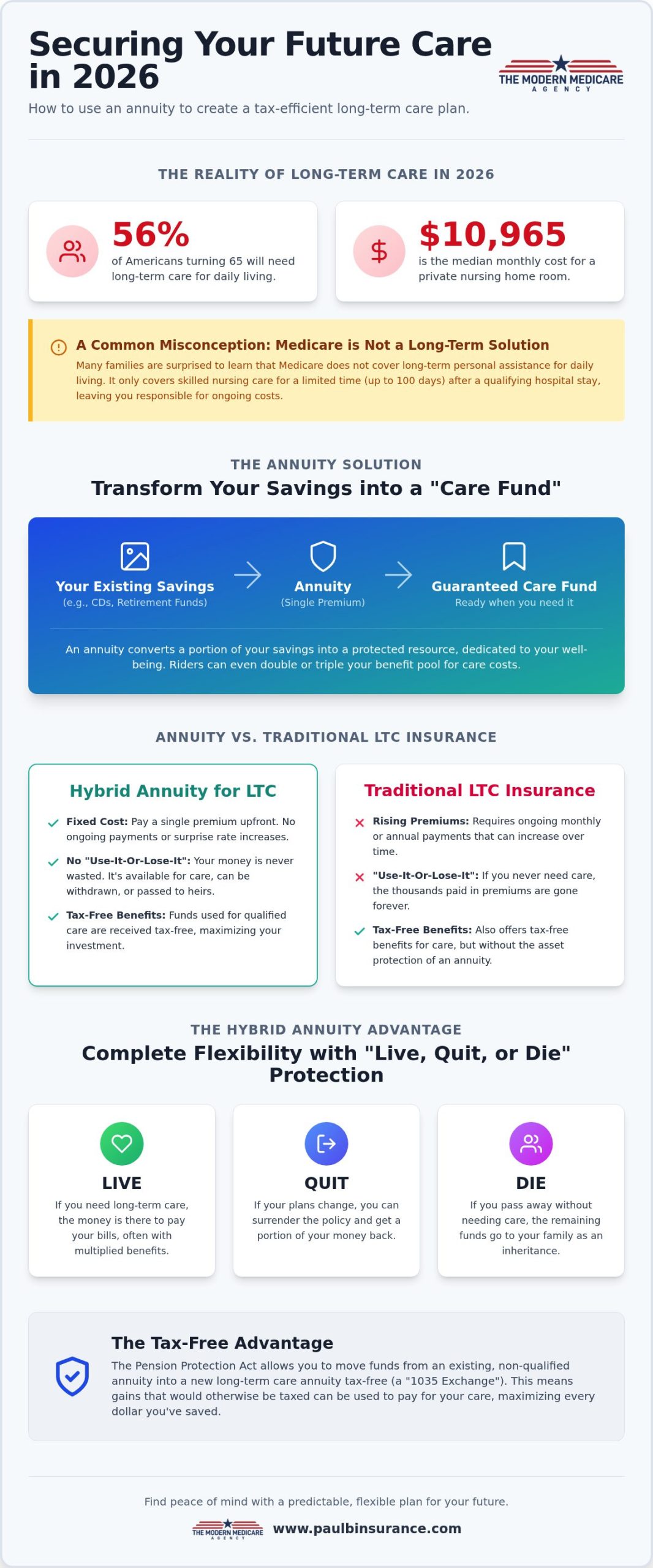
What if you could transform your existing retirement savings into a tax-efficient shield that pays for your future care, without ever writing another check for a high insurance premium? It’s a heavy burden to worry about losing your independence or watching your hard-earned inheritance vanish into medical bills. You aren’t alone in feeling anxious about the fact that 56% of Americans turning 65 will eventually need help with daily living. Because the median cost of a private nursing home room has reached $10,965 a month in 2026, more families are using an annuity to fund long-term care to create a guaranteed safety net.
You deserve a plan that’s easy to understand and even easier to manage. This guide will show you how to turn your retirement funds into a reliable source of support that protects your family and your future. We’ll walk through the current 2026 rules for tax-free exchanges and show you how to gain total peace of mind regarding your future health needs.
Key Takeaways
- Understand why relying on Medicare for daily help is a risk and how you can take control of your future care costs starting today.
- Explore the benefits of using an annuity to fund long-term care to create a reliable safety net that doesn’t require ongoing monthly payments.
- Unlock the tax benefits of the Pension Protection Act to pay for your health needs using funds that would otherwise be taxed.
- Compare fixed-cost annuities with traditional insurance to ensure your plan remains affordable even as care costs change in 2026.
- Learn why working with an independent guide who compares dozens of options is the simplest way to find true peace of mind.
The Reality of Long-Term Care Costs in 2026
Long-term care is often misunderstood as a strictly medical service. In reality, it’s the personal assistance you need for daily living when you can no longer manage tasks like dressing, bathing, or preparing meals on your own. As we move through 2026, this type of care has become a significant financial hurdle for many families. With 56% of Americans turning 65 expected to need some form of help, the question isn’t just if you’ll need care, but how you’ll pay for it without draining your life savings. Personal accounts are under immense pressure because home care costs have been rising at nearly 8% annually for years. This is why many people are now looking at the strategy of using an annuity to fund long-term care as a proactive safety net.
Why Medicare Isn’t a Long-Term Care Plan
One of the most common sources of confusion is the belief that Medicare will step in to cover stay-in-care costs. It’s a stressful realization when families find out this isn’t the case. Medicare Part A is designed for medical recovery, not for the long-term help required by chronic conditions or aging. It generally covers skilled nursing facilities only after a qualifying hospital stay, and even then, the support is temporary. You might find our Medicare Advantage Guide helpful for understanding how those plans manage short-term rehab needs, but they aren’t a solution for permanent care. The “100-day rule” is a cliff that catches many by surprise; after 100 days of skilled care, Medicare’s coverage ends completely, leaving you to foot the entire bill.
The Emotional Toll of Unplanned Care
The anxiety of potentially “spending down” your hard-earned assets just to qualify for government help like Medicaid is a heavy burden. It feels like a loss of control over the legacy you wanted to leave behind. Long-term care refers to the daily assistance required when you can no longer perform basic activities like dressing or bathing on your own, a service that currently costs a median of $10,965 per month for a private nursing home room in 2026. Planning ahead is a gift of certainty for your spouse and children. It removes the guesswork and the frantic searches for funding during a health crisis. While some still look toward traditional long-term care insurance, the unpredictable premiums can add to your stress. By using an annuity to fund long-term care, you can lock in a predictable way to pay for these needs while protecting the inheritance you’ve worked so hard to build.
How an Annuity Works to Fund Your Care
Think of an annuity as a dedicated bucket of money you set aside for your future self. While most people use these buckets to provide a steady retirement paycheck, using an annuity to fund long-term care changes the goal from an “Income Fund” to a “Care Fund.” You pay a premium today, and in return, the insurance company guarantees that a specific pool of money is available when your health needs change. If you need help immediately, an “immediate” annuity starts paying out right away. If you’re planning ahead, a “deferred” annuity sits and grows, waiting until the day you actually need it. It’s a simple way to turn a portion of your savings into a protected resource for your well-being.
Understanding Long-Term Care Riders
A rider is essentially a booster for your care fund. It’s an optional feature that allows you to tap into your principal or death benefit specifically to pay for care costs. In many 2026 contracts, these riders are remarkably powerful. Some can double or even triple your initial investment if you require professional care. To start receiving these benefits, a doctor usually certifies that you need help with at least two “Activities of Daily Living.” These are basic tasks like bathing, dressing, or moving around your home. This clear structure removes the guesswork and ensures you have the support you need when life becomes difficult. If you’re feeling overwhelmed by these options, talking to an independent expert can help clarify which rider fits your specific situation.
Hybrid Annuities: The ‘Live, Quit, or Die’ Protection
One reason hybrid models have become so popular in 2026 is their incredible flexibility. Traditional insurance often feels like a gamble because if you never need care, the premiums you paid are simply gone. Hybrid annuities solve this “use-it-or-lose-it” problem by offering what we call “Live, Quit, or Die” protection. If you “Live” and need care, the money is there to pay the bills. If you decide you no longer need the coverage, you can “Quit” and take back a portion of your money or turn it into income. If you “Die” without ever needing care, the remaining balance goes to your family as an inheritance. This is why using an annuity to fund long-term care through a hybrid model has become a cornerstone of modern retirement planning. It ensures your hard-earned savings are never wasted, providing a sense of security that traditional policies simply can’t match.
Annuity vs. Traditional Long-Term Care Insurance
Choosing the right way to protect your future often feels like a choice between two very different paths. Traditional long-term care insurance is built on ongoing payments. You pay a monthly or annual premium to keep the coverage active. The challenge in 2026 is that many of these traditional policies have seen significant premium increases. It is a stressful experience to receive a letter saying your costs are going up when you are already retired. Using an annuity to fund long-term care offers a different kind of stability. Instead of a “subscription” model, you typically make one single payment. This “one and done” approach means you never have to worry about a surprise bill or a rate hike later in life.
The way insurance companies look at your health is another major difference. Traditional policies have very strict health requirements. If you have a history of certain illnesses, you might be denied coverage entirely. Annuities are much more accessible. The underwriting process is often simpler and more lenient. This makes them a reliable option for those who want protection but have been told “no” by traditional carriers. Another comfort is the “return of premium” feature. With an annuity, your money is still your money. If you never end up needing care, that principal can often be returned to you or passed on to your loved ones. Traditional insurance is usually “use it or lose it,” which can feel like a waste of money if you stay healthy.
When an Annuity is the Clear Winner
For many seniors, the decision becomes easy when they look at their existing savings. If you have a lump sum of cash sitting in a low-interest savings account or a CD, that money is essentially “lazy.” It isn’t growing enough to keep up with the rising costs of care. Moving those funds into an annuity puts that money to work immediately. This strategy fits perfectly alongside Medigap plans to create a total shield for your retirement. While your Medigap plan handles the doctor bills and hospital stays, the annuity is there to cover the help you need at home or in a facility. It is also a lifesaver for those with pre-existing conditions who are considered uninsurable by traditional standards.
The Trade-offs to Consider
It’s important to be realistic about how these products work. The initial cost to start an annuity is higher than the first premium of a traditional policy. You are committing a larger amount of capital upfront to secure your future care fund. You also need to consider liquidity. Most annuities have surrender charges if you try to take all your money out within the first few years. This means you should only use funds that you don’t plan on needing for daily expenses. Every family has a different comfort level with these trade-offs. The goal is to move from a state of uncertainty to a clear, structured path that protects your independence and your legacy.
The Tax-Free Advantage: Section 1035 and the Pension Protection Act
If you already own an annuity, you might be sitting on a hidden treasure. Many people bought annuities years ago for simple growth, but those old contracts often don’t have the modern features needed to handle 2026 health costs. This is where the Pension Protection Act (PPA) becomes your best friend. In the past, if you took money out of your annuity to pay for a nurse or a care facility, the IRS would treat the growth as taxable income. The PPA changed the rules. Now, if your annuity is set up correctly, those gains can be used to pay for care completely tax-free. It’s a massive advantage because it allows you to stretch your dollars much further than a standard withdrawal ever could.
Using an annuity to fund long-term care through this tax-free miracle is one of the smartest ways to protect your estate. If you have a non-qualified annuity, which is one you funded with money that was already taxed, you are the perfect candidate for this strategy. You aren’t just paying for care. You are making sure the government doesn’t take a cut of the money you’ve set aside for your health.
Moving Your Old Annuity to a Care-Focused One
A 1035 exchange is simply a way to modernize your coverage without a tax penalty. Think of it as a direct hand-off between insurance companies. Because you never touch the money during the transfer, the IRS doesn’t see it as a taxable event. This is the ideal time to review your old contracts. Many policies from a decade ago don’t meet the current PPA standards. A 1035 exchange allows you to move that value into a new, care-focused contract that does. To qualify, your exchange must follow a few simple rules:
- The transfer must be between non-qualified annuities.
- The new policy must be LTC-qualified under PPA guidelines.
- The funds must move directly from the old company to the new one.
Maximizing Your After-Tax Dollars
Imagine you need $5,000 for a month of home care. If you take that money from a traditional savings account or a standard withdrawal, you might actually need to pull out $6,500 just to have $5,000 left after taxes. By using a PPA-qualified annuity, that same $5,000 comes out tax-free. This preserves more of your principal and ensures more of your estate stays in your family’s hands. Non-qualified annuities are the primary candidates for this strategy. If you want to see if your current policy qualifies for this upgrade, contact us for a simple review of your options.
Your Journey to Peace of Mind: Next Steps
Navigating the complex maze of 2026 healthcare options doesn’t have to be a solo mission. It is completely normal to feel a bit overwhelmed by the technical details of riders, tax codes, and policy transfers. Using an annuity to fund long-term care is a powerful strategy, but it works best when it’s tailored to your specific life story. You deserve a partner who listens to your concerns and helps you build a shield around your savings. At The Modern Medicare Agency, we see ourselves as your personal guides. Our goal is to move you from a state of uncertainty to one of total clarity, ensuring you have a plan that feels right for your family and your future.
We don’t believe in high-pressure sales tactics. Instead, we offer what we call a “clarity session.” This is an initial conversation where we look at your current situation and your goals for the years ahead. Paul Barrett has built this agency on the principle of being a committed advocate for seniors. We are here to educate and protect you, making sure you understand every choice before you make it. Whether you are worried about rising nursing home costs or simply want to protect an inheritance, we provide the impartial support you need to make a confident decision.
Why an Independent Broker is Your Best Advocate
There is a big difference between a “captive” agent and an independent broker. A captive agent works for one specific insurance company. They only have one set of tools to offer you, even if those tools aren’t the best fit for your needs. Because we are independent, we have access to more than 40 different carriers. This independence allows us to shop the entire market on your behalf. We can compare how different Medicare Part D plans might interact with your care strategy, ensuring there are no gaps in your coverage. Our support doesn’t end when you sign a paper; we provide year-round assistance as your health needs and the 2026 regulatory landscape continue to change.
Starting Your Custom Care Plan
Getting started is simpler than you might think. For our first meeting, you don’t need to have everything figured out. It helps to bring any existing insurance policies you own and a basic list of what you hope to achieve. We will walk through a methodical, step-by-step process together:
- Reviewing your current retirement assets and any old annuities.
- Identifying the specific care triggers that matter most to you.
- Comparing multiple carriers to find the most reliable “Care Fund” options.
- Handling the 1035 exchange paperwork to ensure a tax-free transition.
The journey to certainty starts with a single conversation. By taking this step now, you are removing the anxiety of the unknown and replacing it with a structured path forward. Your future self will thank you for the certainty you create today.
Securing Your Future with Confidence
You now understand how the landscape of care has shifted as we move through 2026. It is no longer enough to hope for the best. You deserve a strategy that protects both your health and your legacy. By using an annuity to fund long-term care, you can lock in a predictable safety net that avoids the stress of rising premiums and the “use-it-or-lose-it” risk of traditional policies. These modern tools allow your savings to work harder, especially with the tax-free advantages offered by the Pension Protection Act.
You don’t have to navigate these complex choices on your own. Paul Barrett and The Modern Medicare Agency provide empathetic, jargon-free support across 34+ states. We compare 40+ top-rated carriers to ensure you get independent guidance tailored to your specific goals. Our mission is to move you from a state of worry to a place of total certainty. Let Paul Barrett help you find peace of mind; schedule your free 2026 care planning session today. Taking this step today means you can stop worrying about the “what-ifs” and start enjoying your retirement with the security you’ve earned.
Frequently Asked Questions
Is using an annuity to fund long-term care better than traditional insurance?
It depends on your personal health and financial goals, but many prefer using an annuity to fund long-term care because it offers a fixed, single-pay cost. Traditional insurance often comes with ongoing premiums that can increase over time, which creates financial stress during retirement. Annuities also provide a return of your money if you don’t use it, whereas traditional insurance is typically a “use it or lose it” model.
What happens to the money in my annuity if I never need long-term care?
Your money stays in your account and can be passed on to your family as an inheritance. Unlike traditional insurance policies where premiums are gone if you stay healthy, an annuity acts as a protected asset. If you never need professional care, the remaining balance can also be turned into a steady stream of retirement income for yourself, ensuring your hard-earned savings are never wasted.
Can I use an existing annuity I already own to pay for care tax-free?
Yes, you can often move your current annuity into a care-focused one through a tax-free 1035 exchange. This process allows you to modernize an old contract so that the gains can be used for health expenses without triggering a tax bill. It’s a smart way to update your plan without the IRS taking a cut of your growth, providing you with more resources for your future needs.
Does Medicare pay for any part of long-term care in 2026?
Medicare does not pay for long-term stays or daily help with activities like bathing and dressing. In 2026, it still only covers short-term skilled nursing or rehab after a hospital stay, and even that support is limited to a maximum of 100 days. Most families find themselves responsible for the full cost of care once that brief window of medical recovery ends, which is why proactive planning is so vital.
What is a ‘hybrid’ annuity and how does it help with nursing home costs?
A hybrid annuity combines the features of a standard retirement account with a long-term care rider. It helps with nursing home costs by providing a pool of money that can double or triple in value specifically for your health needs. This “multi-use” design ensures that your savings are available for care, income, or a legacy for your children, removing the anxiety of choosing between different types of protection.
Are there health requirements to get an annuity with a long-term care rider?
There are health requirements, but they are generally much more lenient than those for traditional insurance. Most companies use a simplified process that focuses on your ability to perform daily tasks rather than a deep dive into your entire medical history. This makes it a great option for people who might have been turned down for other types of coverage but still want a reliable way to pay for care.
How much money do I need to start an annuity for long-term care?
The amount required depends on the insurance carrier and the level of care you want to secure for your future. Since these are often funded with a single payment, you’ll typically use a lump sum from a savings account, a CD, or an existing annuity. We can help you compare 40+ carriers to find a plan that fits your specific budget while providing the maximum amount of protection possible.
What is the Pension Protection Act and why does it matter for my retirement?
The Pension Protection Act is a federal law that allows you to use the growth in your annuity tax-free for qualified care expenses. This matters because it essentially gives you a “tax discount” on your healthcare, making your savings last much longer. Using an annuity to fund long-term care under these rules is one of the most efficient ways to protect your independence and your family’s inheritance from rising costs.

Article by
Paul Barrett
Paul Barrett, CMIP is the founder of The Modern Medicare Agency, an independent Medicare-only brokerage based in Melville, NY. With 18 years of Medicare-exclusive experience, a CMIP designation, and more than 5,000 clients served across 37 states, Paul is one of the most credentialed independent Medicare specialists on Long Island — and one of the most direct.
He represents 40+ carriers with no quotas and no allegiances, which means his recommendations are based entirely on what fits each client's specific situation. He is the author of Medicare Mastery Unlocked and host of the Wise Guys Retirement Talk podcast. His content is grounded in primary sources, real carrier intelligence, and 18 years of watching what happens when people get Medicare right — and when they don't.
📞 631-358-5793 | paulbinsurance.com