
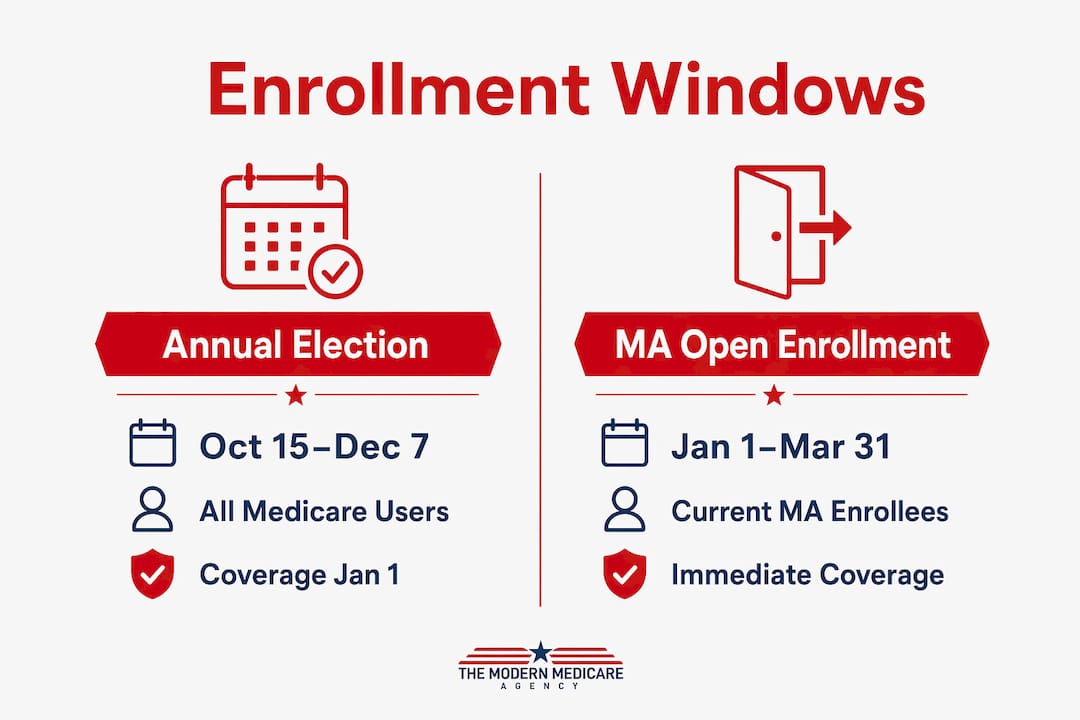
Yes, you can leave your Medicare Advantage plan and return to Original Medicare. The two routine windows are the Annual Election Period (AEP: October 15–December 7) and the Medicare Advantage Open Enrollment Period (MA OEP: January 1–March 31). Your first move is simple: call 1-800-MEDICARE (1-800-633-4227) or log in to Medicare.gov to initiate the change. There is no CMS disenrollment penalty for switching back, but two consequential risks follow you if you miss the timing: a permanent Part D late-enrollment penalty and potential loss of guaranteed-issue Medigap rights.
- Annual Election Period (AEP): runs from mid-October to early December each year. Coverage starts January 1.
- MA Open Enrollment Period (MA OEP): runs from early January through March. Coverage starts the first day of the month after your request is received.
- Special Enrollment Periods (SEPs): Triggered by qualifying life events such as moving outside your plan’s service area or your plan leaving the area.
- Part D timing: If your MA plan included drug coverage, enroll in a stand-alone Part D plan within a limited window after losing that coverage to avoid a permanent penalty.
- Medigap: Verify your guaranteed-issue rights before you disenroll. Losing that window can make Medigap unaffordable or unavailable.
Table of Contents
- When you can switch back: AEP, MA OEP, and effective dates
- Step-by-step: how to drop Medicare Advantage and return to Original Medicare
- What happens to your drug coverage and prior authorizations when you switch
- Costs and financial consequences of returning to Original Medicare
- Medigap guaranteed-issue rights, timing, and the Medigap trap
- Pre-switch checklist: what to confirm before and after you switch
- Expert tips from an independent Medicare agent
- Key Takeaways
- What switching actually looks like from an agent’s perspective
- Paulbinsurance can walk you through every step of the switch
- Authoritative sources and official resources
When you can switch back: AEP, MA OEP, and effective dates
The two primary enrollment windows work differently, and picking the wrong one can delay your coverage by months.
Annual Election Period runs each fall. Anyone on Medicare can use it, and any change you make takes effect January 1. This is the most flexible window because it is not limited to current MA enrollees.
Medicare Advantage Open Enrollment Period runs early each year. It is available only to people already enrolled in a Medicare Advantage plan, and you get only one coverage change during the window. Submit your request early in the period, and your Original Medicare coverage starts the first day of the following month after your request is received. The clock starts the day your plan or CMS receives the request, not the day you mail it.
Special Enrollment Periods exist for qualifying life events. Moving outside your plan’s service area is the most common trigger. If you move and do not join a new MA plan during that SEP, Medicare automatically enrolls you in Original Medicare once your old plan drops you. Some SEPs also carry guaranteed-issue Medigap rights, which matters enormously for your supplemental coverage options.
| Enrollment Window | Dates | Who Can Use It | Coverage Effective Date |
|---|---|---|---|
| Annual Election Period (AEP) | Fall months each year | All Medicare beneficiaries | Typically January 1 |
| MA Open Enrollment Period (MA OEP) | Early year months | Current MA enrollees only; one change | Beginning of month after request received |
| Special Enrollment Period (SEP) | Varies by qualifying event | Those with a qualifying life event | Varies by SEP type |
Pro Tip: If you are in the MA OEP and unsure whether to switch, confirm your provider network, drug formulary, and any prior authorization transfers before you finalize. You only get one change during this window, and a mistake may force you to wait until the next AEP.
Step-by-step: how to drop Medicare Advantage and return to Original Medicare
Switching is straightforward when you follow the steps in order. Skipping step two is where most people run into trouble.
-
Verify your enrollment window and effective date. Confirm you are in AEP, MA OEP, or a qualifying SEP. Write down the exact effective date your Original Medicare coverage will start so you know when to expect the change.
-
Handle drug coverage before you disenroll. If your MA plan included prescription drug coverage, select a stand-alone Part D plan and enroll in it simultaneously. You can compare plans at Medicare.gov’s Plan Finder. Do not wait until after your MA plan ends. Enrolling in a Part D plan will often automatically trigger disenrollment from your MA plan.
-
Submit the change through one of three routes. You can enroll in a new plan or drop your MA plan by logging in to Medicare.gov, calling 1-800-MEDICARE (1-800-633-4227), or contacting your plan directly. You do not need a special cancellation form — enrolling in a stand-alone Part D plan typically triggers automatic disenrollment from your MA plan. If you are returning to Original Medicare without Part D, call your plan or 1-800-MEDICARE directly. Record your confirmation number and the date of every call.
-
Confirm your coverage on mymedicare.gov. After your effective date, log in to mymedicare.gov and verify that Part A and Part B show as active. If you enrolled in Part D, confirm it appears there too. Do not assume the change processed correctly until you see it in writing.
-
Escalate if something looks wrong. If your records still show the MA plan after the effective date, call 1-800-MEDICARE immediately and reference your confirmation number. Ask for a case number and document the name of the representative you spoke with. Keep copies of any written correspondence, disenrollment notices, or enrollment confirmations.
Pro Tip: Call your primary care doctor and any specialists after the effective date to confirm they have your updated coverage on file. Providers sometimes bill the wrong plan for weeks after a switch if their records are not updated.

What happens to your drug coverage and prior authorizations when you switch
The 63-day window is the most consequential deadline in this entire process. If your MA plan included Part D drug coverage and you return to Original Medicare without immediately enrolling in a stand-alone Part D plan, you have 63 days from the date you lose drug coverage to enroll in a new plan before a permanent late-enrollment penalty kicks in. That penalty is calculated as a percentage of the national base beneficiary premium and is added to your Part D premium for as long as you have drug coverage. It does not go away.
The 63-day rule: Once your Medicare Advantage drug coverage ends, you have 63 days to enroll in a stand-alone Part D plan. Miss that window and you pay a permanent penalty on top of your monthly Part D premium — every month, for the rest of your coverage.
Prior authorizations are a separate issue. Your MA plan may have pre-approved certain medications, procedures, or specialist visits. When you return to Original Medicare, those authorizations do not transfer. Original Medicare does not use prior authorization for most services the way MA plans do, so in many cases this actually simplifies access. However, if you are mid-treatment with a specialty drug that required PA under your MA plan, confirm with your prescriber that the drug is covered under Original Medicare Part B or your new Part D formulary before the switch takes effect.
Pharmacy access also shifts. MA plans typically use a network of preferred pharmacies. Original Medicare combined with a stand-alone Part D plan has its own pharmacy network, which may differ. Check that your regular pharmacy is in-network under the new Part D plan before you finalize enrollment.
Costs and financial consequences of returning to Original Medicare
The financial picture changes significantly when you leave a Medicare Advantage plan. MA plans are legally required to cap your annual out-of-pocket costs. Original Medicare has no such cap. That single difference is the most important number in this decision.

Under Original Medicare, Part B generally covers most of approved outpatient costs, but beneficiaries pay a portion of the costs with no annual ceiling. For a routine year, that may be manageable. For someone with a serious illness, a surgery, or ongoing specialist care, uncapped 20% coinsurance can accumulate fast. Original Medicare also does not cover routine dental, vision, or hearing — services many MA plans include.
Key cost dimensions to compare:
- Monthly premiums: Most MA plans charge a low or $0 premium beyond the standard Part B premium. Original Medicare alone has no additional premium, but a Medigap policy adds a monthly cost that varies by plan, age, and state.
- Out-of-pocket maximum: MA plans have a legally required annual cap. Original Medicare has none.
- Part B coinsurance: 20% of approved costs with no annual ceiling under Original Medicare.
- Part A deductible: Applies per benefit period under Original Medicare, not per year.
- Medigap: Adds a monthly premium but eliminates or sharply limits your out-of-pocket exposure.
| Cost Factor | Medicare Advantage | Original Medicare (no Medigap) | Original Medicare + Medigap |
|---|---|---|---|
| Annual out-of-pocket cap | Yes (legally required) | None | Varies by plan (Plan G covers most gaps) |
| Part B coinsurance | Varies by plan | 20% (no ceiling) | Covered by Medigap |
| Routine dental/vision/hearing | Often included | Not covered | Not covered |
| Monthly premium (beyond Part B) | Often $0–low | $0 | Added Medigap premium |
| Provider network | Restricted network | Any Medicare-accepting provider | Any Medicare-accepting provider |
Warning: Returning to Original Medicare without a Medigap policy exposes you to unlimited out-of-pocket costs. A single hospitalization or cancer diagnosis can generate tens of thousands of dollars in 20% coinsurance with no annual ceiling to stop it.
Medigap guaranteed-issue rights, timing, and the Medigap trap
Medigap is where the most consequential and least-understood risk lives. In most states, Medigap insurers can apply medical underwriting outside guaranteed-issue windows, meaning they can deny your application or charge significantly higher premiums based on your health history. The Medigap trap is simple: if you miss your guaranteed-issue window, you may find Medigap unaffordable or unavailable entirely.
Two guaranteed-issue windows are most relevant here. First, if you are in your first 12 months of a Medicare Advantage plan and decide to return to Original Medicare, you have a guaranteed right to buy a Medigap policy for a limited time after disenrolling. Second, certain SEPs, such as your plan leaving your service area, also trigger guaranteed-issue rights. Outside these windows, most states leave the decision entirely to the insurer.
A handful of states offer broader protections. Connecticut, Maine, Massachusetts, Missouri, New York, and Washington have state-level rules that extend guaranteed-issue rights beyond the federal minimums. If you live in one of these states, your options are materially better. If you do not, the window is narrow and the stakes are high.
The Medigap trap in plain terms: Once your guaranteed-issue window closes, an insurer can look at your medical history and either deny your application or price the policy out of reach. For someone with diabetes, heart disease, or a prior cancer diagnosis, this can mean no affordable path to supplemental coverage — ever.
Action steps before you disenroll:
- Confirm whether you are still within your first 12 months on an MA plan.
- Check your state’s Medigap rules at Medicare.gov or by calling your State Health Insurance Assistance Program (SHIP).
- If you have a guaranteed-issue right, apply for Medigap before or simultaneously with disenrolling from MA, not after.
Pro Tip: Lock in your Medigap policy before you finalize the MA disenrollment if at all possible. Applying after the fact, even by a few days, can put you outside the guaranteed window in states without extended protections.
Pre-switch checklist: what to confirm before and after you switch
Use this checklist the week you plan to initiate the switch and again after your effective date.
Before you switch:
- Confirm you are in AEP, MA OEP, or a qualifying SEP and note your exact effective date.
- Check whether you are within your first 12 months on the MA plan (guaranteed-issue Medigap window).
- Contact your State Health Insurance Assistance Program (SHIP) to verify state-specific Medigap protections.
- Select a stand-alone Part D plan on Medicare.gov’s Plan Finder and confirm your medications are on the formulary.
- Apply for Medigap if you have guaranteed-issue rights — do this before or simultaneously with disenrolling.
- Call 1-800-MEDICARE or contact your plan to initiate the disenrollment. Record the confirmation number, date, and representative’s name.
- Save copies of all written correspondence, disenrollment notices, and enrollment confirmations.
After your effective date:
- Log in to mymedicare.gov and confirm Part A, Part B, and Part D all show as active.
- Call your primary care doctor and key specialists to confirm they have your updated coverage on file.
- Verify your regular pharmacy is in-network under your new Part D plan.
- Update your insurance information with any hospitals or outpatient facilities you use regularly.
Expert tips from an independent Medicare agent
The mechanics of switching are not the hard part. The hard part is the timing, and the things that go wrong almost always come down to a mismatch between when MA drug coverage ends and when Part D begins, or a Medigap application filed one week too late.
What experienced agents watch for: The most common costly mistake is a beneficiary who disenrolls from MA in December, assumes their Part D starts January 1, and discovers their new plan was not processed in time. A one-month gap in drug coverage can trigger the 63-day penalty clock. Agents confirm the Part D effective date matches the MA end date before the client finalizes anything.
A few other things agents routinely check before a client switches:
- Provider continuity: Confirm your doctors and specialists accept Original Medicare. Most do, but some concierge or hospital-employed physicians have opted out. Check the Medicare.gov provider directory before the switch.
- Prior authorization transfers: If you have an active PA for a specialty drug or procedure, document it in writing from your MA plan before disenrolling. It will not transfer, but having it documented helps your prescriber navigate the new coverage.
- Medigap application timing: Agents often submit the Medigap application and the MA disenrollment request on the same day to avoid any gap in the guaranteed-issue window.
- Confirmation documentation: Save every confirmation number, every letter, and every email. If a billing dispute arises three months later, that paper trail is what resolves it.
Paul Barrett has been working with Medicare consumers as an independent agent since 2007. At Paulbinsurance, the team helps clients verify Medigap eligibility, select and enroll in Part D plans, and confirm that every coverage change processes correctly before the effective date.
Key Takeaways
Switching from Medicare Advantage back to Original Medicare is possible during two annual windows, but the Medigap and Part D timing decisions you make before you disenroll determine whether the switch costs you more or less in the long run.
| Point | Details |
|---|---|
| Two routine windows | AEP (Oct 15–Dec 7) and MA OEP (Jan 1–Mar 31) are the standard routes back to Original Medicare. |
| 63-day Part D rule | Enroll in a stand-alone Part D plan within 63 days of losing MA drug coverage to avoid a permanent penalty. |
| Medigap guaranteed-issue rights | Verify your window before disenrolling — losing it can make Medigap unaffordable or unavailable. |
| No out-of-pocket cap | Original Medicare has no annual out-of-pocket maximum; without Medigap, your financial exposure is unlimited. |
| Paulbinsurance guidance | Paulbinsurance helps clients verify Medigap eligibility, enroll in Part D, and confirm coverage changes before the effective date. |
What switching actually looks like from an agent’s perspective
Most people who call about switching from Medicare Advantage are not confused about whether they can switch. They are worried about what they might miss. The Medigap question is almost always the one that keeps them up at night, and for good reason. The mechanics of disenrollment are simple. The consequences of getting the Medigap timing wrong can follow someone for the rest of their coverage.
The most useful thing an independent agent does in this situation is not fill out forms. It is asking the right questions in the right order: Are you still in your first year on this plan? What state are you in? What medications are you on, and is your pharmacy in the new Part D network? Those answers shape everything else. When clients work through this process with the Paulbinsurance team, they leave knowing their Part D starts the same month their MA plan ends, their Medigap application is in before the guaranteed window closes, and their providers are updated.
Paulbinsurance can walk you through every step of the switch
Returning to Original Medicare is a decision that deserves more than a checklist. The coverage verification, Part D selection, and Medigap eligibility check all need to happen in the right order, and one missed step can create a gap that costs real money.

At Paulbinsurance, the team of independent Medicare agents helps you confirm your enrollment window, check your Medigap guaranteed-issue status, compare and enroll in a stand-alone Part D plan, and verify that your coverage changes process correctly. If you need help evaluating whether Original Medicare plus a Medicare Supplement plan is the right financial fit, that conversation is part of the service too.
Paulbinsurance is an independent agency, not a government office. The team works for you, not for any single carrier.
Ready to get started? Call Paulbinsurance directly or visit paulbinsurance.com to schedule a no-cost coverage review. Bring your current plan information and your list of medications, and the team will handle the rest.
This article is general information, not professional legal or financial advice. Enrollment rules, premiums, and state Medigap protections change annually. Confirm current rules at Medicare.gov or by calling 1-800-MEDICARE (1-800-633-4227) before making any coverage change.
Authoritative sources and official resources
For final confirmation on enrollment windows, Part D rules, and Medigap guidance, go directly to the primary sources.
Official resources to bookmark:
Medicare.gov is the authoritative starting point for all enrollment period rules, plan comparison tools, and Medigap guidance. The 1-800-MEDICARE line (1-800-633-4227) connects you to live assistance and is the right number to call when initiating a disenrollment or confirming a change. Save your confirmation number from every call.
- Medicare.gov — Enrollment windows and plan changes: medicare.gov/basics/get-started-with-medicare/get-more-coverage/joining-a-plan
- Medicare.gov — Special Enrollment Periods: medicare.gov/basics/get-started-with-medicare/get-more-coverage/joining-a-plan/special-enrollment-periods
- Medicare.gov — When to buy Medigap: medicare.gov/health-drug-plans/medigap/ready-to-buy/when
- Medicare.gov — Part D drug costs: medicare.gov/basics/costs/drug/drug-costs
- KFF (Kaiser Family Foundation): Independent policy analysis on Medicare Advantage enrollment trends and beneficiary costs — useful for context on how MA and Original Medicare compare financially.
- State Health Insurance Assistance Programs (SHIP): Free, unbiased counseling on Medicare options in your state. Find your local SHIP at shiphelp.org.
- Center for Medicare Advocacy: In-depth resources on the Medigap trap and beneficiary rights when switching coverage.