
You can have Medicare and employer insurance together at the same time, and for most people still working past 65, keeping both is not only possible but often the right call. The single most important thing you need to do right now: ask your HR department in writing whether your coverage is a “group health plan based on current employment” and whether your prescription drug coverage is “creditable.” Those two answers determine almost every enrollment decision you’ll face.
The short version:
- If your employer has a large workforce, your employer plan typically pays first and Medicare pays second. You can delay Part B without penalty while actively working.
- If your employer has a smaller workforce, Medicare generally pays first. Delaying Part B in this situation can leave you with uncovered costs.
- You have a limited special enrollment period after active employment ends to enroll in Part B without a penalty. That clock starts when employment ends, not when COBRA expires.
- COBRA does not count as active employer coverage for Medicare enrollment purposes.
Table of Contents
- How does Medicare and employer insurance work together?
- When should you enroll in Medicare if you still have employer coverage?
- Who pays what: premiums, deductibles, and the payment sequence
- Does your employer’s drug coverage protect you from Part D penalties?
- What to ask HR and what to get in writing
- How to switch from employer coverage to Medicare without gaps
- Key Takeaways
- What I see most often — and what actually matters
- How Paulbinsurance helps you get this right
- Authoritative sources to bookmark
How does Medicare and employer insurance work together?
The term for this is coordination of benefits, and it comes down to one question: which plan pays first? Medicare.gov’s coordination rules make the employer-size rule clear. For employers with 20 or more employees, the group health plan pays first. For employers with fewer than 20 employees, Medicare pays first.
What “primary” and “secondary” actually mean for your wallet
The primary payer processes the claim first and pays up to its coverage limits. Whatever remains goes to the secondary payer, which may cover part or all of the leftover balance depending on its rules. If the secondary payer doesn’t cover the rest, you pay it.

When your employer plan is primary and Medicare is secondary, Medicare often picks up a large portion of what your employer plan doesn’t cover, which can significantly reduce your out-of-pocket costs. When Medicare is primary (small employer), your employer plan acts as a supplement to Medicare’s payment.
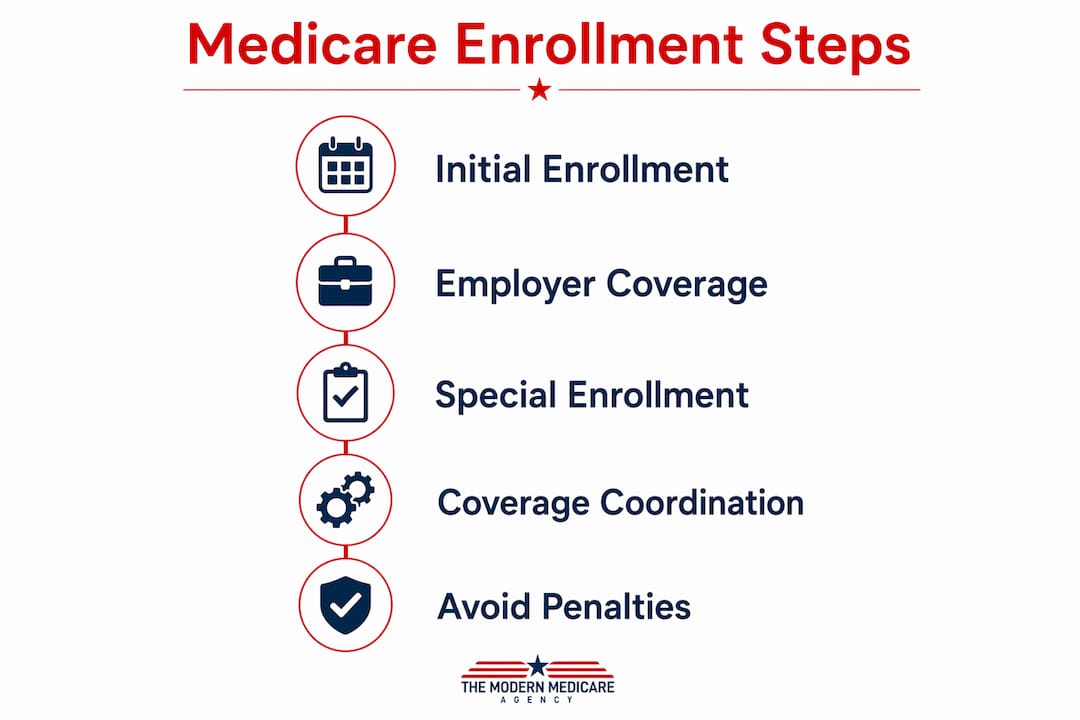
Employer-size scenarios at a glance
| Scenario | Primary Payer | Secondary Payer | Key Risk |
|---|---|---|---|
| Employer with 20+ employees, actively working | Employer group plan | Medicare | Minimal if both plans coordinate properly |
| Employer with fewer than 20 employees, actively working | Medicare | Employer plan | Gaps if Part B is delayed |
| Retiree coverage (former employer) | Medicare | Retiree plan | Retiree plans vary widely; confirm terms |
| COBRA after leaving employment | Medicare | COBRA | COBRA is not active employer coverage |
The Benefits Coordination & Recovery Center (1-855-798-2627) is the official resource when you’re unsure who pays first. Contact them before you drop or decline any coverage, and tell your providers whenever your insurance situation changes.
Tribal plans and union plans can follow different rules than standard employer group plans. If your coverage comes through a union or a tribal employer, confirm the payer order directly with your plan administrator and with Medicare, since the standard employer-size rule may not apply in the same way.
Pro Tip: Ask HR to confirm in writing that your plan is defined as “group health plan coverage based on current employment.” That exact phrase matters. Plans that don’t meet that definition won’t protect you from Part B late-enrollment penalties.
When should you enroll in Medicare if you still have employer coverage?
Timing is where most people make costly mistakes. There are two enrollment windows that matter here: the Initial Enrollment Period and the Special Enrollment Period.

Initial Enrollment Period (IEP)
Your IEP runs for seven months: the three months before the month you turn 65, the month you turn 65, and the three months after. If you’re already receiving Social Security benefits, Medicare Parts A and B typically enroll you automatically. If you’re not receiving Social Security, you need to sign up actively.
Most people working at a large employer (20+ employees) enroll in Part A during the IEP because it’s usually premium-free and adds a layer of hospital coverage. They delay Part B because their employer plan is primary and the Part B premium isn’t worth paying for secondary coverage. That’s a legitimate strategy, but only if the employer plan qualifies as active group coverage.
Special Enrollment Period (SEP): the 8-month window
When active employment ends, or when employer coverage ends, whichever comes first, you get an 8-month Special Enrollment Period to sign up for Part B without a penalty. According to Medicare guidance, this SEP is tied to the end of active employment, not the end of COBRA.
Here’s where people get burned: they leave their job, elect COBRA thinking it extends their enrollment window, and then miss the 8-month SEP entirely. COBRA is not active employer-based coverage for Medicare purposes. The clock starts ticking the day employment ends, regardless of whether you’re on COBRA.
Practical timing rule: If you know your employer coverage end date, aim to enroll in Part B about a month before that date so there’s no gap in coverage. You can enroll during the SEP even before employment officially ends.
Warning: Marketplace plans (ACA exchange plans) also do not count as active employer-based coverage for SEP purposes. Enrolling in a Marketplace plan after leaving your job instead of using your SEP to enroll in Medicare can trigger permanent Part B penalties.
Who pays what: premiums, deductibles, and the payment sequence
Understanding the payment order is one thing. Knowing what you’ll actually owe is another.
Standard Medicare cost-sharing you’re responsible for
- Part A: No premium for most people (if you’ve worked 40+ quarters). The deductible per benefit period in 2026 is $1,676.
- Part B: The standard monthly premium in 2026 is $185.00. You also pay 20% coinsurance on most Part B services after the annual deductible ($257 in 2026), with no out-of-pocket maximum under Original Medicare.
- Part D: Premiums vary by plan; you pay separately unless your employer plan includes drug coverage.
Original Medicare’s cost-sharing gaps are real. The 20% Part B coinsurance with no cap is the biggest exposure for most people, which is why Medigap or a strong employer plan as secondary coverage matters.
How a claim actually flows
- You receive a covered service.
- The primary payer processes the claim and pays its share.
- The claim goes to the secondary payer, which pays based on its own rules.
- You receive an Explanation of Benefits from each payer showing what was paid and what you owe.
- You pay any remaining balance the secondary payer doesn’t cover.
Sample payment scenarios
Large employer (employer pays first): You have a $5,000 hospital bill. Your employer plan pays $4,000. Medicare reviews the remaining $1,000 and may cover a portion based on what it would have paid as primary. Your out-of-pocket could be minimal.
Small employer (Medicare pays first): Same $5,000 bill. Medicare pays its share first. Your employer plan picks up some of the remainder. Because Medicare is primary, your employer plan’s secondary coverage may leave less of a gap than if you had no Medicare at all.
Retiree coverage: Retiree plans almost always require you to have Medicare as primary. If you don’t enroll in Medicare when required, your retiree plan may deny claims or pay as if Medicare had paid its share, leaving you with a larger bill.
Does your employer’s drug coverage protect you from Part D penalties?
Prescription coverage is its own enrollment track, and the key word is “creditable.” Employers are required to notify you each year whether their drug coverage is creditable, meaning it’s at least as good as standard Medicare Part D coverage.
If your employer drug coverage is creditable, you can delay enrolling in a standalone Part D plan without penalty for as long as you have that coverage. Once it ends, you have 63 days to enroll in Part D before the late-enrollment penalty kicks in.
If your employer drug coverage is not creditable, you should enroll in a Part D plan during your IEP to avoid penalties. Every month you go without creditable drug coverage after your IEP adds a permanent penalty to your Part D premium.
Action steps for prescription coverage:
- Ask HR for the annual creditable coverage notice (employers must provide this before October 15 each year).
- Keep that notice. It’s your evidence if there’s ever a dispute about your enrollment window.
- If your employer coverage ends mid-year, you have 63 days from that date to enroll in Part D without penalty.
- If you enroll in a Medicare Advantage plan that includes drug coverage (MA-PD), that plan replaces both your Part B and Part D coverage. You generally cannot keep a standalone employer drug plan alongside an MA-PD plan.
Pro Tip: Store your creditable coverage notices with your Medicare card and any HR letters about your coverage end date. If SSA ever questions your Part D enrollment timing, that paper trail is your defense.
What to ask HR and what to get in writing
Getting the right documents from HR before you retire or lose coverage is the single most protective thing you can do. Here’s a practical checklist.
Documents and confirmations to request:
- Written confirmation that your plan is a “group health plan based on current employment” (use that exact phrase).
- Written confirmation of whether your prescription drug coverage is creditable.
- Your exact employer coverage end date.
- Whether retiree coverage will be offered after you leave, and on what terms.
- A copy of your plan’s Summary Plan Description.
Sample language to use with HR:
“Can you confirm in writing that my health coverage qualifies as a group health plan based on current employment for Medicare coordination purposes? I also need written confirmation of whether my prescription drug coverage is creditable under Medicare Part D standards.”
Costly mistakes to avoid:
- Assuming COBRA extends your Medicare enrollment window. It doesn’t. The COBRA and Medicare rules are a common source of permanent penalties.
- Assuming any coverage counts as active employer-based coverage. Only plans tied to current employment qualify.
- Not getting written confirmation of your coverage end date. Verbal assurances from HR don’t hold up if there’s an SSA dispute.
- Waiting until after coverage ends to start the Medicare enrollment process.
Pro Tip: If there’s any dispute about your SEP start date, contact the Social Security Administration directly and bring your written HR confirmation. Keep employer notices, COBRA election paperwork, and Medicare enrollment records in one folder. That combination resolves most disputes quickly.
How to switch from employer coverage to Medicare without gaps
If you’ve decided to retire or drop employer coverage, the sequence of enrollment matters as much as the timing.
Decision checklist before you switch:
- Compare your current employee premium share against the Part B premium ($185.00/month in 2026) plus a Medigap or Medicare Advantage plan premium.
- Check whether your current providers accept Medicare assignment.
- Review your drug formulary under both your employer plan and available Part D plans.
- Confirm whether your employer offers retiree coverage and what it costs.
The typical sequence to avoid gaps:
- Confirm your exact employer coverage end date in writing.
- Enroll in Part B during your SEP (ideally a month before employer coverage ends).
- If drug coverage isn’t continuing, enroll in Part D within 63 days of losing creditable coverage.
- If you want Medigap, enroll within six months of your Part B effective date for guaranteed-issue underwriting.
Comparing your coverage options after leaving employer insurance
| Factor | Original Medicare + Medigap | Medicare Advantage | Employer Retiree Plan |
|---|---|---|---|
| Provider access | Any Medicare-accepting provider | Network-based | Varies by plan |
| Predictable costs | High (Medigap covers most gaps) | Moderate (copays vary) | Depends on employer terms |
| Drug coverage | Separate Part D plan needed | Often included | Often included |
| Premium cost | Higher combined premium | Often lower premium | Employer may subsidize |
Pro Tip: If you plan to retire within the year, the simplest path is usually to stay on employer coverage until your last day of employment, then use the 8-month SEP to enroll in Medicare. Trying to coordinate a mid-year switch adds complexity without much benefit.
Key Takeaways
Using Medicare and employer insurance together is manageable when you know the employer-size rule, protect your 8-month SEP window, and get written confirmation from HR before coverage ends.
| Point | Details |
|---|---|
| Employer size is the deciding factor | Employers with 20+ employees pay first; fewer than 20 means Medicare pays first. |
| COBRA does not extend your SEP | The 8-month Part B enrollment window starts when active employment ends, not when COBRA expires. |
| Creditable drug coverage protects you | Keep your annual creditable coverage notice; you have 63 days after losing it to enroll in Part D penalty-free. |
| Get HR confirmation in writing | Written proof of your plan type and coverage end date is your evidence if an SEP dispute arises with SSA. |
| Paulbinsurance can help you navigate this | Paul Barrett and the team at Paulbinsurance specialize in Medicare enrollment, plan comparisons, and SEP timing guidance. |
What I see most often — and what actually matters
Most people who come to me for help with this situation have already made one of two mistakes: they assumed COBRA would protect their enrollment window, or they never asked HR the right questions before leaving their job.
The employer-size rule sounds simple, but its consequences are not. A person at a small employer who delays Part B thinking their employer plan covers them adequately can end up with a permanent premium penalty and uncovered medical bills simultaneously. That’s a painful combination.
What I’d tell anyone approaching this decision: the paperwork matters more than the plan choice at this stage. Before you compare premiums or networks, get written confirmation from HR that your plan qualifies as active group coverage. Get the creditable coverage notice for your drug plan. Mark the date your coverage ends on your calendar and count eight months forward. That’s your hard deadline for Part B enrollment.
The plan comparison, whether that’s Medigap versus Medicare Advantage, or keeping employer retiree coverage, comes second. The enrollment window comes first. Missing it costs you permanently; getting it right costs you nothing.
How Paulbinsurance helps you get this right
Navigating Medicare enrollment while you still have employer coverage is one of the most time-sensitive decisions you’ll face in retirement planning. Paulbinsurance works with people in exactly this situation: still working, approaching 65, trying to figure out whether to delay Part B, what to do about drug coverage, and how to avoid a penalty that follows you for life.

The team at Paulbinsurance can confirm your SEP timeline, help you get the right questions answered with HR, and compare your options across Medicare Advantage plans, Medigap supplements, and Part D drug plans once you’re ready to make the switch. Paul Barrett has been working with Medicare consumers since 2007, and the firm’s approach is education first: you understand your options before you make any decisions.
To get started, schedule a plan review with the Paulbinsurance team. Bring your HR confirmation letter and your creditable coverage notice, and the team will walk through your enrollment windows, cost comparisons, and next steps with you.
Authoritative sources to bookmark
These are the official and most reliable resources for confirming the rules covered in this article:
- How Medicare works with other insurance — Medicare.gov’s coordination of benefits hub, including the interactive tool to find out who pays first.
- Working past 65 — Official CMS guidance on delaying Part B and how active employer coverage affects your enrollment options.
- Who pays first? — The employer-size rule explained directly by Medicare, with contact information for the Benefits Coordination & Recovery Center.
- Social Security Administration (SSA) — Call 1-800-772-1213 to confirm SEP dates, report coverage changes, or resolve enrollment disputes. Have your HR written confirmation ready when you call.
- Benefits Coordination & Recovery Center — Call 1-855-798-2627 if you have questions about who pays first or if a claim is being processed incorrectly.
Keep your employer’s written notices, your creditable coverage confirmation, and your Medicare enrollment records together in one place. If SSA or Medicare ever questions your enrollment timing, those documents are your evidence. A verbal conversation with HR won’t resolve a dispute; a dated letter will.