




If your employer has a large workforce (meeting the threshold for a large group health plan) and you’re under 65 with Medicare based on a disability, you can generally delay Part B. Your employer plan pays first. If your employer has fewer than 100 employees, Medicare is primary, and you need Part B now.
That single rule, established in CMS guidance on Medicare Secondary Payer (MSP) provisions, determines almost every coordination decision you’ll face. The Benefits Coordination & Recovery Center (BCRC) manages the data behind it, and Medicare.gov spells out the enrollment windows. Get the employer-size question wrong and you risk either paying Part B premiums you don’t need yet, or facing a late-enrollment penalty that follows you for years.
Before you do anything else:
- Ask HR how many employees your company had on 50% or more of its business days last year
- Confirm whether your plan is a large group health plan (LGHP) or a multi-employer plan
- Find out whether your insurer automatically sends claims data to Medicare or whether you must report coverage to the BCRC yourself
- Start a folder today: insurance cards, pay stubs showing premium deductions, and any employer letters confirming your coverage
Pro Tip: Photograph your insurance card front and back, then email it to yourself with the subject line “Employer Coverage Proof [date].” That timestamp can matter enormously if you need to prove continuous coverage for a Special Enrollment Period later.
Table of Contents
- How does Medicare coordination of benefits work for disabled beneficiaries?
- When is your employer plan primary, and when is Medicare primary?
- When should you enroll in Medicare Part A and Part B?
- Step-by-step: how to coordinate Medicare with your employer plan
- How to fix common billing problems
- How job loss, COBRA, and retiree coverage change the picture
- Paulbinsurance can help you get this right
- Key Takeaways
- What most people get wrong about this process
- Useful sources and contacts
How does Medicare coordination of benefits work for disabled beneficiaries?
Coordination of benefits (COB) is the process that decides which plan pays first when you have more than one type of coverage. The primary payer pays up to its limits, then the secondary payer, often Medicare, considers what’s left. For people under 65 on Medicare because of a disability, that order depends on your employer’s size and your current employment status.
Here’s what happens when a claim is filed:
- The provider submits the claim to the primary payer
- The primary payer processes it and pays its share (or denies it)
- The remaining balance goes to the secondary payer
- If the primary payer hasn’t paid within roughly 120 days, providers may bill Medicare, which can make a “conditional payment”
- Medicare then seeks to recover that conditional payment once the primary payer pays
The BCRC is the federal hub for all of this. It collects other-coverage information, investigates when Medicare suspects another payer should be primary, and coordinates recovery when Medicare paid conditionally. The BCRC does not process claims directly, but it is the right place to report coverage changes and ask general MSP questions. Reach them at 1-855-798-2627 (TTY: 1-855-797-2627).
Key point: A conditional payment is not a penalty. It’s Medicare covering costs temporarily while the primary payer sorts things out. But if you ignore it, Medicare will pursue recovery from you or your provider.
When is your employer plan primary, and when is Medicare primary?
The MSP disability provisions set four conditions that must all be met for Medicare to be secondary. You must be under 65 and on Medicare because of a disability. The insured person under the group health plan must be you or a family member. That coverage must be based on your current employment status. And the employer must have 100 or more employees.

| Your situation | Who pays first |
|---|---|
| You or a family member works for an employer with 100+ employees | Employer plan (Medicare is secondary) |
| You or a family member works for an employer with fewer than 100 employees | Medicare (enroll in Part B now) |
| Multi-employer plan where at least one employer has 100+ employees | Employer plan is primary for all enrollees |
| You’re on COBRA (not active employment) | Medicare usually pays primary |
| You have retiree coverage only (not active employment) | Medicare usually pays primary |
| You’re covered under a spouse’s employer with 100+ employees | Employer plan is primary |
A few things people miss: the 100-employee count includes both full-time and part-time workers, and the employer only needs to meet that threshold on 50% or more of its business days during the prior calendar year. Multi-employer plans, such as union plans, are primary for everyone enrolled as long as at least one participating employer clears the 100-employee mark.
Federal rules also prohibit employers from treating you differently because you have Medicare. Employers are prohibited from treating you differently because you have Medicare, including refusing coverage, offering different benefits, or encouraging you to choose Medicare over employer coverage.
When should you enroll in Medicare Part A and Part B?
Part A typically starts automatically when you’ve received Social Security Disability Insurance (SSDI) benefits for 24 months. You don’t need to do anything for Part A in most cases. Part B is different: you choose when to enroll, and the timing matters.
You can delay Part B without penalty only when your employer plan is primary. If Medicare is primary (small employer, COBRA, or retiree coverage), delaying Part B leaves you with a serious coverage gap and a late-enrollment penalty that adds to your premium permanently.
The Special Enrollment Period (SEP) gives you up to eight months after your employment or job-based coverage ends, whichever comes first, to sign up for Part B without a penalty. That eight-month clock starts the day coverage ends, not the day you first become eligible. Miss it, and you wait until the next General Enrollment Period (January–March), with coverage starting July 1 and a penalty attached.
Dos and don’ts on timing:
- Do notify Social Security when your employer coverage ends so your SEP clock is documented
- Do enroll in Part B promptly if your employer has fewer than 100 employees
- Don’t assume COBRA preserves your SEP rights the same way active employment does
- Don’t wait to see if a bill gets paid before reporting a coverage change to the BCRC
- Do check when Medicare Part B starts relative to your enrollment date so there’s no gap
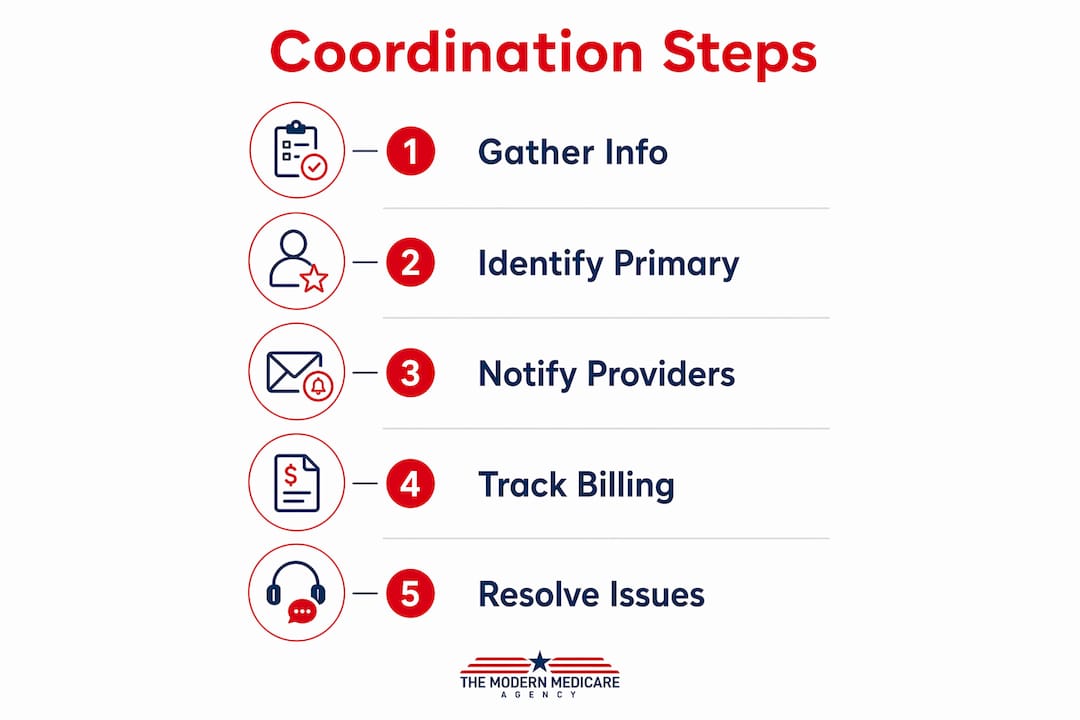
Step-by-step: how to coordinate Medicare with your employer plan
-
Confirm employer size. Ask HR for the employee count on 50% or more of business days last year. Get it in writing. This single number determines payer order.
-
Ask HR these specific questions:
- Is this plan primary for Medicare beneficiaries under 65?
- Does the plan automatically report enrollment to Medicare or the BCRC?
- Is this a multi-employer or multiple-employer plan?
- What happens to my coverage if I go on COBRA or leave employment?
-
Verify crossover agreements. Ask your insurer whether it has a COB Agreement (COBA) with the BCRC to automatically send claim data to Medicare. If not, you must report your coverage to the BCRC yourself. Assuming automatic coordination is one of the most common and costly mistakes disabled beneficiaries make.
-
Build your documentation file. Keep insurance ID cards with effective dates, pay stubs showing premium withholding, W-2s, and any employer letters confirming coverage. The SEP requires proof of continuous employer coverage to waive the late-enrollment penalty.
-
Tell every provider and pharmacy about both plans. Give them your employer insurance card and your Medicare card at every visit. Check your Explanation of Benefits (EOBs) from both plans after each claim to catch billing errors early.
Pro Tip: Create a simple spreadsheet listing each provider, the date you gave them both insurance cards, and the name of the person you spoke with. If a claim gets routed wrong, that log is your first line of defense.
How to fix common billing problems
The most frequent issues:
- Provider bills Medicare first when the employer plan is primary
- Primary payer delays payment past 120 days, triggering a conditional Medicare payment
- Insurer and Medicare never exchanged claim data because no crossover agreement exists
Step-by-step fixes:
- Gather your proof. Pull the EOB from the employer plan, your insurance card, and any HR letter confirming the plan is primary.
- Contact the provider’s billing office. Ask them to resubmit the claim to the correct primary payer. Provide the employer plan’s payer ID.
- File an adjustment with the primary insurer if the claim was denied in error. Reference the MSP disability rules and your employer’s size.
- Notify the BCRC (1-855-798-2627) if Medicare made a conditional payment and the primary payer has now paid. Medicare will recover the conditional amount from the primary payer’s payment.
Keep a copy of every letter, and send it certified mail or with an email read receipt.
How job loss, COBRA, and retiree coverage change the picture
Losing active employment changes your coordination status immediately. The moment you’re no longer an active employee, your employer plan typically loses its primary-payer status under the disability MSP rules. That’s when Part B enrollment becomes urgent.
COBRA is continuation coverage, not active employment coverage. Medicare usually pays primary to COBRA for disabled individuals. If you elect COBRA while already on Medicare, Medicare pays first and COBRA pays second. Carrying COBRA without Part B in that scenario leaves you exposed on the Medicare side.
Retiree coverage follows the same logic: because it’s not based on current employment, Medicare is primary. Retiree plans often work well as secondary coverage, but they don’t preserve your SEP rights the way active employment does.
Coverage-change checklist:
- Will you lose active employment status? If yes, enroll in Part B within your SEP window
- Is COBRA your only bridge? Confirm Medicare is primary before assuming COBRA covers everything
- Does your retiree plan require Part B enrollment before it pays? Many do
- Contact Social Security and the BCRC within 30 days of any coverage change
For state-level employer disability protections that may affect your coverage status during a transition, NJ temporary disability rules offer a useful example of how employer-side policies can interact with federal coordination rules.
Paulbinsurance can help you get this right
Sorting out payer order, SEP documentation, and billing disputes is genuinely complicated, especially when you’re managing a disability at the same time. Paulbinsurance takes the guesswork out of it.

Paul Barrett has been helping Medicare consumers since 2007, and the agency’s approach is education first: you understand your options before you make any decisions. The team can review your employer plan documents, confirm whether your plan is primary or secondary, walk you through the HR questions to ask, and help you build the documentation file you’ll need for a future SEP. If you’re already dealing with a conditional payment or a billing dispute, they can guide you through the appeal process and BCRC reporting steps.
Whether you’re deciding between Medicare Advantage plans or figuring out how supplements work for people under 65, Paulbinsurance covers the full picture. Request a no-pressure consultation at paulbinsurance.com and bring your insurance card, a recent pay stub, and any HR letters you have. That’s enough to get started.
Key Takeaways
When you’re under 65 with disability-based Medicare, the employer-size rule determines everything: a 100-employee threshold sets payer order, and that order drives every enrollment, billing, and documentation decision you face.
| Point | Details |
|---|---|
| The employer size threshold rule defining primary payer status | Employer plans with 100+ employees are primary; Medicare is secondary for disabled beneficiaries under 65. |
| Special Enrollment Period window lasting several months after employment or coverage ends | You have up to eight months after employment or job-based coverage ends to enroll in Part B without a penalty. |
| Verify crossover agreements | Confirm whether your insurer auto-reports to Medicare; if not, report your coverage to the BCRC at 1-855-798-2627. |
| Document everything now | Keep insurance cards, pay stubs, and employer letters to prove continuous coverage and protect your SEP rights. |
| Paulbinsurance guidance | Paul Barrett’s team reviews employer plans, confirms payer order, and helps build SEP documentation since 2007. |
What most people get wrong about this process
The conventional wisdom says “just call Medicare and they’ll sort it out.” That’s not wrong, but it’s incomplete in a way that costs people real money.
The BCRC is powerful, but it’s reactive. It investigates when it learns you have other coverage. If you never report your employer plan, and your insurer has no crossover agreement with Medicare, claims can sit in limbo for months. Providers eventually bill Medicare, Medicare pays conditionally, and then the recovery process starts. None of that is catastrophic, but it creates paperwork, delays, and stress that a single phone call to HR and the BCRC could have prevented.
The other mistake: treating COBRA as a safe harbor. People assume that because COBRA continues their employer coverage, it continues their coordination status. It doesn’t. The disability MSP rules require current employment status, and COBRA explicitly falls outside that definition. Enrolling in COBRA without enrolling in Part B, when Medicare is now primary, is an expensive error.
Ask precise questions. Store proof the day you get it. Don’t wait for a billing problem to tell you something went wrong.
Useful sources and contacts
- Medicare.gov coordination page: The clearest plain-language explanation of payer order, conditional payments, and how to report coverage changes. Start here.
- CMS MSP Disability Overview (PDF): The authoritative training document on employer-size rules, multi-employer plans, and current employment status criteria.
- CMS Coordination of Benefits page: Details on BCRC roles, COBA crossover agreements, and Voluntary Data Sharing Agreements with employers.
- SSA disability and Medicare guidance: Social Security’s resource for working beneficiaries on when Medicare is primary versus secondary and how to report coverage.
- Medicare COB Getting Started booklet: Publication 11546 walks through reporting steps and BCRC contact instructions in plain language.
- BCRC: 1-855-798-2627 (TTY: 1-855-797-2627). Call to report other coverage, ask MSP questions, or address conditional payment recovery.
- Paulbinsurance.com: Independent Medicare agents who specialize in disability-based coordination, SEP documentation, and plan selection for beneficiaries under 65.