
Most people approved for Social Security Disability Insurance must wait 24 months from their SSDI entitlement date before Medicare coverage begins. Two major exceptions exist: people diagnosed with ALS (amyotrophic lateral sclerosis) qualify for Medicare immediately, and people with end-stage renal disease (ESRD) follow a separate, shorter timeline tied to dialysis start dates.
- Exceptions at a glance: ALS triggers immediate Medicare eligibility. ESRD coverage typically begins in the fourth month of dialysis, with earlier options in some home dialysis training cases. No other medical condition waives the 24-month rule.
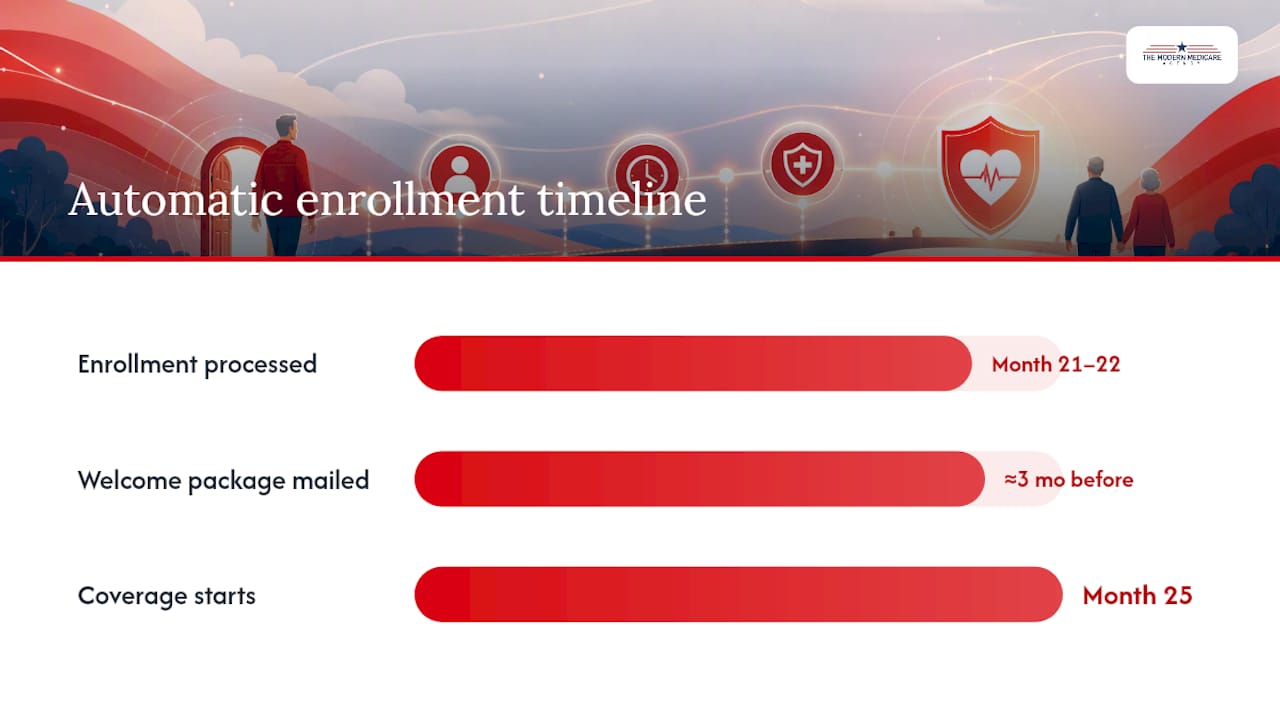
- Automatic enrollment timing: SSA and CMS enroll you automatically after 24 qualifying months. Your Medicare card and welcome package arrive roughly three months before your coverage start date.
- Do this now: Pull out your SSA award letter and find the “date of entitlement.” That date, not your approval date, starts the 24-month clock. Confirm your mailing address is current with SSA at SSA.gov so the card reaches you.
Key Takeaways
Most SSDI recipients under 65 must complete 24 months of SSDI entitlement before Medicare begins, with ALS and ESRD as the primary exceptions that shorten or eliminate that wait.
| Point | Details |
|---|---|
| The 24-month rule | Medicare starts 24 months after your SSDI entitlement date, not your application or approval date. |
| ALS and ESRD exceptions | ALS triggers immediate Medicare; ESRD coverage typically begins in the fourth month of dialysis. |
| Find your entitlement date | Check your SSA award letter for the “date of entitlement” — retroactive months count toward the 24. |
| Bridge coverage options | Medicaid, COBRA (up to 29 months with disability extension), and Marketplace plans can cover the gap. |
| Part B enrollment warning | Declining Part B without qualifying employer coverage creates a permanent late-enrollment penalty. |
| Paulbinsurance | Free consultations cover timeline verification, bridge coverage review, and Medigap vs. Advantage comparisons for SSDI beneficiaries. |
Table of Contents
- What is the SSDI Medicare waiting period and how does it differ from the cash waiting rule?
- When does the 24-month clock start? Timeline and worked examples
- What exceptions and waivers shorten or eliminate the 24-month wait?
- What are your coverage options during the 24-month gap?
- What will Medicare cost you after the 24 months?
- How does automatic Medicare enrollment work and what arrives in the mail?
- A practical checklist to avoid coverage gaps before and after Medicare starts
- Why the waiting period catches so many people off guard
- How Paulbinsurance helps you navigate from SSDI to Medicare
- Sources
What is the SSDI Medicare waiting period and how does it differ from the cash waiting rule?
The 24-month Medicare waiting period is a statutory rule that applies to SSDI beneficiaries under age 65. It was written into law to limit Medicare enrollment to people with long-term disabilities rather than those with short-term conditions. The clock starts on your month of SSDI entitlement, which is the first month you were legally entitled to SSDI cash benefits, not the month SSA approved your application.
Here is where people get confused: SSDI cash payments come with their own separate five-month waiting period. You must be disabled for five full months before your first SSDI check arrives. Medicare’s 24-month count begins from that entitlement month, so in practice, a newly disabled person faces roughly 29 months from disability onset before Medicare coverage starts.
For Medicare eligibility under 65, the two main parts work like this:
- Part A covers inpatient hospital stays, skilled nursing facility care, hospice, and some home health services.
- Part B covers outpatient care, doctor visits, preventive services, and durable medical equipment.
Both parts activate together at the 24-month mark under automatic enrollment, though you can decline Part B if you have qualifying employer coverage.
When does the 24-month clock start? Timeline and worked examples
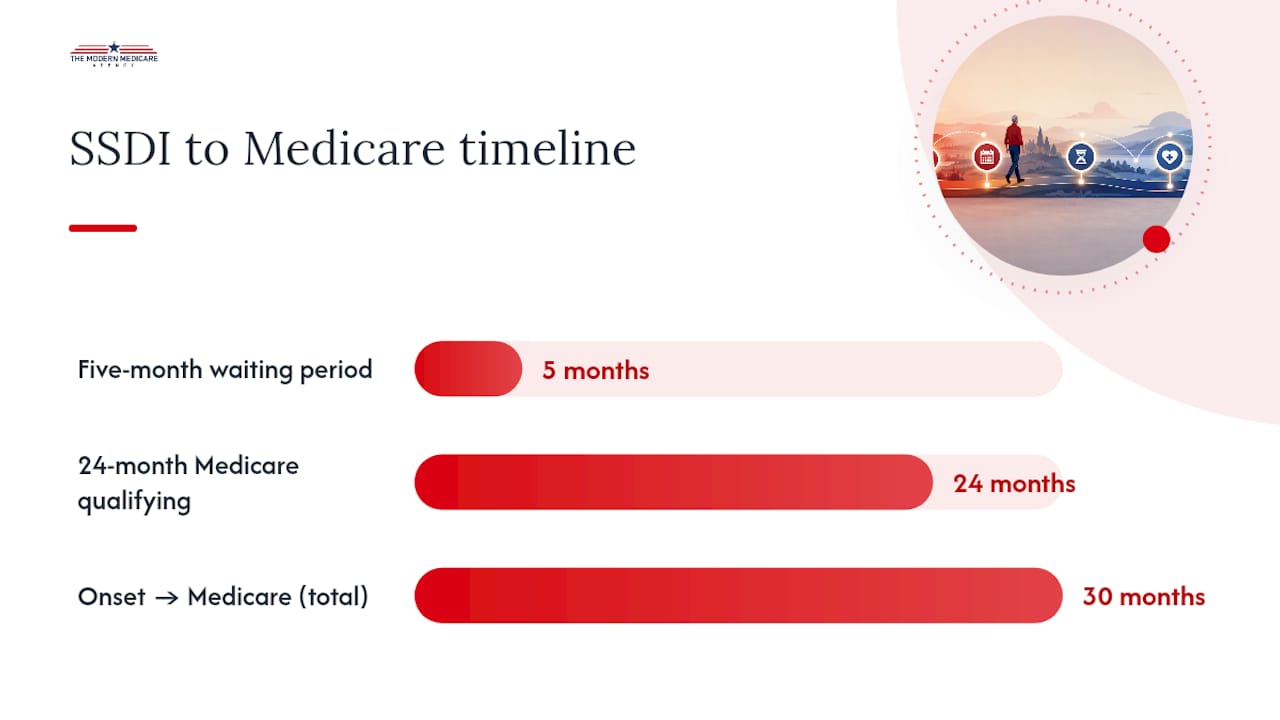
The timeline has a specific sequence. Understanding it lets you calculate your own Medicare start date without guessing.
Standard timeline steps:
- Month of disability onset: Your disabling condition begins.
- Months 1–5: The SSDI five-month waiting period. No cash benefits paid during this window.
- Month 6: Your SSDI entitlement month. This is Month 1 of your 24-month Medicare qualifying period.
- Months 6–29: You receive SSDI cash benefits. These 24 months count toward Medicare eligibility.
- Month 30: Medicare Part A and Part B coverage begins.
Example A: Straightforward approval, no retroactive pay
Maria became disabled in January 2024. SSA approved her claim in August 2024 with an entitlement date of July 2024 (after the five-month wait). Her 24-month Medicare clock starts July 2024. Medicare coverage begins July 2026.
Example B: Approval with retroactive entitlement months
James applied late. SSA approved his claim in March 2025 but found his entitlement date was September 2023. Those retroactive months count. If September 2023 is Month 1, his 24 months ended September 2025, meaning Medicare coverage may already be active or starting very soon after his approval.
Example C: Turning 65 during the waiting period
If you turn 65 before the 24-month SSDI waiting period ends, you become eligible for Medicare through age-based eligibility instead. The waiting period stops mattering entirely at that point.
Pro Tip: Your SSA award letter contains a line labeled “date of entitlement” or “month of entitlement.” That exact date is what you need. If you cannot find it, call SSA at 1-800-772-1213 and ask specifically for your “SSDI entitlement month.” Write it down and keep it with your insurance documents. For a deeper look at coordinating your Medicare and Social Security benefit dates, Paulbinsurance has a dedicated guide.
What exceptions and waivers shorten or eliminate the 24-month wait?
Two conditions carry firm exceptions. A few additional situations can also affect timing.
- ALS (amyotrophic lateral sclerosis): Medicare begins the same month SSDI entitlement starts. No waiting period at all. If you receive an SSDI award based on ALS, contact SSA immediately to confirm your Medicare start date.
- End-stage renal disease (ESRD): ESRD has its own Medicare rules. Coverage generally starts in the fourth month of dialysis treatments. If you participate in a home dialysis training program, coverage can begin even earlier, in some cases as soon as the first month of training. Kidney transplant recipients have separate rules as well. Confirm your specific situation with SSA or CMS directly, since the timing depends on your treatment type and start date.
- Disabled widows and widowers: Individuals receiving SSDI as a disabled widow or widower may face different rules depending on their age and benefit type. SSA can clarify whether the standard 24-month rule applies.
- Retroactive entitlement: This is not a formal waiver, but it has the same practical effect. If SSA backdates your entitlement month, those retroactive months count toward the 24. Some beneficiaries discover their 24 months are already complete or nearly complete at the time of approval.
ALS and ESRD exceptions are narrowly defined. Check Medicare.gov’s ESRD page and your SSA notice to confirm whether special program rules apply to your treatment timeline.
What are your coverage options during the 24-month gap?
If you get SSDI, you are likely in a 24-month waiting period before Medicare starts. The good news is that several coverage options can fill that gap. Here is how the main ones compare:
| Option | Who qualifies | When coverage starts | Typical cost | How long it lasts |
|---|---|---|---|---|
| Medicaid | Low-income SSDI recipients; rules vary by state | Often immediately upon approval | Low or no premium | Ongoing while eligible |
| COBRA | People who had employer coverage before SSDI | Day after prior coverage ends | Full premium plus 2% admin fee | Up to 29 months with disability extension |
| Marketplace plan | Anyone without other qualifying coverage | Next month after enrollment | Varies; premium tax credits available | Until Medicare starts |
| Employer plan | Those still employed or covered as a dependent | Per employer’s open enrollment | Shared premium with employer | While employment continues |
| Veterans’ benefits | Eligible veterans | Per VA enrollment | Low or no cost | Ongoing while eligible |
Steps to enroll in bridge coverage:
- Medicaid: Apply through your state Medicaid office or at HealthCare.gov. Bring your SSA award letter, proof of income, and ID. Medicaid eligibility rules are set jointly by federal guidelines and your state, so income limits and covered services differ significantly from one state to the next.
- COBRA: Your former employer’s HR department or plan administrator sends a COBRA election notice within 14 days of your coverage loss. You have 60 days to elect it. People on SSDI may qualify for an 11-month disability extension, bringing total COBRA coverage to 29 months. The Department of Labor’s COBRA consumer guide explains the disability extension rules in detail.
- Marketplace: Apply at HealthCare.gov. Losing employer coverage is a qualifying life event that opens a special enrollment period.
Pro Tip: When you apply for a Marketplace plan, include your SSDI income on the application. SSDI counts as income for premium tax credit calculations. Once Medicare starts, report it immediately to HealthCare.gov. Keeping a Marketplace plan active after Medicare begins can result in repaying premium tax credits you were not entitled to.
What will Medicare cost you after the 24 months?
Medicare is not free, but the costs are predictable once you know what to look for. Check Medicare.gov’s cost pages for current-year premiums and deductibles, since these figures are updated annually.
- Part A premium: Most people pay no premium for Part A if they or their spouse worked and paid Medicare taxes for at least 40 quarters (10 years). If you have fewer than 30 quarters of work history, a premium applies.
- Part B premium: Part B carries a monthly premium for everyone. The standard amount is set each year by CMS. Higher-income beneficiaries pay more through the Income-Related Monthly Adjustment Amount (IRMAA), which is based on income reported two years prior. Most SSDI recipients fall below the IRMAA threshold and pay the standard rate.
- Part D (prescription drug coverage): Part D is optional but worth enrolling in when Medicare starts to avoid a late-enrollment penalty later. Premiums vary by plan. Paulbinsurance’s guide to Medicare Part D drug coverage walks through how to compare plans by formulary and cost.
- Deductibles and cost-sharing: Both Part A and Part B carry annual deductibles and coinsurance. These can add up quickly without a supplement or Advantage plan.
Pro Tip: Part B premiums are typically deducted directly from your SSDI check once Medicare starts. If your SSDI benefit is lower than the Part B premium, CMS will bill you directly instead. Check your first Medicare Summary Notice to confirm which method applies to you, and contact SSA if the deduction does not appear within the first two months of coverage.
How does automatic Medicare enrollment work and what arrives in the mail?
SSA and CMS handle enrollment automatically for SSDI recipients. You do not file a separate Medicare application. Here is the sequence:
- Month 21–22 of SSDI entitlement: CMS processes your automatic enrollment for Parts A and B.
- Approximately 3 months before your coverage start date: Medicare mails your welcome package and Medicare card. The package includes your Medicare number, coverage start date, and instructions for declining Part B.
- Coverage start date (Month 25 of entitlement): Parts A and B are active.
- If the card does not arrive: Call 1-800-MEDICARE (1-800-633-4227) or log into your account at Medicare.gov. Also verify your address with SSA.
Reasons you might decline Part B:
- You have active employer-sponsored coverage through your own job or a spouse’s job that is considered primary.
- The Part B premium creates a financial hardship and you have other qualifying coverage.
That penalty is permanent.
CMS guidance states that the welcome package includes specific instructions for declining Part B. Follow those instructions exactly. If you have employer coverage and want to delay Part B, SSA’s Part B enrollment page explains the documentation you need to avoid the penalty later.
If you return to work while on SSDI, your Medicare coverage does not end immediately. SSA’s work incentives guidance explains how Medicare continues through the trial work period and an extended period of eligibility, giving you a meaningful safety net while you test employment.
A practical checklist to avoid coverage gaps before and after Medicare starts
Do these things now:
- Locate your SSA award letter and write down your SSDI entitlement month.
- Log into SSA.gov and confirm your mailing address is current.
- Apply for Medicaid at your state office if your income qualifies. Approval can happen quickly and provides immediate coverage.
- If you lost employer coverage, check whether COBRA is still available and calculate whether the 29-month disability extension applies to you.
Six to three months before Medicare starts:
- Compare Marketplace plans at HealthCare.gov as a backup if Medicaid does not cover you.
- Gather any employer coverage documentation you may need to delay Part B without penalty.
- Research Medigap and Medicare Advantage options so you are ready to choose when your card arrives. The Medigap guide for people under 65 from Paulbinsurance is a useful starting point.
When your Medicare card arrives:
- Confirm your coverage start date matches your calculated entitlement timeline.
- Decide whether to keep Original Medicare with a Medigap supplement or enroll in a Medicare Advantage plan.
- Enroll in a Part D plan if you are not choosing an Advantage plan that includes drug coverage.
- Cancel any Marketplace plan and report your Medicare start date to HealthCare.gov to stop premium tax credits on time.
Pro Tip: Talk to a licensed Medicare agent before your coverage starts, not after. The window when you first become Medicare-eligible under 65 may come with guaranteed-issue rights for Medigap plans in some states, meaning insurers cannot deny you or charge more based on your health. That window closes. Missing it can cost you significantly more in premiums for years.
Why the waiting period catches so many people off guard
The 24-month rule surprises nearly every new SSDI recipient. The assumption is that disability approval means immediate Medicare. It does not, and the gap between those two events is where real financial damage happens.
What advisors at Paulbinsurance see repeatedly: a beneficiary receives their SSDI approval letter, assumes Medicare is coming soon, and does nothing about coverage for months. Then a medical event hits during the gap, and they face full out-of-pocket costs or a delayed procedure. The fix is almost always the same: check the entitlement date on the award letter, apply for Medicaid the same week, and set a calendar reminder for the 21-month mark to watch for the Medicare welcome package.
Retroactive entitlement is the other piece most people miss. A beneficiary who applied late and received a backdated entitlement date may find that their 24 months are already partially or fully served. Advisors who catch this early can redirect the client from scrambling for bridge coverage to preparing for Medicare enrollment instead.
The waiting period is a policy design choice, not an oversight. It was built to target Medicare toward people with lasting disabilities. Understanding that framing helps beneficiaries stop waiting for an exception that does not exist and start planning around the timeline that does.
How Paulbinsurance helps you navigate from SSDI to Medicare
Getting from SSDI approval to active Medicare coverage without a gap or penalty requires knowing your exact timeline, your bridge options, and which Medicare plan fits your situation once coverage starts. That is exactly what a free consultation with Paulbinsurance covers.

Paul Barrett and the Paulbinsurance team have been helping Medicare consumers since 2007. A consultation includes a review of your SSDI entitlement month to confirm your Medicare start date, an evaluation of Medicaid, COBRA, and Marketplace options for the gap period, and a side-by-side look at Medicare Advantage vs. Medigap supplement plans once your coverage begins. Part D drug plan comparisons are included as well.
- Review your SSDI entitlement month and confirm your Medicare start date
- Evaluate bridge coverage options (Medicaid, COBRA, Marketplace) for your specific income and state
- Compare Medigap and Medicare Advantage plan options side by side
- Estimate your Part B and Part D costs before your first bill arrives
Schedule a free call at Paulbinsurance and get a clear picture of what comes next.
Sources
Official sources update their figures and rules annually. Verify any specific premium, deductible, or eligibility detail directly with these sources before making coverage decisions.
This article provides general information about Medicare and SSDI rules. It is not a substitute for personalized advice from a licensed Medicare agent or legal professional. Confirm current rules and premium amounts directly with SSA, CMS, or a qualified advisor before making coverage decisions.