
AEP (October 15–December 7) is the broad annual window where any Medicare beneficiary can join, switch, or drop a Medicare Advantage or Part D plan. OEP (January 1–March 31) is a narrower “do-over” window available only to people already enrolled in a Medicare Advantage plan on January 1. If you’re on Original Medicare and want to switch, AEP is your window. If you landed in a Medicare Advantage plan and want out, OEP gives you one shot to fix that before April.
- AEP: October 15–December 7. Changes effective January 1.
- OEP: January 1–March 31. Changes effective the first of the month after your plan receives the request.
- Bottom line: Use AEP to make your annual plan decision. Use OEP only if you’re already in Medicare Advantage and need to course-correct.
Key Takeaways
AEP (October 15–December 7) is the annual window for all Medicare beneficiaries to change plans; OEP (January 1–March 31) is a one-time corrective window only for people already enrolled in Medicare Advantage on January 1.
| Point | Details |
|---|---|
| AEP dates and scope | October 15–December 7; open to all Part A/B enrollees for broad plan changes. |
| OEP eligibility limit | Only Medicare Advantage enrollees as of January 1 can use OEP; one election allowed. |
| Effective dates differ | AEP changes take effect January 1; OEP changes take effect the first of the following month. |
| GEP is not OEP | GEP (also Jan 1–Mar 31) is for people missing Part A/B; coverage starts July 1 with likely penalties. |
| Paulbinsurance | Independent agents compare plans across carriers at no cost; reach out before your window closes. |
Table of Contents
- How AEP and OEP compare at a glance
- What is the Annual Enrollment Period and how does it work?
- What is the Medicare Advantage Open Enrollment Period?
- Other enrollment windows you should know about
- How to figure out which window applies to you
- What an experienced Medicare agent sees that most beneficiaries miss
- Paulbinsurance helps you get this right the first time
- Sources
How AEP and OEP compare at a glance
| Dimension | AEP (Annual Enrollment Period) | OEP (MA Open Enrollment Period) |
|---|---|---|
| Dates | October 15–December 7 | January 1–March 31 |
| Who can use it | Any Medicare Part A and/or Part B enrollee | Only those already in a Medicare Advantage plan on January 1 |
| Allowed actions | Join, switch, or drop MA; add, switch, or drop Part D | One change: switch MA plans OR drop MA and return to Original Medicare (plus optional Part D) |
| Effective date | January 1 of the following year | First of the month after the plan receives the request |
| Typical use case | Annual plan review and switch | Correcting a plan choice made during AEP |
The biggest practical differences worth keeping in mind:
- OEP allows one election only. You cannot make multiple changes during January–March.
- AEP lets you make changes to both Medicare Advantage and Part D in the same window.
- If you’re on Original Medicare in January, OEP does not apply to you at all.
- You cannot use OEP to join a Medicare Advantage plan for the first time.
Don’t confuse OEP with GEP. The General Enrollment Period also runs January 1–March 31, but it serves a completely different population: people who missed their Initial Enrollment Period for Part A and/or Part B. OEP is for Medicare Advantage enrollees. GEP is for people who don’t yet have Part A or Part B. Same calendar window, entirely different purpose. This confusion is one of the most common mistakes beneficiaries make, and it can cause real coverage delays if you act under the wrong assumption. A quick comparison of Medicare enrollment periods can help you sort out which window is yours.
What is the Annual Enrollment Period and how does it work?
AEP runs October 15 through December 7 every year and lets Medicare beneficiaries join, switch, or drop Medicare Advantage and Part D plans, with all changes taking effect January 1. This is the window most people think of when they hear “Medicare open enrollment,” and it’s the one that gets the most attention for good reason: it’s the only time most beneficiaries can make broad plan changes without a qualifying life event.
Who can use AEP: Anyone enrolled in Medicare Part A and/or Part B. You don’t need to be in a Medicare Advantage plan to participate. If you’re on Original Medicare and want to add a Part D drug plan, AEP is your window.
What you can do during AEP:
- Join a Medicare Advantage plan for the first time (if you have Part A and Part B)
- Switch from one Medicare Advantage plan to another
- Drop Medicare Advantage and return to Original Medicare
- Add a standalone Part D prescription drug plan
- Switch from one Part D plan to another
- Drop Part D entirely (though this carries penalty risk if you go without creditable coverage)
How to submit changes: You have four options. Use Medicare.gov, call 1-800-MEDICARE (1-800-633-4227), contact the plan directly, or submit a paper enrollment form. Have your Medicare number, Part A and Part B start dates, and current plan ID ready before you call or log in.
AEP enrollment checklist:
- Pull out your Medicare card and note your Medicare number and coverage start dates.
- List every prescription drug you take, including dosage and frequency.
- Confirm your preferred doctors and specialists are in the plan’s network.
- Compare total annual costs, not just monthly premiums (deductibles, copays, out-of-pocket maximums).
- Submit your enrollment by December 7. Changes submitted after that date will not take effect January 1.
Pro Tip: Don’t assume you can make multiple plan changes during AEP and have only the last one count. While CMS rules do allow a later election to supersede an earlier one during AEP, relying on this creates confusion and processing risk. Make your decision once and submit it cleanly.
One often-overlooked AEP pitfall: if you switch from Medicare Advantage back to Original Medicare during AEP, you may not be able to get a Medigap (Medicare Supplement) policy at standard rates. Outside of guaranteed-issue windows, insurers in most states can apply medical underwriting, meaning your health history could result in higher premiums or outright denial.
What is the Medicare Advantage Open Enrollment Period?
The Medicare Advantage Open Enrollment Period runs January 1 through March 31 and is available only to people already enrolled in a Medicare Advantage plan on January 1. Think of it as a safety net, not a second AEP. NCOA frames it exactly that way: AEP is your comprehensive annual review; OEP is a limited corrective window for MA enrollees who realize their plan isn’t working.
What OEP allows:
- Switch from your current Medicare Advantage plan to a different Medicare Advantage plan
- Drop Medicare Advantage entirely and return to Original Medicare
- If you return to Original Medicare, you may also join a standalone Part D drug plan
What OEP does not allow:
- Joining Medicare Advantage for the first time (you must already be enrolled in MA on January 1)
- Making changes to a standalone Part D plan if you’re staying on Original Medicare
- Making more than one election during the January–March window
Per CMS enrollment and disenrollment guidance, plans must process OEP elections and apply an effective date of the first of the month following the receipt of the request.
Example timeline: You enrolled in a Medicare Advantage plan during AEP and it became effective January 1. By mid-January, you realize your primary care doctor isn’t in the network. You contact a different MA plan on February 10. That plan receives and processes your request by February 14. Your new coverage begins March 1.
Key OEP rule to remember: OEP gives you exactly one election between January 1 and March 31. Use it wisely, because once you make that change, you’re locked in until the next AEP unless a Special Enrollment Period qualifying event occurs.
Steps to use OEP:
- Confirm you are currently enrolled in a Medicare Advantage plan (not Original Medicare).
- Identify the plan you want to switch to, or decide to return to Original Medicare.
- Contact the new plan directly, call 1-800-MEDICARE, or visit Medicare.gov.
- Ask for written confirmation and note the effective date.
- If returning to Original Medicare, arrange a Part D plan at the same time.
For a deeper look at the mechanics, Paulbinsurance’s OEP guide walks through common scenarios step by step.
Other enrollment windows you should know about
AEP and OEP aren’t the only periods that matter. Several other windows apply to specific situations, and mixing them up can cost you coverage or trigger lifetime penalties.

Initial Enrollment Period (IEP): This is the 7-month window centered on your 65th birthday: three months before, the month of, and three months after. Most people enroll in Part A and Part B during their IEP. Missing it without qualifying employer coverage in place can mean coverage gaps and a lifetime late-enrollment penalty on your Part B premium. If you’re approaching 65, IEP is the window that matters most.
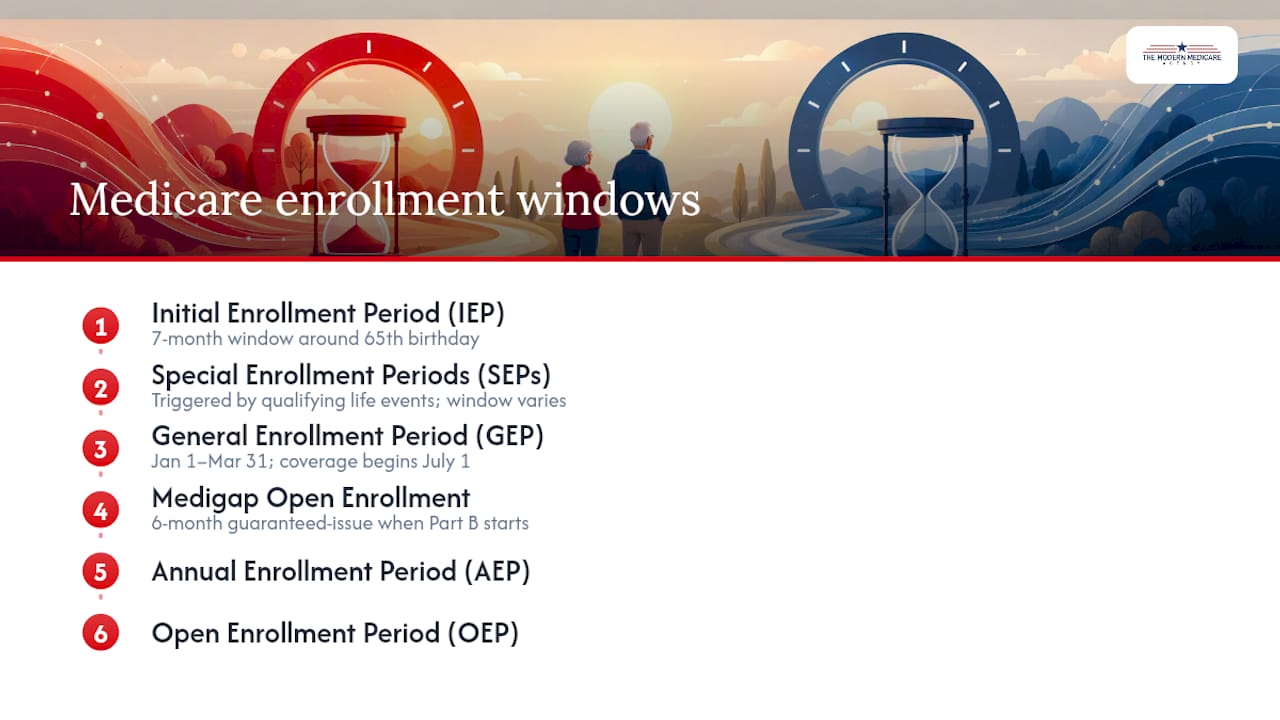
Special Enrollment Periods (SEPs): SEPs are triggered by qualifying life events: losing employer coverage, moving out of your plan’s service area, gaining or losing Medicaid eligibility, and others. They don’t follow a fixed calendar. The window length and allowed actions depend on the specific triggering event. SEPs are the mechanism that protects people who experience a coverage change mid-year.
General Enrollment Period (GEP): The GEP runs January 1–March 31, the same calendar window as OEP, but it serves people who missed their IEP and need to enroll in Part A and/or Part B for the first time. Coverage under GEP starts July 1, not January 1, and late-enrollment penalties typically apply. This delay is significant: someone who enrolls in March under GEP won’t have Part B coverage until July. If you’re in this situation, read about avoiding Medicare late penalties before you act.
Medigap Open Enrollment: When you first enroll in Part B, you get a 6-month guaranteed-issue window to buy any Medigap policy sold in your state, regardless of health history. This window does not repeat. After it closes, insurers in most states can use medical underwriting. This is why the decision to drop Medicare Advantage and return to Original Medicare deserves careful thought, especially outside that initial window.
Pro Tip: If you’re under 65 and on Medicare due to a disability, your Medigap guaranteed-issue rights may differ by state. Check your state’s rules before assuming you have the same 6-month window.
How to figure out which window applies to you
The decision tree is short. Answer these three questions:
- Are you enrolled in Medicare Part A and/or Part B? If not, your window is IEP (if you’re near 65) or GEP (if you missed IEP without qualifying coverage).
- Are you currently in a Medicare Advantage plan? If yes, you can use both AEP (October–December) and OEP (January–March). If no, only AEP applies for plan changes.
- Did a qualifying life event just occur? If yes, a SEP may be available right now, regardless of the calendar.
AEP route (October 15–December 7):
- Gather your Medicare card, current plan ID, and drug list.
- Visit Medicare.gov’s plan finder or call 1-800-MEDICARE.
- Compare plans on network, formulary, and total annual cost.
- Enroll by December 7. Coverage starts January 1.
OEP route (January 1–March 31):
- Confirm you’re in a Medicare Advantage plan as of January 1.
- Decide: switch to a different MA plan, or return to Original Medicare.
- Contact the new plan or 1-800-MEDICARE. Get written confirmation.
- Note your effective date (first of the following month).
- If returning to Original Medicare, enroll in Part D at the same time.
Documents to have ready for either window:
- Medicare card (your Medicare number)
- Part A and Part B effective dates
- Current plan name and ID number
- Complete drug list (name, dosage, frequency)
- Names of your preferred doctors and specialists
Pro Tip: Before calling 1-800-MEDICARE, write down your top three questions. The hold times can be long, and having your questions ready means you get everything answered in one call. A licensed independent Medicare agent can often answer the same questions faster and help you compare plans side by side at no cost to you.
Avoiding common pitfalls during these windows is worth the extra preparation. A guide to common Medicare enrollment mistakes covers the errors agents see most often.
What an experienced Medicare agent sees that most beneficiaries miss
The most common mistake I see isn’t missing a deadline. It’s making the right move at the wrong time, or making a move without understanding the downstream consequences.
The OEP-versus-GEP confusion is the clearest example. A beneficiary who missed their IEP calls in February thinking they can use “open enrollment” to get Part B. They’re told they can, and technically they can, under GEP. But they don’t find out until later that their coverage won’t start until July 1. Four months without Part B coverage, and often a lifetime penalty on top of it. That’s a painful outcome from a simple calendar misread.
The Medigap risk is the other one that keeps me up at night. When someone drops Medicare Advantage during OEP and returns to Original Medicare, they often assume they can pick up a Medigap policy to cover the gaps. In most states, outside of guaranteed-issue windows, that’s not guaranteed. A 70-year-old with a few health conditions may find that Medigap underwriting prices them out or denies them entirely. The decision to leave Medicare Advantage is sometimes the right one. But it needs to happen with eyes open.
The CMS enrollment and disenrollment guidance lays out the rules clearly, but the rules don’t tell you what they mean for your specific situation. That’s where an independent agent earns their keep.
Paulbinsurance helps you get this right the first time
Sorting through AEP, OEP, GEP, and Medigap windows on your own is manageable, but one wrong turn can mean months without coverage or a penalty that follows you for life. Paulbinsurance is a team of independent Medicare agents who work for you, not for any single insurance carrier. That means when you call, you get a straight comparison of plans across multiple carriers, not a pitch for whichever plan pays the highest commission.

Paul Barrett has been helping Medicare beneficiaries navigate these decisions since 2007. The team covers Medicare Advantage, Medigap, Part D prescription drug plans, dental, hospital indemnity, and more. Every consultation is free, and there’s no obligation to enroll. If you’re heading into AEP or trying to use OEP before March 31, now is the right time to get a plan comparison done. Visit Paulbinsurance or call to speak with an agent who can walk you through your options in plain language.
Sources
These are the primary sources used to confirm dates, eligibility rules, and effective-date guidance in this article:
- Open Enrollment | Medicare
- What’s the difference between Medicare’s Open Enrollment Period and the Medicare Advantage Open Enrollment? | NCOA
- CY 2026 Contract Year Enrollment and Disenrollment Guidance | CMS
- When to sign up for Medicare | SSA
This article is general information, not a substitute for advice from a qualified financial advisor. Consult a qualified financial professional about your own circumstances before acting on anything here.