




If you were suddenly diagnosed with a serious condition, would your bank account be able to withstand the $7,186 out-of-pocket costs that have become standard for 2026 bronze plans? This is why many families are looking closer at Critical Illness insurance to bridge the gap. It’s a simple way to ensure that a medical crisis doesn’t turn into a financial one.
It’s a heavy burden to carry. You’ve worked hard to build a stable life, yet the complexity of modern healthcare can make you feel like you’re one diagnosis away from financial distress. You aren’t alone in feeling overwhelmed by rising costs and the confusing fine print of supplemental plans. It’s natural to want clarity when your family’s security is on the line.
This guide is here to replace that anxiety with a clear path forward. You’ll discover how these plans act as a dedicated financial safety net, delivering a tax-free payment directly to you when it matters most. It’s about giving you the freedom to focus on your health instead of your bills. We will break down exactly how these benefits function and provide an unbiased look at how to select the right protection for your family’s needs.
Key Takeaways
- Learn why the rising healthcare costs of 2026 make having a supplemental safety net more important than ever for your peace of mind.
- Discover how a simple, lump-sum payment gives you the freedom to focus on getting better without worrying about the bills.
- Find out the best way to choose between Critical Illness insurance and cancer-specific plans by looking at your own family history.
- Use our 2026 checklist to calculate your personal financial gap so you can choose a plan that fits your budget and your needs.
- See how an independent advocate helps you compare options from over 40 carriers to find the protection you deserve.
What is Critical Illness Insurance and Why Does it Matter in 2026?
Think of your current health plan as a shield for your doctor’s bills. It does a great job of paying the hospital, but it doesn’t pay your mortgage or your grocery bill while you’re recovering. This is where What is Critical Illness Insurance comes into play. It acts as a financial bridge. Instead of sending money to a provider, the insurance company sends a tax-free cash payment directly to you upon a qualifying diagnosis. This money is yours to use however you see fit, filling the holes that standard medical coverage often leaves wide open.
The “Gap” is more than just a number on a balance sheet. It’s the distance between what your insurance pays and what it actually costs to keep your life running during a health crisis. Standard plans are designed to cover clinical care, but they rarely account for the loss of income or the daily expenses that continue even when you’re unable to work. Critical Illness insurance steps into that space to offer a layer of protection that keeps your family’s daily life stable.
The 2026 Reality of Out-of-Pocket Costs
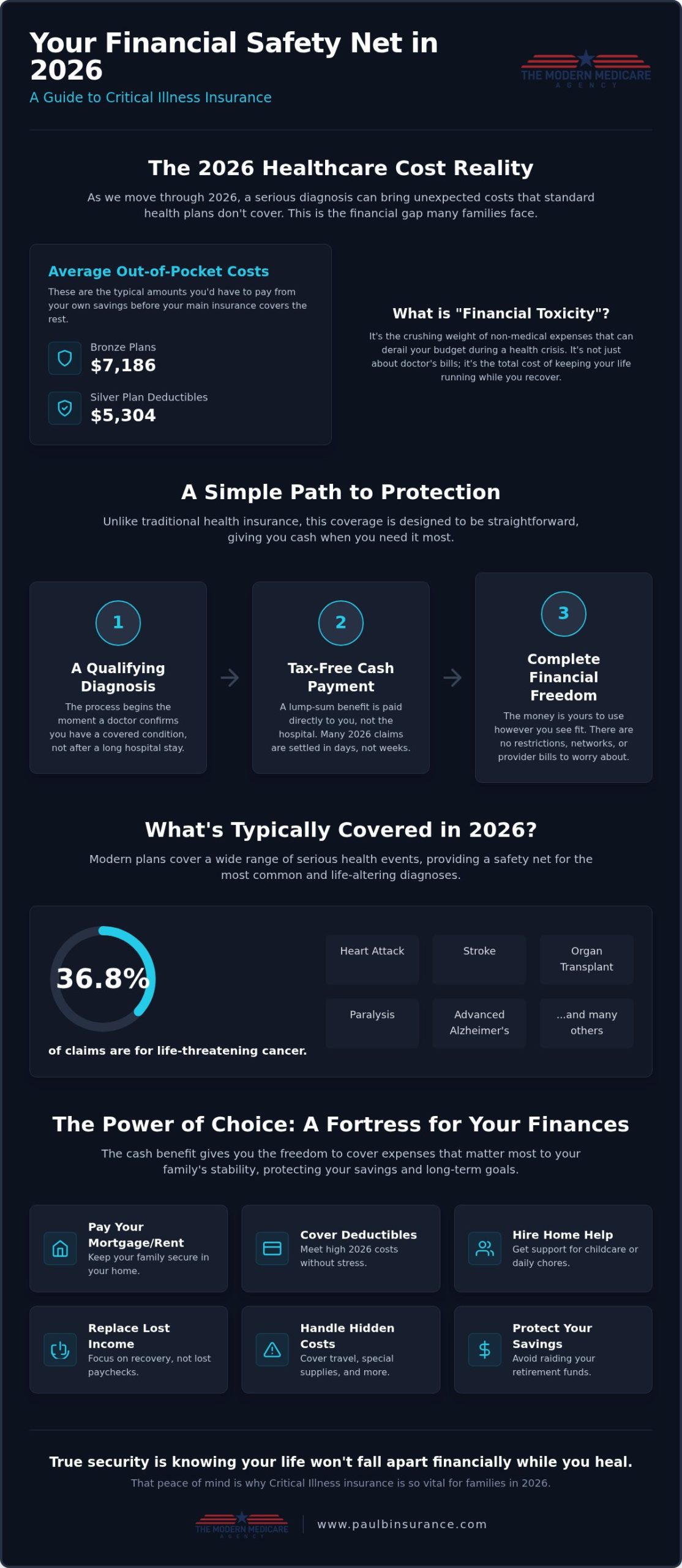
As we move through 2026, the cost of staying healthy has changed significantly. Standard silver plans now carry average deductibles of $5,304, while bronze plans have climbed to $7,186. That’s a lot of money to find on short notice. Beyond the hospital bills, a serious illness often brings hidden costs like travel to out-of-state specialists or taking time off work to care for a loved one. Financial toxicity in 2026 is the crushing weight of these non-medical expenses that can derail even the most carefully planned budget. It’s not just about the medical bills; it’s about the total cost of a crisis.
A Safety Net for Your Savings
When a health crisis hits, the last thing you want to do is raid your retirement fund or sell off assets you’ve worked years to accumulate. This coverage provides a lump-sum payment that acts as a fortress for your long-term goals. You get to decide how to use the money. Maybe you need it for:
- Paying your monthly mortgage or rent to stay in your home.
- Covering those high 2026 deductibles before your other insurance kicks in.
- Hiring help around the house or childcare during your recovery.
- Buying specialized groceries or medical supplies not covered by a standard plan.
True security isn’t just about paying the surgeon. It’s about knowing your life won’t fall apart financially while you are trying to heal. That peace of mind is the real reason Critical Illness insurance has become so vital for families this year. It’s about protecting your future while you focus on the present.
How Critical Illness Benefits Work: The Simple Path to Protection
Navigating a health crisis is hard enough. You shouldn’t have to worry about how your insurance company will pay out. With Critical Illness insurance, the process is designed to be simple. The trigger for your benefit isn’t a long hospital stay. It isn’t a specific surgery. Instead, it’s the diagnosis itself. Once a doctor confirms you have a covered condition, the claim process begins.
In 2026, the industry has moved toward much faster claim settlements. Many top carriers now use automated systems to process your paperwork in days rather than weeks. This speed is essential because bills don’t stop just because you’re in the hospital. Unlike traditional health insurance that pays the doctor for specific treatments, this coverage provides a one-time cash payment directly to you. You don’t have to wait for the hospital to send a bill. You don’t have to worry about whether a specific procedure was covered by your primary plan. The money arrives in your bank account so you can use it exactly when the stress is highest.
Qualifying Conditions and What to Expect
Most 2026 plans cover a broad range of serious health events. This includes life-threatening cancer, which currently represents about 36.8% of all claims, as well as heart attacks and strokes. Many modern policies have also expanded to include organ transplants, paralysis, and Advanced Alzheimer’s. This last addition is vital for seniors who want to protect their savings from the high costs of long-term care. One of the best parts? This benefit pays out regardless of your other insurance. Whether you use Medicare Advantage Plans or private coverage, this cash benefit is separate and yours to keep.
No Restrictions on How You Spend Your Benefit
The freedom of a cash benefit is what provides real peace of mind. There are no networks to follow and no approved spending lists. You might use the funds to fly to a specialized treatment center in another state. You could use it to cover your household bills while you take a few months off work to heal. It can even pay for home modifications or extra help with childcare. If you’re feeling unsure about which Critical Illness insurance plan fits your medical history, talking to an independent expert can help clear up the confusion. Having that cash on hand means you can focus entirely on your recovery. The logistics of daily life are already handled, leaving you with one less thing to worry about.
Critical Illness vs. Cancer Insurance: Which One Do You Need?
Choosing between these two types of coverage can feel like a riddle. You want to be protected, but you don’t want to pay for things you don’t need. The right choice often depends on your family history and your existing medical plan. While cancer remains a primary concern for many, making up about 36.8% of the market share in 2025, it isn’t the only health crisis that can drain a bank account. Understanding the difference between a broad safety net and a specialized one is the first step toward true peace of mind.
The Scope of Coverage
Think of Critical Illness insurance as a broad umbrella. It’s designed to shield you from a variety of medical storms, including heart attacks, strokes, and organ failure, along with life-threatening cancer. It provides a versatile layer of protection for those who want to be ready for anything. On the other hand, cancer-specific plans are more like a high-quality raincoat. They focus deeply on one area. These plans sometimes offer specialized benefits for experimental treatments or long-term chemotherapy that a general policy might not highlight as clearly.
In 2026, we’re seeing more families choose to “stack” these protections. They might keep a base critical illness policy for its wide reach and add a specific cancer rider to deepen their coverage. A helpful tip for your journey is to look closely at your current employer or private benefits first. You want to identify any overlaps so you aren’t paying for the same benefit twice. Our goal is to help you build a lean, effective strategy that leaves no gaps in your security.
Supplementing Your Medicare Strategy
This is where the conversation gets specific for those on Medicare. If you’ve chosen Medicare Advantage Plans, you’re likely aware of the maximum out-of-pocket (MOOP) limits. While these limits protect you from infinite costs, the 2026 MOOP can still be a multi-thousand-dollar hurdle. A lump-sum payout from a critical illness policy can cover that entire amount in one go, effectively “erasing” your deductible and co-pays during a crisis.
You might wonder, “Doesn’t my Medigap plan cover this?” While Medigap is excellent for hospital and doctor bills, it doesn’t put cash in your hand for everyday life. It won’t pay for the specialized diet you might need or the high cost of certain prescriptions that fall under Medicare Part D. Having that extra cash gives you the freedom to choose better care options or simply keep your household running while you focus on healing. It’s about moving from a state of distress to one of absolute certainty.
Choosing Your Coverage: A 2026 Checklist for Success
Selecting the right Critical Illness insurance doesn’t have to be a guessing game. It’s about looking at your life today and planning for a tomorrow that feels secure. When you sit down to compare plans, start with your own family tree. If heart disease or cancer runs in your family, you’ll want a plan that prioritizes those triggers. This personal assessment ensures you aren’t just buying a policy, but building a defense tailored to your actual risks.
To find your ideal coverage level, you need to calculate your “Financial Gap.” In 2026, we suggest a simple formula: take your health plan’s deductible and add three months of essential living expenses. If you have a bronze plan with a $7,186 deductible, and your monthly bills are $3,000, your gap is roughly $16,186. Subtract your liquid emergency savings from your calculated financial gap to find your ideal coverage amount. This number represents the “bridge” you need to stay afloat during a recovery.
Before you sign a contract, check for two specific 2026 details: survival periods and portability. A survival period is the amount of time you must live after a diagnosis before the benefit is paid, which is usually around 14 to 30 days. Portability is equally vital. It ensures that if you move to a new state or leave your current job, your protection stays with you. If you’re ready to see how these numbers look for your specific household, you can request a personalized plan comparison to find the best fit.
Finding the Right Benefit Amount
In 2026, most supplemental plans fall within a common range of $10,000 to $30,000. While a $50,000 policy sounds great, it might come with a monthly premium that feels like a burden. The goal is to find a balance. You want a lump-sum payout that covers your “Financial Gap” without making your monthly budget feel tight. Remember, even a $10,000 policy can be the difference between using your retirement fund and keeping it intact. It’s about choosing a manageable cost for a meaningful benefit.
The Fine Print Simplified
Understanding how you qualify for a plan is the next step. Many 2026 carriers offer “Simplified Issue” policies. These don’t require a physical exam or blood work; you simply answer a few health questions. If you have existing health concerns, you might look for “Guaranteed Issue” options, though these often have lower benefit limits. Be sure to check for “Recurrence Benefits” as well. This feature allows you to receive a second payout if the same condition returns after a treatment-free period, which is a powerful addition for long-term security. Your age and tobacco use will still play a role in your 2026 premium, so it’s always better to lock in a rate while you’re healthy.
The Advantage of an Independent Medicare Broker
When you call a large insurance carrier directly, you’re only getting one side of the story. These representatives are restricted to the products their company sells, which means your options are limited from the start. In the fast-moving 2026 insurance market, having a narrow view can lead to gaps in your coverage or higher costs than necessary. You deserve a broader perspective that puts your needs first.
This is where the power of choice becomes your greatest asset. At The Modern Medicare Agency, we act as your personal advocate. Instead of pushing a single brand, we compare options from over 40 different carriers. We look at the fine print of Critical Illness insurance policies across the board to find the one that actually matches your budget and health history. It’s a journey from a state of confusion to one of absolute certainty, led by an expert who works for you, not the insurance companies.
Our commitment doesn’t end when you sign a policy. The 2026 landscape is constantly shifting, and you need a partner who provides year-round support. Whether you have a question about a claim or need to adjust your coverage as your life changes, we’re here to help. This ongoing relationship is what separates a dedicated broker from a simple sales transaction.
Unbiased Guidance for Your Unique Situation
An independent broker doesn’t have carrier quotas to meet. Our only goal is to find a personalized fit that protects your family’s financial future. Paul Barrett has built this agency to be a calm guide through the often-stressful insurance maze. We take the time to listen to your concerns, explaining Critical Illness insurance in plain English so you can make an informed decision without the pressure of high-sales tactics. We believe that an empowered client is a protected client.
Your Journey to Peace of Mind Starts Here
Getting started is a simple, stress-free process. We begin with a conversation to understand your specific “Financial Gap” and family history. From there, we provide a clear, side-by-side comparison of your best 2026 options. There’s no obligation and no rush; we move at your pace. If you want to learn more about how to find the right partner, our Medicare Broker guide offers a deeper look at what to expect from a trusted advisor. We’re ready to help you move from uncertainty to peace of mind today.
Step Into a Future of Financial Certainty
You’ve seen how the right plan can turn a moment of medical distress into a journey of recovery and peace. By understanding your personal financial gap and choosing a plan that travels with you, you’re taking a vital step toward protecting your family’s savings. Critical Illness insurance isn’t just about paying bills; it’s about giving yourself the freedom to focus on what matters most: your health and your loved ones.
Paul Barrett and our team are here to act as your calm guide through these complex choices. We offer personalized support across 34+ states and provide access to over 40 top insurance carriers to ensure you get the best fit for 2026. You don’t have to navigate these rising costs alone. Get a Simple, Unbiased Comparison of Your 2026 Options today and secure the peace of mind you deserve. Your future self will thank you for the certainty you build today.
Frequently Asked Questions
Is critical illness insurance worth it in 2026?
Yes, it’s a smart move for many families because healthcare costs continue to climb. With bronze plan deductibles averaging $7,186 this year, a single diagnosis can create an immediate financial crisis. This coverage provides the cash you need to protect your savings and stay afloat. It’s a tactical way to ensure that a medical event doesn’t turn into a long-term debt problem for your household.
Does critical illness insurance cover cancer?
Absolutely, life-threatening cancer is a core condition covered by almost every plan in 2026. Since cancer accounts for a large portion of claims, these policies are designed to provide a significant lump-sum payment upon diagnosis. This money helps you manage the high costs of specialized treatments and the everyday bills that don’t stop just because you’re focused on getting better and staying strong.
How is critical illness insurance different from disability insurance?
The main difference lies in the trigger for payment. Disability insurance replaces a portion of your monthly paycheck if you’re unable to work for an extended time. Critical Illness insurance pays out a single, tax-free lump sum the moment you’re diagnosed with a covered condition. You don’t have to be out of work to receive the money; the diagnosis itself is enough to provide you with immediate support.
Do I need a medical exam to get critical illness coverage in 2026?
You often won’t need one. Many 2026 carriers offer “Simplified Issue” Critical Illness insurance, which only requires you to answer a few health questions. This makes it much faster to get protected without the hassle of a physical exam or blood work. While some plans with very high benefit amounts might ask for more detail, most people can find excellent coverage through a simple, straightforward application process.
Can I use my critical illness payout for anything I want?
What happens if I have a Medicare Advantage plan and get a critical illness?
It acts as a powerful supplement to your existing coverage. While your Advantage plan pays for your medical care, you’re still responsible for co-pays and deductibles until you reach your out-of-pocket maximum. The cash from a supplemental policy can cover those costs entirely. It effectively erases the financial burden of your 2026 out-of-pocket limits, allowing you to focus on healing instead of hospital bills.
Are critical illness insurance premiums tax-deductible?
Usually, they are not. Most people pay their premiums with after-tax dollars, so they don’t qualify for a deduction. However, there is a significant benefit to this arrangement. Because you’ve already paid taxes on the premium money, the lump-sum payout you receive after a diagnosis is typically tax-free. This ensures that the full amount of your benefit is available to help you when you need it most.
Is there a waiting period before coverage begins?
Most plans do have a short waiting period, which is typically around 30 days from the time your policy starts. This means the diagnosis must occur after this period for the benefit to be paid. You should also look for a survival period in your contract, which is the number of days you must live after a diagnosis to receive the funds. An independent broker can help you compare these specific details.

Article by
Paul Barrett
Paul Barrett, CMIP is the founder of The Modern Medicare Agency, an independent Medicare-only brokerage based in Melville, NY. With 18 years of Medicare-exclusive experience, a CMIP designation, and more than 5,000 clients served across 37 states, Paul is one of the most credentialed independent Medicare specialists on Long Island — and one of the most direct.
He represents 40+ carriers with no quotas and no allegiances, which means his recommendations are based entirely on what fits each client's specific situation. He is the author of Medicare Mastery Unlocked and host of the Wise Guys Retirement Talk podcast. His content is grounded in primary sources, real carrier intelligence, and 18 years of watching what happens when people get Medicare right — and when they don't.
📞 631-358-5793 | paulbinsurance.com