
A hospital indemnity plan pays you a fixed cash benefit when you’re hospitalized, money you can spend on anything, not just medical bills. It works alongside your regular health insurance rather than replacing it.
- Typical use: cover your deductible, replace lost income, or pay household bills while you recover
- Payment style: a set dollar amount per day or per event, decided when you buy the policy
- Common source: offered as a voluntary employer benefit or purchased as an individual policy
Key Takeaways
Hospital indemnity plans pay a fixed cash benefit directly to you during a covered hospital stay, and that cash covers whatever expense matters most, medical or not.
| Point | Details |
|---|---|
| Cash goes to you | Payouts are unrestricted and can cover deductibles, rent, or lost income. |
| Daily benefits range widely | Common selections run from $150 to $500 per day, based on the plan chosen. |
| Employer plans are often guaranteed-issue | Group coverage skips medical underwriting for eligible employees. |
| It supplements, never replaces | Major medical, Medigap, and Medicare still handle your actual provider bills. |
| Paulbinsurance compares your options | Independent agents can evaluate hospital indemnity alongside Medicare supplement and Advantage plans. |
Table of Contents
- What Is a Hospital Indemnity Plan, Exactly?
- How Hospital Indemnity Coverage Actually Works
- What Hospital Indemnity Insurance Covers and Excludes
- Who Actually Needs This Kind of Coverage?
- Hospital Indemnity Costs, Benefit Amounts, and Enrollment Rules
- Hospital Indemnity vs. Medigap, Accident, and Critical-Illness Plans
- A Short Checklist Before You Buy a Policy
- How Hospital Indemnity Fits Around Medicare
- The Practical Case for Hospital Indemnity
- Get Help Comparing Hospital Indemnity and Medicare Options
- Frequently Asked Questions
- Sources
What Is a Hospital Indemnity Plan, Exactly?
A hospital indemnity plan, sometimes called fixed-indemnity hospital insurance, pays a set dollar amount to you when you’re admitted to the hospital. It doesn’t pay your hospital, your doctor, or your surgeon directly. The money lands in your account, and you decide what happens next.
This distinction exists because major medical insurance, even good insurance, rarely covers everything a hospital stay costs. Your health plan pays claims to providers, but it doesn’t cover your mortgage payment while you’re out of work, the parking garage fees at the hospital, or the babysitter you need for your other kids. Hospital indemnity insurance was built specifically to fill that gap, paying cash benefits for hospital-related events including inpatient stays and intensive care.
People typically use the payout for:
- Their major medical deductible or coinsurance
- Rent, groceries, or utility bills during recovery
- Childcare or transportation costs tied to the hospital stay
A three-day hospital stay under a typical daily benefit plan generates a fixed cash payment, paid to you, with no restrictions on how you spend it.
How Hospital Indemnity Coverage Actually Works
Premiums usually come out of your paycheck if your employer offers the plan, or you’re billed directly if you bought an individual policy. Either way, the amount is fixed and doesn’t fluctuate with how sick you get in a given year.
Coverage kicks in when specific events happen. Common triggers include:
- Inpatient hospital admission — the core trigger for nearly every policy
- ICU stays — often paid at a higher daily rate than standard admission
- Outpatient surgery or ER visits — covered on some plans, excluded on others
Filing a claim follows a simple pattern: you submit proof of the hospital stay, the insurer verifies it against your policy’s definition of a covered event, and payment follows. MetLife’s own example puts typical claims processing around 10 business days once they have everything they need.
Pro Tip: Read how your policy defines “admission” before you buy. Some insurers require a 24-hour minimum stay to trigger payment, which means an overnight ER observation might not qualify even though it felt like a hospital stay to you.

What Hospital Indemnity Insurance Covers and Excludes
Coverage varies by carrier, but most policies pay for a similar core set of events, plus optional extras.
Commonly covered:
- Inpatient hospital admission (the baseline benefit)
- ICU confinement, often at a boosted daily rate
- Childbirth-related hospital stays
- Outpatient surgery, rehab, or ambulance transport, depending on the rider
Common exclusions and limits:
- Pre-existing conditions during an initial waiting period
- A maximum number of paid benefit days per year
- Per-event or per-year benefit caps
A simple scenario shows how this adds up: a $150-per-day plan covering a four-day stay pays $600. Add a $1,000 ICU rider for two of those days, and the total climbs to $2,600, cash you control entirely.
Who Actually Needs This Kind of Coverage?
Hospital indemnity insurance tends to make the most sense for a specific set of situations, not everyone with health insurance.
- High-deductible health plan holders who’d otherwise pay thousands out of pocket before other coverage kicks in
- People with limited emergency savings, since medical debt and delayed care disproportionately affect adults without a financial cushion
- Retirees on fixed incomes who need predictable cash flow if a hospital stay disrupts their budget
- Expecting parents anticipating childbirth-related hospital costs
- Workers without paid sick leave, who need income replacement more than medical bill coverage
Ask yourself: Could I cover a $2,000 unexpected expense this month? Does my job pay me if I’m out for a week? If either answer is no, the coverage is worth pricing out.
Pro Tip: If you already carry a critical-illness or accident policy, check for overlapping triggers before adding hospital indemnity. Paying two premiums for benefits that both fire on the same event wastes money.
Hospital Indemnity Costs, Benefit Amounts, and Enrollment Rules
Premiums depend on a handful of factors you control and a few you don’t.
- Daily benefit amount you choose — higher payouts cost more, scaled roughly to the benefit size
- Age and smoker status — standard underwriting variables for most supplemental products
- Riders — ICU boosts, ambulance coverage, or maternity add cost but expand the payout
- Employer-sponsored versus individual — group plans are often cheaper and easier to get approved for
Daily benefit selections commonly range from about $150 to $500 per day, and picking a higher tier raises your premium in roughly the same proportion. Employer-sponsored plans are frequently guaranteed-issue for eligible employees, meaning no medical exam. Individual policies often require underwriting and may impose a waiting period before pre-existing conditions are covered.
| Feature | Typical Range or Rule |
|---|---|
| Daily benefit amount | $150 to $500 per day |
| Underwriting (employer plan) | Often guaranteed-issue, no exam |
| Underwriting (individual plan) | Medical questions or waiting period common |
| Claims processing example | Around 10 business days |
Hospital Indemnity vs. Medigap, Accident, and Critical-Illness Plans
Hospital indemnity gets confused with other supplemental products constantly, but each one targets a different problem.
- Payment target: hospital indemnity pays you; major medical pays your provider
- Payout style: fixed cash regardless of your actual bill, versus claims-based payments tied to real charges
- Medigap exists to cover Medicare Part A and B cost-sharing specifically, not general living expenses
- Critical-illness plans pay out on a diagnosis like cancer or a heart attack, not any hospital stay
- Accident plans only pay when the trigger is an accident, not an illness
If your real worry is Medicare’s cost-sharing gaps, a Medicare supplement plan may be the better first purchase.
A Short Checklist Before You Buy a Policy
Run through these questions before signing anything:
- Does it pay per day or as a lump sum per event? This changes how predictable your payout is.
- What’s the waiting period before pre-existing conditions or even standard claims are covered?
- What’s excluded? Get the exclusions list in writing, not just a sales summary.
- Does it coordinate with other coverage you already hold, or does it duplicate a benefit you’re already paying for?
- Is it portable if you leave your job, or does coverage end with employment?
- What does it cost at the daily benefit level you actually need?
Ask HR or your agent directly whether enrollment is guaranteed-issue, when coverage starts relative to your enrollment date, and how long claims typically take to pay.
How Hospital Indemnity Fits Around Medicare
Hospital indemnity insurance doesn’t replace Medicare or a Medicare supplement, and it was never designed to. It pays cash directly to you, which you can then apply toward Medicare Part A hospital deductibles, coinsurance, or simple living expenses while you recover.
For Medicare beneficiaries on a fixed income, a hospital indemnity payout can absorb the shock of a Part A deductible without touching savings meant for something else.
Pro Tip: Before buying, confirm whether your indemnity payout counts against any coordination-of-benefits clause tied to other coverage. It rarely does, but it’s worth five minutes on the phone to be sure.
The Practical Case for Hospital Indemnity
Since 2007, Paul Barrett has helped Medicare consumers sort through supplemental options that actually match their finances, not just their diagnosis. Clients most often use hospital indemnity as a pragmatic buffer, cash that protects savings while their main coverage handles the medical bills.
Get Help Comparing Hospital Indemnity and Medicare Options
Paulbinsurance is the independent alternative to guessing your way through open enrollment alone. As independent agents, we compare hospital indemnity policies alongside Medicare Advantage and Medicare supplement options side by side, so you see the actual tradeoffs before you commit to a premium.

If you’re on Medicare or approaching it and wondering whether hospital indemnity fills a real gap in your coverage, a free conversation is the fastest way to find out. Explore Medicare Advantage plan options with an agent who will walk through your specific situation, not a generic script, and get a clear answer on whether hospital indemnity belongs in your coverage mix.
Frequently Asked Questions
Is hospital indemnity insurance worth it?
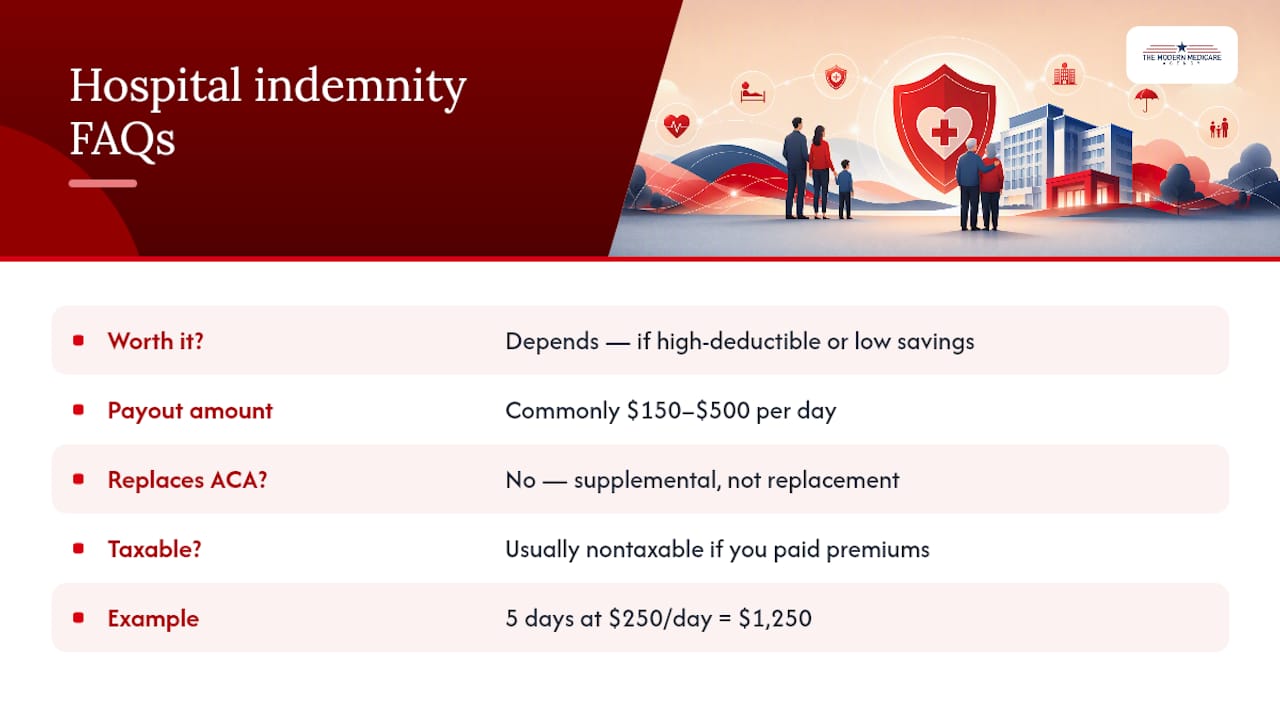
It depends on your finances more than your health. If you have a high-deductible plan, thin savings, or no paid sick leave, the fixed payout often justifies the premium. If you already have strong emergency savings and comprehensive major medical coverage, it’s less essential.
How much will I actually get paid?
That depends entirely on the daily benefit you select at purchase, commonly between $150 and $500 per day. A five-day stay under a $250-per-day policy pays $1,250, before any ICU or rider boosts.
Is a hospital indemnity plan a replacement for ACA marketplace insurance?
No. It’s supplemental coverage that pays cash on top of, not instead of, a major medical plan. It doesn’t cover routine doctor visits, prescriptions, or preventive care the way ACA-compliant plans do.
Is the payout taxable?
If you paid the premiums yourself with after-tax dollars, the benefit is typically not taxable. If your employer paid the premiums pretax, the payout may be taxable. Check with a tax professional for your specific situation.
This article is general information, not a substitute for advice from a qualified financial advisor. Consult a qualified financial professional about your own circumstances before acting on anything here.
Sources
- Hospital Indemnity Insurance – Anthem
- What Is Indemnity Health Insurance? – Investopedia
- How hospital indemnity insurance works | Guardian