




What if the “safe” choice you’ve made for your healthcare is actually the biggest threat to your retirement savings? Many people believe that sticking with basic coverage is enough, but they soon discover that the 20% gap in Original Medicare can lead to unlimited bills. Learning how to choose a medicare plan to lower out-of-pocket costs is the key to stopping this drain. It’s normal to feel overwhelmed by more than 40 carriers and 2026 costs like the $1,736 Part A deductible. You’ve worked hard for your savings, and the anxiety of health inflation is heavy.
I want to help you replace that stress with a sense of total security. As an independent advocate, I serve you rather than a single insurance company. In this guide, you’ll discover simple, expert strategies to shield your retirement from unexpected bills. We’ll look at the $202.90 Part B premium and the new prescription drug caps to see how they impact your monthly budget. By the end, you’ll have a clear, step by step path to decide whether a Medicare Advantage or a Supplement plan is the right shield for your future. Let’s move from uncertainty to a state of complete certainty together.
Key Takeaways
- Understand the “Medicare Gap” and how to protect yourself from the unlimited 20% coinsurance risk that can drain retirement savings.
- Compare the predictable, fixed-cost structure of Medigap plans against the lower monthly premiums of Medicare Advantage options for 2026.
- Follow a clear, 5-step roadmap on how to choose a medicare plan to lower out-of-pocket costs by auditing your current medical usage and prescriptions.
- Learn how the Maximum Out-of-Pocket (MOOP) limit serves as a critical safety net against catastrophic medical debt.
- Discover the peace of mind that comes from working with an independent advocate who compares over 40 carriers to find your ideal health budget.
Why Medicare Cost Planning in 2026 Feels Different
Transitioning from an employer health plan to Medicare often feels like moving from a paved road to an unmapped forest. For decades, your company likely handled the heavy lifting of insurance decisions. Now, as you look toward 2026, the responsibility sits squarely on your shoulders. It’s a stressful shift. Healthcare isn’t just another bill in retirement; it’s often the largest variable expense you’ll face. Understanding how to choose a medicare plan to lower out-of-pocket costs is the first step in turning that variable into something predictable.
Let’s start with a concrete number. In 2026, the standard monthly premium for Part B is $202.90. While this is a fixed starting point, the costs that follow can vary wildly based on your health and your plan structure. This article is your roadmap. We’ll move from the current state of confusion to a place of financial certainty, ensuring your retirement savings stay where they belong. You deserve to enjoy your retirement without the shadow of medical debt hanging over you.
The Shift to a Fixed-Income Healthcare Strategy
Medical inflation in 2026 makes proactive planning essential. When you’re on a fixed income, a single unexpected hospital stay can feel like a direct hit to your nest egg. For example, the 2026 Part A deductible is $1,736. If you wait until you’re sick to “figure it out,” you’ve already lost the chance to save. Smart insurance isn’t about hoping you don’t get sick. It’s about building a shield around your savings so that a diagnosis doesn’t become a financial crisis. Protecting your nest egg requires looking at your health risk today, not tomorrow.
Medicare as a Foundation, Not a Ceiling
Many people assume that Medicare (United States) provides total coverage. In reality, it’s a foundation, not a ceiling. Original Medicare (Parts A and B) typically covers about 80% of your medical costs. That remaining 20% has no limit, which is a high-risk strategy for 2026. You have the power to control these costs through your choices. Whether you look toward Medigap plans for maximum predictability or Medicare Advantage for lower monthly premiums, you are the one in the driver’s seat. Your choice determines whether you face a predictable budget or a mountain of bills.
Identifying the “Medicare Gap”: Where Your Money Goes
Most people are surprised to learn that Original Medicare has no safety net. It’s designed to share costs with you, but that share can be unpredictable. When exploring how to choose a medicare plan to lower out-of-pocket costs, you must first understand the “Gap.” This is the 20% of medical bills that you are responsible for under Part B. While 20% of a $100 doctor visit is only $20, 20% of a $100,000 hospital bill is a crisis. Without a cap on this spending, your retirement savings are at unlimited risk.
Hospital stays bring their own challenges. In 2026, the Part A deductible is $1,736 per benefit period. It’s a common mistake to think this is an annual fee. In reality, if you’re out of the hospital for 60 days and then return, you may have to pay that $1,736 again. It’s these recurring costs that make the Medicare Plan Finder so essential for comparing your options. Understanding these holes in your coverage is essential when learning how to choose a medicare plan to lower out-of-pocket costs for the long term.
The 2026 Prescription Drug Cap (Part D)
There’s good news for your pharmacy budget in 2026. A new federal limit caps your out-of-pocket drug costs at $2,000 for the year. This is a massive shift from previous years when costs could climb much higher. This safety net ensures that even the most expensive medications won’t bankrupt you. You can find more details on this in our guide to Medicare Part D. If you feel unsure about which gaps to prioritize, you can talk to an independent advocate who can help you map out your specific risks.
Hidden Costs: Dental, Vision, and Hearing
Don’t forget the costs that aren’t in the “Gap” because they aren’t covered at all. Original Medicare generally excludes routine dental work, eye exams, and hearing aids. These “small” expenses often add up to thousands of dollars over a year. If you’re concerned about these gaps, you might consider adding dental insurance plans to your coverage. By addressing these hidden fees early, you can create a truly predictable monthly health budget.
Strategy 1: Medicare Supplement Plans for Maximum Predictability
When you’re deciding how to choose a medicare plan to lower out-of-pocket costs, you’re really choosing between two different financial philosophies. The first is Medicare Supplement (Medigap). I often call this the “Pay Now, Save Later” strategy. You pay a higher monthly premium upfront, but in return, you face nearly zero costs when you actually use medical services. It’s the ultimate tool for predictability in a world where healthcare costs seem to change every day.
Imagine walking into your doctor’s office or a specialist’s clinic and knowing exactly what the bill will be: zero. For many, that peace of mind is worth the monthly premium. You also gain incredible freedom. You can see any doctor in the U.S. that accepts Medicare, which is a major advantage over more restrictive networks. While a KFF analysis of Medicare Advantage plans shows how other structures handle out-of-pocket limits, Medigap remains the primary way to bypass those limits entirely. It removes the stress of “in-network” vs. “out-of-network” altogether.
Is a Supplement Plan Right for Your Budget?
The ideal candidate for a Supplement plan is someone who hates surprises. If you prefer a fixed monthly line item rather than wondering if a diagnostic test will cost you $50 or $500, this is your path. While your monthly premiums are higher than other options, your total yearly healthcare spend becomes remarkably stable. You aren’t just buying insurance; you’re buying a predictable lifestyle. Medigap Plans, like Plan G, are the gold standard for those who want to eliminate the 20% coinsurance risk entirely.
The Long-Term Value of Medigap
If you live with a chronic condition, Medigap is often the most cost-effective choice over the long term. Frequent doctor visits or ongoing treatments can quickly trigger out-of-pocket costs in other plans. With a Supplement, those visits are covered. It’s a methodical way to protect your savings from the “death by a thousand cuts” that small copays can cause. Remember, you must have Part A and Part B to buy one of these plans. For a deeper look at your options, read our guide on What Is Medicare Supplement Insurance?. This is how you move from a state of distress to one of total certainty.
Strategy 2: Medicare Advantage for Low Premiums and MOOP Protection
If the “Pay Now” approach of Medigap doesn’t fit your current budget, you might consider the “Pay as You Go” style of Medicare Advantage. This is a popular choice for those who want to keep their monthly fixed costs as low as possible. Many of these plans offer $0 or very low monthly premiums. This allows you to keep more of your Social Security check every month while still receiving protection that goes beyond what Original Medicare provides. You still pay your standard Part B premium of $202.90, but the Advantage plan often covers the rest of the monthly cost.
Understanding how to choose a medicare plan to lower out-of-pocket costs involves looking closely at the Maximum Out-of-Pocket (MOOP) limit. In 2026, the maximum limit for in-network services is $9,250. While that might sound high, it’s actually a vital safety net. Remember, Original Medicare has no limit on your 20% coinsurance risk. The MOOP acts as a legal ceiling on your medical spending. Once you reach this limit, the plan pays 100% of your covered medical costs for the rest of the year. This provides a clear “safety valve” that prevents financial ruin during a health crisis.
You also get the convenience of an “All-in-One” plan. Most Medicare Advantage options include prescription drug coverage (Part D), along with dental, vision, and hearing benefits. This simplifies your life. You don’t have to manage multiple insurance cards or separate monthly bills. It’s a streamlined way to handle your health needs under one roof.
The Trade-off: Networks and Copays
There’s always a trade-off for lower premiums. With Medicare Advantage, you usually must stay within a specific provider network, such as an HMO or PPO. Instead of the “zero bill” experience of Medigap, you’ll pay small copays when you use services. For example, you might pay $20 for a primary care visit or $40 for a specialist. It’s essential to check if your favorite doctors are “in-network” before you sign up. If you want to see which plans cover your specific doctors, contact us today for a personal plan comparison.
Who Saves the Most with Medicare Advantage?
The ideal candidate for this strategy is someone who is generally healthy and prefers lower monthly fixed costs. If you only see a doctor a few times a year, paying a high Medigap premium might not make sense. You can save those monthly dollars and only pay copays when you actually need care. The MOOP stays in the background, ready to protect you if your health needs suddenly change. It’s a logical way to balance your monthly budget with catastrophic protection.
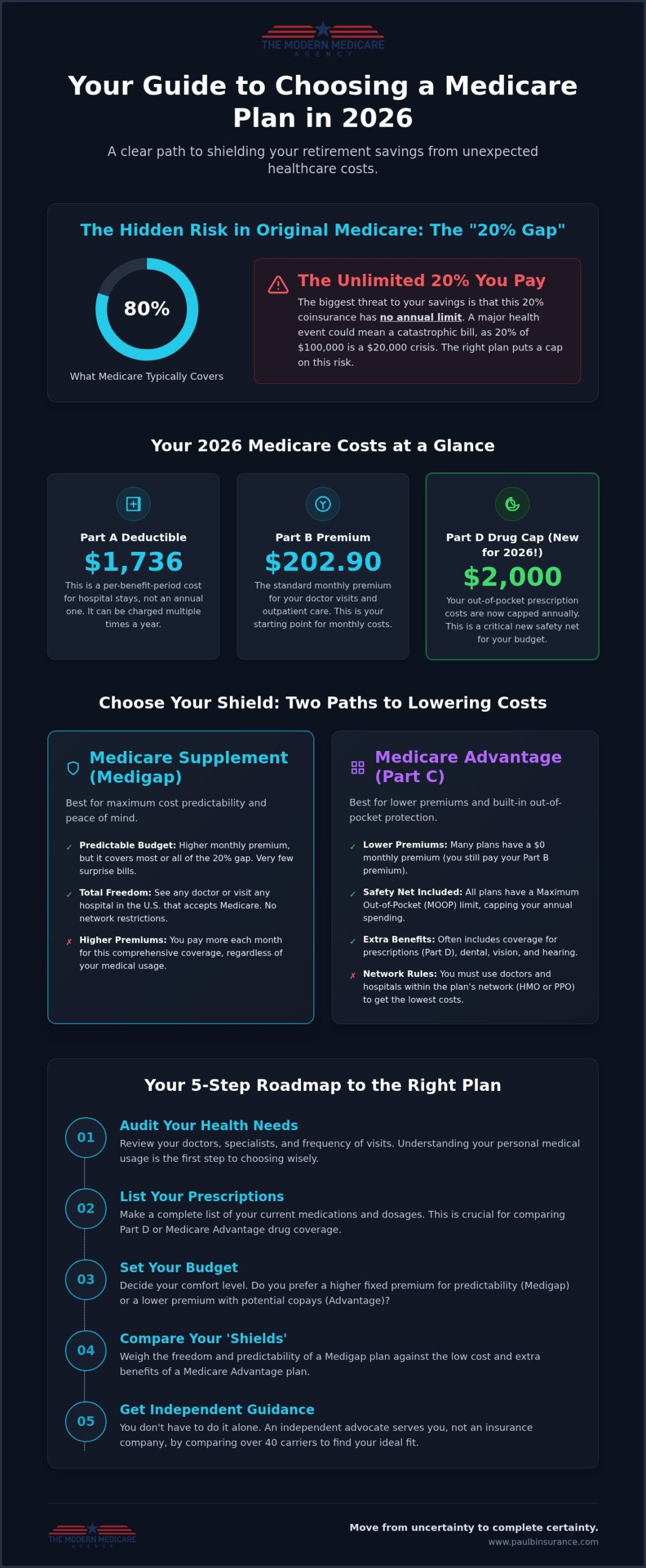
How to Choose: Your 5-Step Roadmap to Lowering Costs
Finding the right coverage doesn’t have to be a source of anxiety. It’s simply a matter of following a logical path from confusion to clarity. When you’re ready to learn how to choose a medicare plan to lower out-of-pocket costs, use this 5-step roadmap to protect your savings in 2026. This process moves you away from guesswork and toward a predictable monthly health budget.
- Step 1: Audit your 2025 medical usage. Look back at the last year. How often did you actually see a doctor? Were there unexpected tests or hospital stays? This data tells you if you need the high protection of Medigap or the low premiums of Advantage.
- Step 2: List your “Must-Have” medications. With the new $2,000 out-of-pocket cap in 2026, checking plan formularies is more important than ever. You want to ensure your specific drugs are covered under the most favorable tier.
- Step 3: Decide on your “Budget Style.” This is where you choose your financial philosophy. Do you prefer a higher monthly premium to eliminate “bill surprises,” or do you prefer low premiums and paying small copays as you go?
- Step 4: Check your Medicare Eligibility. Timing is everything. Ensure you know your specific enrollment windows to avoid lifelong penalties.
- Step 5: Talk to an independent broker. Don’t try to navigate 40+ carriers alone. A professional can compare every option side-by-side to find your ideal match.
The Value of an Independent Medicare Broker
Many people mistakenly call a “captive” agent who only works for one insurance giant. These representatives can only show you a limited slice of the market. An independent broker like Paul Barrett works for you, not the insurance company. We have access to over 40 carriers, allowing us to be a calm guide through the complex 2026 landscape. This service is usually provided at no cost to you, as we are compensated by the carriers. You get an expert advocate in your corner who prioritizes your needs. For more on how this works, see our Medicare Broker Guide.
Avoiding the Costly Late Enrollment Penalties
Missing your Initial Enrollment Period is one of the most expensive mistakes you can make. These penalties aren’t just one-time fees; they stay with you for life. The Part B late enrollment penalty adds an extra 10% to your premium for every 12-month period you were eligible but did not enroll. To keep your costs low, I encourage you to start your planning at least 6 months before you turn 65. Starting early allows you to move through this journey with peace of mind rather than rushing under pressure. By taking these steps, you can secure a future where your health is protected and your savings are safe.
Securing Your Financial Future for 2026
You now have the tools to move from a state of uncertainty to one of complete confidence. We’ve explored how the 20% gap in Original Medicare can impact your savings and why the new 2026 drug caps offer a vital safety net. Whether you choose the total predictability of a Supplement plan or the low monthly costs of Medicare Advantage, your decision today protects your retirement tomorrow. Understanding how to choose a medicare plan to lower out-of-pocket costs is the most important step in safeguarding your nest egg.
You don’t have to make these decisions alone. I provide independent advice by comparing over 40 carriers to find the perfect fit for your specific health needs. My zero-pressure, educational approach has helped clients across 34 states find peace of mind. Schedule a free, reassuring consultation with Paul Barrett today. Your journey to a secure healthcare budget starts with a single conversation. I’m here to guide you every step of the way.
Frequently Asked Questions
What is the maximum out-of-pocket limit for Medicare in 2026?
Original Medicare (Parts A and B) actually has no maximum out-of-pocket limit. This means you are responsible for 20% of your medical bills without a ceiling. However, Medicare Advantage plans are required to have a legal limit. In 2026, the maximum out-of-pocket limit for in-network services is $9,250. Many individual plans set much lower limits to provide better protection for your budget. This limit is a key factor when deciding how to choose a medicare plan to lower out-of-pocket costs.
Is it better to have a Medicare Advantage plan or a Medigap plan to save money?
The best choice depends entirely on your health usage and risk tolerance. A Medicare Advantage plan typically offers $0 or low monthly premiums, making it attractive if you are generally healthy. A Medigap plan has higher monthly premiums but covers almost all your out-of-pocket costs at the doctor. If you see specialists frequently, Medigap often saves you more in the long run by eliminating unpredictable copays and the 20% coinsurance gap that Original Medicare leaves behind.
Does Medicare Part B have a deductible in 2026?
Yes, Medicare Part B has an annual deductible of $283 in 2026. You must pay this amount out-of-pocket for covered medical services before Medicare begins to pay its share. Once you meet this deductible, you typically pay 20% of the Medicare-approved amount for most doctor services. If you have a Medigap plan, it may cover some or all of your costs after this deductible is met, depending on the specific plan letter you choose for your coverage.
How much does Medicare cost per month for a 65-year-old in 2026?
For most 65-year-olds, the standard monthly cost starts with the Part B premium, which is $202.90 in 2026. Most people don’t pay a premium for Part A if they have worked at least 10 years in the U.S. Beyond these base costs, your total monthly expense will include any premiums for a Part D drug plan, a Medigap policy, or a Medicare Advantage plan. These additional costs vary based on the specific carrier and coverage level you select.
What is the 2026 Part D “donut hole” change I keep hearing about?
The “donut hole” or coverage gap has been officially replaced by a much simpler system in 2026. The most significant change is a new $2,000 annual out-of-pocket maximum for prescription drugs covered under Part D. Once you spend $2,000 on your medications, you won’t pay anything else for covered drugs for the rest of the year. This provides incredible peace of mind for those with high medication costs and simplifies your monthly financial planning significantly.
Can I change my Medicare plan if my out-of-pocket costs become too high?
You can generally change your plan during the Annual Enrollment Period, which runs from October 15 to December 7 each year. Changes made during this time take effect on January 1. If you are already in a Medicare Advantage plan, you also have a window from January 1 to March 31 to switch to a different Advantage plan or return to Original Medicare. Moving to a Medigap plan later may require medical underwriting depending on your specific state’s laws.
Does Medicare cover dental and vision costs in 2026?
Original Medicare does not cover routine dental, vision, or hearing services. To get this coverage, many beneficiaries choose a Medicare Advantage plan, as these often include these extra benefits as part of the package. Alternatively, you can purchase standalone dental and vision insurance plans. Addressing these costs is a vital part of learning how to choose a medicare plan to lower out-of-pocket costs, as these “small” expenses can add up quickly over a full year.
How do I find out if my doctor is in-network for a 2026 plan?
The most reliable way is to check the specific plan’s online provider directory or call the doctor’s office directly with the plan name. Since networks can change from year to year, it’s important to verify this during the enrollment period. As an independent broker, I can also help you check multiple plan networks at once to ensure your favorite doctors and specialists are included before you make a final decision on your 2026 health coverage.

Article by
Paul Barrett
Paul Barrett, CMIP is the founder of The Modern Medicare Agency, an independent Medicare-only brokerage based in Melville, NY. With 18 years of Medicare-exclusive experience, a CMIP designation, and more than 5,000 clients served across 37 states, Paul is one of the most credentialed independent Medicare specialists on Long Island — and one of the most direct.
He represents 40+ carriers with no quotas and no allegiances, which means his recommendations are based entirely on what fits each client's specific situation. He is the author of Medicare Mastery Unlocked and host of the Wise Guys Retirement Talk podcast. His content is grounded in primary sources, real carrier intelligence, and 18 years of watching what happens when people get Medicare right — and when they don't.
📞 631-358-5793 | paulbinsurance.com