




Yes. Extra Help (the Part D Low-Income Subsidy) can eliminate or sharply cut your Medicare drug plan premium, deductible, and copays if you’re disabled and living on a limited income. Since January 1, 2024, everyone who qualifies gets a full 100% premium subsidy, not the partial help older rules allowed.
You can apply any time, no enrollment window required. Some people, including those on Medicaid or Supplemental Security Income (SSI), are automatically enrolled and never need to fill out a form.
- Full or partial premium coverage depending on income
- Reduced or eliminated annual deductible
- Capped copays on covered generic and brand-name drugs
- No Part D late-enrollment penalty while you’re enrolled
Start at SSA.gov or Medicare.gov for the official rules, or talk to Paul B Insurance if you want someone to walk through the paperwork with you.
Key Takeaways
Extra Help eliminates or sharply reduces Part D premiums, deductibles, and copays for eligible disabled and low-income Medicare beneficiaries, with full subsidies now standard for new awards.
| Point | Details |
|---|---|
| Full subsidy since 2024 | New Extra Help awards starting on or after January 1, 2024 receive 100% premium coverage. |
| SSDI doesn’t mean automatic enrollment | Only SSI, full Medicaid, or a Medicare Savings Program trigger deemed eligibility; SSDI recipients must apply. |
| Apply any time | Use SSA’s online i1020 form, phone, mail, or a state Medicaid agency; no enrollment window applies. |
| Avoid the top denial cause | Accurately report all countable assets and household income to prevent processing delays. |
| Get personalized screening | Paulbinsurance offers free Extra Help eligibility checks and Part D plan matching based on your prescriptions. |
Table of Contents
- What Is the Extra Help Program and Who Qualifies as Disabled?
- Who Meets the Income and Resource Limits for Extra Help?
- What Does Extra Help Actually Save You on Prescriptions?
- How Do You Apply for Extra Help Step by Step?
- Do You Need to Apply, or Are You Automatically Enrolled?
- When Does Coverage Start, and What Happens if You’re Not Yet Enrolled?
- What Documentation Mistakes Cause Extra Help Denials?
- How Paul B Insurance Helps You Navigate Extra Help and Part D
- Does Extra Help Affect Your Taxes or Other Benefits?
- How Often Do You Need to Renew Extra Help, and Does It Expire?
- What Do People Get Wrong About Extra Help?
- Why Disabled Beneficiaries Often Miss This Benefit
- Get Help Applying for Extra Help and Choosing a Part D Plan
- Frequently Asked Questions
- Sources
What Is the Extra Help Program and Who Qualifies as Disabled?
Extra Help is the federal subsidy that lowers what you pay for Medicare Part D prescription drug coverage. It’s not a separate drug plan. It’s assistance layered onto whatever Part D or Medicare Advantage plan with drug coverage you already have.
The program serves two groups: seniors 65 and older, and people under 65 who qualify for Medicare because of a disability. Age has nothing to do with eligibility for Extra Help itself. What matters is your income, your resources, and whether you’re already on Medicare.
The biggest recent shift affects everyone equally: as of January 2024, any Extra Help award with a coverage start date on or after January 1 of that year comes with the full premium subsidy, replacing the old sliding scale that gave partial help to some applicants. If you were denied full assistance years ago under the old formula, it’s worth checking again.
- Applies to Medicare enrollees of any age, including those disabled and under 65
- Replaces the old partial subsidy tiers with one full subsidy level for new awards
- Works alongside your existing Part D or Medicare Advantage drug plan
Who Meets the Income and Resource Limits for Extra Help?
Eligibility comes down to two numbers: your countable income and your countable resources, both of which the Social Security Administration reviews and adjusts annually. The general guidance ties income eligibility to 150% of the federal poverty level, though exact dollar thresholds shift every year, so don’t rely on a figure you saw two years ago.
You don’t need to apply if you already fall into one of these “deemed” categories:
- You have full Medicaid coverage
- You receive SSI payments
- You’re enrolled in a Medicare Savings Program (QMB, SLMB, or QI)
There’s one notable exception: people in the Qualified Disabled and Working Individuals (QDWI) program are not automatically deemed eligible and must apply separately.
Pro Tip: If you’re married and living with your spouse, SSA counts both of your incomes and resources together, even if only one of you is on Medicare. This trips up a lot of applicants who assume only their own numbers count.
Here’s where disabled beneficiaries often get confused: receiving Social Security Disability Insurance (SSDI) does not automatically enroll you in Extra Help. Only SSI, full Medicaid, and Medicare Savings Program enrollment trigger automatic eligibility. If you’re on SSDI alone, you need to submit an application.
What Does Extra Help Actually Save You on Prescriptions?
The savings are concrete, not vague. Depending on your income level, Extra Help pays toward your Part D premium, your annual deductible, and your copayments, and it protects you from the Part D late-enrollment penalty for as long as you’re enrolled.
Full-benefit recipients typically see:
- Little to no monthly premium (as long as your plan is at or below the regional benchmark amount)
- Little to no annual deductible
- Copays capped at a small, fixed amount for covered generics and a somewhat higher fixed amount for covered brand-name drugs
- $0 cost sharing once you cross the catastrophic coverage threshold
Medicare estimates the total value of Extra Help can run into thousands of dollars a year for someone who’d otherwise pay full price on multiple prescriptions.
One catch worth understanding: the “benchmark rule.” Extra Help covers premiums up to a regional benchmark amount set each year. If you pick a plan priced above that benchmark, you’ll owe the difference out of pocket, even with full Extra Help. Checking your plan’s premium against the current benchmark before you enroll saves you an unpleasant surprise later.
How Do You Apply for Extra Help Step by Step?
If you’re not automatically deemed eligible, applying is more straightforward than most people expect.
- Apply online through the SSA’s Extra Help application (i1020), by phone, at a local Social Security office, or through your state Medicaid agency.
- Gather your documents before you start: recent income statements (SSDI award letters, pension statements, wages), bank and investment statements, proof of Medicare enrollment, and photo ID.
- Submit the application and keep a copy of everything, including the date you filed.
After you apply, expect a written decision by mail, often called by color: Purple, Yellow, or Green notices, each signaling a different subsidy level or a denial. Most decisions arrive within a matter of weeks, though processing can stretch longer if your file needs additional verification.
- Apply online, by phone, in person, or through your state agency
- Keep proof of income and assets organized before you start
- Watch your mail for the official notice explaining your subsidy level
Do You Need to Apply, or Are You Automatically Enrolled?
If you have full Medicaid, SSI, or a Medicare Savings Program, SSA deems you eligible without any paperwork on your end. You’ll get an official notice confirming your subsidy level, and if you’re not yet in a Part D plan, Medicare will facilitate enrollment into one automatically so you’re not left without drug coverage.
- Deemed groups: full Medicaid recipients, SSI recipients, Medicare Savings Program enrollees
- QDWI enrollees are the exception and must file an application
- Facilitated enrollment places deemed individuals into a plan if they haven’t chosen one themselves
When Does Coverage Start, and What Happens if You’re Not Yet Enrolled?
Coverage generally begins the month after SSA approves your application, though deemed eligibility can start immediately. Anyone awarded Extra Help with a start date on or after January 1, 2024 gets the full premium subsidy, a meaningful change from the tiered system used in prior years.
If you’re eligible but haven’t picked a Part D plan yet, the LI NET program acts as a temporary safety net, covering prescriptions in the gap and potentially reimbursing costs you already paid.
- Coverage can start the month after approval, or sooner if deemed
- LI NET bridges the gap between eligibility and plan enrollment
- You can reapply any time your income or resources change; eligibility is reviewed annually
Pro Tip: Keep every pharmacy receipt from the moment you believe you’re eligible. If LI NET later confirms your coverage retroactively, those receipts are what get you reimbursed.
What Documentation Mistakes Cause Extra Help Denials?
Most denials trace back to paperwork, not actual ineligibility. Incomplete or inaccurate financial disclosures are consistently the most common reason applications get kicked back for review or denied outright.
- Underreporting resources like a second bank account, a certificate of deposit, or an old life insurance policy with cash value
- Confusing countable assets (savings, stocks, extra property) with non-countable ones (your primary home, one vehicle, personal belongings)
- Leaving out a spouse’s income or resources when you live together
- Submitting outdated statements instead of current ones
Pro Tip: Before you submit, list every account and asset you or your spouse hold, then mark each one countable or non-countable. Catching a missing account now beats appealing a denial later.
How Paul B Insurance Helps You Navigate Extra Help and Part D
Paul Barrett has worked with Medicare consumers since 2007, and Paulbinsurance built its approach around a simple idea: you make better decisions when someone explains your options in plain language first.
For disabled beneficiaries specifically, that means help screening for Extra Help eligibility, assistance gathering and organizing the documents SSA asks for, and matching you to a Part D plan that actually covers your prescriptions at the lowest cost.
Education first isn’t a slogan here. It’s the difference between a client who understands why a plan denied a claim and one who’s just confused and frustrated.
- Eligibility screening before you apply, so you know your odds
- Help completing SSA forms accurately the first time
- Plan comparisons based on your actual prescription list, not guesswork
- Transparency about how the agency gets paid: commissions from carriers, never fees charged to you
Does Extra Help Affect Your Taxes or Other Benefits?
Extra Help is not taxable income. The subsidy pays your pharmacy and premium costs directly through Medicare’s system, so you never receive a check, and there’s nothing to report on your federal tax return. It doesn’t show up as income on a 1099 or any other tax form, and it doesn’t push you into a higher tax bracket.
It also generally doesn’t jeopardize your other public benefits. SSI has strict resource limits, but Extra Help itself isn’t counted as income or a resource against your SSI eligibility. The same holds for Medicaid: receiving Extra Help doesn’t reduce your Medicaid benefits or create a conflict between the two programs. In fact, the programs are designed to work together, since full Medicaid recipients are automatically deemed eligible for Extra Help in the first place.
Where it gets more nuanced is with state-level assistance. Some states run their own pharmaceutical assistance programs that wrap around Extra Help, covering costs the federal subsidy doesn’t fully absorb, particularly for expensive brand-name drugs. These state programs typically don’t penalize you for also receiving Extra Help. If anything, having both is common, and the two often coordinate benefits rather than duplicate them. Programs like Supplemental Nutrition Assistance Program (SNAP) or Low Income Home Energy Assistance Program (LIHEAP) eligibility also generally isn’t affected by Extra Help, since these programs each have their own separate income tests that don’t factor in drug subsidy amounts you receive.
The bottom line for most disabled beneficiaries: applying for Extra Help carries no downside risk to your existing benefits or tax situation. The application itself asks about your finances, but approval doesn’t create new income, new tax liability, or a new asset that counts against other programs.
How Often Do You Need to Renew Extra Help, and Does It Expire?
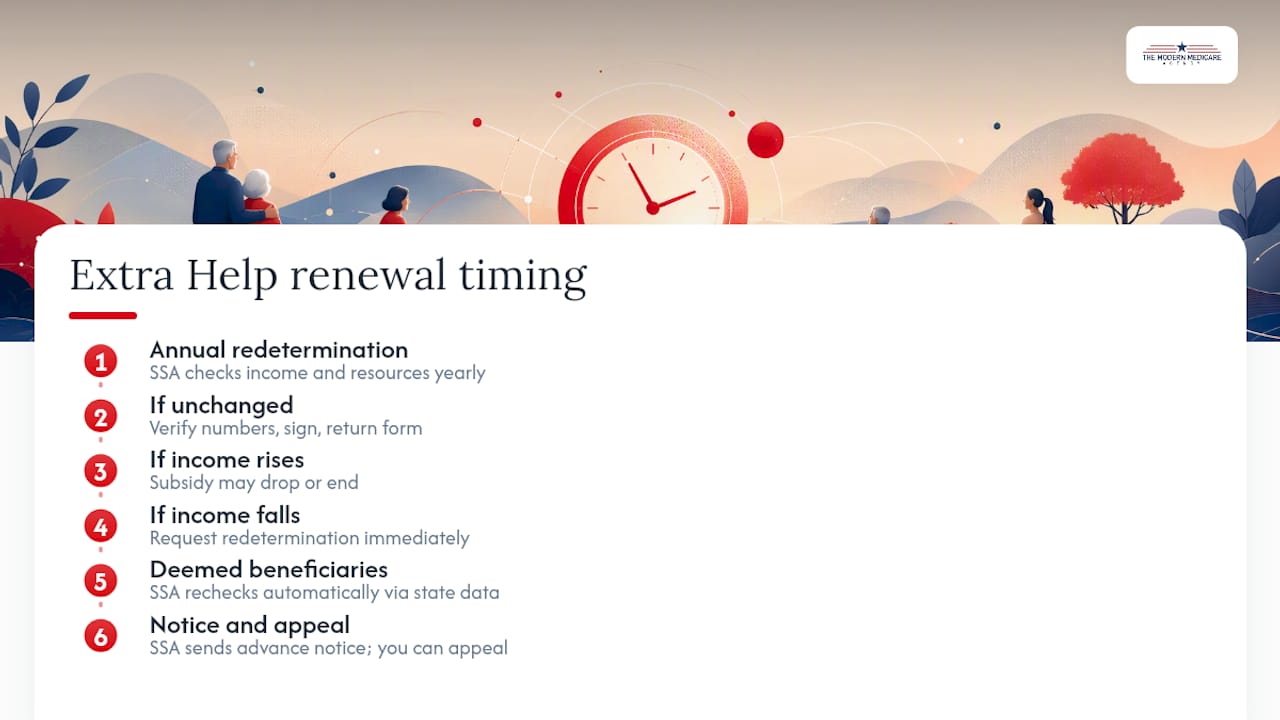
Extra Help isn’t a one-time approval that lasts forever without review. SSA conducts an annual redetermination for most beneficiaries, checking whether your income and resources still fall within the current year’s limits. You’ll typically receive a notice, sometimes called a redetermination form, asking you to confirm or update your financial information.
If your circumstances haven’t changed much, renewal is often simple: verify the numbers, sign, and return the form. If your income or resources have grown, perhaps from a small inheritance, a part-time job, or a change in living arrangements, your subsidy level could shift from full to partial, or in some cases end altogether. The reverse is also true. If your financial situation gets tighter, you can request a new determination immediately rather than waiting for the next annual review.
Deemed beneficiaries, those with full Medicaid, SSI, or a Medicare Savings Program, go through a similar annual recheck, but SSA handles most of it automatically using data already on file with state Medicaid agencies. You may still get a notice confirming your continued eligibility even if you never have to do anything.
One detail that surprises people: losing Extra Help doesn’t happen without warning. SSA sends notices well before any change takes effect, giving you time to appeal the decision or provide updated documentation if you believe the determination is wrong. If your income or resources change for the worse at any point during the year, don’t wait for the annual cycle. You can reapply or request a redetermination the moment your situation shifts, and coverage can adjust accordingly rather than forcing you to overpay for months.
What Do People Get Wrong About Extra Help?
The most persistent myth is that Social Security Disability Insurance (SSDI) automatically qualifies you for Extra Help. It doesn’t. SSDI gets you Medicare eligibility, but Extra Help requires either deemed status through SSI, full Medicaid, or a Medicare Savings Program, or a separate application based on your income and resources.
Another common misunderstanding: people assume owning a home or a car disqualifies them. It doesn’t. Your primary residence and one vehicle are non-countable resources under SSA’s rules, so they don’t count against the resource limit at all.
Some beneficiaries also believe applying once and getting denied means they’re permanently ineligible. That’s false. Eligibility is reviewed annually, and your financial situation this year has no bearing on whether you might qualify next year, or even a few months from now if your income drops.
A few more quick answers to common questions:
Can you have Extra Help and a Medicare Advantage plan? Yes, as long as the plan includes Part D drug coverage.
Does applying hurt your credit or count as a loan? No. It’s a subsidy, not a loan, and SSA’s review has no connection to credit reporting.
What if you’re denied but your income didn’t change? You can request an appeal or reconsideration rather than simply reapplying from scratch.
Why Disabled Beneficiaries Often Miss This Benefit
Disabled beneficiaries under 65 frequently assume Extra Help is a senior program, so they never check their own eligibility, even when their income clearly qualifies. That assumption costs real money every month.

The fastest way to find out where you stand is to check your numbers against current limits at SSA.gov or ask an agent to run the screening for you.
Get Help Applying for Extra Help and Choosing a Part D Plan
Figuring out whether you qualify for Extra Help, then picking a Part D plan that actually covers your medications at the lowest cost, is two separate puzzles most people are solving alone. Paulbinsurance closes that gap by handling both at once: agents check your eligibility for Extra Help and match you to a drug plan built around your actual prescription list, not a generic recommendation.

A consultation costs you nothing. Paulbinsurance is paid by insurance carriers when you enroll through an agent, not by charging you a fee, so there’s no cost to sit down and find out what you qualify for. You’ll walk away knowing your Extra Help status, your likely subsidy level, and which Part D drug plans actually cover what you take.
If you’re ready to find out where you stand, reach out to Paulbinsurance for a free plan comparison and Extra Help screening. It takes one conversation to know exactly what you’re eligible for.
Frequently Asked Questions
Does Extra Help cover Medicare Advantage plans with drug coverage?
Yes, as long as your Medicare Advantage plan includes Part D prescription drug benefits, Extra Help applies the same way it would to a standalone Part D plan.
How long does an Extra Help application take to process?
Most decisions arrive within a few weeks, though cases needing extra income or resource verification can take longer.
Can you qualify for Extra Help if you’re under 65 and on Medicare due to disability?
Yes. Age isn’t a factor. Anyone on Medicare, disabled or not, can qualify based on income and resources.
What happens if your income changes mid-year after you’re approved?
Report the change and request a new determination immediately rather than waiting for your annual review, since your subsidy level can adjust either up or down.
This article is general information, not a substitute for advice from a qualified financial advisor. Consult a qualified financial professional about your own circumstances before acting on anything here.
Sources
- Medicare
- SSA — Apply for Medicare Part D Extra Help program
- SSA POMS: HI 03001.020 – Eligibility for Extra Help (02/11/2026)