



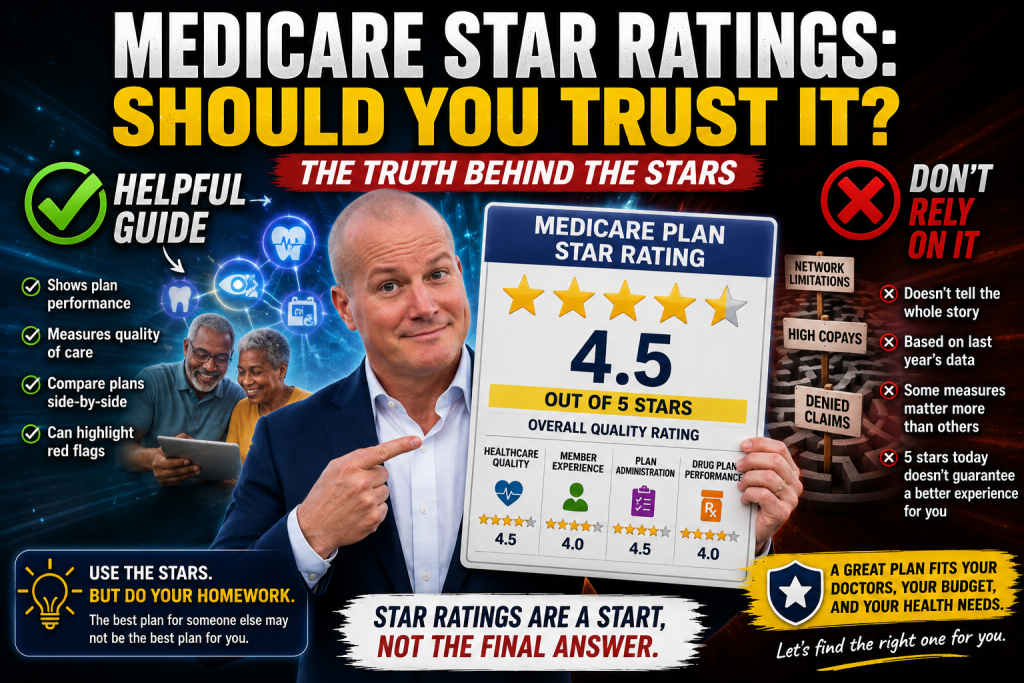
Every fall, Medicare plans get rated on a familiar 1-to-5 star scale — the same kind you’d see on a restaurant or a hotel. It’s tempting to read it exactly that way: more stars, nicer experience. But star ratings do something a hotel rating never does — they directly control how many billions of dollars the federal government pays your insurance company. Understanding that connection changes how you should actually use the rating when you’re comparing plans.
What the Rating Officially Measures
The Medicare Star Rating system is run by the Centers for Medicare & Medicaid Services (CMS), and it scores Medicare Advantage and Part D plans from 1 to 5 stars based on dozens of quality measures — things like member experience, preventive care, chronic condition management, and customer service. On paper, it’s a consumer comparison tool, and CMS built it to help people shop with more information than a premium and a brochure.
But that’s only half the story.
The Part Most People Never See: How Stars Set the Money
Here’s the mechanism that actually drives what happens to your plan year over year.
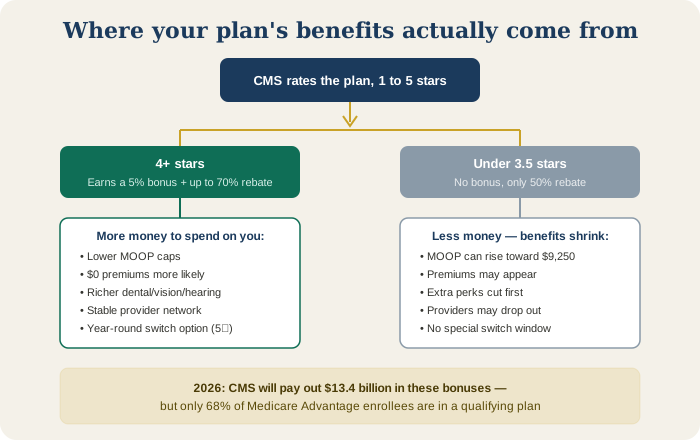
The 5% Quality Bonus. CMS sets a “benchmark” in every county — the maximum it’s willing to pay a private insurer per Medicare Advantage enrollee. If a plan’s contract rates 4.0 stars or higher, CMS automatically boosts that benchmark by a flat 5%. In 2026, this Quality Bonus Program will pay out $13.4 billion across the industry — more than four times what it cost in 2015. But only about 68% of Medicare Advantage enrollees are currently in a plan that qualifies, down from 75% the year before.
The rebate percentage. When a plan bids below its benchmark, the difference is called “savings,” and the government returns a share of it to the insurer as a rebate — which the insurer is legally required to spend on your benefits, not pocket as pure profit. How much of that rebate a plan keeps depends entirely on its star rating:
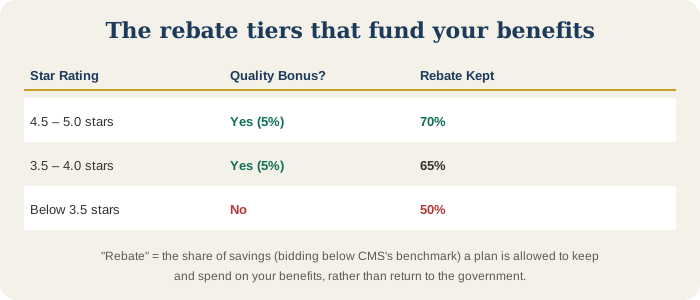
That gap — 70% vs. 50% — is enormous in dollar terms across a large plan, and it’s the reason star ratings matter so much more to insurers than a simple quality label would suggest.
How This Actually Shows Up in Your Benefits
When a plan’s rebate money shrinks, the plan doesn’t absorb that loss quietly — the change gets passed down to members, usually the following plan year:
- The out-of-pocket cap can rise. A well-funded 4.5-star plan might set its MOOP well below the federal ceiling — sometimes as low as 3,000-3,500. A plan that loses its bonus funding may push that number up toward the legal maximum, $9,250 in 2026.
- “$0 premium” plans can add a monthly cost. The bonus pool is a major part of what makes $0-premium plans possible in the first place. Losing that funding can mean a real premium appears where there wasn’t one before.
- Dental, vision, and hearing allowances shrink first. By law, rebate dollars have to go toward reducing your costs or funding extra, non-Medicare benefits. When the rebate percentage drops, these “extras” are typically the first thing trimmed.
- Networks can shrink too. To manage costs with less revenue, some carriers narrow their provider networks — which is why a longtime doctor can suddenly become “out-of-network” the following year with no warning that feels connected to anything you did.
Paul’s Honest Take: This is exactly why I tell clients not to treat a plan’s current benefits as a permanent promise. A plan can look fantastic this year and genuinely shrink next year — not because the insurer decided to be less generous, but because a small ratings dip changed how much government money is funding those benefits in the first place. It’s worth checking the star rating every single Annual Enrollment Period, even for a plan you already like.
It’s Gotten Worse: The 2026 Wave of Plan Exits
Everything above used to be a slow, gradual pressure. In the last two years, it’s become something much sharper: insurers are increasingly choosing to exit markets entirely rather than absorb the cost of running a lower-rated plan.
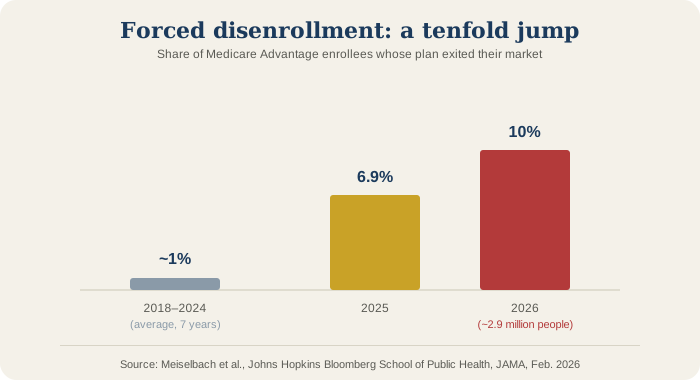
A February 2026 study from the Johns Hopkins Bloomberg School of Public Health and Georgetown University, published in JAMA, found that the forced disenrollment rate — the share of Medicare Advantage members whose plan simply stopped being offered in their county — averaged about 1% a year from 2018 through 2024. In 2025, it jumped to 6.9%. In 2026, it reached 10% — roughly 2.9 million people losing their plan, not by choice, in a single year. That’s a tenfold increase in just two years.
Who gets hit hardest: the study found that people in PPO plans, smaller carriers, lower-rated plans, and rural counties were disproportionately affected. In seven states — Vermont, Idaho, Wyoming, North and South Dakota, Maryland, and New Hampshire — more than 40% of Medicare Advantage enrollees faced this disruption. Vermont was the most extreme case: 92% of the entire state’s Medicare Advantage enrollees had their plan exit the market.
This isn’t only about small players. Humana has publicly said it’s exiting multiple markets for a second consecutive year — an announced move for 2027 affecting roughly 600,000 members — explicitly framed by its own leadership as an effort to “prioritize higher-performing plans.” Smaller carriers have been hit even harder: Clear Spring Health withdrew entirely from Colorado, Georgia, and Illinois, leaving its members there to find new coverage from scratch.
Paul’s Honest Take: What’s happening here is the same mechanism as the star-rating rebate system, just accelerated. When the government reduced how much it overpays Medicare Advantage plans, carriers responded by cutting the plans and regions that were no longer profitable — and that overwhelmingly means lower-rated plans and rural markets. If you’re on a 3 or 3.5-star plan, especially in a rural area or with a smaller carrier, I’d treat this year’s Annual Notice of Change letter as required reading, not junk mail.
If your plan exits, you’re not left without options. You’ll receive a Special Enrollment Period to choose a new Medicare Advantage plan, or move back to Original Medicare — and you cannot be denied or charged more because of a pre-existing condition during that transition. It’s a disruptive process, but not a dangerous one, as long as you act during the window rather than letting it lapse.
This trend isn’t reversing next year, either. CMS finalized changes to the star ratings methodology in 2026 that are projected to send an additional $18.6 billion to insurers over the next decade — but researchers who track this closely don’t expect it to slow the pace of plan exits or benefit cuts for lower-rated plans. The financial pressure pushing carriers toward “profit over enrollment” isn’t a one-year blip; it’s the direction the whole program is heading.
What to Actually Do If You’re Worried About Your Plan
If you’re on a lower-rated plan, in a rural area, or with a smaller or regional carrier, here’s a concrete way to handle it rather than just worrying:
- Check your plan’s current star rating now, don’t wait for fall — the Medicare Plan Finder at Medicare.gov shows it directly.
- Open your Annual Notice of Change (ANOC) letter the day it arrives. It’s the single clearest signal of what’s changing for your plan next year, and it typically arrives by late September.
- If your plan is a PPO with a smaller or regional carrier, treat that combination as a higher-risk profile based on the current data, and have a backup plan researched before Annual Enrollment opens, not after.
- If your plan does exit, don’t panic — use your Special Enrollment Period promptly, and know that pre-existing conditions can’t be used against you during that transition.
- When in doubt, call and ask directly rather than guessing from a letter alone — a five-minute conversation can confirm whether your specific plan and region are genuinely at risk.
When Do New Ratings Actually Come Out — and What’s Changing?
Star ratings follow a predictable annual rhythm, worth knowing so you’re not caught off guard:
- August–September: CMS gives carriers a private “Plan Preview” of their preliminary data, so insurers can review their scores and file administrative challenges before anything goes public.
- Early October: CMS publishes the finalized ratings for the upcoming plan year directly on the Medicare Plan Finder.
- October 15th: Annual Enrollment opens just days later — deliberately timed so you can see current ratings before choosing or renewing a plan.
One labeling quirk worth understanding: ratings are named for the year the benefits take effect, not the year they’re published. The ratings CMS releases in October 2026 are called the “2027 Star Ratings,” even though they land in your mailbox and on Medicare.gov this fall.
A correction worth being precise about: CMS has finalized a significant methodology overhaul for 2027 — removing 11 measures focused on administrative processes (like appeals handling and complaint volume) and shifting more weight toward clinical outcomes and patient experience. It’s a real, verified change. But the actual rating impact of that overhaul won’t show up until the 2029 Star Ratings, released in October 2028 — not this October. Some industry coverage has blurred that distinction; the measure changes begin affecting data collection in the 2027 measurement year, but the ratings themselves take two more years to reflect it.
Paul’s Honest Take: This is a good example of why it pays to read past the headline on anything Medicare-related. “Massive volatility this October” makes for an attention-grabbing claim, but the actual CMS timeline says otherwise. What I’d genuinely watch for is 2028: that’s when plans lose the administrative-measure “buffer” that’s historically helped some carriers hold onto a decent rating even with real gaps in clinical performance. If a plan has been leaning on strong customer-service scores to offset weaker clinical numbers, 2029 is when that math changes.
Why Insurers Sue the Government Over a Fraction of a Star
Because even a small ratings change can swing tens or hundreds of millions of dollars for a large carrier, insurers fight hard to defend their scores. Companies including Humana and Clover Health have filed legal challenges against CMS, arguing that the underlying scoring methodology — including the specific numeric “cut points” used to translate raw performance data into star levels — is flawed or applied inconsistently.
These challenges aren’t just noise: in 2026, a court ruling in Clover Health’s favor forced CMS to recalculate star ratings across the industry, which retroactively increased bonus eligibility, rebate percentages, and even Special Enrollment Period access for some plans.
Paul’s Honest Take: This is a genuinely strange feature of the system worth understanding: the star rating you see for a plan might not be final in the way it looks. Legal challenges can and do change ratings after the fact — which is one more reason not to treat a star rating as gospel, and to recheck a plan’s current standing rather than relying on what you remember from last year.
The One Genuine Perk: The 5-Star Escape Hatch
There’s a real, practical upside to all this for consumers, and it’s worth knowing whether or not you currently care about star ratings at all.
If a plan earns a perfect 5.0-star rating, CMS grants it a special privilege: a year-round Special Enrollment Period. Normally, you’re limited to switching plans during the fall Annual Enrollment Period (October 15 – December 7) or the Medicare Advantage Open Enrollment Period (January 1 – March 31). But if a qualifying 5-star plan is available in your area, you can switch into it once, any time between December 8 and November 30 of the following year — completely outside the normal enrollment calendar.
In 2026, only 21 contracts nationwide earned a full 5.0-star rating, so this option is genuinely selective and not available everywhere. But if one exists in your area and you’re unhappy with your current plan, it’s a real, underused way out that doesn’t require waiting for fall.
How to Actually Use Star Ratings When Shopping
Given all of this, here’s the honest way to read a star rating:
- Treat it as a stability index, not a satisfaction score. A 4+ star plan is financially well-supported and more likely to keep its current benefits stable. A sub-3.5-star plan is on shakier financial ground, and its perks are genuinely more vulnerable to cuts next year.
- Don’t assume a lower-starred plan is bad care. The rating blends dozens of measures at the contract level, not necessarily your specific experience with your specific doctors within that plan.
- Recheck every year, even for a plan you’re happy with. Ratings and their financial consequences reset annually — what funded your benefits last year isn’t guaranteed to fund them next year.
- If a 5-star plan exists near you, know you have a standing option, not just during the fall rush.
Frequently Asked Questions
Does a higher star rating mean better doctors or hospitals? Not directly. The rating measures the insurance plan’s overall performance — things like member satisfaction, preventive screening rates, and complaint volume — not the quality of any individual doctor within the network.
Can a plan’s star rating change mid-year? Ratings are generally set annually, but as the Clover Health case shows, a legal challenge can force a retroactive recalculation that changes bonus eligibility and rebate percentage after the fact.
If my plan drops below 4 stars, will my benefits definitely get worse? Not guaranteed, but the financial pressure to reduce benefits increases meaningfully. Some carriers absorb the hit for a year to retain members; many don’t, especially for the non-mandatory “extra” perks.
Where do I actually check a plan’s current star rating? The Medicare Plan Finder at Medicare.gov displays the current rating for every plan available in your area, alongside the specific benefits and costs for that plan year.
When do new star ratings actually come out? CMS releases finalized ratings for the upcoming plan year in early October — typically between October 5th and October 15th — timed deliberately to land just before the Annual Enrollment Period opens on October 15th, so you can see current ratings before you shop or renew.
Confusingly, a “2027 Star Rating” doesn’t mean it comes out in 2027 — does it? Right — ratings are labeled by the year the benefits take effect, not the year they’re published. The “2027 Star Ratings” are actually released in October 2026, ahead of AEP for the 2027 plan year.
Is it worth switching plans purely to chase a higher star rating? Not on its own — a slightly lower-rated plan with your specific doctors in-network is often the better choice than a higher-rated plan that doesn’t include your care team. Use the rating as one input, not the deciding factor.
What happens if my plan exits my market entirely? You’ll get a Special Enrollment Period to choose a new Medicare Advantage plan or return to Original Medicare, and insurers cannot deny you or charge more for pre-existing conditions during that transition. It’s worth acting promptly once you’re notified rather than waiting until close to a deadline.
How do I know if my plan is at risk of exiting or getting cut back? Watch your mail closely every fall for your plan’s Annual Notice of Change (ANOC) — it details exactly what’s changing for the coming year. If your current plan sits at 3 or 3.5 stars, is a PPO, is offered by a smaller carrier, or you’re in a rural area, the recent data suggests you’re in a higher-risk category and it’s worth double-checking your plan’s status even before ANOC arrives.
The Bottom Line
Star ratings aren’t fake, and they’re not meaningless — but they’re doing a very different job than most people assume. Rather than reading them purely as “how good is this plan,” it’s more accurate — and more useful — to read them as “how financially supported is this plan right now, and how likely is it to keep its current benefits.” Check the rating every year, even for a plan you already have, and don’t be afraid to ask directly how a rating change might affect what you’re paying next year.
Related Reading
- Original Medicare vs. Medicare Advantage: The Foundational Difference
- Deductibles, Coinsurance, Copays, and MOOP: What’s the Difference?
- Medicare Networks Explained: HMO, PPO, PFFS
- Prior Authorization: What It Is and Why It Matters
Sources:
- KFF — Medicare Will Spend More Than $13 Billion on the Medicare Advantage Quality Bonus Program in 2026
- KFF — How Medicare Pays Medicare Advantage Plans: Issues and Policy Options
- Medicare.gov — Special Enrollment Periods
- CMS — Medicare Advantage and Part D Star Ratings
- Johns Hopkins Bloomberg School of Public Health — 1 in 10 Medicare Advantage Enrollees Face Forced Disenrollment in 2026
- AJMC — Unprecedented Spike in Plan Exits Threatens Medicare Advantage Stability
- Healthcare Dive — Medicare Advantage Bonuses Will Exceed $13B This Year, KFF Finds
- CMS — Contract Year 2027 Medicare Advantage and Part D Final Rule Fact Sheet
This article reflects 2026 Medicare rules and is for educational purposes. Star ratings and plan benefits change every year — if you’d like help checking how a specific plan’s current rating might affect your coverage, call us at 631-358-5793. No pressure, no cost.