




Annual Enrollment Period runs October 15 through December 7, and any change you make takes effect January 1. Before that window closes, you need to do five things: read your Annual Notice of Change (ANOC), list every medication with exact dosage, verify your key doctors are still in network, estimate your realistic total yearly cost, and submit or confirm whatever change you choose. Miss the deadline and you stay locked into your current plan, even if premiums jumped or your pharmacy dropped out of network; for detailed local guidance, see our tips on Medicare enrollment in New Jersey.
This annual enrollment period changes checklist walks through each step in the order Paul Barrett’s team uses when reviewing a client’s coverage, start to finish.
- Read the ANOC that arrived by late September
- List medications with dosage, frequency, and pharmacy
- Call your top two or three providers to confirm network status
- Add up premium plus realistic out-of-pocket costs, not premium alone
- Submit your change and save the confirmation number
The Annual Enrollment Period officially runs Oct 15 to Dec 7, with elections taking effect January 1 of the following year.
Key Takeaways
Finishing your AEP review comes down to reading the ANOC, verifying meds and providers, comparing total annual cost, and confirming your submission before December 7.
| Point | Details |
|---|---|
| Know your deadline | AEP runs October 15 to December 7, with changes effective January 1. |
| Read the ANOC first | It lists every premium, formulary, network, and cost change before you compare anything. |
| Compare total cost | Add premium plus realistic out-of-pocket drug and specialist costs, not premium alone. |
| Verify by phone | Call providers directly since online directories often lag behind actual network changes. |
| Get an independent agent | Paulbinsurance offers free plan reviews using the same 10-minute checklist agents run each season. |
Table of Contents
- Annual Enrollment Checklist: Documents to Gather Before You Compare Plans
- How Do You Compare Plans by Total Cost, Not Just Premium?
- When Should You Start Your AEP Review Each Year?
- What Special Enrollment Periods Let You Change Outside AEP?
- What Should You Do After You Submit Your Enrollment Change?
- What Do Agents Check in a 10-Minute AEP Review?
- What Actually Matters Most in Your AEP Decision?
- Get Help Finishing Your AEP Review Before December 7
- Frequently Asked Questions
- Sources
Annual Enrollment Checklist: Documents to Gather Before You Compare Plans
Before you open Plan Finder or call anyone, spend twenty minutes pulling together the paperwork. This is the part beneficiaries skip, and it’s the part that causes the most rework later.
1. Collect four documents. Your Medicare card, your current plan’s member ID card, this year’s ANOC or Evidence of Coverage (EOC), and any pharmacy receipts from the past two or three months.
2. Build a clean prescription list. For each drug, write down the exact name (brand or generic), dosage, frequency, and whether you fill it locally or through mail order. A prescription list that says “blood pressure medication” is useless to a Plan Finder search. One that says “Lisinopril 20mg, once daily, filled at CVS” is not.
3. List every provider you see regularly. Include primary care, specialists, and any hospital system you’d use for a planned procedure. Note whether continuity of care matters to you, meaning you’d rather pay more than switch doctors mid-treatment.
4. Flag anything unusual coming up. A knee replacement scheduled for March, a trip abroad, a move to a different state. These affect which plan type makes sense.
5. Record your current costs. Write down this year’s premium, deductible, typical copays, and your plan’s maximum out-of-pocket limit. You need this baseline to know if a new plan actually saves money or just looks cheaper on paper.
- Medicare card and current plan ID
- ANOC/EOC and recent pharmacy receipts
- Prescription list with dosages and pharmacy preference
- Provider and specialist list with continuity-of-care notes
- Current premium, deductible, copay, and out-of-pocket figures
Once this is assembled, you’re not guessing anymore. You’re comparing real numbers against real numbers.
How Do You Compare Plans by Total Cost, Not Just Premium?
The mistake almost everyone makes is picking the plan with the lowest monthly premium and stopping there. A $0 premium plan can cost you more over a year than a $45 premium plan, depending on your drug tiers and how often you see specialists.
Medicare’s Plan Finder tool lets you enter your exact prescription list and preferred pharmacy, then estimates annual drug costs across every plan available in your area. Enter the precise dosage and frequency, not a rough guess, since tier placement can shift the estimate by hundreds of dollars.
- Add expected premium for the full year
- Add estimated out-of-pocket drug costs from Plan Finder
- Add expected copays for the number of specialist visits you actually have
- Compare that total against this year’s baseline, not against the sticker premium alone
Check formulary tiers for your specific drugs, and look for prior authorization or step therapy requirements, since both can delay a refill in January if you don’t catch them now. Then verify providers by phone. Online directories often lag behind actual network changes, so a call to the front desk asking “are you in network for [specific plan name] next year” catches problems a search filter misses.
If you’re weighing Medicare Advantage against Original Medicare plus a supplement, the tradeoff usually comes down to extra benefits versus predictable cost. Medicare Advantage often bundles dental or vision; Medigap plans typically offer more predictable out-of-pocket spending nationwide.

Pro Tip: Run the Plan Finder comparison twice, once with your exact pharmacy selected and once with the largest mail-order option. The cost difference can be surprising.
When Should You Start Your AEP Review Each Year?
Your ANOC typically arrives by September 30, and that’s your starting gun, not December 7. Starting the review as soon as the ANOC lands gives you roughly two weeks before Plan Finder traffic and phone hold times spike.
- Late September: ANOC arrives; read it the same week
- Early October: New plan details typically post to Plan Finder
- October 15: AEP opens; enter changes as soon as you’ve decided
- Early December: Final week to submit or confirm your choice
- December 7: AEP closes at midnight
- January 1: New coverage or confirmed current plan takes effect
- Read the ANOC and flag any premium, formulary, or network change
- Gather documents and build your prescription and provider lists
- Run Plan Finder comparisons once new plan data posts
- Call providers to verify network status
- Submit your decision before December 7 and save confirmation
What Special Enrollment Periods Let You Change Outside AEP?
AEP isn’t the only door. Special Enrollment Periods (SEPs) open when specific qualifying events happen, and the timelines are tighter than AEP’s seven weeks.
- Moving out of your plan’s service area
- Losing employer or union coverage
- Gaining or losing Medicaid eligibility
- Certain plan contract changes initiated by Medicare itself
SEPs usually require documentation of the qualifying event and often carry a shorter window, sometimes 60 days from the event. Verify your specific eligibility on Medicare.gov rather than assuming you qualify.
What Should You Do After You Submit Your Enrollment Change?
Submitting isn’t the finish line. Save your confirmation number and take a screenshot of the confirmation screen the moment you finish. Double check the plan ID and effective date match what you intended.
In early January, call your pharmacy to confirm it’s showing your new plan, and call your main provider’s office to confirm the network status went through on their end too.
- Confirmation number saved
- Plan ID and January 1 effective date verified
- Pharmacy shows correct new plan
- Provider network status confirmed
If something didn’t process, call your plan’s member services line first, then 1-800-MEDICARE if the plan can’t resolve it.
Pro Tip: If a medication gets rejected at the pharmacy in early January, ask the pharmacist for a temporary supply while you sort out the prior authorization. Most plans allow a transition fill.
What Do Agents Check in a 10-Minute AEP Review?
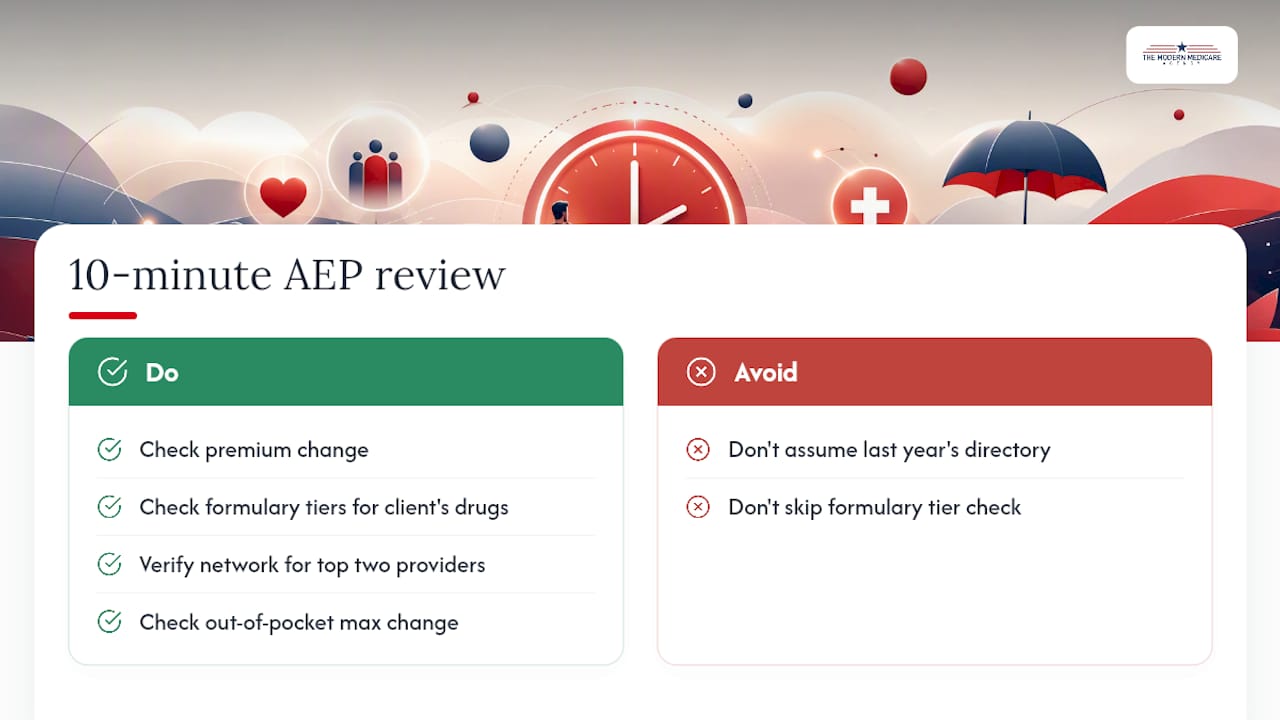
Paul Barrett’s agency has run this same review with clients since 2007, and the errors repeat every single season. The two most common: assuming last year’s provider directory is still accurate, and skipping the formulary tier check because “the drug is still covered,” without noticing it moved to a higher tier.
A focused ten-minute review covers five things: premium change, formulary tier shifts for the client’s actual drugs, network status for their top two providers, out-of-pocket maximum change, and whether a qualifying life event might open an SEP instead.
The plans that look identical on the surface, same premium, same star rating, are often the ones with the biggest hidden formulary shift. That’s the check almost nobody does on their own.
An independent agent doesn’t cost you anything extra since compensation comes from the carrier, and a second set of eyes catches the changes a printed 10-question checklist is designed to flag.
What Actually Matters Most in Your AEP Decision?
Most AEP advice treats every step as equally urgent. It isn’t. If you do only one thing this season, read the ANOC line by line, because that document tells you exactly what changed, and most beneficiaries never open it past the first page.
The conventional advice to “shop around every year” oversells the upside. If your ANOC shows no material change to your drugs, network, or costs, staying put is a perfectly rational choice, and chasing a marginally lower premium can backfire if it means switching pharmacies or losing a specialist relationship you value.
What the data actually supports is prioritizing total annual cost over premium, and prioritizing provider verification by phone over trusting a directory. Those two habits catch more problems than any other step in this checklist. Everything else, the timeline, the documents, the SEP rules, exists to support those two decisions.
Get Help Finishing Your AEP Review Before December 7
Working through this checklist alone is doable, but a second set of eyes catches what a solo review often misses, especially the formulary and network details that don’t show up until you’re already mid-comparison. Paulbinsurance is built around exactly that gap: independent agents who specialize in Medicare, at no added cost to you, since carriers pay the commission either way.

If you’re deciding between sticking with Original Medicare and adding a supplement or switching to Medicare Advantage, our guide on Medicare Advantage plans and our breakdown of Medigap coverage both walk through the tradeoffs in plain language. Or skip the reading and talk to someone directly. Reach out to Paulbinsurance before December 7 to have an agent run your specific medications, providers, and costs through a real comparison, so your January coverage is a decision you made on purpose, not a default you missed.
Frequently Asked Questions
What happens if I miss the Annual Enrollment Period deadline?
You typically keep your current plan for the coming year unless you qualify for a Special Enrollment Period tied to a specific life event, like moving or losing employer coverage.
Do I need to do anything if I’m happy with my current plan?
Read the ANOC anyway. Plans can change premiums, formularies, or networks even if you don’t touch anything, so confirm nothing shifted before assuming you’re fine.
How long does it take for an enrollment change to process?
Changes submitted during AEP take effect January 1, regardless of whether you submit on October 16 or December 6. Save your confirmation number either way.
Can an independent agent help me for free?
Yes. Independent agents are paid commission by the insurance carrier when you enroll, so working with one costs you nothing extra beyond the plan’s normal premium.
This article is general information, not a substitute for advice from a qualified financial advisor. Consult a qualified financial professional about your own circumstances before acting on anything here.
Sources
- Medicare Open Enrollment period rules