
What if your medical bills for 2026 didn’t have to be a source of constant anxiety? Most people feel a sense of dread when they see terms like coinsurance or deductibles because they feel like hidden traps for your hard-earned savings. Truly understanding medicare cost-sharing is the first step to turning that confusion into a solid financial strategy. It’s not just about paying bills. It’s about knowing exactly where your money goes so you can stay in control of your health and your budget.
We understand how exhausting it is to keep up with changing rules and complex jargon. You’ve likely felt that familiar sting of worry about the 2026 Part D changes or the Part B deductible increase to $283. We’re here to help you move from uncertainty to a place of absolute clarity. This guide will show you how deductibles, copays, and coinsurance work together so you can protect your savings and choose your next plan with confidence. We’ll walk through the new $2,100 out-of-pocket cap for prescriptions and explain how to create a strategy that finally puts a reliable limit on your yearly spending.
Key Takeaways
- Master the simple mechanics of deductibles and copays so you can accurately predict your monthly healthcare expenses without any surprises.
- Discover how the new $2,100 out-of-pocket limit for Part D in 2026 acts as a reliable safety net for your prescription drug spending.
- Protect your retirement savings by understanding medicare cost-sharing and how different plan types structure your financial responsibility.
- Compare the pay-as-you-go style of Medicare Advantage against the steady, predictable costs of Medigap to see which fits your lifestyle.
- Learn how a dedicated advocate can filter through 40+ carriers to find the one plan that provides the most security for your 2026 budget.
What Is Medicare Cost-Sharing? Defining the Basics Simply
Think of cost-sharing as the way you and Medicare split the bill for your healthcare. It’s simply the portion of medical expenses you pay out-of-pocket while your plan covers the rest. Many people feel overwhelmed by these terms, but there’s a reassuring reality to keep in mind. Since the inception of Medicare (United States), the program was never intended to cover every single penny of your medical costs. It’s a partnership. By understanding medicare cost-sharing, you remove the element of surprise that causes so much stress. Once you know how the pieces fit together, you can plan your 2026 budget with actual numbers instead of guesses. Knowing what to expect provides a sense of security that no amount of jargon can replace.
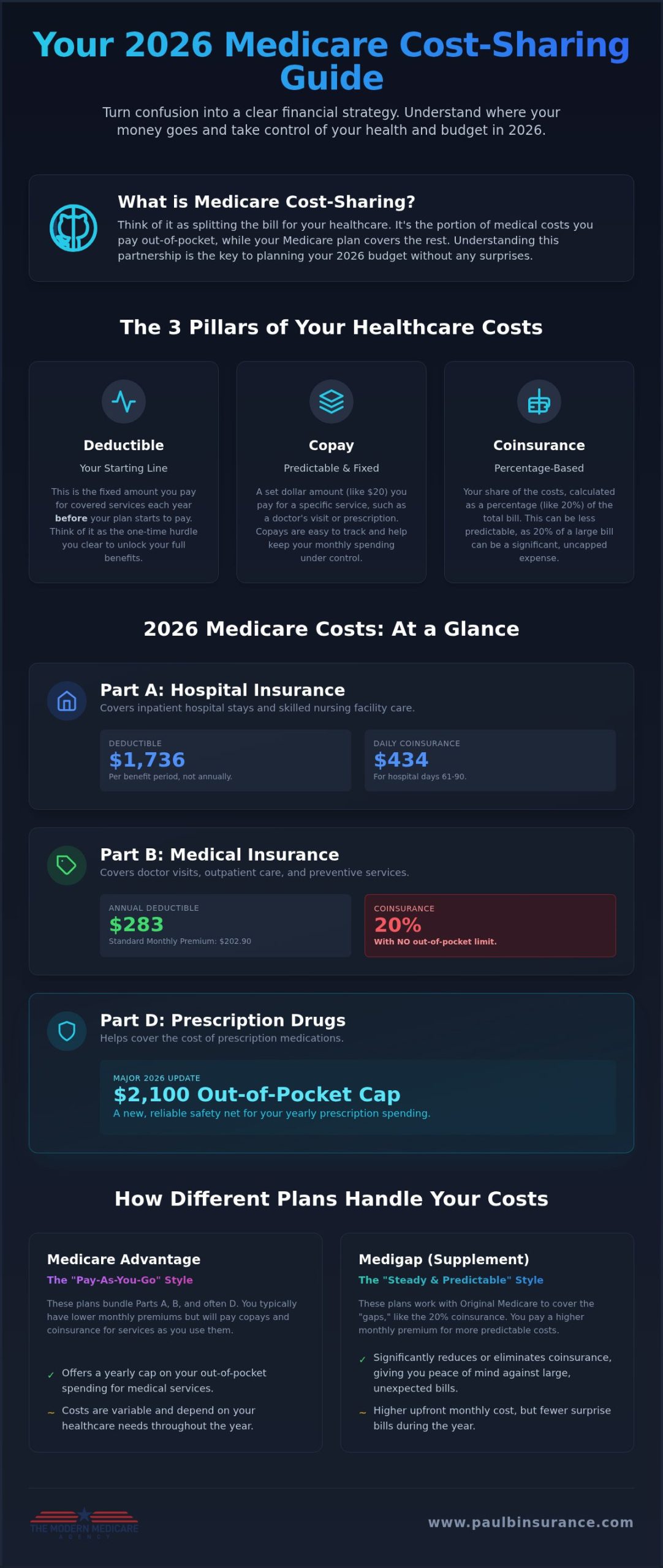
The system relies on three main pillars: deductibles, copays, and coinsurance. Each one plays a specific role in your journey through the healthcare system. Understanding these pillars is the first step toward true peace of mind.
The Deductible: Your Starting Line
Think of your deductible as your starting line for the year. This is the “front-end” cost you pay for services before your insurance coverage officially kicks in. In 2026, different parts of Medicare have their own specific deductibles. You’ll encounter one amount for hospital stays and a different one for doctor visits. Your deductible is the initial contribution you make toward your care before your plan begins to share the costs. Once you’ve met this amount, the “sharing” part of cost-sharing truly begins. It’s a one-time hurdle you clear before your benefits expand.
Copays vs. Coinsurance: What’s the Difference?
Once your deductible is out of the way, you’ll usually pay either a copay or coinsurance for your medical needs. A copay is a fixed, predictable dollar amount you pay at the time of service. You might pay a $20 copay for a primary care visit or a set amount for a specific prescription. These are easy to track. They don’t change based on the total bill, which helps you stay in control of your monthly spending.
Coinsurance is different because it’s a percentage-based share of the cost. In Original Medicare, you’ll often see a standard 20% coinsurance for Part B services. This is often the “hidden stressor” for many seniors. While 20% of a small bill is manageable, 20% of a major surgery can be a significant financial burden. Because coinsurance is tied to the total cost, it’s less predictable than a flat copay. Choosing between Medicare Advantage plans or Medigap plans often comes down to how you prefer to handle these specific costs.
The 2026 Cost-Sharing Landscape for Parts A, B, and D
Planning for 2026 means looking at the specific numbers that will impact your wallet. When you are reviewing the official Medicare costs for the upcoming year, it’s helpful to see how Parts A, B, and D work as a team. These three parts cover your hospital visits, doctor appointments, and prescriptions. While they provide comprehensive care, they each have different rules for how you pay your share. Truly understanding medicare cost-sharing across these parts is the only way to see the full picture of your annual healthcare spend.
Part A: Hospital Stays and Benefit Periods
Part A is your hospital insurance. Most people enjoy a $0 premium because they’ve worked long enough to qualify. However, the costs appear if you’re admitted to the hospital. For 2026, the Part A deductible is $1,736. It’s vital to remember this is a “per-occurrence” cost, not an annual one. If you go into the hospital, stay for a week, and then return three months later, you might have to pay that deductible again. This happens because of the “benefit period” rule. A benefit period ends only after you’ve been out of the hospital for 60 days in a row. If you stay longer than 60 days, you’ll start paying daily coinsurance of $434 for days 61 through 90.
Part B: The 20% Coinsurance Rule
Part B covers your doctors and outpatient services. In 2026, the standard monthly premium is $202.90, which is usually deducted right from your Social Security check. Before Medicare starts paying, you’ll need to meet a $283 annual deductible. Once that’s met, the standard 20% coinsurance rule takes over. This is where many people feel the most anxiety. Original Medicare has no cap on this 20%. If you have a $50,000 outpatient procedure, your share would be $10,000. This lack of a safety net is why understanding medicare cost-sharing is so important before you choose a plan. If you’re feeling unsure about these gaps, you can compare Medicare Part D and other options to find a better fit for your budget.
Finally, Part D handles your prescriptions and plays a huge role in your 2026 financial planning. For the first time, there’s a hard limit on what you’ll pay for drugs, which we’ll detail in the next section. When you add up your Part B premiums, your deductibles, and your potential 20% coinsurance, you get your total healthcare spend. Seeing these numbers clearly is the best way to move from confusion to a state of certainty.
The 2026 Prescription Drug Revolution: Part D Cost-Sharing
We’ve entered a new era for prescription drug coverage. For years, the biggest fear for many seniors was hitting the “donut hole” and facing massive bills. In 2026, that fear is finally a thing of the past. The most significant change in understanding medicare cost-sharing this year is the introduction of a hard $2,100 out-of-pocket maximum. Once you spend $2,100 on your covered medications, you pay $0 for the rest of the year. This is a massive relief for the 56.3 million people enrolled in Part D plans across the country.
Choosing the right plan is now more about your specific medications than ever before. Since different plans cover different drugs at varying costs, your personal list of meds determines how quickly you’ll reach that safety net. It’s no longer just about the monthly premium; it’s about the total journey you’ll take with your pharmacy costs throughout the year. You want to feel secure knowing your prescriptions won’t drain your savings.
Goodbye Donut Hole: The New Part D Structure
The old, confusing coverage gap has been completely removed from the system. Instead, your drug costs now follow a much simpler three-phase journey. First, you might have a deductible, which cannot exceed $615 in 2026. Next, you enter the initial coverage phase where you pay your plan’s copays or coinsurance. Finally, once your total out-of-pocket spending hits $2,100, you reach the cap. This structure makes your budget far more predictable. Because 82% of Medicare Advantage drug plans now charge a drug deductible, having this cap is a vital safety net. You can find more details in our guide on Medicare Part D Explained: Your Simple Guide.
The M3P Program: Smoothing Your Costs
Even with a $2,100 cap, a single expensive prescription in January could still feel like a heavy burden. To fix this, Medicare introduced the Medicare Prescription Payment Plan, or M3P. This program allows you to spread your out-of-pocket drug costs into monthly installments throughout the year. It’s a “pay-over-time” option that removes the sting of a large pharmacy bill all at once. If you’re on high-cost medications, this program ensures you never have to choose between your medicine and your other bills. It turns a large, sudden expense into a manageable part of your monthly budget. This is a major step in understanding medicare cost-sharing because it prioritizes your peace of mind and financial security.
Comparing Cost-Sharing: Medicare Advantage vs. Medigap
Choosing between Medicare Advantage and Medigap is like choosing your financial comfort zone. Do you prefer a lower monthly bill with costs that only appear when you see a doctor, or would you rather pay more upfront to ensure no surprises later? Truly understanding medicare cost-sharing is about matching these two distinct paths to your personal health needs and budget. Both options provide security, but they structure your responsibility in very different ways.
Medicare Advantage: The Predictable Cap
Medicare Advantage plans are often popular because they have very low monthly premiums. In 2026, the average premium for these plans is just $15 per month. You essentially “pay-as-you-go” by covering small copays for doctor visits or specialist appointments. The real safety net here is the Maximum Out-of-Pocket (MOOP) limit. For 2026, the in-network maximum is $9,250, though many individual plans set their limits much lower. Once you hit this cap through your various copays and coinsurance, the plan pays 100% for all covered services for the rest of the year. This cap ensures that even a difficult health year won’t lead to unlimited medical debt. You can learn more about how these caps work in our Medicare Advantage Plans: A Simple Guide for 2026.
Medigap: The “Set It and Forget It” Strategy
If the idea of a $9,000 potential bill causes you stress, Medigap might be the better fit for your peace of mind. These plans are designed to “fill the gaps” left by Original Medicare. When you have a Medicare Supplement Insurance plan, it handles your 20% Part B coinsurance and often your Part A hospital deductible. It is the preferred choice for people who want absolute predictability. You pay a higher monthly premium, but in return, you can often walk out of the doctor’s office without ever reaching for your wallet. It’s important to remember that Medigap plans do not include prescription drug coverage. You will still need a separate Part D plan to take advantage of the new $2,100 drug spending cap we discussed earlier.
Both paths offer a journey from uncertainty to a state of financial protection. One protects you with a yearly cap, while the other protects you by covering the costs before they ever reach you. If you’re ready to find out which strategy saves you the most money in 2026, reach out to our expert team to compare options from over 40 different carriers. Understanding medicare cost-sharing is much easier when you have a dedicated advocate walking you through the math.
How an Independent Broker Simplifies Your Math
Trying to calculate your own 2026 medical budget can feel like a second job. Between the $283 Part B deductible and the new $2,100 Part D spending limit, the math gets complicated quickly. Truly understanding medicare cost-sharing isn’t just about reading a chart. It’s about knowing how those numbers apply to your specific health history. That’s where we come in. We’ve helped people across more than 34 states find clarity in a system that often feels designed to be confusing.
Unlike a representative who only works for one insurance company, an independent Medicare Broker: Your Guide to a Trusted Advisor works for you. We have access to over 40 different insurance carriers. This matters because there are dozens of different ways to structure your cost-sharing. One carrier might have a lower copay for your specific specialist, while another has a better price for your unique medication list. We find the one that fits your life, not the one that fits a corporate quota. Our goal is to be the unambiguous champion of the consumer.
Our Process: From Confusion to Certainty
We don’t start with a sales pitch. We start with your needs. Our team analyzes your specific doctors and your list of prescriptions first. This personalized approach is the only way to move you from a state of distress to one of absolute certainty. Since 82% of Medicare Advantage drug plans now charge a drug deductible in 2026, we make sure that doesn’t catch you off guard. We provide unbiased and impartial recommendations because we don’t answer to the insurance companies. Our support doesn’t end when you sign your name on an enrollment form. We stay by your side year-round, so if you have a question about a bill in July, we’re still here to help you solve it.
Your Next Steps for a Stress-Free 2026
The best way to protect your savings is to schedule a “Medicare check-up” during the Open Enrollment period. This is your chance to get a personalized cost-sharing projection for the coming year. We’ll show you exactly how your costs will look under different plan types, whether you choose Medicare Advantage plans or Medigap plans. You don’t have to navigate this complex system alone. We’re here to be your calm, patient guide, removing the anxiety from a difficult process. Understanding medicare cost-sharing becomes simple when you have an ethical expert in your corner who prioritizes your peace of mind over high-pressure tactics.
Your Path to a Predictable 2026
Navigating 2026 doesn’t have to be a source of constant stress. You’ve seen how the new $2,100 drug spending cap and the clear structure of Parts A and B deductibles can work in your favor. Truly understanding medicare cost-sharing is about more than just memorizing numbers; it’s about the security of knowing your savings are protected from hidden costs. Whether you prefer the low-premium approach of Medicare Advantage or the zero-surprise nature of Medigap, you now have the framework to choose your next plan with absolute confidence.
You shouldn’t have to calculate these complex figures on your own. We’re here to be your calm, patient guide through every step of this journey. Our team provides 100% independent and unbiased guidance, comparing options from over 40 top-rated carriers to find your perfect match. With personalized support available in 34+ states, we make sure your 2026 healthcare budget stays on track. Let Paul and the team help you find the right plan for 2026 so you can focus on what matters most. You’ve got this, and we’re right here with you.
Common Questions About 2026 Medicare Costs
What is the maximum I will have to pay for prescriptions in 2026?
In 2026, the absolute most you’ll pay for covered prescriptions is $2,100. This new federal cap serves as a vital safety net for your pharmacy spending. Once you reach this total through your plan’s deductible and copays, you pay $0 for your covered medications for the rest of the year. It’s a major milestone in understanding medicare cost-sharing because it finally provides a predictable finish line for your drug expenses.
Does Medicare Advantage have a limit on out-of-pocket costs?
Yes, every Medicare Advantage plan includes a Maximum Out-of-Pocket limit, often called a MOOP. For 2026, the highest this limit can be for in-network medical services is $9,250. Many of the 40+ carriers we compare actually set their limits much lower than this federal maximum. Once your combined copays and coinsurance reach this set limit, the plan covers 100% of your covered medical care for the remainder of the year.
Is coinsurance the same thing as a copay?
No, they are two different ways you share costs with your insurance plan. A copay is a fixed dollar amount, such as paying $20 for a doctor visit. Coinsurance is a percentage of the total bill, like the 20% share you pay for Part B services. While copays are easy to budget for, coinsurance can be less predictable because it depends on the total cost of the medical service or procedure you receive.
What happens if I cannot afford my Medicare deductibles?
If you find it difficult to cover costs like the $283 Part B deductible, several assistance programs are available. You might qualify for Medicare Savings Programs or the Extra Help program, which specifically assists with prescription drug costs. We can help you explore these options and look for plans that offer lower upfront costs. Our goal is to find a solution that fits your budget while ensuring you still get the care you need.
Can I change my plan if my cost-sharing becomes too high?
You can typically switch your plan during the Annual Enrollment Period from October 15 to December 7. There is also a second window from January 1 to March 31 for those already in a Medicare Advantage plan. If your current plan’s costs are creating financial stress, these periods allow you to move to an option with a lower out-of-pocket limit. We recommend a yearly review to ensure your plan still matches your health needs.
Do Medigap plans cover the Part B deductible in 2026?
For most people new to Medicare, Medigap plans like Plan G and Plan N do not cover the Part B deductible, which is $283 in 2026. You’ll generally pay this amount once per year before your supplement plan starts covering your other out-of-pocket gaps. This remains a small, one-time annual hurdle. Once it’s met, your Medigap plan provides the robust, predictable coverage that helps many seniors find true peace of mind at the doctor’s office.
Is there a limit on how much the 20% Medicare coinsurance can cost me?
In Original Medicare, there is no cap on the 20% coinsurance you owe. If you have a $100,000 hospital bill, your share would be $20,000 without additional coverage. This is why understanding medicare cost-sharing is so important for your financial security. To protect yourself, you can choose a Medicare Advantage plan with a yearly spending limit or a Medigap plan that pays that 20% share for you, effectively removing your financial risk.

Article by
Paul Barrett
Paul Barrett, CMIP is the founder of The Modern Medicare Agency, an independent Medicare-only brokerage based in Melville, NY. With 18 years of Medicare-exclusive experience, a CMIP designation, and more than 5,000 clients served across 37 states, Paul is one of the most credentialed independent Medicare specialists on Long Island — and one of the most direct.
He represents 40+ carriers with no quotas and no allegiances, which means his recommendations are based entirely on what fits each client's specific situation. He is the author of Medicare Mastery Unlocked and host of the Wise Guys Retirement Talk podcast. His content is grounded in primary sources, real carrier intelligence, and 18 years of watching what happens when people get Medicare right — and when they don't.
📞 631-358-5793 | paulbinsurance.com