
Is Zepbound the Same as Ozempic? A Simple Guide for 2026

Is Zepbound the Same as Ozempic? A Simple Guide for 2026

Just last week, a client named Sarah called me, here at The Modern Medicare Agency, sounding completely exhausted after spending hours trying to figure out why her neighbor’s Ozempic was covered while her own Zepbound prescription faced a different set of rules. It is incredibly frustrating to feel like you are guessing about your health and your budget at the same time. You might have heard that medicare coverage for zepbound and ozempic has shifted significantly this year, and you are right to feel a bit overwhelmed by the new terminology. Does it feel like the rules change every time you visit the doctor? The team at The Modern Medicare Agency wants to help you replace that anxiety with a clear, simple path forward.

In this guide from The Modern Medicare Agency, you will discover the key differences between Zepbound and Ozempic and learn how the new 2026 Medicare rules affect your coverage. We will walk through the medical details of each drug, the new $2,000 out-of-pocket spending cap, and the specific eligibility rules for the 2026 GLP-1 Bridge program. By the time we are finished, you will have a clear understanding of your options so you can choose your plan with total peace of mind.

Key Takeaways

  • Understand the medical differences between Zepbound and Ozempic and how their unique active ingredients affect your body differently.
  • Learn how medicare coverage for zepbound and ozempic is determined by your specific health diagnosis rather than just the drug name.
  • Discover how the new $2,000 annual out-of-pocket cap for 2026 Medicare Part D plans provides a vital safety net for your prescription costs.
  • Identify if you qualify for the 2026 Medicare GLP-1 Bridge program, which offers a new pathway for weight management medication coverage.
  • Gain peace of mind by learning how to compare over 40 different carriers to find the most reliable and affordable plan for your needs.

Understanding the Basics: Are Zepbound and Ozempic Really the Same?

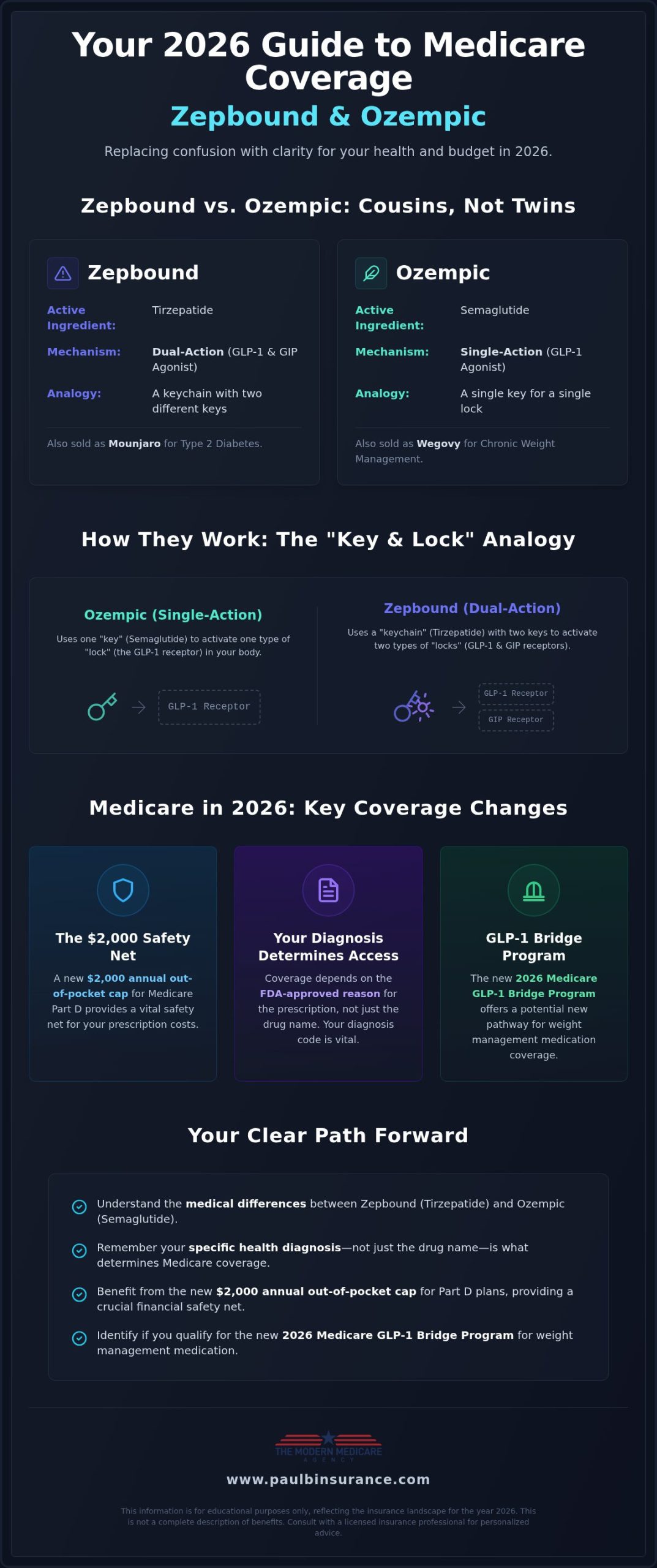
It is very common to feel confused by the sea of brand names currently hitting the market. You see one name on the evening news and a different one on your friend’s prescription bottle. To answer the most common question first: No, Zepbound and Ozempic are not the same medication. Think of them as cousins rather than twins. While they both belong to a class of medications that help regulate appetite and blood sugar, they contain different active molecules that interact with your body in unique ways. In 2026, these medications have become household names for seniors, yet the terminology remains a major source of anxiety. Understanding the science behind the label is the first step toward securing the right medicare coverage for zepbound and ozempic. We see many people who feel left behind by the fast pace of medical changes, but a little clarity goes a long way.

Meet the Molecules: Semaglutide and Tirzepatide

The confusion often starts because one single drug can have two different brand names depending on what it is treating. It helps to look at the actual ingredients inside the pen. Here is how they break down:

  • Ozempic contains semaglutide. This is the same active ingredient found in Wegovy.
  • Zepbound contains tirzepatide. This is the same active ingredient found in Mounjaro.

You might wonder why drug companies use so many different names for what seems like the same thing. It mostly comes down to how the FDA approves them for specific uses. One name is used for treating type 2 diabetes, while another is used specifically for chronic weight management. Understanding How GLP-1 Drugs Work helps clarify that while Ozempic targets one specific hormone receptor, Zepbound targets two. This distinction can lead to different results and, more importantly, different insurance rules.

Why the Name on the Box Matters for Your Insurance

Medicare looks closely at what is called the “indicated use” of a drug. This simply means the specific reason your doctor wrote the prescription. If your doctor prescribes Zepbound, Medicare traditionally sees a weight loss medication. If they prescribe Mounjaro, they see a diabetes medication. Even though the molecule inside the pen is exactly the same, the name on the box changes how your Medicare Part D plan evaluates the claim.

This is why your diagnosis code is so vital. Your doctor must provide a code that matches the FDA-approved use for that specific brand name. Without that match, you might face a denial at the pharmacy counter. We often see clients who are eligible for medicare coverage for zepbound and ozempic but get stuck in a loop of paperwork because the name on the prescription doesn’t align with the primary reason for treatment. Getting this right from the start saves you both money and stress.

How They Work: A Simple Comparison of Semaglutide vs. Tirzepatide

Have you ever wondered why you feel full after a small meal on some days, but can’t seem to stop snacking on others? It often comes down to hormones. These medications act as “hormone helpers” that mimic the signals your body naturally sends to your brain. When you understand how these signals work, the landscape of medicare coverage for zepbound and ozempic becomes much easier to understand. Ozempic uses a single-action approach. It focuses on one hormone called GLP-1, which helps slow down how fast your stomach empties and tells your brain you have had enough to eat. It is a reliable method that has helped many people manage their blood sugar for years.

Zepbound takes things a step further with a dual-action approach. It mimics GLP-1, but it also targets a second hormone called GIP. This combination is why the FDA approval for Zepbound was such a significant milestone for weight management in 2026. By hitting two different pathways, Zepbound often leads to more significant weight loss than single-action drugs. However, it is important to remember that “more” isn’t always better for everyone. Your unique health history and how your body reacts to these hormones will determine which path is safest for you.

The Key and Lock Analogy

Think of your body’s cells as having tiny locks called receptors. To get a specific result, like feeling full, you need the right key to open that lock. An agonist is simply a medication that acts like a key to fit into a lock and turn a specific system on in your body. Ozempic carries one key that fits into the GLP-1 lock. Zepbound is like a keychain with two different keys that open two different locks at the same time. This dual-action can create a stronger signal for your body to manage energy and hunger. If you’re feeling stuck choosing between these options, you can compare Part D plans with us to see which “key” fits your current budget and health goals.

Common Side Effects to Discuss with Your Doctor

Since both medications change how your digestive system moves, it’s very common to experience some “settling in” symptoms. Most people report feelings of nausea or mild digestive changes when they first start. Because Zepbound works on two different hormone pathways, some people find their side effects feel a little different than they would on Ozempic. The good news is that these feelings usually fade as your body gets used to the medication. Doctors typically use a slow “titration” schedule, which means they start you on a very low dose and increase it gradually over several months. This patient approach helps your body adjust comfortably. It’s always a good idea to have a calm conversation with your doctor about what to expect so you can feel confident as you begin your journey toward better health.

Approved Uses: Why Your Diagnosis Determines Your Access

The label on your prescription bottle is important, but for insurance companies, your medical diagnosis is what really opens the door to coverage. Many seniors feel a sense of dread when they hear their medication might not be covered. It often feels like a technicality is standing between you and your health. Understanding how the FDA categorizes these drugs can help you and your doctor navigate the system more effectively. In 2026, the rules for medicare coverage for zepbound and ozempic are tied directly to specific health conditions that go beyond just weight or blood sugar numbers. We want to help you understand these rules so you don’t face unexpected hurdles at the pharmacy.

Ozempic is primarily approved to help adults with type 2 diabetes manage their blood sugar. Because it also has a proven track record of reducing the risk of major heart events, Medicare plans are much more likely to approve it when these conditions are present. On the other hand, Zepbound is approved for chronic weight management. A common mistake we see is the “off-label” trap. This happens when a doctor prescribes Ozempic for weight loss alone. Since the FDA hasn’t approved Ozempic specifically for that use, your insurance plan will likely deny the claim. This can be a huge financial blow if you’re on a fixed income. It’s a stressful situation that we want to help you avoid.

Ozempic and Heart Health

In 2026, Ozempic has become a cornerstone for seniors with cardiovascular concerns. It’s often prescribed not just for diabetes, but specifically to protect the heart. Medicare plans recognize that controlling blood sugar and protecting the heart go hand-in-hand. This dual benefit makes it much easier to secure coverage through a Medicare Part D plan. Recent 2026 updates also highlight its role in kidney protection. This adds another layer of medical necessity that insurance companies respect. It’s about more than just one number on a lab report. It’s about your long-term safety.

Zepbound and Sleep Apnea

One of the biggest shifts we’ve seen in 2026 is the new approval for Zepbound to treat moderate-to-severe obstructive sleep apnea. This is a game-changer. For years, many seniors were denied coverage because their plan excluded weight loss drugs. Now, if you have a sleep apnea diagnosis, that same medication may be viewed as a necessary treatment for a respiratory condition. It’s a new pathway to access that didn’t exist before. If you’ve been denied in the past, this 2026 update might be the key to finally getting the medicare coverage for zepbound and ozempic that you need. It brings a new sense of hope to many who felt stuck in a confusing system.
Is Zepbound the Same as Ozempic? A Simple Guide for 2026

Medicare Coverage in 2026: Will Your Plan Pay?

If you’ve been feeling anxious about how you’ll afford your prescriptions this year, I have some very good news to share. 2026 is a landmark year for anyone using high-cost medications. For the first time ever, there’s a hard limit on what you have to pay out of your own pocket. This change is specifically designed to protect you from the soaring costs of modern medicine. Understanding the new rules for medicare coverage for zepbound and ozempic is no longer about guessing; it’s about knowing your rights under the new laws.

While Medicare has traditionally excluded drugs used solely for weight loss, the situation has changed significantly. If your medication is prescribed for a health condition like type 2 diabetes, heart disease, or even chronic kidney disease, it’s often covered as a standard benefit. The key is knowing whether your specific plan includes these drugs on its formulary, which is just a fancy word for its list of covered drugs. Whether you have a Medicare Advantage plan or a standalone Part D plan, checking that list is the most important step you can take today. Every plan has a different list, and those lists can change every year.

The 2026 Out-of-Pocket Cap Explained

The biggest relief for many seniors is the new $2,000 annual cap on all Medicare Part D prescription drug costs. Once you spend $2,000 on your covered medications in 2026, you won’t pay another penny for the rest of the year. Because drugs like Zepbound and Ozempic can be expensive, you’ll likely reach that cap much faster than in previous years. This makes choosing the right Medicare Part D plan more vital than ever. You want a plan that counts your specific medication toward that cap so you can reach your safety net as early as possible. It provides a level of financial security that simply didn’t exist before this year.

The Medicare GLP-1 Bridge Program

Starting on July 1, 2026, a special temporary program began that changes the game for those seeking weight management support. The Medicare GLP-1 Bridge program provides coverage for Zepbound with a predictable $50 monthly copay. To qualify, you generally need to meet certain BMI thresholds, such as a BMI of 35 or higher, or a lower BMI combined with conditions like high blood pressure or heart disease. This program is a temporary bridge designed to help until broader rules take effect in 2028. It’s a wonderful opportunity to get the care you need without the financial stress. If you’re feeling confused about your eligibility, you can reach out for a personal plan review to see if this bridge is the right path for you.

Finding Certainty: How to Navigate the 2026 Plan Maze

It is completely natural to feel a sense of dread when you look at the long list of insurance companies and plan options available this year. Many people make the mistake of simply staying with the company they have always used or picking the first name they recognize. In 2026, that single decision could cost you thousands of dollars. Each insurance company builds its own list of covered drugs, and they don’t all treat these new medications the same way. When you only look at one carrier, you are only seeing a tiny slice of the map. We want to show you the whole picture so you can move forward with total confidence.

As independent brokers, we don’t work for the insurance companies. We work for you. We have the tools to compare over 40 different carriers at the same time. This is the only way to truly guarantee that you are getting the best medicare coverage for zepbound and ozempic available in your area. Our mission is to protect you from high out-of-pocket costs by doing the heavy lifting and research on your behalf. You shouldn’t have to be an insurance expert to get the medicine your doctor says you need.

The ‘Formulary Search’ Process

We use a math-based approach to find your ideal plan. This starts by looking at your specific medication list and checking it against every available formulary. We pay close attention to “Tiering.” For example, one plan might list your medication as a Tier 3 drug, while another calls it a Tier 4. This small change can drastically affect your monthly copay. We also look at pharmacy networks. Using a “preferred” pharmacy instead of a “non-preferred” one can often save you hundreds of dollars over the course of the year. We look at these tiny details so you don’t have to worry about them.

Your Next Steps for Peace of Mind

You don’t have to wait until you are standing at the pharmacy counter to find out if your plan will pay. A quick, conversational call can clear up the confusion and give you a clear look at your 2026 options. We’ll walk you through the specifics of medicare coverage for zepbound and ozempic and help you understand exactly when you’ll hit that $2,000 spending cap. Our goal is to move you from a state of uncertainty to a state of absolute certainty. Let us help you find the right 2026 plan today so you can focus on your health instead of your paperwork.

Take Control of Your Health and Your Budget in 2026

The healthcare landscape has changed significantly this year, but you don’t have to navigate it alone. We have explored how Zepbound and Ozempic offer different paths to better health and how the 2026 rules provide a new safety net for your wallet. Whether it’s the $2,000 out-of-pocket cap or the new GLP-1 Bridge program, there are now more ways than ever to manage your costs. Securing reliable medicare coverage for zepbound and ozempic shouldn’t feel like a source of constant anxiety.

Our team is here to take the weight off your shoulders. We provide a personalized drug formulary analysis and independent advice that always puts your needs first. Instead of feeling limited by one company, we help you compare 40+ carriers to find the perfect fit for your specific health journey. You deserve the peace of mind that comes from knowing your plan is working as hard as you are. Get a Simple, Unbiased Review of Your 2026 Medicare Options

You now have the information you need to make a great choice. We are ready to help you turn that knowledge into a plan that protects your health and your future with total certainty.

Frequently Asked Questions

Does Medicare Part D cover Zepbound for weight loss in 2026?

Yes, in 2026, Zepbound is covered for weight loss through the temporary GLP-1 Bridge program. This program launched on July 1, 2026, and provides a much-needed pathway for those who don’t have a diabetes diagnosis. You’ll need to meet specific BMI criteria and have your doctor submit a prior authorization. This is a significant shift from previous years when weight loss medications were almost always excluded from standard Part D coverage.

Can I switch from Ozempic to Zepbound if my Medicare plan changes?

You can switch medications, but it isn’t as simple as swapping one pen for another. Since Ozempic and Zepbound have different FDA-approved uses, your doctor must provide a diagnosis code that matches the new medication. If you switch to Zepbound for weight management, you’ll likely move from standard Part D coverage to the Bridge program rules. It’s a journey that requires careful coordination between your physician and your insurance carrier to avoid gaps in care.

What is the $2,000 Part D cap and how does it work in 2026?

The $2,000 cap is a new financial safety net that limits your total yearly spending on covered prescriptions. Once your out-of-pocket costs reach $2,000 in 2026, your plan pays 100 percent of your covered drug costs for the rest of the year. This is particularly helpful for high-cost medications. It removes the fear of the “donut hole” and provides a predictable budget for your healthcare. It’s one of the most reassuring changes for seniors in decades.

Will my Medicare Advantage plan cover Ozempic for Type 2 Diabetes?

Most Medicare Advantage plans do cover Ozempic when it’s prescribed to manage Type 2 Diabetes or reduce cardiovascular risk. Since these plans include prescription drug coverage, Ozempic is typically listed on their formulary. However, your specific copay will depend on which “tier” the plan assigns to the drug. We can help you look at the drug lists for over 40 carriers to ensure your specific plan offers the most reliable medicare coverage for zepbound and ozempic.

How much will I pay for Zepbound under the Medicare GLP-1 Bridge?

Eligible patients will pay a flat copay of $50 for a 30-day supply of Zepbound under the Bridge program. This price is a massive reduction from the retail costs that often exceeded $1,000 in previous years. This predictable cost helps remove the anxiety of shifting prices at the pharmacy. Keep in mind that this program is currently scheduled to run through December 31, 2027, providing a stable window for your weight management treatment plan.

Is tirzepatide more effective than semaglutide for seniors?

Clinical data suggests that tirzepatide, the active ingredient in Zepbound, can lead to more significant weight loss because it targets two hormone receptors instead of just one. Ozempic uses semaglutide, which only targets the GLP-1 receptor. While “more” weight loss sounds better, it doesn’t mean it’s the right choice for every senior. Some people tolerate the single-action approach of semaglutide much better. Your doctor will help you decide which molecule fits your specific health profile and goals.

What happens if my Medicare drug plan removes my medication from its list?

If your plan removes a drug, they generally must provide a 30-day notice or a one-time transition refill. This can be a very stressful moment, but you have options. You can work with your doctor to request a “formulary exception” or appeal the decision based on medical necessity. Alternatively, you can use the Annual Enrollment Period to switch to one of the other 40+ carriers that still includes your medication on their list. We specialize in helping clients navigate these sudden changes.

Do I need a special ‘prior authorization’ for these medications?

Yes, both Zepbound and Ozempic almost always require prior authorization. This means your doctor must submit paperwork to your insurance company proving that you meet the specific medical criteria for the drug. For medicare coverage for zepbound and ozempic, this usually involves verifying your diagnosis, such as Type 2 Diabetes for Ozempic or a specific BMI for Zepbound under the Bridge program. It’s a methodical process, but once approved, it provides the certainty you need to start your treatment.

Paul Barrett

Article by

Paul Barrett

Paul Barrett, CMIP is the founder of The Modern Medicare Agency, an independent Medicare-only brokerage based in Melville, NY. With 18 years of Medicare-exclusive experience, a CMIP designation, and more than 5,000 clients served across 37 states, Paul is one of the most credentialed independent Medicare specialists on Long Island — and one of the most direct.

He represents 40+ carriers with no quotas and no allegiances, which means his recommendations are based entirely on what fits each client's specific situation. He is the author of Medicare Mastery Unlocked and host of the Wise Guys Retirement Talk podcast. His content is grounded in primary sources, real carrier intelligence, and 18 years of watching what happens when people get Medicare right — and when they don't.

📞 631-358-5793 | paulbinsurance.com

What Is Medicare Part B and What Does It Actually Cover?

The complete guide to Medicare’s medical insurance — every service it covers, exactly what it costs in 2026, how it works with group insurance and VA benefits, and the excess charges most people have never heard of until they get a surprise bill.

The Short Answer

Medicare Part B is medical insurance — it covers doctor visits, outpatient care, preventive services, durable medical equipment, and more. Unlike Part A, Part B is not premium-free for anyone: everyone pays a monthly premium (202.90in2026formostpeople),anannualdeductible(283), and 20% coinsurance on most covered services, with no yearly cap on that 20% under Original Medicare alone. Whether you need to enroll at 65, and whether delaying is safe, depends heavily on your employment status and your employer’s size — getting this wrong is one of the most consequential and permanent mistakes in all of Medicare.

Key Takeaways

  • Part B is never premium-free — everyone pays a monthly premium, and higher earners pay significantly more through IRMAA.
  • The 20% coinsurance under Original Medicare alone has no yearly cap — this is the single biggest financial risk in Medicare, and it’s the reason Medigap and Medicare Advantage exist.
  • Whether you can safely delay Part B without a penalty depends on your employer’s size: 20+ employees generally allows delay; fewer than 20 generally does not.
  • Missing your enrollment window triggers a permanent 10% penalty for every 12-month period you went without coverage.
  • Veterans can and generally should enroll in Part B even with VA benefits, since Medicare and VA coverage don’t coordinate — each only pays for care received within its own system.
  • “Excess charges” from non-participating providers can add up to 15% on top of what Medicare approves, and only some Medigap plans protect you from them.

What Part B Actually Covers

While Part A handles hospital room and board, Part B is the half of Original Medicare that covers medical care and most services delivered outside a hospital admission — doctor visits, outpatient procedures, and ongoing medical needs.

What’s covered

  • Doctor visits — primary care and specialists
  • Outpatient surgeries and procedures
  • Diagnostic lab work, X-rays, and MRIs
  • Emergency room visits
  • Ambulance services
  • Outpatient mental health care
  • Physical, occupational, and speech therapy
  • Chemotherapy and radiation received in an outpatient clinic
  • Durable Medical Equipment (DME) — wheelchairs, oxygen equipment, blood sugar monitors, walkers, and similar equipment
  • Ambulatory surgical center services

Preventive services: the part Medicare gets genuinely right

Most preventive services are covered at 100%, with no deductible and no copay, as long as your provider accepts Medicare assignment. This includes:

  • Your one-time “Welcome to Medicare” wellness visit, available within your first 12 months on Part B
  • Annual wellness visits after that
  • Flu shots and most other recommended vaccines
  • Mammograms
  • Colonoscopies and other cancer screenings
  • Diabetes and cardiovascular screenings
  • Many other screenings recommended by the U.S. Preventive Services Task Force

Paul’s Honest Take: This is one of the most underused parts of Medicare, full stop. I’ve had clients who paid for a private physical every year out of habit and never realized their annual wellness visit through Medicare was completely free. If you haven’t used your Welcome to Medicare visit or your annual wellness visit, that’s real value sitting on the table.

What’s NOT covered

  • Routine dental care — cleanings, fillings, dentures, extractions
  • Routine vision exams and eyeglasses
  • Hearing aids (though diagnostic hearing tests ordered by a doctor may be covered)
  • Long-term custodial nursing home care — help with daily living activities, as opposed to short-term skilled or medical care
  • Routine prescription drugs you pick up at a retail pharmacy — that’s Part D’s job, not Part B’s
  • Cosmetic surgery, unless medically necessary (such as reconstruction after an accident or mastectomy)
  • Most care received outside the United States, with very limited exceptions
  • Routine foot care, such as nail trimming, in the absence of a qualifying medical condition
  • Acupuncture, except for a narrow, specific chronic low back pain benefit
  • Concierge medicine fees and membership-style charges some practices add on top of standard care
  • Long-term care insurance-style services, including most home-based personal care that isn’t tied to a skilled medical need

Paul’s Honest Take: The dental and vision exclusions are the ones that surprise people most, especially since they’re such routine parts of healthcare for most adults. This is exactly why so many Medicare Advantage plans build dental, vision, and hearing benefits into their coverage — Original Medicare was simply never designed to include them, and that gap doesn’t go away on its own.

What Part B Costs in 2026

Part B has three separate cost components, and understanding all three matters:

Cost Component

2026 Amount

Standard monthly premium

$202.90

Annual deductible

$283

Coinsurance on most covered services

20%

The premium is deducted automatically from your Social Security check if you’re already collecting benefits. If you’re not yet collecting Social Security, you’ll receive a bill, typically every three months.

The deductible works differently than Part A’s — it’s a straightforward annual figure. You pay the first $283 of Medicare-approved outpatient costs each calendar year, and then Medicare’s cost-sharing kicks in.

The coinsurance is where the real risk lives. After your deductible is met, Medicare pays 80% of the Medicare-approved amount for most covered services, and you’re responsible for the remaining 20%. There is no yearly cap on this 20% under Original Medicare alone. If you have a $100,000 course of cancer treatment, your 20% share is $20,000 — unless you have a Medigap policy or Medicare Advantage plan absorbing that cost.

Paul’s Honest Take: I put this in bold because it’s genuinely the single most important number in this entire guide. That uncapped 20% is the whole reason Medigap and Medicare Advantage exist as products in the first place. Original Medicare by itself was never designed to protect you from a truly expensive year — it was designed to cover 80% of it and leave the rest to you.

IRMAA: What Higher Earners Actually Pay

If your income is above certain thresholds, you’ll pay more for Part B through the Income-Related Monthly Adjustment Amount (IRMAA) — based on your tax return from two years prior. For 2026, that means your 2024 income determines your premium tier.

2024 Income (Individual)

2024 Income (Married, Joint)

Total Part B / Month

$109,000 or less

$218,000 or less

$202.90

$109,001 – $137,000

$218,001 – $274,000

$284.10

$137,001 – $171,000

$274,001 – $342,000

$405.80

$171,001 – $205,000

$342,001 – $410,000

$527.50

$205,001 – $499,999

$410,001 – $749,999

$649.20

$500,000 and above

$750,000 and above

$689.90

At the top tier, you’re paying more than three times the standard premium. If your income has recently dropped — retirement, the loss of a spouse, or certain other life-changing events — you can appeal your IRMAA determination using Form SSA-44.

Do You Have to Enroll? And What Happens If You Don’t?

Technically, Part B is optional — Medicare won’t force you into it. But opting out without a valid alternative is genuinely risky, because of how the penalty structure works.

If you don’t sign up during your Initial Enrollment Period (the 7-month window around your 65th birthday) and you don’t have qualifying employer coverage, you’ll face a permanent 10% penalty added to your premium for every full 12-month period you went without Part B. That penalty doesn’t expire — you pay it for as long as you have Part B, which for most people means for the rest of your life.

Example: If you delayed enrollment by 24 full months without a valid exception, you’d pay an extra 20% on top of the standard $202.90 premium in 2026 — roughly $40.58 more, every month, permanently.

How Part B Works with Group Insurance

Just like Part A, whether you can safely delay Part B without penalty comes down to one specific number: how many employees your company has.

Companies with 20 or more employees: If you or your spouse are actively working and covered by a genuine group health plan, your workplace insurance is primary, and you can legally delay Part B without any penalty. When that employment or coverage eventually ends, you get an 8-month Special Enrollment Period to enroll in Part B penalty-free.

Companies with fewer than 20 employees: Medicare automatically becomes your primary insurer at 65, regardless of your employment status. You need to enroll in Part B right on schedule. If you don’t, your small employer’s plan can legally refuse to pay claims that Medicare should have covered first — potentially leaving you responsible for the full cost.

Paul’s Honest Take: I say this in nearly every guide I write, because it’s genuinely one of the costliest misunderstandings I encounter: “I have good coverage at work” and “I’m protected from Medicare’s enrollment deadlines” are two completely different statements, and whether the second one is true depends entirely on your employer’s size — not how generous the coverage feels. Confirm the actual employee count before you decide to delay anything.

Retiree Coverage Is Not the Same as Active Employer Coverage

This is a distinction that catches a genuinely large number of people off guard: the “20 or more employees” exception only applies to active employment. If you retire and your former employer offers you retiree health benefits — sometimes a genuinely good, comprehensive plan — that coverage does not create a Special Enrollment Period the way active group coverage does, and it does not exempt you from enrolling in Part B on time.

Paul’s Honest Take: I’ve seen this mistake more than once, and it’s an especially painful one because it happens to people who did everything right during their working years. Someone retires with a strong retiree health plan from a large employer, assumes it works the same way their active coverage did, and delays Part B — only to find out later that retiree coverage was never a valid reason to delay in the first place. The moment you stop actively working, that clock starts, regardless of how good your retiree plan looks on paper. If you’re retiring and keeping employer retiree benefits, treat enrolling in Part B as something to handle right on schedule, not something retiree coverage lets you postpone.

Why You Need Both Part A and Part B for Medigap or Medicare Advantage

Here’s a foundational requirement worth understanding clearly, since it shapes every other coverage decision in Medicare: you must be enrolled in both Part A and Part B before you can buy a Medigap policy or enroll in a Medicare Advantage plan. Neither product exists as a standalone substitute for Original Medicare — both are built specifically to work alongside it.

  • Medigap fills the cost-sharing gaps left by Original Medicare (Parts A and B) — it has nothing to fill in if you’re not enrolled in both parts to begin with.
  • Medicare Advantage legally must provide at least the same coverage as Parts A and B combined, which is only possible because you’re required to be enrolled in both before a Medicare Advantage carrier can enroll you.

Paul’s Honest Take: This surprises people who assume they can somehow “skip” Part B and go straight into a Medicare Advantage plan to avoid the extra premium. It doesn’t work that way — Part B enrollment, and its premium, is a prerequisite either way, whether you end up on Original Medicare with Medigap or on a Medicare Advantage plan. There’s no path through Medicare that avoids the Part B premium once you’re actually using the system.

Does Medicare Work If You’re a Veteran?

Yes — and if you have VA health benefits, understanding how the two systems relate is genuinely important, because they work differently than most people assume.

Medicare and VA benefits do not coordinate. These are two entirely separate systems that each pay only for care received within their own network. Medicare doesn’t pay for care you receive at a VA facility, and VA benefits don’t pay for care you receive from a non-VA doctor or hospital. You, the veteran, choose which system to use each time you seek care.

Here’s the critical point: having VA benefits does not exempt you from Medicare’s enrollment deadlines. VA coverage is not considered a qualifying reason to delay Part B without penalty. If you don’t enroll in Part B during your Initial Enrollment Period and you’re relying solely on VA benefits, you can still trigger the permanent late enrollment penalty.

Why the VA itself recommends enrolling in Medicare anyway:

  • It gives you access to civilian doctors and hospitals outside the VA system
  • VA healthcare funding depends on annual Congressional appropriations, which isn’t guaranteed to remain stable
  • If VA authorizes only part of your needed care at a non-VA facility, Medicare can help cover the rest
  • Having both gives you meaningfully more flexibility and security than relying on either system alone

Paul’s Honest Take: This is one of the most common misconceptions I run into with veterans specifically, and it’s an expensive one to get wrong. Good VA coverage feels like it should be enough, and it might genuinely handle most of your care — but it doesn’t protect you from the Part B enrollment clock the way employer coverage from a large company can. The VA itself actively encourages enrolling in Medicare Parts A and B for exactly this reason. If you have VA benefits and are approaching 65, this is worth a direct conversation before you assume you’re covered.

Veterans who enroll in Part B can also purchase a Medigap policy, which can be particularly valuable if you use non-VA providers regularly — though if you primarily rely on VA facilities for most of your care, the value of an added Medigap policy may be more limited, and worth weighing carefully.

How Long Does It Actually Take to Get Part B Approved?

This is one of the most practical, and most overlooked, pieces of planning — especially if you’re leaving a job after 65 and coordinating your Part B start date around the end of your employer coverage. Applying isn’t instant, and the timeline depends heavily on which enrollment window you’re using.

Enrollment Situation

Typical Processing Time

When Coverage Actually Starts

Initial Enrollment Period (around 65)

2–4 weeks, sometimes up to 6

1st of your birthday month (if applied in the 3 months before) or 1st of the month after you apply (if applied during or after your birthday month)

Special Enrollment Period (leaving employer coverage)

4–8 weeks, sometimes longer

1st of the month after your application is submitted

General Enrollment Period (Jan 1–Mar 31, missed window)

4–6 weeks

1st of the month after you apply

Why the Special Enrollment Period takes longer: applying after leaving employer coverage requires two forms, not one — Form CMS-40B (the actual Part B application) and Form CMS-L564 (Request for Employment Information), which your employer needs to complete to verify you had qualifying coverage. Social Security has to manually review both, which is exactly why this route consistently takes longer than a standard Initial Enrollment Period application.

Paul’s Honest Take: This timeline question comes up constantly with clients who are retiring or leaving a job after 65, and it deserves real attention — not just because of the penalty risk we’ve already covered, but because a slow approval can leave you with an actual gap in coverage if you time it too tightly. My standard advice: start this process at least 2 to 3 months before you need Part B to actually begin, not the week your employer coverage ends. If your former employer is slow to complete their portion of Form CMS-L564, that alone can hold up the entire application — so it’s worth following up with your HR or benefits department directly rather than assuming it’s been submitted.

Practical tips to avoid delays

  • Apply online through SSA.gov whenever possible. It’s consistently the fastest method — mailed or faxed forms are more prone to getting lost or delayed.
  • If you’re on a Special Enrollment Period, submit Form CMS-L564 alongside Form CMS-40B, not separately. They need to arrive together, and one incomplete form can stall the whole application.
  • Expect a short intake lag even with online applications. It can take several business days for an online submission to actually appear on a local Social Security agent’s screen — don’t panic if you call shortly after applying and they say they don’t see it yet.
  • Once approved, you don’t have to wait for your physical card. Your Medicare Beneficiary Identifier typically appears in your online Social Security or Medicare.gov account within a day or two of approval, and you can print a temporary card from there — the physical card generally arrives by mail within about 30 days.

Excess Charges: The Cost Almost Nobody Knows to Ask About

Here’s a detail that surprises even people who’ve been on Medicare for years: not every doctor who accepts Medicare agrees to accept Medicare’s approved amount as full payment.

Providers fall into three categories:

  • Participating providers accept Medicare assignment, meaning they agree to accept the Medicare-approved amount as payment in full. This covers the vast majority of providers — roughly 98% of doctors nationally.
  • Non-participating providers still accept Medicare patients but haven’t agreed to accept the standard rate. They can charge an excess charge of up to 15% above the Medicare-approved amount.
  • Opted-out providers have left the Medicare system entirely and can charge whatever they want under a private contract — Medicare pays nothing at all for care from these providers, except in emergencies.

How excess charges actually work: if the Medicare-approved amount for a service is $300 and you see a non-participating provider, they can legally charge up to an additional $45 (15%) on top, for a total bill of $345 — and that excess amount doesn’t count toward your Part B deductible.

Eight states currently prohibit or limit excess charges entirely: Connecticut, Massachusetts, Minnesota, New York, Ohio, Pennsylvania, Rhode Island, and Vermont. If you live in one of these states, you’re generally shielded from excess charges from providers within your state — though you could still face them if you receive care from a non-participating provider elsewhere.

Paul’s Honest Take: This is exactly why Medigap Plan G matters so much for people who want maximum flexibility. Plan G covers excess charges in full — Plan N does not. If you’re the kind of person who wants the freedom to see any doctor without worrying about billing surprises, that distinction is worth understanding clearly before you pick between the two. And regardless of which plan you choose, it’s always worth asking a new provider directly whether they accept Medicare assignment before your first appointment.

The HSA Rule: Part B Closes the Door Too

If you’re hoping to keep contributing to a Health Savings Account, know this clearly: enrolling in Part B — or any part of Medicare — ends your ability to make new HSA contributions. This isn’t unique to Part B; it applies the moment you enroll in Medicare in any form, including premium-free Part A.

If keeping your HSA active matters to you, the only way to legally delay both Part A and Part B is through qualifying employer coverage — which, as covered above, generally requires an employer with 20 or more employees. And because Part A enrollment can be backdated up to 6 months once you do enroll, it’s smart to stop HSA contributions 6 months before you plan to sign up for Medicare or file for Social Security, whichever comes first.

Frequently Asked Questions

Is there a cap on what I’ll pay for Part B services in a year? Not under Original Medicare alone — the 20% coinsurance has no yearly limit. A Medigap policy or Medicare Advantage plan is what actually caps your exposure.

What happens if I don’t sign up for Part B on time? You’ll generally face a permanent 10% penalty on your premium for every 12-month period you went without coverage, unless you qualify for a Special Enrollment Period through active employer coverage.

Do I need Part B if I have good coverage through a small employer? Almost certainly yes. If your employer has fewer than 20 employees, Medicare becomes your primary insurer at 65 regardless of your job coverage, and not enrolling can leave you exposed to unpaid claims and a lifelong penalty.

Do veterans need Medicare Part B if they have VA benefits? Generally, yes. Medicare and VA benefits don’t coordinate — each only pays for care within its own system — and VA coverage doesn’t exempt you from Medicare’s enrollment deadlines or penalties.

What is a Part B excess charge? An additional charge, up to 15% above the Medicare-approved amount, that a non-participating provider can legally bill you. It doesn’t count toward your deductible, and only Medigap Plan G (among current plans) covers it in full.

Can I keep contributing to my HSA if I enroll in Part B? No. Enrolling in any part of Medicare, including Part B, ends your HSA contribution eligibility going forward.

How long does it take to get approved for Part B? It depends on the enrollment window. Initial Enrollment Period applications typically process in 2–4 weeks. Special Enrollment Period applications, used when leaving employer coverage, generally take 4–8 weeks since Social Security must manually verify your prior coverage using Form CMS-L564. Start the process at least 2–3 months before you need coverage to begin, especially when coordinating around a job ending.

The Bottom Line

Part B is the half of Medicare that covers your everyday medical care — and it’s also where the real financial exposure of Original Medicare lives, thanks to that uncapped 20% coinsurance. Whether you should enroll at 65, whether you can safely delay, and how much of that exposure you’re carrying all depend on details specific to your situation: your employer’s size, your income, your VA status, and which doctors you actually see.

If you want help sorting out exactly how Part B applies to your specific circumstances — or want to understand how Medigap or Medicare Advantage could close that uncapped coinsurance gap — that’s exactly the conversation I have with clients every day, at no cost to you.

Call 631-358-5793 or visit paulbinsurance.com to set up a time to talk it through.

Paul Barrett, CMIP, is the founder of The Modern Medicare Agency, based in Melville, NY, and has spent 18+ years exclusively helping people navigate Medicare — never life insurance, never annuities, just Medicare. He’s licensed in 37 states, represents more than 40 carriers, and has personally helped over 5,000 clients choose coverage that actually fits their lives.

Figures current as of 2026 and sourced from CMS, Medicare.gov, and the Social Security Administration. Individual circumstances vary, especially around employer coverage, VA benefits, and income-based premiums — always verify your specific situation before making enrollment decisions.

Sources

Related Post

Scroll to Top

Request a Callback with
Paul Barrett

Fill out the form below, and we'll call you within 24 hours.