




Many Medigap plans cover emergency medical care overseas, but the protection is thin and capped. Coverage tops out at a $50,000 lifetime limit, applies only after a $250 annual deductible, pays 80% of costs, and counts only within the first 60 days of a trip. Original Medicare almost never pays for care abroad, so most travelers still need separate travel medical and evacuation insurance.
TL;DR:
- Most Medigap plans with foreign travel benefits cover emergency care only within the first 60 days of travel and for claims under a $50,000 lifetime cap.
- The benefit applies only to sudden illnesses or injuries requiring immediate treatment, excluding routine visits or planned checkups abroad.
- Expensive air ambulance evacuations are not included in Medigap coverage, so travelers should purchase separate evacuation insurance with high coverage limits.
- Policyholders must file claims with detailed documentation, including itemized bills and translations, since hospitals rarely bill Medicare directly.
- Confirm your specific Medigap plan’s coverage and the remaining benefit balance before traveling, and consider supplementing with dedicated travel insurance for comprehensive protection.
Table of Contents
- Medigap Foreign Travel Emergency Benefits: Who’s Covered and What Counts
- The Numbers That Actually Limit Your Coverage
- What Happens at the Hospital: Billing, Documentation, and Filing a Claim
- Where Medigap Falls Short and What to Buy Instead
- Pre-Trip Checklist: Steps to Take Before You Leave the Country
- What I’ve Learned Watching Travelers Get This Wrong
- Get Your Medigap Travel Benefits Verified Before You Book
- Where to Verify the Official Rules Yourself
- Sources
Medigap Foreign Travel Emergency Benefits: Who’s Covered and What Counts
The foreign travel emergency benefit is not automatic across every Medicare product. It exists only in certain Medigap plans, and it only kicks in for genuine emergencies, not for a checkup you scheduled while visiting family in Portugal.
Medigap Plans C, D, E, F, G, H, I, J, M, and N include the foreign travel emergency benefit. Plans A, K, and L generally do not. A few of these letter plans, notably E, H, I, and J, are legacy plans no longer sold to new buyers, but people who already hold them keep the coverage.
- Plans with the benefit: C, D, E, F, G, H, I, J, M, N
- Plans without it: A, K, L (check your specific policy to confirm)
- Legacy plans (E, H, I, J) are closed to new enrollees but still valid for existing policyholders
“Emergency” has a specific meaning here. Medicare defines it as a sudden illness or injury requiring immediate care, where waiting until you got home would risk your health. A broken ankle on a hiking trail in Peru qualifies. A routine cardiology follow up you booked while abroad does not, even if Medicare would cover that same visit inside the United States, according to background guidance on how the benefit is scoped.
It also helps to understand where Medigap sits in the bigger picture. Medigap is a supplement, not a standalone policy. It pays second, after Original Medicare processes a claim, and it cannot be paired with a Medicare Advantage plan at all. If you’re enrolled in Medicare Advantage, this particular benefit does not apply to you, and your overseas coverage options look different. Our guide to Medicare Advantage and traveling abroad walks through those distinctions if you’re unsure which category you fall into.
The Numbers That Actually Limit Your Coverage
Four figures determine what you’ll actually get paid if something goes wrong overseas, and all four apply together, not separately.
The lifetime cap is a set amount. That’s not per trip and not per year. It’s a running total across your entire time holding the policy. If you file a $12,000 claim after a hospitalization in Italy one year and a $9,000 claim after an accident in Thailand two years later, you’ve used $21,000 of that lifetime allowance permanently. There’s no reset button.
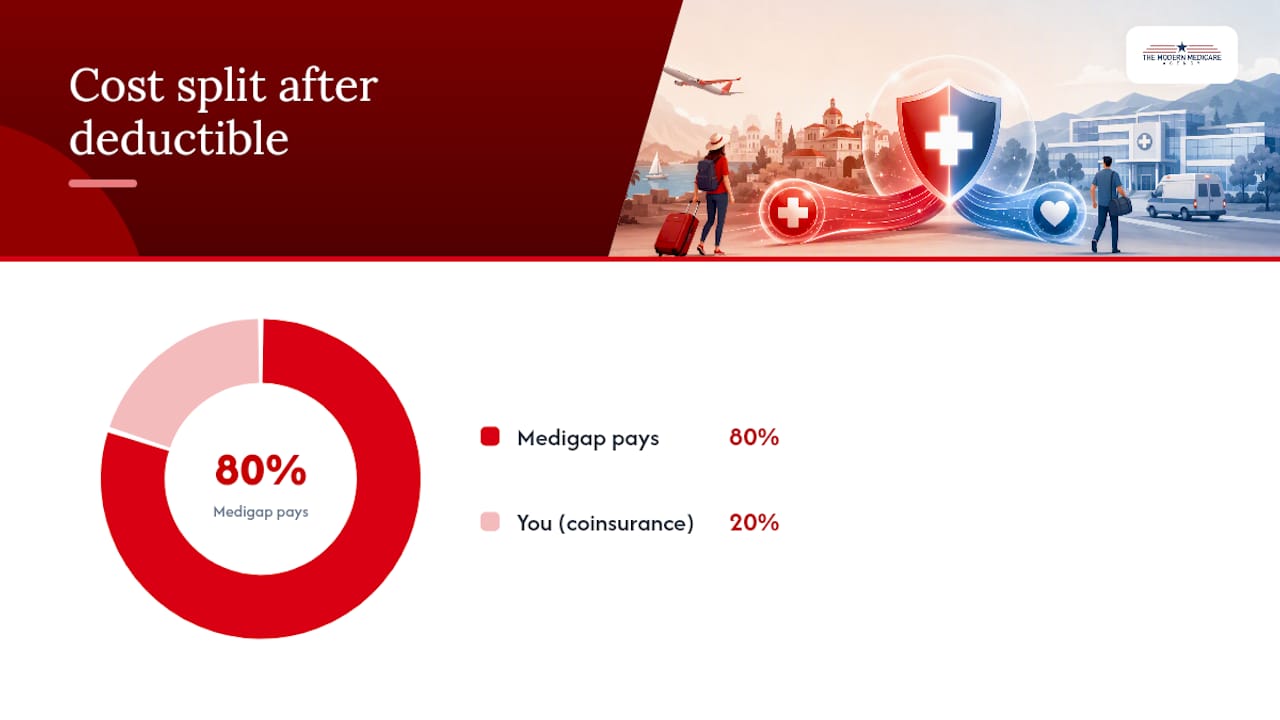
The core math: After a $250 annual deductible, Medigap pays 80% of billed charges, up to a $50,000 lifetime cap, for emergencies that begin within the first 60 days of a trip.
That leaves you responsible for the remaining 20% coinsurance, plus anything above the deductible threshold within a given year, plus the full cost of anything that pushes past your lifetime cap. A serious cardiac event with an ICU stay abroad can run well past $50,000 on its own, particularly if air ambulance transport gets involved.
- Lifetime cap: $50,000 total, not renewable
- Annual deductible: $250
- Coinsurance: Medigap pays 80% after the deductible
- Time limit: only emergencies starting in the first 60 days of a trip
The 60 day rule catches people off guard. Snowbirds who spend the winter in Mexico or expats splitting time between countries often exceed that window without realizing their emergency coverage quietly expired partway through the trip.
One more wrinkle: Plans C and F closed to new Medicare enrollees on January 1, 2020. If you became eligible for Medicare on or after that date, you cannot buy either plan, even though people who already held them before the cutoff keep full access, including the foreign travel benefit.
What Happens at the Hospital: Billing, Documentation, and Filing a Claim
Foreign hospitals rarely bill Medicare directly. Most expect payment at the time of service, in local currency, before you’re discharged, which means you’re fronting the cost and hoping for reimbursement later.
That reality makes documentation the single biggest factor in whether your claim gets paid. Hospitals abroad aren’t set up to file Medicare paperwork on your behalf, so the burden falls on you to submit an itemized bill yourself.
- Get an itemized bill, not a summary receipt. It needs to break out each service, procedure, and charge separately.
- Request an English translation if the original documents are in another language, or have one prepared before you file.
- Collect the discharge summary, including diagnosis codes if the facility uses them, along with dates of treatment and the treating physician’s name and signature.
- Submit to Medicare first if any portion might fall under a rare statutory exception, then submit the remaining balance to your Medigap insurer with your policy number and a copy of everything.
- Keep copies of every document you send, along with confirmation numbers or tracking, and note the date you filed.
Pro Tip: Photograph every bill and document on your phone the moment you receive it, before anything gets lost or damaged in transit home. A blurry photo of a hospital invoice has saved more claims than people realize.
Nonprofit resources like NCOA’s Medicare travel guidance echo this point consistently: the traveler who documents everything on the spot has a far smoother claims experience than the one who tries to reconstruct records weeks later from memory.
Where Medigap Falls Short and What to Buy Instead
Medigap’s foreign emergency benefit was never designed to be a complete travel insurance replacement. It’s a backstop, and a fairly narrow one.
Here’s what it doesn’t touch:
- Medical evacuation or repatriation flights back to the United States
- Trip interruption, cancellation, or lost baggage costs
- Routine care, prescription refills, or chronic condition management while traveling
- Any cost once you’ve exhausted the $50,000 lifetime cap
- Emergencies that start after day 60 of a trip
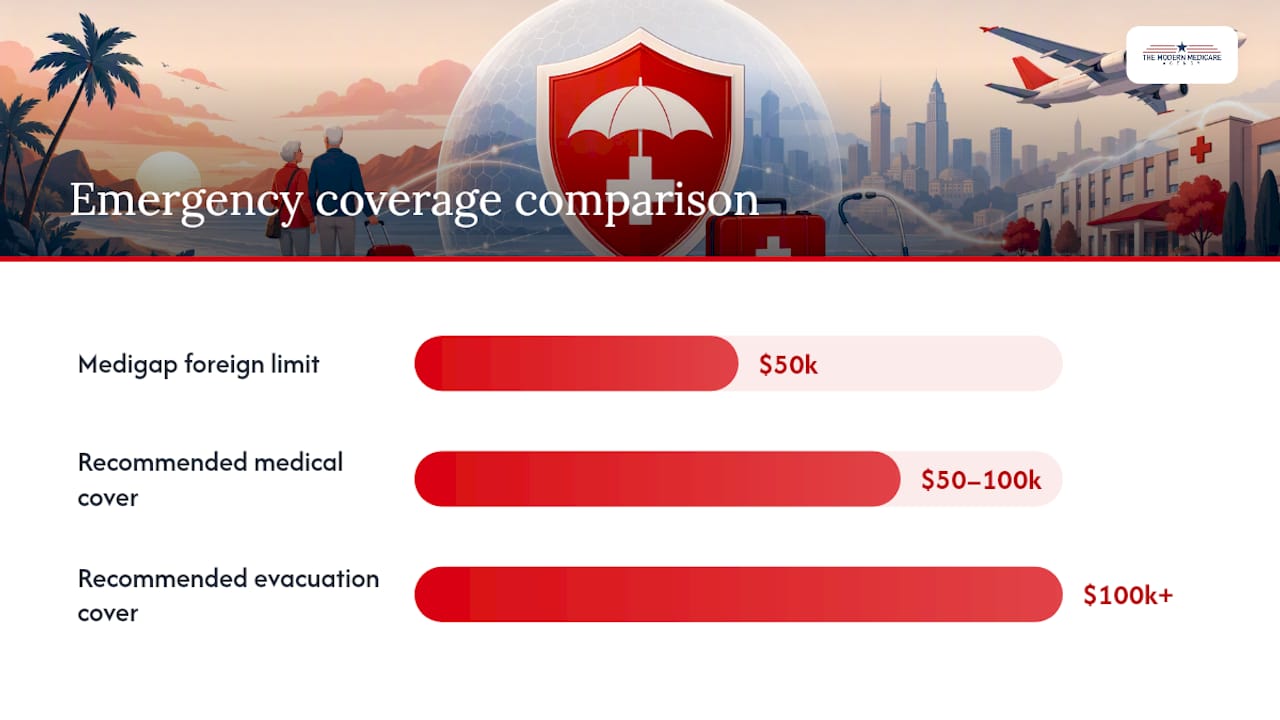
Evacuation is the gap that catches people hardest. An air ambulance flight from a remote area back to a hospital capable of treating you can run into six figures on its own. The U.S. Department of State strongly recommends buying medical evacuation coverage before international travel, particularly to regions with limited local medical infrastructure.
Industry guidance from travel insurance marketplaces generally recommends at least $50,000 to $100,000 in emergency medical coverage and $100,000 or more in evacuation coverage, scaled up depending on your destination and health history. That evacuation figure matters because air ambulance costs routinely dwarf hospital bills, which is exactly why a policy limit that sounds generous for hospital care can still leave you exposed for the flight home.
When shopping for a supplemental policy, look for direct-pay agreements with hospitals in your destination country, 24/7 assistance lines, and, if you have ongoing health conditions, a waiver for pre-existing conditions. Not every travel policy offers that waiver, and it’s often the deciding factor for Medicare beneficiaries with a chronic diagnosis.
Pre-Trip Checklist: Steps to Take Before You Leave the Country
A little preparation before departure does more to protect you than anything you can do once you’re already overseas and dealing with a crisis.
- Call your Medigap insurer or agent and confirm in writing that your specific plan includes the foreign travel emergency benefit, along with your remaining lifetime balance and claims process.
- Buy a separate travel medical and evacuation policy sized to your destination and health profile, and confirm whether pre-existing conditions are covered before you pay for it.
- Build a travel medical folder, physical or digital, containing your Medicare card, Medigap policy number and insurer contact, travel insurance documents and emergency numbers, a current medication list, and copies of relevant medical records.
- Note the nearest U.S. embassy or consulate for your destination and save the contact information alongside your other travel documents.
- Bring a credit card with a high limit since most foreign hospitals expect payment before discharge, and set aside a folder specifically for receipts and bills as you accumulate them.
Pro Tip: If you have any language barrier concerns, look up whether your travel insurance provider offers a 24/7 multilingual assistance line before you go. Explaining chest pain symptoms through a translation app in an emergency room is not where you want to be improvising.
If your travel involves extended stays, whether seasonal snowbird trips or longer stints abroad, it’s worth reviewing how the 60 day emergency window interacts with your specific schedule. Our Medicare guide for snowbirds covers that timing question in more depth.
What I’ve Learned Watching Travelers Get This Wrong
Since 2007, I’ve had the same conversation with clients dozens of times: they assumed Medicare would follow them overseas the way it follows them across state lines. It doesn’t. Original Medicare’s coverage outside the U.S. is nearly nonexistent outside a handful of narrow statutory exceptions, and I still meet people who found that out the hard way, mid-trip, with a hospital bill in hand.
The most common mistake isn’t misunderstanding the $50,000 cap. It’s skipping evacuation coverage entirely because the traveler assumes their Medigap plan “has them covered” for anything serious. It doesn’t cover the flight home. I’ve also watched people lose reimbursement money simply because they didn’t grab an itemized bill before leaving the hospital, and by the time they remembered, the facility couldn’t reproduce it.
What actually works is boring but effective: verify your specific plan’s benefit in writing before you go, buy a real evacuation policy sized to your destination, and build the paper trail as you go rather than after you’re home. We recommend the following sequence: confirm what your Medigap plan actually promises, compare it against what a travel policy would add, and make sure nothing falls through the gap between the two.
— Paul
Get Your Medigap Travel Benefits Verified Before You Book
Reading about the $50,000 cap and the 60 day window is one thing. Knowing exactly what your specific Medigap plan promises, and where the gaps sit for your upcoming trip, is another. We have experience helping Medicare beneficiaries sort through supplement plans, and a travel benefit check takes a fraction of the time it takes to untangle a denied claim after the fact.

We’ll pull your current Medigap policy, confirm whether your plan letter includes the foreign travel emergency benefit, and walk you through how it stacks up against separate travel medical coverage for your destination. If you’re weighing whether to switch plans before an upcoming trip, our Medigap comparison guide breaks down the differences between plan letters side by side. Reach out for a free consultation, and we’ll help you leave for your trip knowing exactly what’s covered and what still needs a separate policy.
Where to Verify the Official Rules Yourself
For the government’s own language on limits and claims, start with Medicare’s coverage outside the United States guide and the Medicare.gov travel coverage page. The State Department’s insurance guidance covers evacuation planning, and NCOA’s Medicare travel explainer offers plain language documentation tips.
Sources
- Medicare Coverage Outside the United States (PDF)
- Travel insurance guidance — U.S. Department of State
- Does Medicare cover you when you travel? — NCOA
- Compare travel medical insurance plans & prices (Squaremouth)