
Imagine your children sitting around a kitchen table in 2026, trying to honor your memory while worrying about how to pay for a funeral that now averages $9,170. It’s a heavy thought, isn’t it? You’ve spent your life protecting them, and the last thing you want is for your final chapter to become their financial burden. This is why many people are turning to Final Expense insurance to ensure their families aren’t left with a pile of bills during a time of grief. We know that navigating these options can feel overwhelming, but it doesn’t have to be.
In this guide, you’ll discover how to secure a straightforward, permanent plan designed for the realities of 2026. We’ll clear up the confusion between different policy types and show you how to find a solution that stays with you as you age. You’ll learn exactly how this protection works and how a dedicated expert can help you through a simple, stress-free enrollment process. By the end, you’ll have a clear path to ensuring your loved ones are cared for, just as you’ve always intended.
Key Takeaways
- Understand the updated 2026 costs for funerals and burials to ensure your family isn’t caught off guard by rising prices.
- Learn how Final Expense insurance offers a permanent, simple way to cover end-of-life costs without the need for a medical exam.
- See why specialized coverage for those aged 50 to 85 is often more reliable than traditional term policies that might expire when you need them most.
- Use our 5-step checklist to calculate your specific needs and find a monthly payment that feels comfortable for your wallet.
- Discover the advantage of working with an independent guide who can shop over 40 different companies to find your perfect match.
Understanding the Real Cost of Final Expenses in 2026
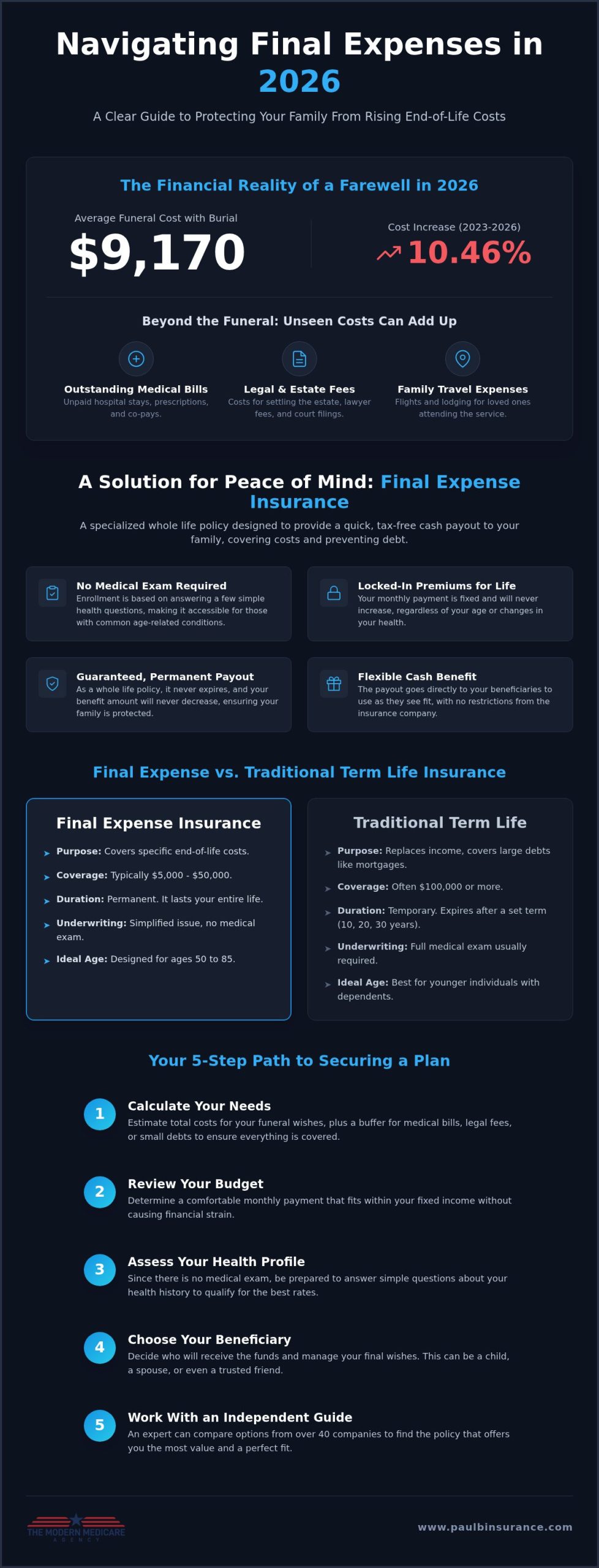
Watching the costs of everyday life rise over the last few years has been stressful for everyone. This inflation hasn’t spared the funeral industry. In 2026, the estimated average cost of a funeral with a viewing and burial has reached approximately $9,170. It’s completely natural to feel a sense of urgency about protecting your children or spouse from these sudden expenses. Final Expense insurance offers a simple way to ensure your family isn’t left with a pile of bills during an already difficult time of grief.
The reality is that “final expenses” often reach far beyond the funeral home’s front door. Families frequently face a wave of unplanned bills, including outstanding medical costs, legal fees for settling an estate, or even travel expenses for relatives coming to pay their respects. True peace of mind comes from knowing that the check is already written. It’s the comfort of knowing your family can grieve without the added weight of a financial crisis, allowing them to focus on the memories that matter most.
Why Funeral Costs are Different Today
If you haven’t looked at funeral pricing in a while, the 2026 figures might come as a surprise. The Consumer Price Index for funeral expenses rose by 10.46% between 2023 and 2026. These aren’t just big-ticket items like a metal casket, which had a median cost of $2,500 back in 2023. Today, “hidden” costs like professional transportation, floral arrangements, and headstones add up quickly. Even the small details, such as obituary notices and death certificates, carry a higher price tag now. Final Expense insurance is a specialized tool designed specifically to cover these 2026 costs so your savings remain untouched for your beneficiaries.
The Emotional Burden of Unplanned Costs
When a loved one passes without a plan, family members often have to scramble. They might have to dip into retirement accounts or put thousands of dollars on high-interest credit cards while they’re still in shock. This stress is a heavy burden to leave behind. In contrast, a pre-funded plan acts as a final act of love. It provides immediate cash that bypasses the long wait of probate. This type of coverage often goes hand-in-hand with Medicare planning, as both help secure your financial future against the unexpected. For more context on how these tools fit into a broader strategy, you can read about Final Expense and Pre-need Insurance as a component of senior care. By handling these details now, you’re giving your family the gift of certainty in a time of distress.
What Is Final Expense Insurance and How Does It Work?
At its heart, Final Expense insurance is a specialized type of whole life insurance. While traditional life insurance policies often focus on replacing income or paying off a large mortgage, this plan is specifically designed to handle end-of-life costs. It’s built for seniors who want to ensure their final wishes are respected without creating a financial crisis for their children. The process is straightforward. You choose a coverage amount, usually between $5,000 and $50,000, and your premiums are locked in for life. Your benefits will never decrease, and the policy won’t expire as long as you keep up with your payments.
When the time comes, the payout goes directly to your chosen beneficiaries in cash. They can use these funds for anything they need. While most use it to cover the latest funeral cost statistics, there are no restrictions. They can pay for medical bills, settle small debts, or even cover travel costs for family members. This flexibility is a major relief during a stressful time. If you’re feeling unsure about which coverage amount fits your needs, you can speak with a guide who understands these options.
The ‘No Medical Exam’ Advantage
One of the most reassuring parts of this insurance in 2026 is the enrollment process. Many seniors worry that their health history will disqualify them from coverage. Most final expense plans use what’s called “simplified issue” underwriting. This means you don’t have to deal with needles, blood tests, or a doctor’s visit. Instead, you answer a few simple health questions. This makes it much easier for those with common conditions like high blood pressure or diabetes to get protected. It’s a dignified way to get the security you deserve without the stress of a clinical physical. Choosing an affordable plan doesn’t mean you’re settling for low quality; it means you’re choosing a plan that respects your time and your health.
Guaranteed Payouts for Life
It’s vital to understand the permanent nature of these policies. Unlike term insurance, which often ends just when you might need it most, this coverage stays with you. It’s designed to be there for the long haul. Even a smaller policy can make a massive difference for a family. It’s the difference between your loved ones mourning in peace and them having to scramble for funds to cover basic costs. Because the premiums for Final Expense insurance never go up, you can build this small, predictable expense into your 2026 budget with total confidence.
Comparing Final Expense to Traditional Life Insurance
Choosing the right protection in 2026 feels different than it did a decade ago. While many big insurance companies push term life because it looks cheaper on paper, many seniors find it’s a temporary fix for a permanent need. Final Expense insurance is built differently. It’s specifically tailored for those in the 50 to 85 age group who want a policy that stays with them for the rest of their lives. Unlike policies designed for younger families, these plans focus on simplicity and certainty.
When you look at your options, three main paths usually emerge:
- Term Life: This covers you for a set period, like 10 or 20 years. If you outlive the term, your coverage simply vanishes.
- Traditional Whole Life: These offer large payouts but are “fully underwritten.” This means you’ll likely face a long medical exam, blood tests, and a deep dive into your medical records.
- Final Expense: This is a “simplified issue” whole life plan. There are no medical exams. You answer a few health questions and, once approved, your coverage is permanent.
The debate between simplified issue and fully underwritten plans often comes down to your health and your time. Fully underwritten plans can take weeks to approve and often reject seniors for minor health issues. In 2026, most people prefer the simplified route because it provides an answer in days, not weeks, and accepts many common health conditions that traditional plans won’t touch.
Why Term Life Often Fails Seniors
Term life has a “cliff” that many people don’t see coming. Once the term ends, the price to renew often jumps so high that it becomes unaffordable. This leaves many seniors in their 70s or 80s with no coverage at all. In 2026, the preference has shifted toward permanent coverage that doesn’t have an expiration date. It’s a similar mindset to why people look for Medigap information. Both are about locking in protection today so you don’t have to worry about rising costs or losing your safety net later.
The Role of Cash Value
One helpful feature of these policies is that they build a small “savings” element over time. While the primary goal is the death benefit for your family, a portion of your premium grows as cash value. You shouldn’t view this as a primary investment, but it’s a nice safety net to have. For a senior in 2026, Cash Value is the guaranteed portion of your policy that grows over time and can be used as a loan in a true financial emergency. It’s just one more way these plans offer a journey from uncertainty to total peace of mind.
How to Choose the Right Final Expense Policy: A 5-Step Checklist
Finding the right protection doesn’t have to be a guessing game. By following a structured path, you can move from a state of uncertainty to one of absolute confidence. This checklist is designed to help you navigate the 2026 insurance market with ease and clarity. It’s about finding a fit for your life today and your family’s future tomorrow.
- Step 1: Calculate your total end-of-life gap. Start by looking at the actual costs of your final wishes, including the funeral, remaining debts, and any legal fees.
- Step 2: Determine a monthly premium that feels comfortable. This should be a payment you don’t even have to think about. It shouldn’t stretch your 2026 budget or cause stress.
- Step 3: Check for Level vs. Graded coverage. Depending on your health, you’ll either qualify for immediate protection or a plan with a short waiting period.
- Step 4: Verify the carrier’s financial strength. In 2026, it’s vital to choose a company with a long history of reliability and high ratings.
- Step 5: Speak with an independent broker. Instead of looking at one company, an independent expert can compare over 40 different options to find your perfect match.
Calculating Your Coverage Needs
When you start the math, remember that costs have shifted. In 2026, a funeral with a viewing and burial averages $9,170, while a viewing with cremation is closer to $6,940. You also need to account for specific items, like a metal casket, which had a median price of $2,500 back in 2023. It’s wise to include a small buffer for unexpected medical bills that your Medicare Part D plan might not cover. The goal is to be fully protected without being over-insured. You don’t want to pay for more coverage than your family actually needs.
Understanding Policy Grades
Most Final Expense insurance plans fall into two categories. “Level” coverage is the goal for most seniors because it provides your full benefit from the very first day. If you have significant health challenges, you might be offered “Graded” or “Modified” benefits. These usually have a two-year waiting period before the full payout is active for non-accidental death. Being honest on your health questionnaire is the best way to ensure your family gets the payout they expect. If you’re ready to see which grade you qualify for, you can find your perfect match today by working with a guide who puts your needs first.
Why Working with an Independent Broker Like Paul Barrett Makes the Difference
Many people feel trapped when they talk to a “captive agent.” These representatives work for just one insurance company. If that company’s rules are too strict or their prices are too high, the agent can’t offer you a better alternative. Paul Barrett operates differently. As an independent broker, he represents over 40 carriers. This independence allows him to act as your advocate, searching for the most reliable Final Expense insurance available in 2026. He isn’t limited to a single menu of options. He’s free to find the one plan that truly serves your family’s needs.
Paul serves as a calm guide in a complex industry. He provides year-round support and is licensed in over 34 states. This means if you move or have questions long after the policy is signed, he’s still there to help. There’s also a significant financial benefit to this approach. This professional guidance costs you nothing extra. The insurance companies compensate the broker directly. You get an expert’s time, research, and knowledge without adding a single penny to your premium.
Unbiased Advice You Can Trust
The goal at The Modern Medicare Agency is to find a perfect fit, not the highest premium. Paul and his team use a personalized comparison process to look at your health profile and your budget. They take a holistic view of your needs. This often means looking at how your life insurance fits alongside your dental and vision plans. When every piece of your coverage works together, you don’t have to worry about gaps in your protection. It’s about building a legacy of care, not just buying a financial product.
Your Journey from Confusion to Certainty
We’ve discussed the rising costs of 2026 and the various types of policies available. It’s a lot of information to process on your own. The journey often starts with a feeling of distress or worry about leaving a financial burden behind. Working with a dedicated expert turns that anxiety into certainty. You move from wondering how your kids will pay for a funeral to holding a policy that guarantees the funds will be there when they’re needed most.
You don’t have to navigate these choices alone. We invite you to a low-pressure, conversational consultation to discuss your 2026 planning. It’s a simple conversation that can provide the peace of mind you and your family deserve.
Securing Your Family’s Future Today
Reflecting on the rising costs of 2026, it’s clear that waiting only makes things more difficult for your loved ones. You’ve learned that Final Expense insurance is a permanent, reliable way to lock in protection without the stress of a medical exam. It’s about more than just a policy; it’s a final act of love that ensures your children can focus on your legacy rather than a pile of bills. By handling these details now, you’re making a choice that provides lasting security and comfort.
You don’t have to navigate these choices alone. As an independent broker, Paul Barrett offers personalized support across 34 states and access to over 40 carriers to find your best fit. These low-pressure consultations come at no cost to you, providing a clear path from uncertainty to total peace of mind. We’re here to help you understand every option clearly and simply, ensuring your plan fits your life perfectly.
Let Paul Barrett guide you to the perfect plan; request your simple quote today.
Take this step today and give your family the gift of a worry-free tomorrow.
Frequently Asked Questions
Is final expense insurance worth it in 2026?
Yes, it is worth it because it covers the massive gap between the $255 Social Security death benefit and rising funeral costs. In 2026, a traditional burial averages over $9,170. Without this protection, your family might have to use high-interest credit cards or deplete their personal savings. Final Expense insurance provides a simple, guaranteed way to remove that financial burden from your children and spouse during a time of grief.
Can I get final expense insurance if I have a pre-existing condition?
You can certainly get coverage even if you have health challenges. Most policies in 2026 use a simplified process that doesn’t require a medical exam or blood tests. You just answer a few basic health questions. If your health history is more complex, there are plans available that don’t ask health questions at all. An independent broker can help you find a carrier that is friendly toward your specific medical condition.
How much does the average final expense policy cost per month?
Most people find these plans quite affordable. For a $10,000 policy in 2026, the average monthly cost typically falls between $50 and $100. Your specific rate depends on your age and health. For example, a 65-year-old woman might pay between $45 and $60, while a man of the same age might pay between $55 and $75. It’s a small, predictable expense that provides a massive amount of security for your loved ones.
What is the difference between burial insurance and final expense insurance?
There is actually no legal difference between these two terms. They are just different names for the same type of whole life insurance. Some companies call it burial insurance to emphasize the funeral aspect. Others use the term Final Expense insurance to show the money can also cover medical bills and debts. Both offer a permanent death benefit that never decreases and premiums that stay the same for as long as you live.
Does final expense insurance have a waiting period before it pays out?
It depends on the specific plan you qualify for. If you’re in relatively good health, you can get a level benefit plan that provides full coverage from the very first day. If you have serious health issues, you might be offered a plan with a two-year waiting period. During this time, if you pass away from natural causes, your family receives the premiums you paid plus interest rather than the full death benefit.
Can I use final expense insurance to pay off credit card debt?
Yes, your beneficiaries can use the money for any purpose they choose. While many people buy it to cover funeral costs, the cash payout is completely unrestricted. Your loved ones can use the funds to pay off credit card balances, settle medical bills, or even cover travel costs for relatives. This flexibility is a major benefit. It allows your family to handle whatever financial needs are most urgent during their transition.
What happens if I move to a different state after buying a policy?
Your coverage stays with you no matter where you move within the United States. Since these are private insurance contracts, they aren’t tied to a specific state or funeral home. If you move from New York to Florida in 2026, your policy remains active as long as you keep paying your premiums. Working with a multi-state agency ensures you have support and guidance regardless of where you decide to spend your retirement.
How do my beneficiaries claim the money when I pass away?
The claim process is designed to be simple and stress-free for your family. Your beneficiaries just need to contact the insurance company or your broker and provide a copy of the death certificate. Most companies process these claims quickly, often within just a few days. This speed is vital because it provides the cash needed to pay for funeral services upfront. It’s one more way this plan takes the pressure off.

Article by
Paul Barrett
Paul Barrett, CMIP is the founder of The Modern Medicare Agency, an independent Medicare-only brokerage based in Melville, NY. With 18 years of Medicare-exclusive experience, a CMIP designation, and more than 5,000 clients served across 37 states, Paul is one of the most credentialed independent Medicare specialists on Long Island — and one of the most direct.
He represents 40+ carriers with no quotas and no allegiances, which means his recommendations are based entirely on what fits each client's specific situation. He is the author of Medicare Mastery Unlocked and host of the Wise Guys Retirement Talk podcast. His content is grounded in primary sources, real carrier intelligence, and 18 years of watching what happens when people get Medicare right — and when they don't.
📞 631-358-5793 | paulbinsurance.com