




Will Medicare help pay for acupuncture if you’re dealing with back pain, migraines, or another condition? The answer depends on your diagnosis, who provides the care, and which type of Medicare coverage you have. It’s understandable to feel unsure: the rules for medicare coverage for acupuncture are narrow under Original Medicare, while Medicare Advantage plans may offer additional benefits.
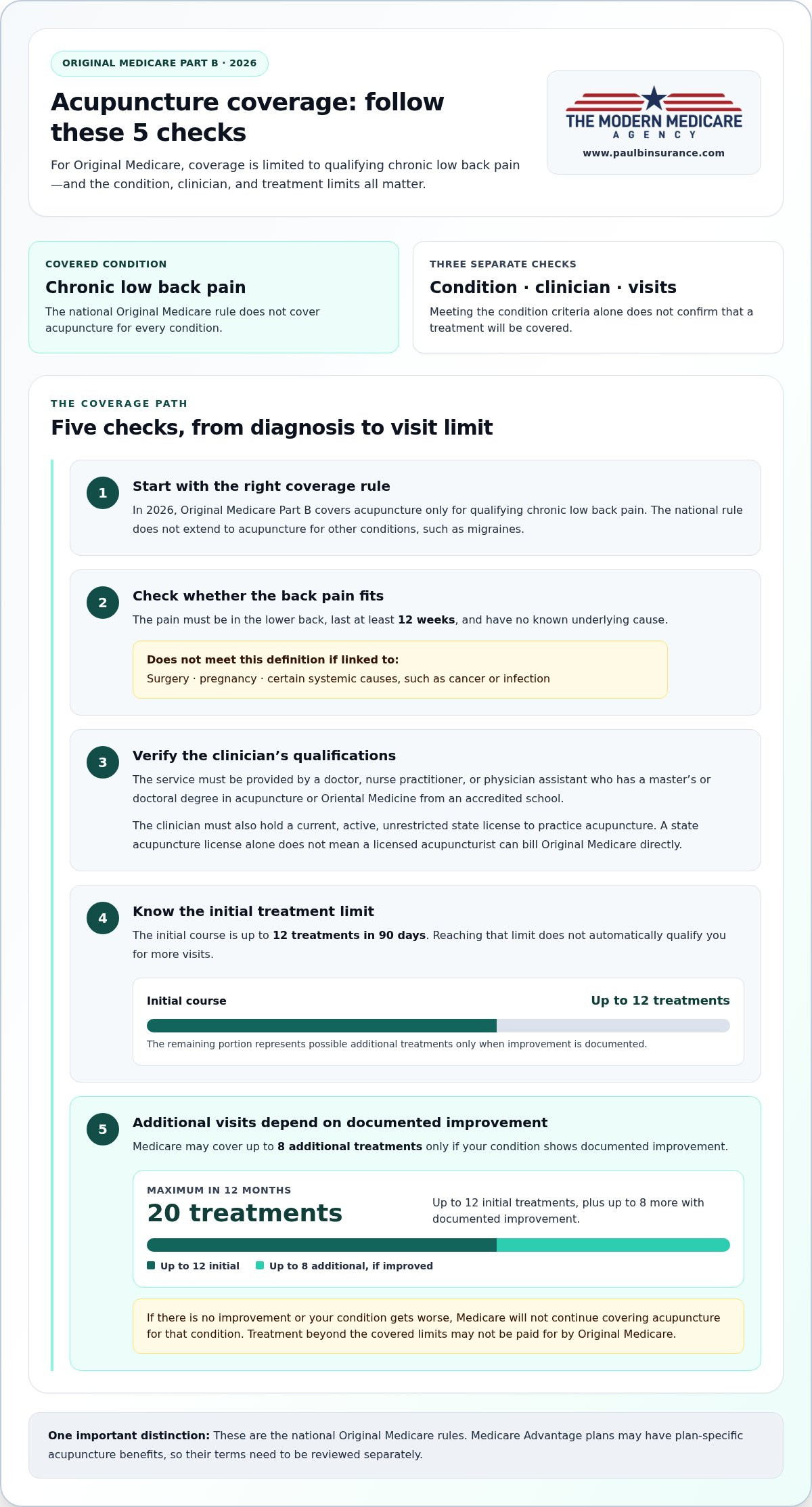
In 2026, Original Medicare covers acupuncture only for qualifying chronic low back pain. The pain must have lasted at least 12 weeks and can’t be linked to surgery, pregnancy, or certain systemic causes, such as cancer or infection. Coverage also has visit limits and provider requirements, so having a qualifying condition alone may not be enough. This guide explains the national Original Medicare rules, what to look for in your Medicare Advantage plan documents, and how limits and out-of-pocket costs may affect you. You’ll have a clearer path to reviewing your coverage before scheduling care.
Key Takeaways
- Medicare coverage for acupuncture under Original Medicare is limited to qualifying chronic low back pain, so the condition being treated matters.
- Before scheduling, review eligibility, provider requirements, and treatment limits to understand how they may affect coverage.
- Medicare Advantage plans may have plan-specific acupuncture benefits. Review your plan documents to understand what applies to you.
- Use a checklist to review your coverage type, condition, provider rules, and session limits before care begins.
- An independent Medicare broker can help you compare plan options and understand your coverage, without promising a particular acupuncture benefit.
Does Medicare cover acupuncture in 2026? Start with the basic rule
Yes, but only in a specific situation. In 2026, Original Medicare Part B covers acupuncture for qualifying chronic low back pain. That national rule does not mean Medicare pays for every acupuncture treatment or for acupuncture used to address any other condition. The diagnosis and details of the care matter.
Acupuncture is a practice in which very thin needles are placed at specific points on the body. For a general overview of the practice and its history, see Acupuncture. Medicare’s coverage rule is narrower than the range of reasons people may seek acupuncture. Keeping that distinction in mind helps clarify what the national policy does, and does not, cover.
What does Medicare mean by chronic low back pain?
For Medicare’s coverage rule, chronic low back pain must last at least 12 weeks and have no known underlying cause. Pain associated with surgery or pregnancy doesn’t meet this definition. The requirement is specific: having back pain for a long time isn’t enough if it is connected to one of these excluded causes or another identifiable systemic cause.
For example, persistent lower back pain without a known underlying cause may fit the condition Medicare describes. Pain that began after surgery does not meet this definition, even if it has continued for 12 weeks or longer. The length of time and the reason for the pain are separate parts of the rule.
Which Medicare coverage does the national rule describe?
This national coverage rule applies to Original Medicare Part B, which helps cover certain medical services outside a hospital. Medicare also includes Part A, which generally relates to hospital care. Understanding the difference between these parts can make coverage information easier to sort through.
Original Medicare Part B covers acupuncture only for qualifying chronic low back pain.
This is the clearest starting point for understanding medicare coverage for acupuncture in 2026. It explains the national Original Medicare rule, but it doesn’t settle every coverage question for people enrolled in Medicare Advantage. Medicare Advantage plans are offered by private insurers and have plan-specific details, so review those terms separately.
Keep the first coverage check focused: is the pain in the lower back, has it lasted at least 12 weeks, and does it have no known underlying cause or connection to surgery or pregnancy? These criteria describe the condition addressed by the national rule. They don’t confirm that a particular treatment will be covered. You’ll also need to consider treatment limits and provider qualifications.
Who qualifies for Medicare acupuncture, and how many sessions are covered?
For Original Medicare in 2026, qualifying chronic low back pain is only the first check. Coverage also depends on the clinician providing the service and how many treatments are needed. Reviewing these requirements separately can help you understand which details matter before scheduling care.
- Eligibility: The condition must meet Medicare’s definition of chronic low back pain.
- Provider: The service must be provided by a clinician who meets Medicare’s qualifications.
- Visit limit: Medicare covers an initial course of up to 12 treatments in 90 days, with additional sessions tied to improvement.
Original Medicare covers up to 12 acupuncture treatments in 90 days, plus up to eight more if you show documented improvement, for a maximum of 20 treatments in 12 months.
What provider qualifications apply under Original Medicare?
Medicare’s provider rules are specific. The treatment must be provided by a doctor, nurse practitioner, or physician assistant with a master’s or doctoral degree in acupuncture or Oriental Medicine from an accredited school. The clinician must also hold a current, active, unrestricted state license to practice acupuncture. Medicare’s official Medicare guidelines for acupuncture coverage describe the applicable requirements.
A state acupuncture license alone does not mean a licensed acupuncturist can bill Original Medicare directly for these services. Before care begins, review whether the clinician and billing arrangement meet Medicare’s rules. Provider qualifications are a separate check from whether your back pain meets the condition criteria.
What happens after the first 12 treatments?
The first 12 treatments are the initial limit, not automatic approval for a full course of care. Medicare may cover up to eight additional sessions only when your condition shows documented improvement. Across a 12-month period, the overall maximum is 20 treatments. If there’s no improvement or your condition gets worse, Medicare won’t continue covering acupuncture for that condition.
Reaching the end of the initial 12 sessions doesn’t by itself qualify you for eight more. Improvement must be documented, and the 20-treatment maximum still applies within the 12-month period. Treatment beyond these covered limits may not be paid for by Original Medicare, so don’t assume additional visits will be covered.
Before your first appointment, make a short checklist: confirm that your condition meets the criteria, review whether the treating clinician has the required training and license, and understand how progress and session counts will be tracked. These steps can help you discuss medicare coverage for acupuncture with a clearer picture of the rules. If you’re also reviewing broader plan options, a free Medicare review can help you compare choices without promising a particular acupuncture benefit.
Original Medicare vs. Medicare Advantage: what can change?
Your acupuncture coverage may depend on how you receive your Medicare benefits. Original Medicare has a national Part B rule. Medicare Advantage plans are offered by private insurers and provide Medicare coverage, but your plan documents explain how acupuncture is covered and whether the plan includes benefits beyond the national rule.
| Original Medicare | Medicare Advantage |
|---|---|
| Part B covers acupuncture only for qualifying chronic low back pain under the national rule. | The plan must cover Medicare-covered services, while its documents explain how coverage works and whether it offers additional acupuncture benefits. |
| Provider qualifications and session limits follow the national coverage requirements. | Review the plan’s acupuncture terms for covered conditions, limits, and member costs. |
What does the Original Medicare rule tell you?
If you have Original Medicare, Part B’s national rule is the starting point: acupuncture is covered only when the chronic low back pain criteria are met. The provider and visit requirements described earlier also apply. This national rule is different from the details in a private plan’s documents. CMS explains the policy behind its decision to cover acupuncture for qualifying chronic low back pain.
In short, the Original Medicare rule sets a common coverage standard, while a Medicare Advantage member should also review the specific plan’s terms. Medicare coverage does not mean every acupuncture service or condition is covered.
What should Medicare Advantage members look for?
Start with your plan’s Evidence of Coverage, the document that explains its benefits and coverage rules. Look for acupuncture or complementary care, then note which conditions qualify, any session limits, and what you may pay. Some plans may offer acupuncture benefits beyond Original Medicare’s chronic low back pain coverage, but those extra benefits aren’t the same across all plans.
For example, one plan’s documents may describe a benefit for a broader set of conditions, while another may follow the Medicare-covered service rules without listing the same added benefit. Don’t assume that a benefit you heard about from another member applies to your plan. Your own plan terms are the guide.
If you’re comparing plans, consider acupuncture alongside the other benefits and coverage details that matter to you. An independent Medicare broker can help you compare Medicare Advantage options and understand how plan documents differ. The plan’s written terms determine whether a specific treatment is covered. A Medicare Advantage plan guide can help you understand the basics as you compare.
How to check acupuncture coverage before scheduling care
A few checks before you book can make your coverage easier to understand. The rules depend on whether you have Original Medicare or Medicare Advantage, and a treatment recommendation by itself doesn’t establish that Medicare will pay for the service. Use this 2026 checklist to review your situation one step at a time.
- Identify your coverage type. Check whether you have Original Medicare or a Medicare Advantage plan. If you’re enrolled in Medicare Advantage, use your current plan materials rather than assuming the Original Medicare rule answers every question.
- Compare your condition with the coverage criteria. With Original Medicare, review whether your pain meets the chronic low back pain definition explained above. A different condition, or pain that doesn’t meet those criteria, isn’t covered under the national Part B acupuncture rule.
- Review the provider requirements. For Original Medicare, check the current Medicare guidance on which clinicians and acupuncture credentials qualify. For Medicare Advantage, read your plan’s terms for any provider requirements that apply to the acupuncture benefit.
- Confirm the limits and your share of costs. Review the session limits that apply, whether additional sessions depend on documented improvement, and what the plan says about your cost-sharing responsibility.
Which documents and details should you review?
For Original Medicare, start with the current acupuncture coverage information on Medicare.gov. For Medicare Advantage, find the plan’s current Evidence of Coverage and the section describing acupuncture or related services. Focus on the conditions covered, visit limits, provider rules, and cost-sharing language. Keep a copy or note of the relevant terms so you can refer to them when reviewing a treatment estimate or claim.
Make sure the documents apply to your coverage in 2026. A plan document from another year may describe different terms, and old cost figures may not reflect current amounts. If a phrase is unclear, note the specific term or question so you can follow up using the plan’s current information.
How can you avoid assumptions about coverage?
Don’t rely on someone else’s plan experience. A benefit available under one Medicare Advantage plan may not apply to another, and a suggested treatment doesn’t automatically meet Medicare’s coverage rules. Keep two questions separate: what care is being proposed, and what does your Medicare coverage say it will pay for?
For a clearer view of your Medicare Advantage choices, an independent Medicare broker can help you compare plan options and review plan information. A Medicare Advantage plan guide can also help you understand how these plans work. A free Medicare review can help you compare plan choices and understand your options.
Get clear on Medicare plan options with supportive, independent guidance
An acupuncture coverage question can be a useful starting point for a broader review of your Medicare coverage. You may also want to understand how your plan handles other health services, prescription drugs, and out-of-pocket responsibilities. Looking at the full picture can help you make sense of your options without assuming that one benefit tells the whole story.
Paul B Insurance, operating as The Modern Medicare Agency, is an independent Medicare broker. The agency offers free Medicare reviews and personalized comparisons of Medicare Advantage, Medigap, and Part D options. A review can help you understand how choices differ, while the applicable plan documents remain the source for specific acupuncture coverage terms.
What can a Medicare review help you understand?
A review can help you compare plan options and organize the questions that matter to you. If you have Medicare Advantage, for example, include acupuncture among the benefits you want to understand, then refer to the plan’s coverage documents for the details. The review supports informed decisions without pressure to enroll or a promise that a particular treatment will be covered.
A plan comparison can clarify choices, but the plan’s terms determine its benefits, limits, and member costs. The goal is to help you move from scattered questions to a clearer view of your options. You can take the information at your own pace and decide what, if anything, you want to do next.
What happens when you are ready to review your options?
You can discuss your Medicare questions in a free phone or Zoom review. Bringing your current plan information and notes about the acupuncture benefit you’re trying to understand can help keep the conversation focused. The review can cover Medicare Advantage, Medigap, and Part D options, while the relevant plan documents provide the specific acupuncture coverage terms.
It’s reasonable to want clarity before making a change. Start with what you have now, identify what you want to compare, and take the next step when you feel ready. An independent broker can help you review plan choices from multiple carriers rather than representing a single carrier.
If you’re ready to talk through your options, you can book a free Medicare review. It’s a supportive way to discuss your coverage questions and compare plan choices with more confidence.
Take your next Medicare step with confidence
Before making a change, gather your current plan information and write down the questions you want answered. That gives you a practical starting point for a conversation about your broader coverage needs, including how to interpret plan documents related to acupuncture. A review can help you compare options, while the plan’s terms determine whether a particular service is covered.
Paul B Insurance is an independent Medicare broker with 18 years of experience, 5,000+ clients served, and 40+ carriers. As an Award-winning agency, the team can help you compare Medicare plan options and understand how they differ. The goal is to help you feel more informed as you decide what fits your needs.
You don’t have to sort through every detail alone or make a decision before you’re ready. Take the next step at your own pace and bring your questions to a supportive review. Book a free Medicare review to discuss your options.
Frequently Asked Questions
Does Medicare cover acupuncture for neck pain or migraines?
Original Medicare’s national medicare coverage for acupuncture rule doesn’t include neck pain or migraines. If you have Medicare Advantage, review your plan’s written terms because they may describe additional acupuncture benefits. For example, if you’re considering treatment for migraines, look for that condition specifically in your plan documents. A general reference to acupuncture doesn’t necessarily explain which diagnoses qualify.
Can Medicare cover acupuncture when back pain has a known cause?
Original Medicare’s national rule may not cover acupuncture if your chronic low back pain has a known underlying cause, because the rule describes pain without one. The reason for your pain matters, not just how long you’ve had it. If a diagnosis or medical record identifies a cause, compare that information with the coverage language. Medicare Advantage members should review their own plan terms rather than assume the same result.
Does Medicare cover acupuncture after back surgery?
Original Medicare’s national coverage definition excludes chronic low back pain associated with surgery, so acupuncture for post-surgical pain may not meet that Part B rule. If your treatment is related to an operation, keep the relevant medical information available while reviewing coverage. Medicare Advantage plans may have plan-specific acupuncture terms, so use your current plan documents to understand whether they address post-surgical treatment and what limits or conditions apply.
Is dry needling included in Medicare acupuncture coverage?
Medicare.gov includes dry needling in its acupuncture coverage description. That doesn’t make dry needling a general benefit: the Part B rule still applies only to qualifying chronic low back pain, along with the applicable provider requirements and treatment limits. If you’re enrolled in Medicare Advantage, read your current plan’s acupuncture language. Don’t assume that mentioning dry needling means it’s covered for every condition or under every plan.
Does Medicare cover acupuncture for arthritis?
Original Medicare’s national acupuncture rule isn’t a general benefit for arthritis. If you’re considering acupuncture to address arthritis, don’t assume the Part B coverage for qualifying chronic low back pain applies to that treatment. Medicare Advantage coverage depends on your plan’s terms. Look for arthritis or the specific condition being treated in the plan’s current written information, and distinguish that benefit from any coverage for low back pain.
What if Medicare denies an acupuncture claim?
Read the written notice first. It should explain why the claim was denied and how to respond, including any deadline. Appeal steps can differ between Original Medicare and Medicare Advantage, so follow the instructions that apply to your coverage and consult current Medicare guidance. Keep the notice with the claim information, treatment records, and relevant plan documents. Having those items together makes it easier to understand the decision and prepare a response.
Can a caregiver help check Medicare acupuncture coverage?
Yes. A caregiver can help organize the beneficiary’s current plan documents, find the acupuncture terms, and note questions about conditions, limits, and cost-sharing. The plan may need the beneficiary’s permission before discussing personal coverage details with someone else. A practical approach is to review the written language together and keep notes of what it says. Avoid applying one person’s plan rules to another person’s coverage.

Article by
Paul Barrett
Paul Barrett, CMIP is the founder of The Modern Medicare Agency, an independent Medicare-only brokerage based in Melville, NY. With 18 years of Medicare-exclusive experience, a CMIP designation, and more than 5,000 clients served across 37 states, Paul is one of the most credentialed independent Medicare specialists on Long Island — and one of the most direct.
He represents 40+ carriers with no quotas and no allegiances, which means his recommendations are based entirely on what fits each client's specific situation. He is the author of Medicare Mastery Unlocked and host of the Wise Guys Retirement Talk podcast. His content is grounded in primary sources, real carrier intelligence, and 18 years of watching what happens when people get Medicare right — and when they don't.
📞 631-358-5793 | paulbinsurance.com